Kabhi Khushi Kabhie Gham
A lavish Bollywood melodrama that blends grand family tradition with diasporic longing. Emotional reunions and clash of generations unfold amidst palatial sets, exploring whether duty should ever eclipse love.
Kabhi Khushi Kabhie Gham

Kabhi Khushi Kabhie Gham

कभी ख़ुशी कभी ग़म

"It's all about loving your parents."

14 December 2001 India 209 min ⭐ 7.7 (588)
Director: Karan Johar
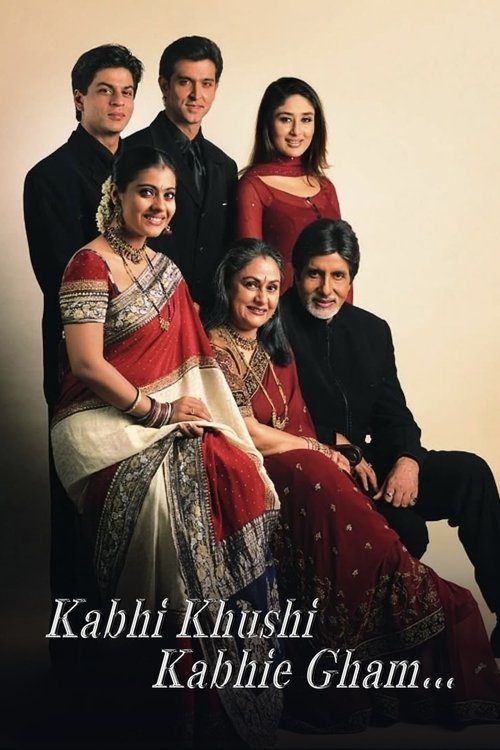
Cast: Amitabh Bachchan, Shah Rukh Khan, Hrithik Roshan, Kajol, Jaya Bachchan
Drama Comedy
Duty vs. Love Class Divide The Diasporic Experience Reconciliation and Forgiveness
Budget: $7,500,000
Box Office: $11,336,308

Overview

Yashvardhan Raichand (Amitabh Bachchan) is a wealthy, staunchly traditional patriarch who lives with his wife Nandini (Jaya Bachchan) and two sons, Rahul (Shah Rukh Khan) and Rohan (Hrithik Roshan). The family's harmony is shattered when Rahul, the adopted elder son, falls in love with Anjali (Kajol), a bubbly woman from a lower middle-class background. Disappointed that Rahul chose love over the family's prestige, Yash disowns him, prompting Rahul to leave India for London with Anjali and her sister Pooja.

Ten years later, the younger son Rohan, who has transformed from a chubby child into a dashing young man, learns the truth about his brother's estrangement. Determined to reunite his broken family, Rohan travels to London. He enrolls in the same university as the now-glamorous Pooja (Kareena Kapoor) and infiltrates Rahul's life, keeping his identity secret to gradually bridge the gap between his father and brother.


Core Meaning

At its heart, Kabhi Khushi Kabhie Gham explores the tension between parampara (tradition) and human connection. While the film initially seems to uphold patriarchal authority, its deeper message is a critique of rigid pride that destroys families. The tagline "It's all about loving your parents" serves as a dual plea: for children to respect their elders, but crucially, for parents to love their children unconditionally, prioritizing their happiness over societal status and ego.

Thematic DNA

Duty vs. Love 30%
Class Divide 25%
The Diasporic Experience 25%
Reconciliation and Forgiveness 20%

Duty vs. Love

The central conflict arises from Rahul's struggle between his dharma (duty) to his father's wishes and his love for Anjali. Yashvardhan represents the old-world belief that family honor supersedes individual happiness, while Rahul attempts to balance both before being forced to choose.

Class Divide

The film sharply contrasts the ultra-rich world of the Raichands (helicopters, palaces) with the chaotic, vibrant middle-class life of Chandni Chowk. This divide is the primary catalyst for the family's separation, highlighting the prejudices embedded in the Indian elite.

The Diasporic Experience

Through Rahul's life in London, the film taps into the NRI (Non-Resident Indian) emotion of longing. Despite material success abroad, the characters perform exaggerated patriotism (singing the anthem, retaining traditions) to compensate for their displacement.

Reconciliation and Forgiveness

Rohan acts as the bridge between the stubborn patriarch and the exiled son. The narrative suggests that time and youthful intervention are necessary to heal wounds caused by an older generation's obstinacy.

Character Analysis

Yashvardhan Raichand

Amitabh Bachchan

Archetype: The Authoritarian Patriarch
Key Trait: Stubbornness

Motivation

To uphold the Raichand family name and traditions at any cost.

Character Arc

Starts as an unyielding figure who values reputation above all. Through the loss of his son and the confrontation with his wife, he slowly realizes his pride has left him isolated, leading to a tearful apology.

Rahul Raichand

Shah Rukh Khan

Archetype: The Dutiful Son / Romantic Hero
Key Trait: Self-sacrifice

Motivation

To be worthy of his adopted family's love; later, to protect his wife and new family.

Character Arc

Begins as the perfect son who seeks validation. After being disowned, he builds a life in London but carries the hidden grief of rejection. He learns that true respect doesn't mean blind obedience.

Pooja 'Poo' Sharma

Kareena Kapoor

Archetype: The Modern Diva
Key Trait: Confidence

Motivation

To be the center of attention and 'PHAT' (Pretty Hot and Tempting).

Character Arc

Transforms from a bullied child into a confident, fashion-obsessed woman in London. She aids Rohan in his plan, proving that beneath her shallow exterior lies a caring heart committed to family.

Rohan Raichand

Hrithik Roshan

Archetype: The Mediator / Catalyst
Key Trait: Perseverance

Motivation

To fulfill his grandmother's wish of reuniting the family.

Character Arc

Evolves from a chubby, teased child ('Laddu') to a physically perfect man. He uses his transformation to infiltrate his brother's life and force the family to confront their pain.

Symbols & Motifs

The Stool/Height Difference

Meaning:

Symbolizes the hierarchy and respect within the family. Rahul often stands on a stool or lower step to be at eye level with his father, or Yash stands higher to assert dominance. The breaking of this visual rule signals shifts in power.

Context:

Used in the title song sequence and confrontation scenes where Yash physically looks down on others.

The Tide/Fire

Meaning:

Represents the continuity of tradition (parampara) and the passing of the torch. It is the sacred flame that must be kept burning, symbolizing the family's honor.

Context:

Seen in the opening credits and Diwali prayers where the wife hands the aarti plate to the husband.

Nandini's Intuition

Meaning:

Represents the spiritual, unbreakable bond between mother and son that transcends physical distance and the father's laws.

Context:

Nandini senses Rahul's arrival (footsteps) before he is even visible, both at the start and during the reunion.

Memorable Quotes

Keh diya na... bas keh diya.

— Yashvardhan Raichand

Context:

Used when Yash shuts down any potential argument from his family members.

Meaning:

Asserts absolute authority. It means 'I've said it, and that's final.' It encapsulates the rigid patriarchy that drives the conflict.

Zindagi mein kuch banna ho, kuch haasil karna ho, kuch jeetna ho, toh hamesha apne dil ki suno.

— Rahul Raichand (quoting Yash)

Context:

Rahul says this to young Rohan before leaving; Rohan later repeats it to reveal his identity.

Meaning:

Advice to 'always listen to your heart' to achieve success. Ironically, Rahul uses his father's words to encourage Rohan, even though Yash ignored Rahul's heart.

Tell me how it was!

— Pooja 'Poo' Sharma

Context:

Said repeatedly after she does something dramatic or selects an outfit.

Meaning:

A catchphrase that highlights her vanity and need for validation, becoming an iconic line for the 'Poo' character.

Lucknow da kurta, Pathani salwar... Tab lage mard, varna lage bekaar.

— Anjali & Rahul

Context:

Sung during the 'Say Shava Shava' dance sequence.

Meaning:

A playful expression of Punjabi culture and aesthetic standards for men, celebrating traditional masculinity.

Philosophical Questions

Is unconditional obedience to parents a virtue or a vice?

The film posits that while respect is essential, blind obedience (as shown by Rahul initially) can lead to misery. True virtue lies in parents earning respect through love, not demanding it through status.

Does blood define family?

Yash's rejection of Rahul is rooted in the fact that he is adopted ('not my blood'). The film challenges this by showing that Rahul is more dutiful and loving than a biological son might be, proving family is defined by bonds of affection, not genetics.

Alternative Interpretations

While ostensibly about 'loving your parents,' modern critics often read the film as a critique of toxic masculinity. Yash Raichand's refusal to listen to his family destroys their happiness, and the resolution only comes when he is humbled. Some interpret the film as reinforcing patriarchal norms, as the son (Rahul) still craves the validation of the father who wronged him, rather than breaking away completely. Another reading suggests the film is a fantasy of the 'perfect Indian family' specifically tailored for the diaspora, alleviating their guilt of leaving home.

Cultural Impact

Kabhi Khushi Kabhie Gham defined the aesthetic of early 2000s Bollywood. It set a benchmark for 'NRI romances' and influenced how Indian families were depicted—wealthy, traditional yet modern. The character of Poo (Pooja) became a massive pop-culture phenomenon, regarded today as an early 'Gen Z' icon for her self-love and fashion. The film's fashion, particularly the heavily embroidered lehengas and sherwanis, dominated Indian wedding trends for years. Critically, it is seen as the peak of the 'family values' era of Hindi cinema.

Audience Reception

The film was a massive commercial success, becoming a blockbuster in India and abroad. Audiences praised the star power, the emotional reunion scenes, and the grandeur. However, critics and some viewers criticized the excessive length (3.5 hours), the melodrama, and the unrealistic portrayal of wealth (e.g., the Raichand estate is a literal English manor). Over time, it has achieved cult status, particularly for its meme-worthy dialogues and the character of Poo.

Interesting Facts

  • The film's title was spelled 'Kabhie' with an extra 'e' due to director Karan Johar's belief in numerology.
  • Shah Rukh Khan's real-life son, Aryan Khan, played the toddler version of Rahul in the opening credits.
  • Abhishek Bachchan filmed a cameo where he refuses to take Poo to prom, but the scene was cut from the final release.
  • Karan Johar was sued for using the song 'It's Raining Men' for Poo's intro without permission and had to pay a fine.
  • The character of Yash Raichand was modeled after Karan Johar's own father, producer Yash Johar.
  • Amitabh and Jaya Bachchan appeared together on screen after a gap of 20 years (since Silsila).
  • In the flashback scene set in 1991, Amitabh sings 'Aati Kya Khandala', a song from the film Ghulam which wasn't released until 1998—a notable anachronism.
  • Hrithik Roshan's character Rohan was originally scripted to have a different introduction, but the makers decided to emphasize his physical transformation.

Easter Eggs

Kuch Kuch Hota Hai References

During the song 'Suraj Hua Maddham', the melody of the title track from Karan Johar's previous film Kuch Kuch Hota Hai plays briefly. Also, SRK and Kajol do their signature hand gesture from that film.

Jugal Hansraj Cameo

Actor Jugal Hansraj, a close friend of Karan Johar, makes an uncredited appearance as Rohan's friend at the end of the film.

Aryan Khan's Appearance

The little boy playing young Rahul in the opening credits is Aryan Khan, marking his first screen appearance.

⚠️ Spoiler Analysis

Click to reveal detailed analysis with spoilers

Frequently Asked Questions

Explore More About This Movie

Dive deeper into specific aspects of the movie with our detailed analysis pages

Comments (0)

Leave a comment

No comments yet. Be the first to share your thoughts!