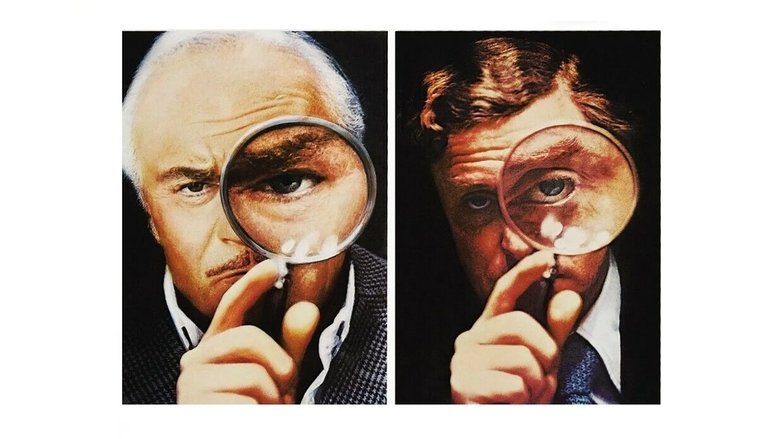
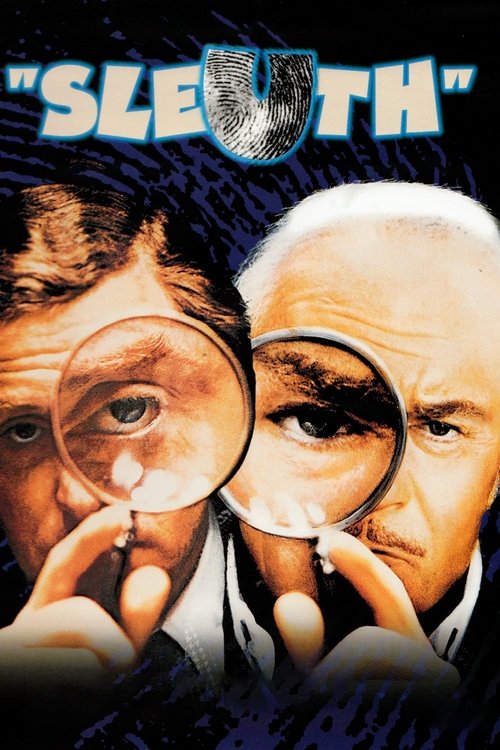
Sleuth
"Think of the perfect crime... Then go one step further."
Overview
Famous detective novelist Andrew Wyke invites Milo Tindle, a younger man of Italian heritage who is having an affair with Wyke's wife, to his lavish, game-filled country estate. Seemingly unfazed by the infidelity, Wyke proposes a bizarre scheme: he wants Milo to stage a fake burglary of his wife's jewelry. The plan ostensibly benefits both—Milo gets the jewels to support the high-maintenance wife, and Wyke collects the insurance money to finance his own mistress.
Milo agrees, entering into what he believes is a profitable conspiracy. However, the evening quickly devolves into a humiliation ritual as Wyke's true sadistic intentions surface. The burglary setup is revealed to be a trap designed to frame Milo, culminating in a terrifying mock execution. This act sets off a chain reaction of revenge, where the roles of hunter and prey constantly shift.
The narrative unfolds as a series of elaborate bluffs and counter-bluffs. Following the initial confrontation, a police inspector arrives to investigate Milo's disappearance, pushing Wyke to the brink of a breakdown. The film builds to a crescendo of psychological warfare, questioning who is truly in control of the deadly game being played.
Core Meaning
At its heart, Sleuth is a scathing satire of the British class system and the 'gentleman detective' genre. Director Joseph L. Mankiewicz deconstructs the artificiality of the classic whodunit, contrasting Andrew Wyke's obsession with orderly, intellectual puzzles against the messy, visceral reality of modern life and violence. The film argues that for the entrenched aristocracy (Wyke), life is a game to be manipulated from a position of privilege, but for the rising working class (Milo), it is a desperate struggle for survival and dignity. Ultimately, it suggests that the refusal to treat others as equals leads to mutual destruction.
Thematic DNA
Class Conflict and Entitlement
The central conflict is fueled by class resentment. Wyke represents the decaying, arrogant aristocracy who views those of lower status as pawns. Milo represents the ambitious, 'jumped-up' immigrant working class. Wyke constantly belittles Milo's heritage and profession (hairdresser), while Milo despises Wyke's unearned snobbery.
Illusion vs. Reality
The film blurs the line between games and real life. Wyke surrounds himself with automata and props, treating crime as a theatrical puzzle. The narrative repeatedly tricks the audience and the characters into believing a performance is reality, highlighting the danger of living within one's own delusions.
Gamesmanship and Dominance
Life is presented as a zero-sum game of 'Sleuth' where winning is the only objective. Both men engage in a battle for dominance, not just over a woman, but over each other's psyche. The obsession with 'winning' the game ultimately overrides their survival instincts.
Character Analysis
Andrew Wyke
Laurence Olivier
Motivation
To prove his intellectual and social superiority; to humiliate the younger rival who dared to take his wife; to maintain the illusion that life is a controllable game.
Character Arc
Starts as an all-powerful puppet master, confident in his superior intellect and class. As the film progresses, his control is stripped away layer by layer until he is reduced to a desperate, pathetic figure who destroys himself rather than accept defeat.
Milo Tindle
Michael Caine
Motivation
Initially love and financial gain, but quickly shifting to pure survival and a burning need for revenge against the man who humiliated him.
Character Arc
Begins as a polite, slightly insecure guest seeking approval. After surviving Wyke's trauma, he hardens into a vengeful force, mastering Wyke's own methods to turn the tables, only to fall victim to the final, fatal move of the game.
Symbols & Motifs
The Automata (Jolly Jack Tar)
The mechanical toys represent Wyke's desire for absolute control. Unlike real people, the automata do exactly what he wants. The laughing sailor ('Jolly Jack Tar') specifically symbolizes the mockery of the situation and the inanimate, soulless nature of Wyke's world.
The sailor laughs maniacally at key moments of humiliation, serving as a silent, mocking chorus to the men's folly, especially in the final scene.
The Maze
A visual metaphor for the plot and Wyke's mind—complex, entrapping, and artificial. It represents the 'game' from which there is no easy escape.
The film opens with the maze, and characters are physically and metaphorically lost within the labyrinth of lies they construct.
The Clown Costume
Symbolizes humiliation and the reduction of a human being to a prop in someone else's entertainment. It strips Milo of his dignity and masculinity.
Wyke forces Milo to wear this oversize costume during the 'burglary,' turning him into a literal caricature of a fool before the mock execution.
Games Room
Represents Wyke's childish refusal to grow up and face reality. It is a shrine to his ego and his belief that he is the 'god' of his own universe.
The main setting of the film, filled with board games, puzzles, and toys, contrasting with the deadly serious nature of the conflict.
Memorable Quotes
It was only a bloody game!
— Milo Tindle
Context:
Spoken by Milo in his final moments as he lies dying on the floor, while the police bang on the door.
Meaning:
The dying realization of the futility of their conflict. It underscores the tragedy that Wyke carried his obsession too far, turning a 'game' into actual murder.
You're a jumped-up pantry boy who doesn't know his place!
— Andrew Wyke
Context:
Wyke shouts this during a heated confrontation, dropping his facade of the polite host.
Meaning:
Reveals the ugly class prejudice beneath Wyke's civilized veneer. It shows that his hatred for Milo is rooted in snobbery rather than just romantic rivalry.
Sex is the game! Marriage is the penalty.
— Andrew Wyke
Context:
Spoken early in the film as Wyke explains his 'enlightened' view of his wife leaving him.
Meaning:
Demonstrates Wyke's cynical, trivializing view of human relationships. He views marriage not as a bond but as a trap or a loss in a game.
Philosophical Questions
Is justice achievable through law, or only through revenge?
The film contrasts the legal system (which Wyke thinks he can outsmart) with 'poetic justice.' Milo realizes the law cannot touch a man like Wyke, so he creates a scenario of vigilante justice, raising the question of whether true equity can exist between unequal social classes.
Does civilization merely mask our primal nature?
Wyke prides himself on being a civilized gentleman, yet his games are barbaric. The film suggests that high culture, etiquette, and social status are fragile veneers hiding the same primitive violent impulses found in the 'lower' classes he mocks.
Alternative Interpretations
The Homoerotic Subtext: Many critics have noted an underlying current of attraction between the two men. The obsession with each other, the intimate nature of their games, and the exclusion of women (who are only discussed or seen in portraits) suggest that the 'game' is a substitute for a sexual relationship they cannot express.
The Suicide Pact: Another reading suggests that Wyke, bored and lonely, subconsciously desires a worthy opponent who can defeat him. In this view, he goads Milo into destroying him because he prefers a dramatic, fatal ending to a life of irrelevance.
Cultural Impact
Sleuth set the gold standard for the 'two-hander' thriller, influencing decades of films focused on psychological duels and singular locations (e.g., Deathtrap, Hard Candy). It successfully bridged the gap between theatrical tradition and cinema, proving that a dialogue-driven film could be visually arresting. The film is culturally significant for preserving two powerhouse performances from different generations of British acting royalty—Olivier's classical theatricality versus Caine's modern cinematic naturalism. It remains a touchstone for discussions on class warfare in British media.
Audience Reception
Upon release and in subsequent decades, Sleuth has been critically acclaimed, holding high ratings (96% on Rotten Tomatoes). Audiences praise the chemistry between Olivier and Caine as the film's strongest asset. The intricate plot twists are frequently cited as a highlight, keeping viewers guessing until the end. Some modern criticisms note the pacing can feel slow or 'stagey' due to its theatrical origins, but the general consensus is that it is a masterpiece of the mystery genre.
Interesting Facts
- The film's opening credits list 'Inspector Doppler' as being played by 'Alec Cawthorne'. This is a fabrication to prevent the audience from realizing it is actually Michael Caine in disguise.
- This was the final film directed by Hollywood legend Joseph L. Mankiewicz.
- It is one of the very few films where the entire on-screen cast (Laurence Olivier and Michael Caine) received Academy Award nominations for acting.
- Michael Caine played the role of Milo Tindle in 1972, and later played Andrew Wyke in the 2007 remake, switching roles across generations.
- Albert Finney was the first choice for Milo Tindle but was rejected for being 'too plump'. Alan Bates was also offered the role but declined.
- The exteriors were filmed at Athelhampton House in Dorset, while the intricate interiors were sets built at Pinewood Studios by famous production designer Ken Adam.
- Laurence Olivier wrote a letter to Michael Caine at the start of filming, asking to be addressed as 'Lord Olivier' initially, but allowing Caine to call him 'Larry' immediately after.
- Michael Caine abstained from alcohol entirely during the 16-week shoot to maintain the mental sharpness required for the dialogue-heavy role.
Easter Eggs
Alec Cawthorne
The credited actor for Inspector Doppler does not exist. The name is a fictional creation inserted into the credits and promotional material to preserve the twist that Doppler is actually Milo Tindle in heavy makeup.
Satire of Detective Fiction
The film is filled with meta-references to the genre. Wyke's novels (e.g., 'The Body in the Tennis Court') and his dialogue mock the tropes of Agatha Christie and S.S. Van Dine, specifically the 'fair play' rules which the film itself proceeds to break.
⚠️ Spoiler Analysis
Click to reveal detailed analysis with spoilers
Frequently Asked Questions
Explore More About This Movie
Dive deeper into specific aspects of the movie with our detailed analysis pages
Comments (0)
No comments yet. Be the first to share your thoughts!