Skip to content
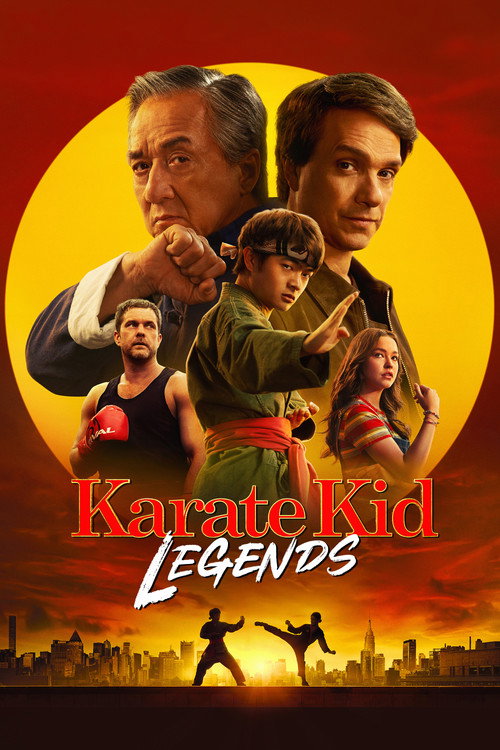
Karate Kid: Legends
A cross-cultural martial arts drama of quiet grief and vibrant urban energy, charting a fractured youth's healing through colliding fighting disciplines against the backdrop of neon-drenched New York streets.
Karate Kid: Legends

Karate Kid: Legends

"When masters unite a new legacy begins."

08 May 2025 United States of America 94 min 7.0 (1,307)

Director: Jonathan Entwistle

Cast: Jackie Chan, Ben Wang, Joshua Jackson, Sadie Stanley, Ming-Na Wen

Drama Action Adventure Synthesis of Traditions and Cross-Cultural Unity Grief, Guilt, and Emotional Reconciliation Belonging and Identity in the Diaspora Honor, Integrity, and Non-Violent Purpose
Budget: $45,000,000
Box Office: $117,105,466

Overview

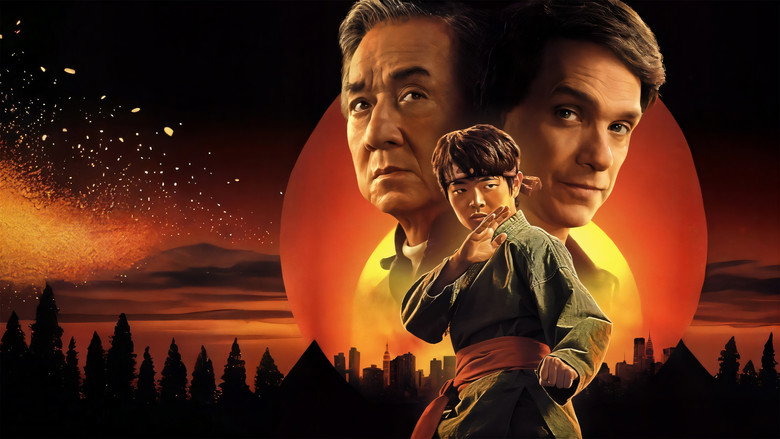
Karate Kid: Legends revitalizes the enduring martial arts saga by bridging decades of cinematic heritage under director Jonathan Entwistle. The narrative centers on Li Fong, a skilled kung fu prodigy living in Beijing whose life is shattered by family tragedy following the untimely death of his older brother. In search of healing and a clean slate, his mother, Dr. Fong, accepts a position at a Manhattan hospital, uprooting Li to the unfamiliar, fast-paced rhythm of New York City under strict instructions that he leave martial arts behind.

As Li attempts to assimilate into high school life, he forms an emotional bond with Mia Lipani and her father Victor, a well-meaning restaurateur facing severe financial distress and the threat of losing his business. However, Li soon attracts the hostility of local karate standout Conor Day. When the opportunity arises to enter the competitive Five Boroughs Tournament—which carries a life-changing cash prize capable of bailing out Victor's eatery—Li realizes that his isolated kung fu foundation cannot withstand the fierce, varied styles of his urban rivals.

Recognizing the young fighter's inner conflict and technical shortcomings, Li's former master, Mr. Han, reunites with him in New York and reaches out to legendary Miyagi-Do sensei Daniel LaRusso. Together, the two iconic mentors guide Li on a transformative path, merging Chinese kung fu and Okinawan karate into a cohesive philosophy designed not merely to win a trophy, but to restore spiritual harmony to a fractured soul.

Core Meaning

The core philosophy of Karate Kid: Legends is encapsulated by the recurring adage, "Two branches, one tree." The film argues that disparate traditions, whether cultural backgrounds, generational values, or contrasting martial disciplines, share a common root in empathy, self-mastery, and moral responsibility.

Beyond physical combat, the story asserts that true strength lies in the capacity to integrate grief into personal evolution rather than allowing trauma to breed isolation or aggression. By bringing the lineages of Mr. Miyagi and Mr. Han together, Entwistle emphasizes that tradition is not an unbending monolith to be rigidly guarded, but an evolving craft enriched by cross-cultural dialogue and human connection.

Thematic DNA

Synthesis of Traditions and Cross-Cultural Unity 35%
Grief, Guilt, and Emotional Reconciliation 25%
Belonging and Identity in the Diaspora 20%
Honor, Integrity, and Non-Violent Purpose 20%

Synthesis of Traditions and Cross-Cultural Unity

The movie examines how divergent styles—Chinese kung fu and Okinawan karate—can complement rather than clash with one another. Through Daniel LaRusso and Mr. Han's joint mentorship, Li learns that rigid adherence to dogma limits growth, whereas openness to foreign techniques yields true mastery.

Grief, Guilt, and Emotional Reconciliation

The tragedy of Bo Fong's death looms over Li and his mother, driving Dr. Fong's protective prohibition against fighting. Martial arts becomes redefined not as an instrument of violence, but as a therapeutic vessel through which Li confronts guilt and honors his brother's memory.

Belonging and Identity in the Diaspora

Li's relocation from Beijing to New York City embodies the immigrant experience of displacement. The film highlights how physical spaces, community bonds, and cross-cultural friendships help displaced youths construct an authentic identity amidst alien environments.

Honor, Integrity, and Non-Violent Purpose

Revisiting foundational tenets of the franchise, the narrative contrasts competitive martial arts driven by ego with defense motivated by civic duty, loyalty to friends, and personal balance.

Character Analysis

Li Fong

Ben Wang

Archetype: Hero Key Trait: Resourceful, quiet resilience

Motivation

To protect his newfound community, save Victor Lipani's family livelihood, and prove that his martial arts practice honors rather than harms his family.

Character Arc

Begins as an emotionally guarded, grieving youth who hides his martial skills out of filial deference, transforming into an adaptable champion who unifies two philosophical disciplines and overcomes his grief.

Mr. Han

Jackie Chan

Archetype: Wise Mentor Key Trait: Patient, soulful wisdom

Motivation

To shepherd his great-nephew through emotional healing while ensuring kung fu principles are applied with wisdom and honor.

Character Arc

Transitions from a reclusive Beijing teacher burdened by family sorrow into a collaborative master willing to embrace outside perspectives alongside an Okinawan karate sensei.

All 5 characters and cast

Symbols & Motifs

The Miyagi-Do Lotus Headband

Meaning:

Represents spiritual lineage, psychological balance, and the unyielding moral compass inherited from Mr. Miyagi, passed forward to guide a new generation.

Context:

Daniel presents the headband to Li before the final rounds of the Five Boroughs Tournament, symbolizing the merging of the Miyagi-Do heritage with Han's kung fu discipleship.

The Bonsai and Bamboo

Meaning:

Contrasting visual emblems of Okinawan patience and deliberate pruning alongside Chinese flexibility and resilience in the wind.

Context:

Used during the joint training montages where Han and Daniel compare philosophies while observing Li adapt to both disciplines in a rooftop community garden.

The Dragon Kick

Meaning:

A dynamic, corkscrew aerial strike that embodies physical and philosophical harmony, fusing kung fu acrobatics with precise karate impact.

Context:

Practiced relentlessly as an incomplete maneuver throughout the second act, it serves as the decisive, acrobatic finishing blow in the tournament climax.

Memorable Quotes

Two branches, one tree.
— Mr. Han

Context

Spoken to Daniel LaRusso during their collaborative training session with Li Fong when comparing karate forms to kung fu postures.

Meaning

Encapsulates the unifying thesis of the entire movie, asserting that all genuine martial paths share a common origin rooted in respect and inner peace.

Balance isn't just about standing on one foot; it's about holding your life together.
— Daniel LaRusso

Context

Delivered to Li Fong as they train on a New York rooftop discussing the loss of Li's brother.

Meaning

Reminds Li that physical martial techniques are meaningless without mental equilibrium and personal accountability outside the ring.

All 3 quotes

Philosophical Questions

Can disparate disciplines harmonize without eroding their essential purity?

The film delves into whether merging kung fu and karate dilutes their sacred cultural origins or enriches both arts, answering through Han and Daniel's cooperative instruction that values universal principles of balance over stylistic tribalism.

How can self-defense practices heal rather than perpetuate historical trauma?

Through Li and Dr. Fong's emotional struggle, the story examines the fine line between physical combat as an instigator of tragedy and martial discipline as an instrument of psychological recovery and resilience.

How It Ends

Alternative Interpretations

One prevalent critical reading interprets the entire narrative as an allegory for modern Asian-American assimilation and cultural synthesis. Under this lens, Li's kung fu embodies his ancestral roots and familial obligations, whereas New York karate represents Western pragmatism and aggression. His victory is not merely athletic; it signifies the harmonious coexistence of dual identities without assimilating away one's cultural core.

Full ending explanation

Cultural Impact

Karate Kid: Legends represents a significant milestone in Hollywood legacy franchise management by uniting two disparate branches of martial arts pop culture: the original 1984 classic continuity extended through Netflix's Cobra Kai, and the 2010 Columbia Pictures reboot starring Jackie Chan. Rather than rebooting or ignoring previous iterations, the movie attempted a holistic narrative canonization.

The film also signaled an important mainstream representation milestone by featuring an authentic Chinese martial artist protagonist played by Ben Wang, highlighting bilingual English-Mandarin domestic realities in working-class New York immigrant communities. While critical reception was modest, the pairing of Chan and Macchio generated significant cross-generational enthusiasm among longtime martial arts cinema fans.

Audience Reception

Audience and critical reception toward Karate Kid: Legends was largely mixed to mildly positive. Critics praised the charismatic, earnest lead performance of Ben Wang and commended the fluid stunt choreography overseen by veteran action coordinators, alongside the undeniable nostalgic charm of watching Jackie Chan and Ralph Macchio share the screen.

Conversely, recurring criticism was aimed at the screenplay's rushed 94-minute pacing and formulaic legacy-sequel narrative structure. Reviewers noted that cramming multiple mentors, a love interest subplot, and a tournament bracket into an abbreviated runtime left several supporting character arcs feeling underdeveloped.

Interesting Facts

  • Sony Pictures conducted a worldwide open casting call in late 2023 with thousands of submissions before selecting American Born Chinese breakout star Ben Wang for the lead role of Li Fong.
  • The production officially bridged the continuity of the original 1984 film universe and the 2010 remake, formally bringing Jackie Chan's Mr. Han and Ralph Macchio's Daniel LaRusso into a single shared cinematic universe.
  • Principal photography took place between April and June 2024, with primary locations spanning Montreal—standing in for New York City during unseasonably cold temperatures—and location shoots in New York.
  • This was the first cinematic entry in the Karate Kid series produced without long-time franchise producer Jerry Weintraub, who passed away in 2015, with Karen Rosenfelt taking over producing duties.
  • Jonathan Entwistle, widely known for directing the television series The End of the F***ing World and I Am Not Okay with This, made his major studio studio feature directorial debut with this film.

Easter Eggs

Johnny Lawrence Cameo

William Zabka makes a brief appearance right before the closing credits, directly nodding to the continuity established by the long-running series Cobra Kai.

Karate Kid Part II Flashback Opening

The film opens with brief visual archival echoes referencing Daniel and Miyagi's journey to Okinawa, explicitly tying the legacy of Okinawan kata to Han's Chinese philosophy.

The Iconic Crane Stance vs. Dragon Stance Gesture

During a lighthearted sparring moment between Han and LaRusso, Daniel briefly raises his arms in the classic crane stance, prompting Han to humorously counter with a traditional mantis and dragon hand guard.

Frequently Asked Questions

Explore More About This Movie

Dive deeper into specific aspects of the movie with our detailed analysis pages

Comments (0)

Leave a comment

No comments yet. Be the first to share your thoughts!

Similar Movies