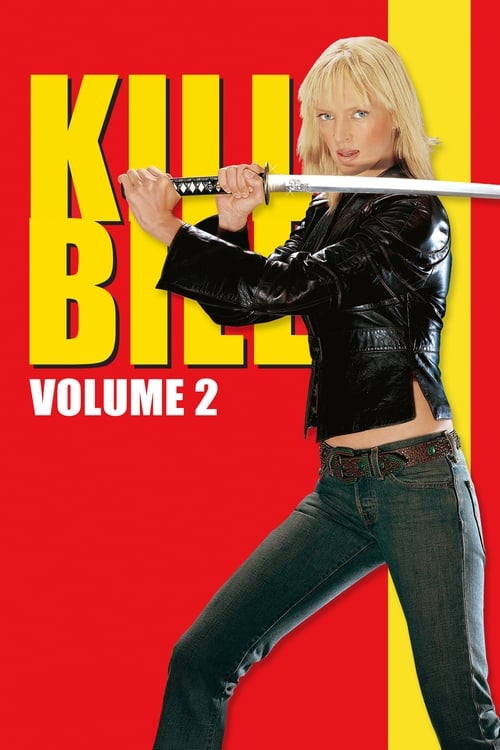
Kill Bill: Vol. 2
"The bride is back for the final cut."
Overview
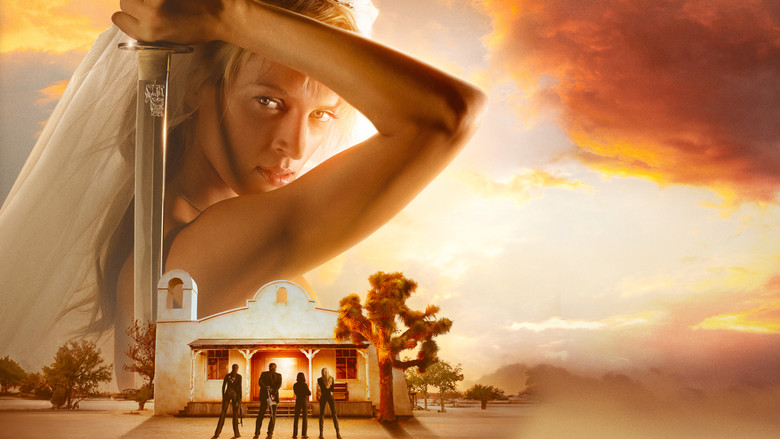
"Kill Bill: Vol. 2" continues the Bride's roaring rampage of revenge against her former lover and boss, Bill, and his Deadly Viper Assassination Squad. Where "Vol. 1" was a frenetic homage to Japanese samurai and kung fu films, this installment shifts its tone to a more deliberate and dialogue-driven narrative, drawing heavy inspiration from Spaghetti Westerns. The film delves deep into the Bride's past, revealing her rigorous and cruel training under the legendary martial arts master, Pai Mei, and the complex, love-hate relationship she shared with Bill.
The Bride, now with two names crossed off her death list, sets her sights on the remaining assassins: Bill's world-weary brother Budd and the treacherous, one-eyed Elle Driver. Her journey is fraught with peril, including being buried alive, leading to a brutal confrontation in a claustrophobic trailer. The narrative builds towards the ultimate showdown with Bill himself, a confrontation that is as much a battle of wits and emotions as it is of swords. The film explores the motivations behind the wedding chapel massacre and culminates in a startling revelation that completely redefines the Bride's quest for vengeance.
Core Meaning
At its heart, "Kill Bill: Vol. 2" is an exploration of the complexities of love, betrayal, and the cyclical nature of violence. While on the surface it is a revenge epic, its core meaning delves into the idea that revenge is not a simple, satisfying act but a painful and transformative journey. Director Quentin Tarantino uses the framework of a revenge plot to deconstruct the very nature of his protagonist, Beatrix Kiddo. He poses the question of whether a "natural born killer" can ever truly escape their inherent nature to find a life of peace and domesticity.
The film ultimately suggests that while the past can never be erased, a different future is possible. The driving force of the narrative shifts from pure vengeance to a powerful maternal instinct, suggesting that the desire to protect and nurture can be a more potent motivator than hatred. The conclusion is not one of triumphant celebration, but of a somber and emotionally complex resolution, implying that the cost of violence is always high, even for the one who survives.
Thematic DNA
Revenge and its Consequences
While revenge is the driving force of the plot, the film explores its emotional and psychological toll. Unlike the more straightforward rampage in "Vol. 1," this installment shows the wearying and sorrowful aspects of The Bride's quest. Her confrontations are more personal and dialogue-heavy, revealing the painful history with her targets. The film questions whether revenge can ever truly provide closure, suggesting it is a hollow pursuit that ultimately leaves scars on the avenger. Budd's resignation and statement that they "deserve to die" adds a layer of fatalistic acceptance to the theme.
Motherhood and Maternal Instinct
This theme becomes the emotional core of the film. The Bride's primary motivation shifts from vengeance for her own suffering to securing a future for her daughter, B.B. The revelation that her daughter is alive recontextualizes her entire journey. The film portrays her maternal instinct as her greatest strength, allowing her to endure being buried alive and to ultimately face Bill. The final line, "The lioness has been reunited with her cub, and all is right in the jungle," explicitly frames the story as a mother's primal need to protect her child.
Love and Betrayal
The complex relationship between Beatrix and Bill is the heart of the film's drama. Flashbacks reveal a deep, albeit dysfunctional, love between them. The wedding chapel massacre is portrayed not just as a business decision but as an act of a heartbroken and murderously possessive lover. Bill's final monologue about Superman is a metaphor for his belief that Beatrix can't escape her true nature as a killer, a nature he both admires and resents her for trying to leave. Their final confrontation is tinged with this tragic love, making the act of killing him a painful necessity rather than a simple victory.
Escape from the Past
Several characters grapple with their pasts. The Bride's entire arc is an attempt to leave her life as an assassin behind for a normal existence. Budd has retreated into a life of squalor, seemingly as a form of self-punishment for his past actions, even pawning his priceless Hattori Hanzō sword. Bill himself seems to live in a state of nostalgic regret. The film explores the question of whether one can truly change their fundamental nature, a question Bill explicitly poses with his Superman analogy. The ending offers a hopeful, if not definitive, answer that a new life is possible, even if the past can never be fully erased.
Character Analysis
Beatrix Kiddo / The Bride
Uma Thurman
Motivation
Initially driven by a burning desire for revenge against those who wronged her and took her unborn child, her motivation undergoes a profound shift upon learning her daughter is alive. Her primary motivation then becomes ensuring her daughter's safety and future, which necessitates the completion of her mission to eliminate all threats from her past life.
Character Arc
In "Vol. 2," The Bride's arc evolves from a pure revenge-seeker to a protective mother. Her journey is one of endurance and rediscovery. After the initial bloodlust of "Vol. 1," she confronts the more emotionally complex and personal relationships from her past. The discovery that her daughter, B.B., is alive becomes the catalyst for her transformation. Her ultimate goal is no longer just to kill Bill, but to reclaim her daughter and her future. The final scene of her crying on the bathroom floor, repeating "thank you," shows the immense emotional release of completing her violent quest and finally being able to embrace her new life as a mother.
Bill
David Carradine
Motivation
His motivation for the massacre is revealed to be a twisted form of jealousy and possessiveness; he couldn't accept Beatrix leaving him and their life for a normal man. He sees her as a "natural born killer" and her attempt at a different life as a betrayal of her true self and of him. In the end, his motivations seem to include a desire to understand why she left and to face the consequences of his own "over-reaction."
Character Arc
Bill is revealed in full in this volume, not as a monstrous villain, but as a complex, charming, and philosophical antagonist. His arc is one of a man grappling with the consequences of his own actions, driven by a possessive love and a broken heart. He appears to have spent the years raising their daughter with a strange mix of paternal care and assassin's logic. His final confrontation with Beatrix is one of resignation and a strange sort of reconciliation. He accepts his death with a sense of fatalistic grace, acknowledging her superiority as a warrior and finally letting her go.
Budd
Michael Madsen
Motivation
Budd's primary motivation appears to be a weary self-preservation mixed with a sense of fatalism. He has pawned his legendary sword and seems to have little ambition beyond getting through the day. His decision to sell The Bride's sword to Elle for a million dollars is a desperate grasp at a better life, but it ultimately leads to his demise.
Character Arc
Budd's arc is one of decline and regret. Once a deadly assassin known as Sidewinder, he now lives in a squalid trailer, working as a bouncer in a strip club. He is the only member of the squad who seems to carry the weight of their past deeds, expressing that The Bride deserves her revenge and that they deserve to die. Despite this, he still acts to save himself, albeit in a pragmatic, non-glamorous way. His arc ends ignominiously, not in a warrior's duel, but through the treachery of Elle Driver, a victim of his own greed.
Elle Driver
Daryl Hannah
Motivation
Elle's motivations are driven by a venomous cocktail of jealousy, ambition, and cruelty. She resents Beatrix for being Bill's favorite and, as is revealed, for earning Pai Mei's respect. Her actions are consistently self-serving and sadistic, from attempting to kill a comatose Beatrix in the hospital to murdering Budd for his sword and money.
Character Arc
Elle Driver's arc is one of pure, unadulterated villainy and bitter rivalry. She harbors a deep-seated hatred and jealousy for Beatrix, stemming from their shared history with both Bill and Pai Mei. Unlike the other characters, she shows no remorse or complexity beyond her sadism and ambition. Her arc culminates in a brutal, claustrophobic trailer fight where her own treachery against Pai Mei is revealed, leading to her being blinded by Beatrix and left to an ambiguous but grim fate with a black mamba.
Symbols & Motifs
The Hattori Hanzō Sword
The Hattori Hanzō sword represents the pinnacle of warrior craftsmanship and the legitimacy of The Bride's quest. It is a tool of righteous revenge, forged by a master who had sworn off making instruments of death. In "Vol. 2," Budd pawning his own Hanzo sword symbolizes his rejection of the warrior code and his descent into a life of shame and regret.
The Bride carries her Hanzō sword throughout her quest. Budd's admission that he pawned his is a key character moment. He later reveals he still has it, showing his lingering connection to his past. Elle Driver's desire to possess The Bride's sword highlights her jealousy and sense of inferiority.
The Five Point Palm Exploding Heart Technique
This mythical death blow symbolizes the ultimate mastery of martial arts and a secret power dynamic. It represents knowledge so deadly that it is rarely taught. That Pai Mei chose to teach it to Beatrix signifies his profound, albeit begrudging, respect for her. It becomes the key to her victory over Bill, a victory achieved not through a prolonged, bloody battle, but through a single, precise, and almost intimate act.
Bill tells Beatrix the legend of the technique during a flashback. Beatrix uses it on Bill in their final confrontation. His surprise that she knows it is his final acknowledgment of her as his superior warrior.
Black and White Cinematography
The use of black and white serves multiple purposes. It acts as an homage to classic samurai and western films. It's also used to visually punctuate significant moments in the narrative, often those of great emotional weight or violence, such as the wedding chapel massacre. This stylistic choice can also represent the stark, moral clarity of The Bride's mission: to kill or be killed.
The opening scene depicting the wedding chapel rehearsal and subsequent massacre is shown in black and white. This stylistic choice sets a somber and serious tone for the events that drive the entire narrative.
The Superman Monologue
Bill's monologue about Superman and his alter ego, Clark Kent, is a complex metaphor for identity and nature. Bill argues that Superman's true self is the superhero, and Clark Kent is the disguise. He uses this to assert that Beatrix's true self is 'The Bride,' a killer, and her attempt at a normal life was just a costume. It symbolizes his inability to accept her transformation and his justification for his actions.
Bill delivers this monologue to Beatrix in their final confrontation, moments before their duel. It is the philosophical climax of the film, laying bare the central conflict of their relationship and The Bride's internal struggle.
Memorable Quotes
That woman deserves her revenge... and we deserve to die. But then again, so does she. So, I guess we'll just see, won't we?
— Budd
Context:
Budd says this to his brother Bill over the phone after being warned that The Bride is coming for him. It shows his philosophical acceptance of his likely fate.
Meaning:
This quote encapsulates Budd's weary resignation and the film's complex morality. It acknowledges the justice in The Bride's quest while also pointing out that in their world of assassins, no one is truly innocent. It sets a fatalistic tone for his character.
Bitch, you don't have a future.
— Beatrix Kiddo
Context:
Beatrix says this to Elle Driver during their vicious fight in Budd's trailer, just before she plucks out Elle's remaining eye.
Meaning:
A cold, definitive statement that marks the end of her rival, Elle Driver. It's a powerful line that signifies Beatrix's absolute certainty in her victory and her utter contempt for Elle, who has just boasted about her own future with Beatrix's sword.
Superman didn't become Superman. Superman was born Superman... I'm calling you a killer. A natural born killer. You always have been, and you always will be.
— Bill
Context:
Bill delivers this monologue to Beatrix during their final confrontation at his villa, using the Superman mythos as an analogy for her identity.
Meaning:
This is the philosophical centerpiece of the film, where Bill explains his worldview and his perception of Beatrix. He argues that her true nature is that of an assassin, and her attempt at a normal life was merely a disguise. It reveals his inability to accept her change and provides the ultimate justification for his actions in his own mind.
Looked dead, didn't I? Well, I wasn't. But it wasn't for lack of trying, I can tell you that... And when I arrive at my destination, I am gonna kill Bill.
— Beatrix Kiddo
Context:
The Bride says this in a voiceover as she drives in a convertible at the beginning of the film, breaking the fourth wall to speak directly to the audience.
Meaning:
This opening monologue re-establishes The Bride's mission with grim determination. It serves as a direct address to the audience, summarizing the events of the first film and setting the stage for the final leg of her "roaring rampage of revenge."
Philosophical Questions
Can a person truly escape their inherent nature?
The film delves into this question through Bill's Superman monologue. He posits that Beatrix, like Superman, is a "natural born killer" and her attempt at a normal life is just a costume. The film explores whether her violent rampage is a return to her true self or a necessary evil she must perform to protect the new self she wants to become—a mother. The ending leaves this question open: is she finally at peace, or is the 'killer bee' merely dormant?
What is the true nature of justice and revenge?
"Kill Bill" moves beyond a simple "eye for an eye" morality. Budd's line, "That woman deserves her revenge, and we deserve to die. But then again, so does she," highlights the moral ambiguity. The film forces the audience to question if The Bride's actions are truly just or simply a continuation of a cycle of violence. Is her rampage a righteous quest, or is she, as Bill suggests, just a killer doing what killers do?
Can love and extreme violence coexist?
The central relationship between Beatrix and Bill is defined by both genuine affection and murderous betrayal. Bill's actions are framed as those of a spurned lover, a "crime of passion." The film explores the dark side of love, where passion curdles into a possessiveness that leads to horrific violence. Their final confrontation is filled with a palpable sense of shared history and sorrow, complicating the simple hero-villain dynamic and asking how two people who loved each other could inflict so much pain.
Alternative Interpretations
One of the most prominent fan theories suggests that The Bride did not actually kill Bill. Proponents of this theory argue that the Five Point Palm Exploding Heart Technique is a myth within the film's universe and that Beatrix and Bill staged his death. Evidence cited includes Beatrix shaking her head 'no' when Bill asks if Pai Mei taught her the technique, Bill taking six steps instead of five before collapsing, and his name not being crossed off the list in the end credits. In this interpretation, the 'death' is a mutual agreement allowing Beatrix to leave with their daughter and live in peace, making the film's ending one of reconciliation rather than revenge. Another interpretation focuses on the idea that Budd was secretly in love with The Bride. This theory posits that his fallout with Bill was over Beatrix and that his actions—giving her a "fighting chance" by leaving her with a flashlight when burying her—are driven by a complex mix of resentment and buried affection. A further reading suggests that Elle Driver may have survived the encounter in the trailer, as her name in the end credits is marked with a question mark rather than being crossed out, leaving her fate deliberately ambiguous.
Cultural Impact
"Kill Bill: Vol. 2" was released in 2004, six months after its predecessor, to critical acclaim. It demonstrated Quentin Tarantino's ability to shift genres seamlessly, moving from the Eastern-influenced action of "Vol. 1" to a more contemplative, dialogue-driven Western. This division of a single story into two distinct stylistic parts was a bold cinematic experiment that influenced how complex narratives could be presented. The film solidified Uma Thurman's status as a formidable action hero and iconic female protagonist, a role she and Tarantino developed together. The character of Bill, masterfully played by David Carradine, is remembered as one of Tarantino's most compelling and nuanced antagonists. The film's blend of homage to Spaghetti Westerns, Shaw Brothers kung fu, and exploitation cinema further cemented Tarantino's reputation as a master of postmodern filmmaking. Its unique visual style, memorable dialogue (especially the Superman monologue), and Robert Rodriguez's score have been widely referenced and parodied in pop culture. While some critics and audiences were divided over the slower pace compared to "Vol. 1," many praised its emotional depth and satisfying conclusion to The Bride's saga, cementing the two-part epic as a landmark of 21st-century cinema.
Audience Reception
Audience reception for "Kill Bill: Vol. 2" was largely positive, with many viewers appreciating its shift in tone from the action-heavy "Vol. 1." Praise was frequently directed at the film's deeper character development, particularly the full introduction of David Carradine's charismatic and complex portrayal of Bill. The witty, philosophical dialogue, a trademark of Tarantino, was seen as a welcome return to form. However, a significant point of criticism for some viewers was the slower, more deliberate pacing, which they felt lacked the kinetic energy of the first installment. The reduced number of large-scale action sequences was a disappointment for those expecting a similar level of stylized violence. Despite this, the claustrophobic trailer fight between The Bride and Elle Driver and the emotionally charged final confrontation with Bill were often cited as standout moments. Overall, while some found it less viscerally entertaining than its predecessor, many viewers and critics considered it a more mature and emotionally resonant conclusion to the saga, providing a satisfying and profound end to The Bride's journey.
Interesting Facts
- The film is deliberately styled as a "Western" in contrast to Vol. 1's "Eastern" influences, reflecting the shift in location and tone.
- Robert Rodriguez, a close friend of Tarantino, composed parts of the score for just $1. In return, Tarantino directed a scene in Rodriguez's film "Sin City" (2005) for the same fee.
- David Carradine, who was a musician, suggested that his character Bill should play the flute. The flute he uses in the film was actually made by Carradine himself.
- The character of Pai Mei, played by Gordon Liu, is based on a legendary figure from Chinese martial arts folklore and has appeared in several Shaw Brothers kung fu films, which were a major inspiration for Tarantino.
- Only three people are killed on-screen in "Kill Bill: Vol. 2," a stark contrast to the high body count of the first film.
- Michael Parks plays two different characters in the Kill Bill saga: Texas Ranger Earl McGraw in Vol. 1 and retired pimp Esteban Vihaio in Vol. 2.
- The brutal fight scene in Budd's trailer was inspired by Tarantino watching "Jackass: The Movie" and deciding to make the violence more raw and less stylized than the fights in Vol. 1.
- The gas can seen in Budd's trailer is a direct reference to the one used by Michael Madsen's character, Mr. Blonde, in Tarantino's "Reservoir Dogs" (1992).
Easter Eggs
The Lonely Grave of Paula Schultz
The Bride is buried in a grave marked "Paula Schultz." This is widely believed to be a reference to the wife of Dr. King Schultz, the character played by Christoph Waltz in Tarantino's later film, "Django Unchained" (2012), connecting the two films within a shared universe.
Samuel L. Jackson's Cameo
Frequent Tarantino collaborator Samuel L. Jackson has a brief, uncredited cameo as Rufus, the organ player at the wedding rehearsal chapel. Though we only see him in silhouette, his voice is unmistakable.
Blade Runner Reference
When Elle Driver has her remaining eye plucked out by Beatrix, her spastic, flailing reaction on the floor is a direct visual homage to the death scene of Pris, the replicant played by Daryl Hannah herself in the sci-fi classic "Blade Runner" (1982).
The Carrucans of Kurrajong
In Esteban Vihaio's house, a book titled "The Carrucans of Kurrajong" by Jasmine Yeun can be seen. This is an inside joke, as Jasmine Yeun Carrucan was the Second Assistant Camera operator on the film.
Black Mamba vs. Sidewinder
Elle Driver uses a black mamba snake to kill Budd. The Bride's codename is Black Mamba, and Budd's is Sidewinder. This creates a symbolic death where, in a way, "Black Mamba" is responsible for the death of "Sidewinder."
⚠️ Spoiler Analysis
Click to reveal detailed analysis with spoilers
Frequently Asked Questions
Explore More About This Movie
Dive deeper into specific aspects of the movie with our detailed analysis pages
Comments (0)
No comments yet. Be the first to share your thoughts!