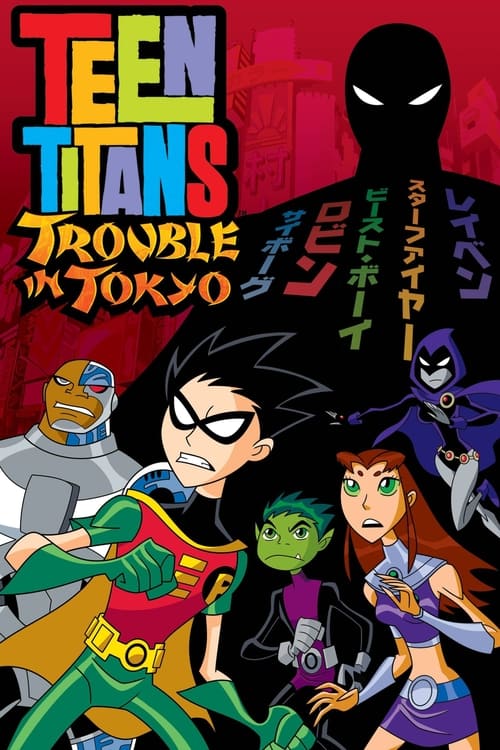
Teen Titans: Trouble in Tokyo
An action-packed animated adventure pulsing with neon-drenched emotion, where a superhero's stoic resolve fractures under the vibrant chaos of a foreign metropolis and blossoming romance.
Teen Titans: Trouble in Tokyo

Teen Titans: Trouble in Tokyo

"The Titans go ninja on the notorious villain Brushogun in their awesome first feature-length movie."

15 September 2006 United States of America 75 min ⭐ 7.9 (439)
Director: Michael Chang Matt Youngberg Heather A. Maxwell
Cast: Greg Cipes, Scott Menville, Khary Payton, Tara Strong, Hynden Walch
Animation Action Science Fiction TV Movie
Identity and Self-Discovery Love and Romance Appearance vs. Reality Culture Clash and Acceptance

Overview

"Teen Titans: Trouble in Tokyo" serves as the feature-length finale to the popular animated series "Teen Titans". The story kicks off when a mysterious, high-tech ninja named Saico-Tek attacks Titans Tower in Jump City. After capturing him, the Titans learn he was sent by a notorious Japanese criminal mastermind known as Brushogun. This revelation prompts the team to travel to Tokyo, Japan, to investigate and bring this new threat to justice.

Upon their arrival, the Teen Titans are met with a bustling, unfamiliar culture and a language barrier. Their search for Brushogun is quickly complicated by the local authorities, specifically Commander Uehara Daizo and his elite team, the Tokyo Troopers, who dismiss Brushogun as a mere urban legend and warn the Titans against interfering. While Robin remains focused on the mission, the rest of the team takes the opportunity to explore the vibrant city, leading to individual comedic and action-filled subplots. However, their sightseeing is cut short when monstrous creatures begin to attack, suggesting that the legend of Brushogun may be terrifyingly real.

As the mystery deepens, Robin's single-minded pursuit of Brushogun puts a strain on his burgeoning romantic feelings for Starfire. The team finds themselves framed for crimes they didn't commit and are forced to go on the run, all while trying to uncover the true nature of Brushogun and the conspiracy that surrounds him. The film blends the series' signature mix of action, humor, and character-driven drama, culminating in a climactic battle for the fate of Tokyo and a long-awaited emotional resolution for its central characters.

Core Meaning

The core meaning of "Teen Titans: Trouble in Tokyo" revolves around the theme of identity and finding balance between one's duties and personal life. The film explores the idea that being a hero is not just about fighting villains, but also about personal growth, vulnerability, and embracing relationships. It particularly focuses on Robin's internal conflict, forcing him to confront the notion that his identity as a hero shouldn't completely overshadow his personal self and his feelings for Starfire. Ultimately, the movie suggests that true strength comes from accepting all parts of oneself, including the capacity for love and the need for connection, and that even heroes deserve a vacation and a chance at happiness.

Thematic DNA

Identity and Self-Discovery 35%
Love and Romance 30%
Appearance vs. Reality 20%
Culture Clash and Acceptance 15%

Identity and Self-Discovery

This theme is primarily explored through Robin's character arc. His obsessive focus on being a hero at the expense of his personal feelings for Starfire creates the central emotional conflict. The film pushes him to question if being a hero is all he is, leading to his eventual admission that he can be more. His journey in Tokyo, a place where he is an outsider and his heroic status is challenged, forces him to look inward.

Love and Romance

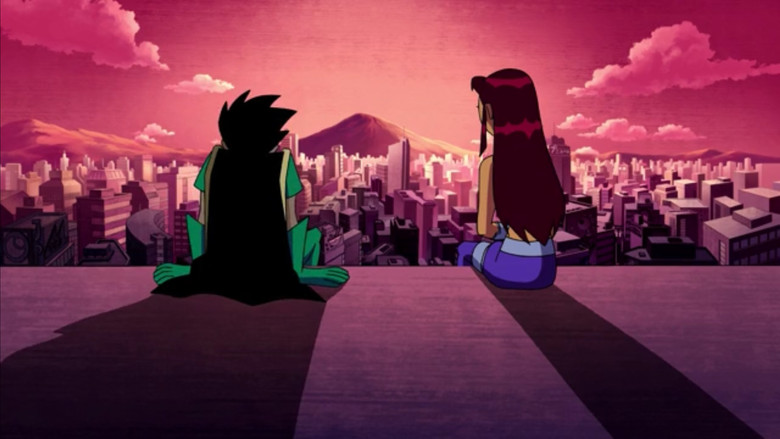
A major focus of the movie is the culmination of the long-teased romance between Robin and Starfire. Their relationship is tested by Robin's emotional unavailability and the external pressures of their mission. The film features several near-kisses and emotionally charged moments, building up to their first true kiss at the climax, which serves as a significant payoff for fans of the series.

Appearance vs. Reality

The central mystery of Brushogun plays heavily on this theme. What appears to be a legendary, all-powerful villain is revealed to be a tragic, exploited artist. Similarly, the respected hero of Tokyo, Commander Daizo, is unmasked as the true manipulative villain. The film constantly challenges the characters and the audience to look beyond the surface, as the ink-based creatures themselves are not what they seem.

Culture Clash and Acceptance

The Titans' journey to Tokyo immerses them in a culture vastly different from their own, leading to humorous misunderstandings and challenges. From language barriers to navigating the city's unique customs, the team must adapt. Beast Boy, in particular, embraces the otaku culture with enthusiasm. The film uses this setting to both celebrate and affectionately parody Japanese pop culture, including anime, kaiju, and karaoke.

Character Analysis

Robin

Scott Menville

Archetype: The Hero
Key Trait: Determined

Motivation

Initially, his motivation is purely to find and defeat Brushogun. This singular focus later shifts to clearing his name and protecting his friends. His underlying motivation throughout the film is to reconcile his duty as a hero with his growing love for Starfire.

Character Arc

Robin begins the film as the stoic, mission-focused leader, repressing his feelings for Starfire in favor of his duties. After being framed and forced to go on the run in an unfamiliar city, his worldview is shaken. He is forced to rely on others and confront his own emotional limitations. His arc culminates in him accepting that he can be both a hero and a person who loves, finally confessing his feelings to Starfire and learning that even heroes need a vacation.

Starfire

Hynden Walch

Archetype: The Heart
Key Trait: Compassionate

Motivation

Her primary motivation is to support her friends and get Robin to open up to her emotionally. She wants to understand him better and for them to finally become a couple.

Character Arc

Starfire's arc is centered on her relationship with Robin. She is patient with his emotional distance but also becomes increasingly frustrated by it. Her journey involves understanding that his dedication to being a hero is part of who he is, while also encouraging him to embrace his feelings. A key moment is when she learns Japanese by kissing a local boy, showcasing her alien nature and creating romantic tension. Her arc resolves as Robin finally reciprocates her feelings, validating her unwavering love and hope.

Commander Uehara Daizo

Keone Young

Archetype: The False Mentor / The Shadow
Key Trait: Deceptive

Motivation

Daizo is motivated by a lust for fame and glory. He wants to be seen as Tokyo's greatest hero, and he is willing to enslave and drain the life from an innocent man to create the villains only he can defeat, thus manufacturing his own legend.

Character Arc

Daizo is introduced as a respected commander and a potential ally. He presents himself as the protector of Tokyo, dismissing Brushogun as a myth. His character undergoes a dramatic shift when he is revealed to be the true villain, a man who exploited a magical artist to manufacture threats and build his own heroic reputation. He doesn't grow but is rather unmasked, his heroic facade crumbling to reveal his greed and ambition.

Brushogun

Cary-Hiroyuki Tagawa

Archetype: The Victim / The Magician
Key Trait: Tragic

Motivation

His sole motivation is to be rescued from his imprisonment and stop Daizo from misusing his power. He endures immense suffering, being slowly drained of his life force by the printing press.

Character Arc

Initially presented as the shadowy main antagonist, Brushogun's arc is a tragic reveal. He is not a villain but a victim. An artist who used magic to bring his creations to life, he was captured and enslaved by Daizo, who used a cursed printing press to harness his power. His motivation is to be freed. He sends Saico-Tek to attract the Titans' attention in a desperate plea for help. His arc ends with a peaceful death after being freed by Robin, finding release from his torment.

Symbols & Motifs

Brushogun's Ink

Meaning:

The ink symbolizes the power of creation and illusion. It represents how reality can be manipulated and how appearances can be deceiving. The creatures born from the ink are formidable but ultimately hollow, lacking true substance, much like Commander Daizo's heroic persona.

Context:

The ink is the medium for all the antagonists the Titans face, from Saico-Tek to the giant monsters. It is later revealed that Brushogun, an artist, brought his drawings to life with magic, but this power was twisted and exploited by Daizo using a cursed printing press. The fact that the ink creatures dissolve in water becomes a key plot point.

Tokyo Tower / Titans Tower

Meaning:

Both towers represent a place of safety, headquarters, and identity for their respective protectors. The initial destruction of Titans Tower symbolizes the disruption of the Titans' world and the catalyst for their journey. The battles in Tokyo, often with its skyline and prominent towers in the background, highlight their status as outsiders trying to protect a city that isn't their own.

Context:

The film opens with a devastating attack on Titans Tower, forcing the team out of their home base. In Tokyo, they are shown around the headquarters of the Tokyo Troopers, a parallel organization. The climax of the film involves a large-scale battle across the city, reinforcing the urban landscape as a battleground.

Robin's Mask

Meaning:

While a constant part of his costume, the mask in this film subtly emphasizes his guarded emotions and his struggle to separate his hero persona from his true self. His brief glimpse without the mask during a vulnerable moment with Starfire is significant, as is his temporary adoption of a disguise when he's a fugitive, forcing him to shed his "Robin" identity.

Context:

Robin's identity is challenged when he is framed for murder and becomes a wanted criminal. He is forced to go undercover, wearing a different outfit and letting his hair down, physically altering the image of "Robin". His most emotionally open moments are with Starfire, where the focus is on his face and the emotions he can't completely hide behind the mask.

Memorable Quotes

Stop talking.

— Starfire

Context:

Spoken at the climax of the film, just after the final battle is won. Robin and Starfire are alone, and he is trying to explain that he was wrong and that being a hero isn't all he is. Before he can finish, Starfire smiles and delivers this line right before they share their first real kiss.

Meaning:

This line is the culmination of five seasons of romantic tension between Starfire and Robin. After Robin finally starts to open up and stammers through his feelings, Starfire gently cuts him off, showing that she understands him without needing the words. It's a moment of emotional release and signifies that the time for hesitation is over.

I know what it means to be a hero, Commander. And trust me - you are no hero.

— Robin

Context:

Robin says this to Commander Daizo during their final confrontation. Daizo boasts that even if Robin defeats him, the people of Tokyo will still see him as a hero and Robin as a criminal. Robin's icy retort dismisses Daizo's superficial understanding of heroism.

Meaning:

This quote encapsulates the film's core theme of what truly defines a hero. Robin, who has spent the entire movie grappling with his identity as a hero, delivers this line with absolute certainty. It's not about fame or public perception, but about integrity and sacrifice, qualities that Daizo completely lacks.

You know, Beast Boy, sometimes, even heroes need a vacation.

— Robin

Context:

This is one of the final lines of the movie. After receiving medals of honor, Beast Boy laments that they probably have to go home now. Robin, holding hands with Starfire, surprises everyone by agreeing to extend their stay in Tokyo for a well-earned vacation.

Meaning:

This line signifies the completion of Robin's character arc. Throughout the movie and the series, he has been resistant to taking time off or relaxing his duties. By finally agreeing with Beast Boy, who has wanted a vacation from the beginning, Robin shows that he has learned to balance his responsibilities with his personal life and the needs of his friends.

I'm a hero, Starfire, and if you don't like it...

— Robin

Context:

This exchange happens after one of their near-kisses is interrupted by Robin's focus on the mission, which upsets Starfire. He confronts her about it, leading to this defensive statement. Starfire replies, "Robin? I like it more than you will ever know," showing her acceptance of all parts of him.

Meaning:

This quote, and Starfire's reply, perfectly illustrates the central conflict between them. Robin uses his hero identity as a shield to keep from getting emotionally close, believing it defines him completely. Starfire's response shows she loves that part of him but also sees the person underneath, highlighting his misunderstanding of her feelings.

Philosophical Questions

What is the true definition of a hero?

The film directly contrasts two definitions of a hero through Robin and Commander Daizo. Daizo believes being a hero is about public perception, fame, and being seen to defeat threats, even if he has to create them himself. Robin, on the other hand, learns that heroism is not just about relentless duty. His journey and final confrontation with Daizo lead him to declare that he knows what a hero is, and it's defined by integrity and sacrifice, not by public accolades. The film suggests that true heroism also involves vulnerability and the courage to build meaningful personal connections.

Can one's duty and personal desires coexist?

This question is the central struggle for Robin. He initially believes that his duty as a hero precludes him from having a personal life or pursuing his feelings for Starfire, seeing it as a distraction or a weakness. The events in Tokyo force him to realize that this binary view is flawed. His love for Starfire doesn't diminish his heroic capabilities; in fact, her rescue and support are crucial. The film's conclusion, where he accepts the need for a vacation and embraces his relationship, is a clear statement that duty and personal happiness are not mutually exclusive and can, in fact, enrich one another.

Alternative Interpretations

One alternative interpretation of the film focuses on Robin's psychological state. His intense, almost violent pursuit of Saico-Tek at the beginning and his pummeling of the ink-ninja until he is apprehended could be seen as Robin struggling with the immense pressure of leadership and his unresolved trauma (often linked to Batman in wider DC lore). His trip to Tokyo, where he is stripped of his authority and becomes a fugitive, can be read as a necessary deconstruction of his hero complex. Only by hitting this low point can he rebuild himself and accept that he is more than just his mission, allowing him to finally connect with Starfire on a human level.

Another reading views the villain, Daizo, as a critique of manufactured heroism and media manipulation. Daizo creates his own crises to maintain his status as a beloved public figure. This can be interpreted as a commentary on how leaders can fabricate or exaggerate threats to consolidate power and win public adoration. Brushogun, the artist whose creative power is twisted for this purpose, represents the corruption of art and truth in the service of propaganda. The Titans, as outsiders, are the only ones who can see through this deception, acting as a force of objective truth against a carefully constructed local narrative.

Cultural Impact

"Teen Titans: Trouble in Tokyo" serves as a capstone to the influential 2003 "Teen Titans" series, a show that played a significant role in popularizing a hybrid American-anime animation style in Western cartoons. The film itself is a love letter to Japanese culture, albeit a somewhat stereotypical one, incorporating elements of kaiju films, anime character designs, J-pop, and the vibrant Tokyo cityscape. It arrived at a time when anime was firmly cementing its place in mainstream Western youth culture, and the movie capitalized on this by immersing its established characters directly into that world.

Critically, the film received generally positive but somewhat mixed reviews. Many saw it as a fun, extended episode that provided a satisfying conclusion, particularly for the long-awaited romantic pairing of Robin and Starfire. However, some critics found the plot to be predictable and felt it didn't quite elevate itself to the level of a standalone feature film, with some side plots feeling like filler. Despite this, for the show's dedicated fanbase, it was a welcome finale after the series' cancellation. It provided emotional closure that the final episode of the series, "Things Change," had left open-ended. The movie remains a significant piece of the "Teen Titans" franchise legacy, often remembered fondly as the 'true' ending of the original story before the radically different "Teen Titans Go!" reboot.

Audience Reception

Audience reception for "Teen Titans: Trouble in Tokyo" is generally positive, especially among fans of the original series for whom it serves as a finale. A major point of praise is the long-awaited consummation of Robin and Starfire's relationship, with their final kiss being a highlight for many viewers who followed their dynamic for five seasons. The film's humor, action sequences, and the signature anime-influenced art style were also well-received, seen as being consistent with the quality of the show.

However, some common criticisms from viewers include that the plot feels like a stretched-out, standard episode rather than a truly cinematic event. The villain, Commander Daizo, is often cited as being predictable and clichéd. Additionally, some feel that characters other than Robin and Starfire, particularly Raven and Cyborg, were sidelined with less impactful subplots that amounted to little more than comic relief. Despite these critiques, the overall verdict from the audience is that it was a fun and emotionally satisfying send-off for a beloved series.

Interesting Facts

  • The movie serves as the series finale for the 2003-2006 "Teen Titans" animated series.
  • David Slack, a head writer for the television series, wrote the screenplay for the film.
  • The film premiered on Cartoon Network on September 15, 2006.
  • During the karaoke scene, Beast Boy sings a comically literal English translation of the Japanese theme song for the "Teen Titans" show.
  • Starfire reveals that Tamaraneans can learn any language through lip contact, which she demonstrates by kissing a random Japanese boy, much to Robin's jealousy.
  • The villain Brushogun does not originate from DC Comics and was created specifically for this movie.
  • The film's animation style is heavily inspired by Japanese anime, a hallmark of the entire series, and this is amplified by the Tokyo setting.

Easter Eggs

During a chase scene, two characters who are clear look-alikes of Kaneda and Yamagata from the iconic 1988 anime film "Akira" make a brief cameo appearance.

This is a direct homage to "Akira," one of the most influential anime films of all time. Given that the visual style of "Teen Titans" was heavily influenced by anime, this reference serves as a nod from the creators to one of their inspirations. The motorcycle chase itself is also reminiscent of sequences from "Akira."

A blob-like monster that attacks Raven bears a strong resemblance to the character No-Face from the Studio Ghibli film "Spirited Away."

This is another tribute to a classic and highly acclaimed Japanese animated film, showcasing the creators' appreciation for the works of Hayao Miyazaki and Studio Ghibli.

Beast Boy wants to visit the Wakamono Shuppan publishing company.

While not a direct crossover, this is a reference to the world of manga publishing, which is a cornerstone of Japanese pop culture. Beast Boy's desire to visit highlights his otaku-like personality. Ironically, the final battle takes place in a similar, abandoned comic book factory.

⚠️ Spoiler Analysis

Click to reveal detailed analysis with spoilers

Frequently Asked Questions

Explore More About This Movie

Dive deeper into specific aspects of the movie with our detailed analysis pages

Comments (0)

Leave a comment

No comments yet. Be the first to share your thoughts!