Knives Out
"Hell, any of them could have done it."
Overview
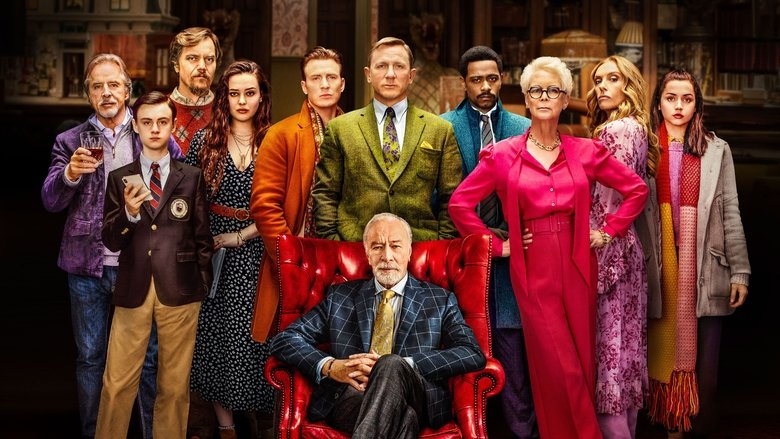
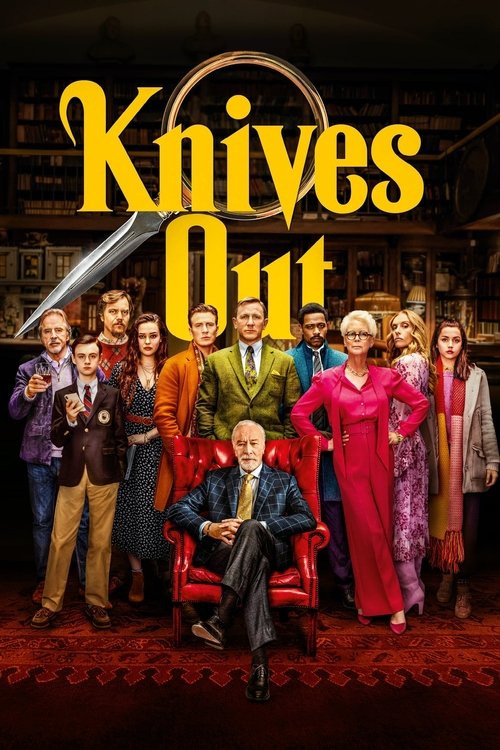
When renowned crime novelist Harlan Thrombey is found dead at his estate just after his 85th birthday, the inquisitive and debonair Detective Benoit Blanc is mysteriously enlisted to investigate. From Harlan's dysfunctional family to his devoted staff, Blanc sifts through a web of red herrings and self-serving lies to uncover the truth behind Harlan's untimely death.
At the center of the investigation is Marta Cabrera, Harlan's kind-hearted nurse who has a peculiar inability to lie without vomiting. She becomes Blanc's unlikely Watson, navigating the treacherous waters of the Thrombey family's greed and deceit. As the will is read and bombshells are dropped, everyone becomes a suspect, and the knives truly come out.
Rian Johnson's "Knives Out" is a clever and modern take on the classic murder mystery. It flips the script by revealing key details early on, shifting the audience's focus from "whodunnit" to "how will they get away with it," creating a gripping and unpredictable ride full of twists and turns.

Core Meaning
"Knives Out" serves as a sharp social commentary on class, privilege, and morality in contemporary America, cleverly disguised as a classic murder mystery. Director Rian Johnson uses the Thrombey family to critique the hypocrisy of the wealthy elite; though they claim to be "self-made" and espouse varying political views, their kindness is superficial and evaporates the moment their inheritance is threatened.
The film champions the inherent goodness and integrity of its immigrant protagonist, Marta, whose empathy and kindness ultimately triumph over the family's greed and entitlement. The narrative suggests that true worth is found in character, not inherited status, and offers a hopeful vision where decency is rewarded, turning the classic power structure on its head.
Thematic DNA
Class Conflict and Wealth Inequality
The film is a pointed satire of the wealthy elite, portraying the Thrombey family as entitled, greedy, and detached from reality. Despite their claims of being "self-made," each member is dependent on Harlan's fortune. Their condescending, yet possessive, attitude towards Marta, whom they call "part of the family" but whose country of origin they can't even name, highlights the class divide. The conflict explodes when Marta inherits everything, stripping away their veneer of civility and exposing their raw entitlement.
Immigration and Xenophobia
"Knives Out" directly engages with the contemporary American political discourse on immigration. Marta, a Latina immigrant and the daughter of an undocumented mother, is the moral center of the film. The Thrombeys' casual racism and hypocritical political arguments reveal their prejudice. They use Marta's immigration status as a weapon when she threatens their inheritance, exposing the performative nature of their liberal ideals. Ultimately, Marta's triumph is presented as a subversion of this xenophobia.
Deception vs. Truth
The entire film is a puzzle box built on lies, secrets, and misdirection. Every character, except for the physically truthful Marta, lies to protect themselves. Marta's inability to lie without vomiting becomes a unique plot device, making her a beacon of truth in a sea of deceit. Detective Blanc's method is to find the truth by observing the patterns within the lies, describing it as a donut hole within a donut's hole. The film explores how truth can be obscured by perspective and self-interest, but will ultimately be revealed.
Kindness and Morality
At its core, the film argues for the power of inherent goodness. Marta's defining trait is her kindness, which Harlan recognizes and rewards. Even when she believes she is guilty and is offered ways out, her conscience and empathy guide her to make the right choice. This is contrasted sharply with the selfish, amoral behavior of the Thrombeys. The film's conclusion, with Marta inheriting the house not through cunning but through character, serves as a moral statement that decency can and should win.
Character Analysis
Benoit Blanc
Daniel Craig
Motivation
Blanc is motivated by an unwavering pursuit of the truth, regardless of its complexity or consequences. He seeks to uncover the natural trajectory of events, what he poetically calls "gravity's rainbow." He is not driven by money but by the intellectual challenge of the puzzle and a deep-seated sense of justice.
Character Arc
Benoit Blanc begins as an eccentric, almost farcical, private investigator of great renown, hired under mysterious circumstances. Initially an observer, he becomes the driving force of the investigation. His arc is one of peeling back the layers of a complex puzzle, moving from theatrical musings about donut holes to a sharp, precise revelation of the truth. He develops a genuine trust and respect for Marta, recognizing her inherent goodness as the key to solving the case.
Marta Cabrera
Ana de Armas
Motivation
Marta's primary motivation is to protect her family, particularly her undocumented mother, from the repercussions of her supposed crime. This is compounded by her genuine affection for Harlan and her powerful moral conscience, which prevents her from being completely deceitful.
Character Arc
Marta starts as Harlan's kind, unassuming nurse, inadvertently caught in a deadly plot. Believing she is guilty of his death, she transforms from a passive pawn into an active participant, trying to cover her tracks while grappling with immense guilt. Her arc is about finding her own strength and agency. By the end, she is no longer just a caretaker but the powerful and deserving inheritor of the Thrombey fortune, having overcome the family's treachery through her fundamental decency.
Ransom Drysdale
Chris Evans
Motivation
Ransom is driven by pure greed and a profound sense of entitlement. Furious at being cut out of Harlan's will, his entire motivation is to reclaim what he believes is rightfully his inheritance, using any means necessary, including murder and framing an innocent woman.
Character Arc
Ransom is introduced as the family's black sheep, a spoiled, arrogant playboy. He initially appears as a potential ally to Marta, helping her escape the family's wrath after the will reading. This facade crumbles as his manipulative nature is revealed. His arc is a downward spiral from entitled antagonist to a confessed murderer, his desperation and cruelty escalating as his plan unravels, culminating in a final, impotent act of rage.
Harlan Thrombey
Christopher Plummer
Motivation
Harlan is motivated by a desire to do the right thing before he dies. He wants to reward Marta's goodness and finally teach his spoiled family a lesson about self-reliance. His love for Marta leads him to make the ultimate sacrifice to protect her from harm.
Character Arc
Harlan's character is explored entirely through flashbacks. He is a clever, successful mystery writer who has grown weary of his family's parasitic nature. His final act—cutting off his family and giving his fortune to Marta—is a deliberate move to force them to stand on their own. Believing he is dying due to Marta's mistake, his arc concludes with a final act of sacrifice, orchestrating his own suicide to protect the person he deems most worthy.
Symbols & Motifs
The Throne of Knives
The iconic chair made of knives symbolizes the family's dysfunction, internal conflict, and the constant backstabbing nature of their relationships. It represents the danger and violence simmering just beneath the surface of their privileged lives. It also represents Harlan's power and the legacy of his sharp, cutting mystery novels. At the end, when Ransom tries to kill Marta with a knife from the throne, it's a fake, symbolizing that his power and threats are ultimately theatrical and hollow.
The throne is a permanent fixture in the main sitting room of the Thrombey mansion, serving as a backdrop for many of the interrogations and the final confrontation. It is the visual embodiment of the film's title.
My House, My Rules, My Coffee" Mug
The mug initially belongs to Harlan, representing his patriarchal control over the family and estate. When Marta is seen drinking from it on the balcony in the final shot, it symbolizes the complete transfer of power and ownership. She has inherited not just the house, but Harlan's position, and will now live by her own rules, which are guided by kindness and integrity.
Harlan is seen with the mug early in the film. The final, powerful shot shows Marta looking down from the balcony at the defeated Thrombey family, holding the mug, signifying her victory and new status as the head of the house.
Marta's Inability to Lie
Marta's regurgitative reaction to lying is a physical manifestation of her innate goodness and honesty. It makes her a uniquely reliable narrator in a story filled with liars, and serves as a moral compass for the audience. This bizarre ailment forces her to be truthful, which ironically complicates her situation but ultimately leads to her salvation.
This trait is established early during her interrogation with Benoit Blanc and becomes a recurring, crucial plot device. It's used for both comedic effect and high-stakes tension, especially when she must mislead the detectives and the family to protect herself.
The Thrombey Mansion
The mansion, filled with oddities, secret passages, and memorabilia from Harlan's mystery novels, functions as a giant Clue board. It represents the labyrinthine nature of the mystery itself and the decaying, hollow core of the Thrombey family's legacy. It is a crumbling castle, a tomb that reflects the moral decay of its inhabitants.
The entire film is set almost exclusively within the mansion and its grounds. Every room holds secrets, and the house itself becomes a character, with its creaks and hidden elements playing into the investigation.
Memorable Quotes
I suspect foul play. I have eliminated no suspects.
— Benoit Blanc
Context:
Blanc says this early in the film to the police detectives, formally announcing his intention to investigate the case despite their conclusion that it was a suicide.
Meaning:
This line establishes Blanc's methodical and suspicious nature. It's a classic detective proclamation that sets the tone for the investigation, signaling that he sees through the initial appearance of suicide and views everyone in the dysfunctional family as a potential culprit.
The family is truly desperate. And when people get desperate, the knives come out.
— Benoit Blanc
Context:
Blanc observes the family's behavior, noting their simmering resentments and greed as their potential inheritance hangs in the balance.
Meaning:
This quote directly references the film's title and encapsulates its central theme: that desperation, particularly over money, strips away civility and reveals people's most vicious instincts. It foreshadows the intense conflict that will erupt among the Thrombeys.
As a matter of fact, eat sh*t. How's that? (points to each family member in turn) Eat sh*t. Eat sh*t. Eat sh*t. Definitely eat sh*t.
— Ransom Drysdale
Context:
This occurs after the first will reading, where Harlan's decision to cut everyone off is revealed, and the family begins to turn on each other. Ransom, having skipped the funeral, shows up just in time to unleash his fury.
Meaning:
This profane and darkly comedic outburst perfectly captures Ransom's character: arrogant, resentful, and utterly contemptuous of his entire family. It's a memorable moment that showcases the deep-seated animosity within the Thrombey clan. The line was improvised by Chris Evans after the original, R-rated line was changed for a PG-13 rating.
But we must look a little closer. And when we do, we see that the donut hole has a hole in its center. It is not a donut hole at all, but a smaller donut with its own hole, and our donut is not whole at all!
— Benoit Blanc
Context:
Blanc delivers this speech as he begins to piece together the final truth of the case, explaining his method of looking past the obvious to find the deeper, more complex reality of the crime.
Meaning:
This is Blanc's signature, rambling metaphor for the case. It illustrates his belief that the mystery is not simple; what appears to be the center of the story (the "donut hole") is actually a more complex structure of its own. It's a convoluted but brilliant way of saying the truth is hidden within another layer of deception.
What is this? CSI: KFC?
— Ransom Drysdale
Context:
Ransom says this during his interrogation with Benoit Blanc, expressing his disdain and impatience with the detective's folksy demeanor and probing questions.
Meaning:
A snarky and memorable insult lobbed at Benoit Blanc, mocking his Southern accent and comparing the investigation to a low-rent version of a popular crime procedural. It highlights Ransom's dismissive and superior attitude towards Blanc.
Philosophical Questions
Does inherited wealth corrupt character?
The film explores this question through the Thrombey family. Each member, having lived a life of privilege funded by Harlan, displays significant moral failings—greed, deceit, laziness, and a profound sense of entitlement. They are unable to function or show genuine compassion when their financial security is threatened. This is starkly contrasted with Marta, who possesses integrity and kindness despite her humble financial status. The film strongly suggests that reliance on unearned wealth has eroded the Thrombeys' character, leaving them hollow and morally bankrupt.
What is the nature of truth in a world of self-serving narratives?
"Knives Out" presents a scenario where almost every character constructs their own version of the truth to suit their needs. The police have one version, the family members each have their own alibis and lies, and Marta has a secret truth she desperately tries to hide. Benoit Blanc's task is to navigate these conflicting narratives. His "donut hole" theory suggests that truth is not a simple fact but a complex structure often hidden within another deception. The film posits that objective truth exists, but it can only be found by a discerning observer who can see past everyone's personal biases and lies.
Alternative Interpretations
While the film's primary reading is a socio-political critique of the American class system, some interpretations focus more on the internal family dynamics. One perspective suggests the film is less about politics and more a straightforward morality play about a patriarch who, realizing he has enabled his family's worst impulses, makes a drastic final move to teach them a lesson in self-reliance and moral fortitude. In this view, Marta isn't just a symbol for immigrants but the embodiment of the work ethic and kindness Harlan's own family lacks.
Another reading delves into the film's metanarrative. As Harlan is a mystery writer, his home and the subsequent events can be seen as his final, most elaborate mystery plot. He sets up the pieces—the changed will, the clues—and his suicide becomes the ultimate narrative device to ensure the "right" ending, where the worthy protagonist (Marta) wins. The entire affair plays out as if it were one of his novels, with Blanc acting as the story's requisite great detective.
Cultural Impact
Released in 2019, "Knives Out" arrived at a time of heightened political polarization in the United States and was lauded for its timely and sharp social commentary on wealth, class, and immigration. The film successfully revitalized the whodunnit genre for modern audiences, blending classic Agatha Christie-style mystery with contemporary humor and social relevance. Its critical and commercial success ($312 million worldwide on a $40 million budget) demonstrated a strong audience appetite for original, star-driven, mid-budget films in an era dominated by franchises.
Critics praised Rian Johnson's Oscar-nominated original screenplay, the ensemble cast's performances, and the film's clever subversion of mystery tropes. Daniel Craig's portrayal of the eccentric Southern detective Benoit Blanc became instantly iconic, launching a new film series. The film was named one of the top ten films of the year by the National Board of Review and the American Film Institute. In pop culture, the film sparked countless discussions about its themes and generated numerous memes, particularly Chris Evans' cable-knit sweater and his "eat sh*t" rant. Its success has been credited with sparking a renewed interest in the murder mystery genre in Hollywood.
Audience Reception
"Knives Out" was met with widespread acclaim from audiences, who praised it as a highly entertaining, clever, and funny film. Viewers particularly enjoyed the sharp, witty dialogue, the satisfyingly intricate plot with its many twists and turns, and the stellar performances from the ensemble cast. Many found it a refreshing return to original, intelligent filmmaking that respects its audience. Daniel Craig's performance as Benoit Blanc was a frequent highlight in audience reviews. The film's blend of classic whodunnit suspense with modern humor and relevant social commentary was often cited as a key reason for its success. Criticisms were minor and infrequent, with some viewers finding the film slightly too long or feeling the mystery was solvable before the final reveal, but the overwhelming consensus was positive, celebrating it as a fun and masterful piece of entertainment.
Interesting Facts
- Director Rian Johnson first conceived the basic idea for the film in 2005 after finishing his debut feature, "Brick."
- Daniel Craig was able to star as Benoit Blanc only because production on the James Bond film "No Time to Die" was delayed.
- The character names are subtle tributes to 1970s musicians: Linda and Richard (Thompson), Walt and Donna (from Steely Dan's Walter Becker and Donald Fagen), and Joni (Mitchell).
- Joseph Gordon-Levitt, a regular collaborator in Rian Johnson's films, has a voice cameo as Detective Hardrock, heard on a TV show Marta's sister is watching.
- The film's title, "Knives Out," is also the name of a 2001 song by the band Radiohead.
- Marta's email address shown in the film is a real, active address, and after the movie's release, it received over 200 emails from fans.
- Chris Evans' famous "Eat sh*t!" line was originally scripted as "F--k you!" but was changed to secure a PG-13 rating. Evans himself suggested the replacement.
- The film's score was composed by Nathan Johnson, Rian Johnson's cousin, who has scored most of his other films. It was recorded at the famous Abbey Road Studios.
- In a bit of age-defying casting, K Callan, who played Great Nana Wanetta Thrombey, is actually six years younger than Christopher Plummer, who played her son Harlan.
Easter Eggs
Apple's "No Bad Guys" Rule
Rian Johnson revealed in an interview that Apple allows filmmakers to use iPhones in their movies, but with a major stipulation: villains cannot be shown using an iPhone on camera. This detail can function as a meta-clue for attentive viewers, as it subtly indicates which characters are not the culprit.
Harlan's Winking Portrait
The large portrait of Harlan Thrombey that looms over the living room was a digital green screen effect. In the final scene, after the mystery is solved and justice is served, the portrait's expression subtly changes to a slight, knowing smirk, as if Harlan is giving his approval from beyond the grave.
Tribute to Ricky Jay
The actor and magician Ricky Jay was originally cast in the role of the security guard, Mr. Prufrock. After Jay passed away during production, M. Emmet Walsh was cast instead. As a tribute, a photograph of Ricky Jay is briefly visible in the film just before Walsh's first appearance.
Reference to "Gravity's Rainbow"
Benoit Blanc mentions the famously complex Thomas Pynchon novel "Gravity's Rainbow," admitting he's never read it but likes the title because it describes his method. This is a nod to the intricate, almost impenetrable nature of the case he is trying to solve.
⚠️ Spoiler Analysis
Click to reveal detailed analysis with spoilers
Frequently Asked Questions
Explore More About This Movie
Dive deeper into specific aspects of the movie with our detailed analysis pages
Comments (0)
No comments yet. Be the first to share your thoughts!