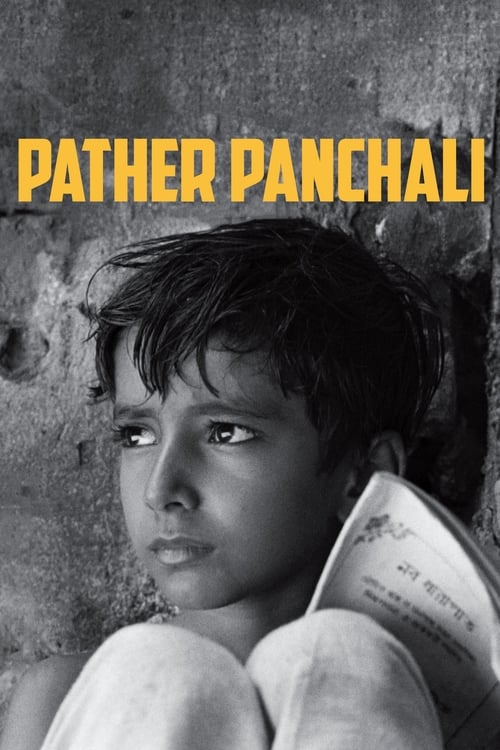
Pather Panchali
পথের পাঁচালী
Overview
"Pather Panchali" (Song of the Little Road) is the debut film of legendary director Satyajit Ray and the first installment of The Apu Trilogy. Set in the early 20th century in the rural village of Nischindipur, Bengal, the film chronicles the life of a poor Brahmin family. The father, Harihar, is a priest and an idealistic dreamer who struggles to provide for his family, always hoping for a better future as a writer. His wife, Sarbajaya, bears the brunt of their poverty, managing the household with scarce resources and worrying for their children, the spirited and free-willed Durga and the curious, observant Apu.
The film doesn't follow a conventional plot but rather unfolds as a series of lyrical vignettes capturing the minutiae of their daily existence. We witness the children's simple joys: chasing a candy seller, watching a traveling bioscope, and their awe at the sight of a distant train, a symbol of the world beyond their village. These moments of wonder are contrasted with the harsh realities of their life, including Sarbajaya's strained relationship with Harihar's elderly cousin, Indir Thakrun, whom she sees as another mouth to feed. The film beautifully captures the sensory details of village life, the changing seasons, and the deep, unspoken bonds of family, painting a poignant and deeply human portrait of struggle, love, and loss.

Core Meaning
The core meaning of "Pather Panchali" lies in its profound humanism and its exploration of the human condition amidst persistent hardship. Director Satyajit Ray wanted to portray life's inherent duality: the coexistence of joy and sorrow, beauty and harshness, innocence and the inevitability of loss. The film isn't a simple story about poverty; it is a meditation on how life, in its most elemental form, continues with dignity and wonder even in the most challenging circumstances. Ray’s message is that poverty does not negate love or the small pleasures that make life meaningful. By focusing on the perspective of the children, Apu and Durga, he emphasizes that the capacity for wonder and connection is a resilient force. Ultimately, the "Song of the Little Road" is a lyrical and bittersweet ode to survival, the passage of time, and the painful, beautiful journey from innocence to experience.
Thematic DNA
Poverty and Survival
Poverty is the central, pervasive force in the family's life. It is not just a lack of money but a constant presence that shapes their relationships and decisions. We see it in the dilapidated home, Sarbajaya's constant anxiety over food, and her resentment towards the elderly Indir, who is another financial burden. Yet, the film shows that their struggle for survival does not extinguish their humanity. The characters find joy in small things, highlighting the resilience of the human spirit. The father, Harihar, remains an optimist, dreaming of a better life, while the family endures.
Innocence vs. Experience
The film is largely seen through the innocent eyes of Apu and Durga. Their world is one of discovery and simple pleasures—the thrill of the train, the taste of stolen fruit, the magic of the bioscope. They are shielded, to some extent, from the crushing weight of their family's poverty. However, the narrative arc is one of losing this innocence. The deaths of Indir and later Durga mark Apu's transition from a state of pure wonder to a confrontation with grief and the harsh realities of life and death, setting the stage for his journey in the rest of the trilogy.
Tradition vs. Modernity
The conflict between the old world and the new is a significant theme spanning the Apu trilogy. In "Pather Panchali," this is symbolized most powerfully by the train. For the children, the train is a mesmerizing spectacle, a noisy, powerful force cutting through their quiet, natural world, representing a future and a world beyond their village. It contrasts with the family's traditional, impoverished rural existence. The family's eventual departure from their ancestral home at the end signifies a painful but necessary step away from the past and towards an uncertain, modern future.
The Power and Indifference of Nature
Nature is a dualistic force in the film. It serves as a magical playground for Apu and Durga, a source of beauty and freedom. The lush landscapes, the ponds, and the fields are integral to their childhood. However, nature is also shown to be merciless and indifferent. The powerful monsoon storm that brings a brief moment of joy to the children ultimately leads to Durga's fatal fever, highlighting the family's vulnerability to the elements and the unforgiving side of the natural world.
Character Analysis
Apu (Apurba Roy)
Subir Banerjee
Motivation
As a young child, Apu's motivations are simple and instinctual: curiosity, play, and his bond with his sister. He is motivated by a sense of wonder, fascinated by the candy seller, the traveling show, and especially the train.
Character Arc
Apu begins as a wide-eyed, curious child, mostly observing the world around him under the guidance of his older sister, Durga. His arc in this film is one of quiet awakening. He experiences the simple joys of childhood but is also a witness to death, first with his great-aunt Indir and then, devastatingly, with Durga. Her death marks the end of his pure innocence and forces him into a more somber understanding of the world, a maturation that continues throughout the trilogy.
Durga
Uma Das Gupta
Motivation
Durga is motivated by a desire for the small joys and beauties of life that are denied to her by poverty. She longs for simple things like sweets and fruits and feels a strong sense of familial love, especially for Apu and Indir. Her actions are driven by an impulsive, carefree nature.
Character Arc
Durga is a vibrant, free-spirited adolescent, full of life despite her family's poverty. She is deeply connected to nature and to her great-aunt Indir. Her arc is tragic; she represents the joyful persistence of life that is ultimately extinguished by hardship. She steals fruit not out of malice, but from a mix of childlike desire and a wish to provide small comforts for others, like Indir. Her dreams of marriage and a better life are cut short by her illness and death, which acts as the catalyst for the family's final disintegration and departure.
Sarbajaya
Karuna Banerjee
Motivation
Sarbajaya's primary motivation is the survival and well-being of her children. She is driven by the practical, daily needs of the household, a stark contrast to her husband's idealistic dreaming. Her frustration and anger stem from her powerlessness against their circumstances.
Character Arc
Sarbajaya's arc is one of hardening resilience in the face of relentless struggle. She begins with dreams of her own but must subsume them to the daily, thankless task of keeping her family afloat. The pressure of poverty makes her stern and sometimes harsh, particularly towards Indir. However, her actions are rooted in a fierce, protective love for her children. The loss of Durga breaks her spirit but also forces her to accept the necessity of leaving their ancestral home, completing her journey from a hopeful wife to a grief-stricken but enduring mother.
Harihar
Kanu Bannerjee
Motivation
Harihar is motivated by a desire to provide for his family, but on his own terms—through his intellectual and priestly pursuits rather than manual labor. He is driven by dreams of a better future and a belief in divine providence, which often renders him ineffective in dealing with their immediate problems.
Character Arc
Harihar is the gentle, scholarly patriarch who remains a hopeful dreamer throughout the film. He is often absent, seeking work, and returns with grand plans that rarely materialize. His arc is largely static; he maintains a passive optimism, believing that God's will is for the best, even as his family sinks deeper into poverty. He fails to grasp the severity of their situation until Durga's death. His return home with gifts for his children, unaware that Durga has died, is the film's most heartbreaking moment, shattering his detachment from reality.
Indir Thakrun
Chunibala Devi
Motivation
Indir's motivation is simple: to find a small measure of comfort, food, and affection in her final days. She seeks connection, which she finds with Durga, and wishes to die in her ancestral home, a final wish that is tragically denied.
Character Arc
Indir, the elderly cousin, represents the past and the burden of the elderly in a family struggling to survive. Her arc is a slow, sad decline. She is shown as mischievous and loving with the children but is a source of conflict with Sarbajaya. Kicked out of the house, she embodies loneliness and the harsh reality of aging in poverty. Her solitary death in the wilderness is a poignant and stark moment that introduces young Apu to the reality of mortality.
Symbols & Motifs
The Train
The train symbolizes the allure and inevitability of modernity, progress, and the world outside the confines of the village. It represents a future of possibilities and escape from the stagnation of their current life. It is both a source of wonder for the children and a harbinger of the changes that will eventually force the family from their home.
Apu and Durga run through fields of kaash flowers to catch their first glimpse of a train. The sound of its distant whistle is a recurring motif. Its powerful, mechanical presence contrasts sharply with the quiet, natural rhythm of village life, highlighting the encroachment of the industrial world.
The Dilapidated Ancestral Home
The crumbling house symbolizes the family's declining fortunes and the decay of their traditional way of life. It is both a shelter and a prison, a repository of memories that is slowly being reclaimed by nature, just as the family's hopes are eroded by poverty. A snake found in the home at the end symbolizes the final ruin, forcing them to leave.
Throughout the film, the house is shown in a state of disrepair. A storm damages it further, leading to the leak that worsens Durga's illness. The family's final departure from the collapsing structure is a poignant admission that their past life is no longer sustainable.
The Stolen Necklace
The bead necklace that Durga is accused of stealing, and which Apu later discovers, symbolizes lost innocence, secret guilt, and the small, desperate desires born of poverty. For Durga, it represents a longing for the beauty and status she cannot have. For Apu, discovering it after her death represents a painful moment of disillusionment and a final, secret connection to his sister.
Durga is accused by a neighbor of stealing the necklace, which she denies. Sarbajaya is shamed by the accusation. Much later, after Durga's death, Apu finds the necklace hidden in a pot. In a moment of quiet maturity, understanding the implications, he throws it into a pond, erasing the last trace of his sister's transgression and childhood secret.
Memorable Quotes
Don't be anxious. Whatever God ordains is for the best.
— Harihar
Context:
Harihar says this to Sarbajaya on multiple occasions when she expresses her worries about their dire financial situation and lack of prospects. It is his standard response to their struggles, showcasing his inability to take concrete action.
Meaning:
This quote encapsulates Harihar's entire philosophy. It reflects his passive optimism and his tendency to defer responsibility to fate or divine will. While intended to be comforting, it highlights the stark difference between his idealistic worldview and Sarbajaya's pragmatic, anxious reality.
We'll go see the train when I'm better, all right? We'll get there early and have a good look. You want to?
— Durga
Context:
Durga says this to Apu from her sickbed as she suffers from a high fever during the monsoon. She is trying to comfort him and herself with the promise of a future adventure, tragically unaware that she is dying.
Meaning:
This is a heartbreaking line filled with dramatic irony. It represents Durga's enduring hope and her simple, childlike desire to share a moment of wonder with her brother. The tragedy lies in the audience's awareness that this promise will never be fulfilled, making it a poignant expression of a life cut short.
Is she asleep?
— Apu
Context:
Apu asks this after Durga has died from her fever. He sees his sister lying motionless and, in his childlike innocence, cannot understand that she is gone forever.
Meaning:
Apu's innocent question starkly illustrates his childhood inability to comprehend the finality of death. It is a devastatingly simple and realistic line that underscores the loss of innocence. It reveals that he is still a child who sees death as a form of sleep, a concept he cannot yet grasp.
Philosophical Questions
Does poverty negate the capacity for joy and love?
The film consistently refutes this idea. Despite their constant struggle, the Roy family's life is filled with moments of profound love and simple joy. The bond between Apu and Durga, their wonder at the world, and even Sarbajaya's fierce, protective love for them demonstrate that emotional richness can thrive independently of material wealth. Ray carefully documents the small pleasures—a shared piece of fruit, the excitement of a festival—to show that the human spirit's capacity for happiness is not solely defined by economic circumstances.
What is the relationship between humanity, nature, and fate?
"Pather Panchali" portrays an intricate relationship between its characters and their environment. Nature is both a beautiful sanctuary and a destructive force. The family is at its mercy, as shown by the devastating monsoon. This raises questions about fate and human agency. Harihar believes their lives are ordained by God, a passive acceptance of fate. Sarbajaya, on the other hand, struggles against their circumstances. The film does not offer a clear answer, instead suggesting that life is a complex interplay of personal choices, social conditions, and the indifferent, powerful forces of the natural world.
How does one confront the transition from innocence to experience?
The film is a profound meditation on this universal journey, primarily through Apu. His childhood is a world of sensory wonder, largely unburdened by adult anxieties. The film explores how this innocence is irrevocably fractured by the experience of death. Apu's quiet observation of the deaths of Indir and Durga forces him to confront grief and impermanence. The final act of him throwing Durga's stolen necklace into the pond is a silent, mature acknowledgment of a painful truth, marking a significant step on his path to understanding the complexities and sorrows of the world.
Alternative Interpretations
While "Pather Panchali" is largely viewed through a humanist lens, some alternative interpretations exist. One perspective views the narrative as a subtle commentary on the decline of the Brahminical class in a changing India. Harihar's inability to provide for his family reflects the impracticality of his scholarly, priestly tradition in a world that is beginning to modernize.
Another interpretation focuses on the ending through a moral or karmic lens. One reading suggests that the family's suffering, particularly Durga's death, can be seen as a tragic consequence of Sarbajaya's harsh treatment of the elderly Indir or as a merciless punishment for Durga's own small transgressions, like stealing. However, most critics argue that Ray avoids such moralizing, instead presenting these events as part of the indifferent, often tragic, flow of life. The film's open-ended, lyrical nature allows for these varied interpretations, letting the viewer project their own sense of justice or meaning onto the family's fate.
Cultural Impact
"Pather Panchali" is a landmark in the history of cinema. Upon its release in 1955, it revolutionized Indian filmmaking, pioneering the Parallel Cinema movement, which championed social realism and authenticity over the conventions of mainstream commercial cinema. It was the first film from independent India to garner major international acclaim, winning the Best Human Document award at the 1956 Cannes Film Festival, which placed Indian cinema on the global map.
Influenced by Italian Neorealism, particularly Vittorio De Sica's "Bicycle Thieves," Ray's use of non-professional actors, on-location shooting, and natural light was groundbreaking for its time and inspired a generation of filmmakers worldwide, including Martin Scorsese and Akira Kurosawa. The film's critical reception was overwhelmingly positive, praised for its poetic realism, deep humanism, and soul-stirring qualities, though some detractors initially criticized its slow pace. For Bengalis, the film is a cultural touchstone, with its characters and imagery becoming iconic symbols of Bengali identity and the beauty of rural life. Its legacy endures, consistently ranked among the greatest films ever made, and it continues to be studied for its masterful visual storytelling and its timeless, universal themes of life, loss, and endurance.
Audience Reception
Upon its initial release in Calcutta in 1955, "Pather Panchali" had a poor initial response. However, through word-of-mouth, it grew into a critical and commercial success. Critics praised its profound humanity, lyrical realism, and emotional depth. It was lauded for breaking away from the conventions of mainstream Indian cinema. Internationally, the film was a sensation, particularly after winning a major award at the 1956 Cannes Film Festival, which established Satyajit Ray as a major filmmaker on the world stage. Western critics were particularly struck by its neorealist style and its universal portrayal of childhood and family. The primary point of criticism, from a minority of viewers, was its slow, meditative pace, which some found trying. Despite this, the overwhelming verdict was that it was a masterpiece, a film that transcends cultural and linguistic barriers to touch the soul of the viewer.
Interesting Facts
- The film's production was halted for long periods due to lack of funds. Director Satyajit Ray sold his life insurance policy and his wife pawned her jewelry to keep filming. Eventually, the Government of West Bengal provided a loan, listed in public records as being for 'roads improvement,' to complete the film.
- Satyajit Ray had never directed a film, cinematographer Subrata Mitra had never shot a motion picture, and the child actors had not been screen-tested before the first day of shooting.
- The iconic scene of Apu and Durga seeing the train for the first time was interrupted for nearly a year. After the first day of shooting in a field of kaash flowers, the crew returned the next week to find all the flowers had been eaten by cows, and they had to wait until the next season to finish the sequence.
- The actress who played Indir Thakrun, Chunibala Devi, was an 80-year-old retired theatre actress. Ray worried she would not live to see the film's completion due to the protracted production schedule.
- The celebrated score by Ravi Shankar was composed in a single session lasting about 11 hours, with Shankar having only seen about half of the edited film.
- The film did not have a complete screenplay; Ray often worked from his own drawings and notes, and the cast took their cues from these.
- The original film negatives were severely damaged in a fire in 1993. They were painstakingly restored by rehydrating and repairing the film, which was then scanned in 4K resolution.
⚠️ Spoiler Analysis
Click to reveal detailed analysis with spoilers
Frequently Asked Questions
Explore More About This Movie
Dive deeper into specific aspects of the movie with our detailed analysis pages
Comments (0)
No comments yet. Be the first to share your thoughts!