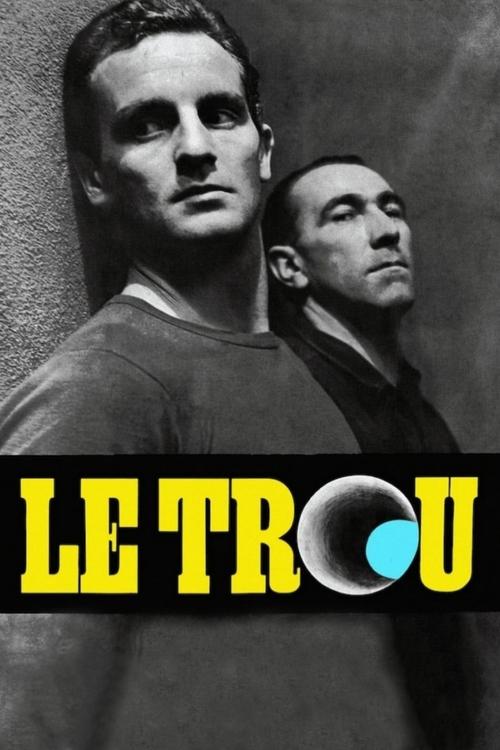
Le Trou
A gripping, documentary-style thriller that meticulously charts the raw physicality and fragile trust of a prison escape, feeling as cold and hard as the concrete being broken.
Le Trou

Le Trou

"Poor Gaspard..."

18 March 1960 France 132 min ⭐ 8.2 (523)
Director: Jacques Becker
Cast: Michel Constantin, Jean Keraudy, Philippe Leroy, Raymond Meunier, Marc Michel
Drama Crime Thriller
Realism and Authenticity Trust and Betrayal Ingenuity and Human Spirit Brotherhood and Solidarity
Box Office: $33,187

Overview

Based on a true 1947 event, Jacques Becker's final film, Le Trou, plunges the viewer into the raw and claustrophobic world of La Santé Prison in Paris. The story begins when a young, well-mannered inmate, Claude Gaspard (Marc Michel), is transferred to a cell already occupied by four hardened criminals: the resourceful Roland Darbant (Jean Keraudy, one of the real-life escapees), the tough and suspicious Manu Borelli (Philippe Leroy), the laid-back Geo Cassine (Michel Constantin), and the jovial Vossellin, nicknamed 'Monseigneur' (Raymond Meunier).

Gaspard's arrival complicates matters, as the four cellmates are on the verge of executing a meticulously planned escape. They have been secretly digging a hole through their concrete floor to access the prison's subterranean tunnels and sewers. Faced with a dilemma, the four men decide to take a monumental risk and bring the newcomer into their confidence, making him a reluctant accomplice in their desperate bid for freedom.

The film painstakingly documents the arduous, minute-by-minute process of the escape attempt. With minimalist dialogue and an absence of a musical score, the focus is entirely on the physical labor, the ingenuity of their makeshift tools, and the mounting tension. As they toil together in the dark, a fragile bond of camaraderie forms, but the constant threat of discovery and the inherent mistrust among them hang heavy in the air, making their success anything but certain.
Core Meaning

The core meaning of Le Trou revolves around the indomitable human spirit and the primal instinct for freedom, pitted against the physical and psychological confines of imprisonment. Director Jacques Becker explores the nature of trust, solidarity, and betrayal within a microcosm of society where collaboration is the only key to liberation. The film is a powerful statement on the sheer will and physical endurance required to reclaim one's autonomy. It examines how a shared, desperate goal can forge intense bonds of fraternity, but also how the pressures of confinement and self-preservation can just as easily shatter them. The film suggests that the true prison is not just made of stone and steel, but also of human fallibility and the choices made under duress.

Thematic DNA

Realism and Authenticity 35%
Trust and Betrayal 30%
Ingenuity and Human Spirit 20%
Brotherhood and Solidarity 15%

Realism and Authenticity

Becker's commitment to realism is the film's defining characteristic. He cast non-professional actors, including Jean Keraudy, who was part of the actual 1947 escape attempt the film is based on. The film eschews a musical score, relying on diegetic sounds like hammering, breathing, and scraping to build tension. Long, unbroken takes, such as the nearly four-minute scene of the men breaking the concrete floor, immerse the audience in the grueling physical reality and duration of the task, making the effort palpable and visceral.

Trust and Betrayal

The entire narrative hinges on the theme of trust. The four original cellmates must decide whether to trust the newcomer, Gaspard, with their lives. A fragile camaraderie is built through shared labor and risk. However, the film constantly questions the foundations of this trust. Gaspard, being from a different social class and less hardened than the others, remains an outsider. This tension culminates in the devastating final act, which serves as a profound exploration of betrayal as the ultimate sin within the prisoners' code of honor.

Ingenuity and Human Spirit

Le Trou is a testament to human resourcefulness and the will to survive. The prisoners demonstrate incredible ingenuity, transforming everyday objects from their cell into effective tools for their escape. A bedpost becomes a battering ram, a toothbrush and a shard of mirror form a periscope, and two bottles are turned into an hourglass. This meticulous focus on the process highlights a core message: the human spirit, when driven by the desire for freedom, can overcome immense physical obstacles through sheer creativity and perseverance.

Brotherhood and Solidarity

Despite the underlying tension, the film is a powerful depiction of male camaraderie forged in extreme circumstances. The five men must work as a single unit, coordinating their efforts, sharing the intense labor, and relying on each other for survival. They share food, cigarettes, and stories, creating a bond that transcends their criminal pasts. The film explores this fraternity as a necessary condition for their endeavor, making the final outcome all the more tragic.

Character Analysis

Roland Darbant

Jean Keraudy

Archetype: The Mentor/The Mastermind
Key Trait: Resourceful

Motivation

His motivation is freedom, approached with the calm determination of someone who has attempted it before. He is driven by a deep-seated desire to overcome the physical constraints of the prison through his own skill and intelligence.

Character Arc

Roland is the experienced leader and technical genius of the group. As one of the real-life escapees, his presence lends the film its core authenticity. His arc is static; he is the unwavering anchor of the plan, confident and methodical from start to finish. He embodies the practical knowledge and unbreakable will required for the escape. He introduces the story, breaking the fourth wall, and his final words to Gaspard carry the weight of experience and sorrow.

Claude Gaspard

Marc Michel

Archetype: The Outsider/The Innocent
Key Trait: Impressionable

Motivation

His primary motivation is self-preservation. Initially, this aligns with the group's goal of escape. But when the warden presents him with an easier, legal path to freedom, his motivation shifts, and he prioritizes his own release over his loyalty to the others.

Character Arc

Gaspard is the audience's surrogate, a soft-spoken newcomer thrust into a high-stakes plot. His arc is the film's central dramatic and moral journey. Initially fearful and hesitant, he is gradually integrated into the group, seemingly embracing their code of solidarity. However, his different background and the news of his potential release create a conflict of loyalties, leading to his ultimate, devastating choice that seals the group's fate and his own moral downfall.

Manu Borelli

Philippe Leroy

Archetype: The Skeptic/The Lieutenant
Key Trait: Suspicious

Motivation

Manu is driven by a fierce desire for freedom and a protective instinct for his original group. His motivation is rooted in a pragmatic and world-weary understanding of human nature, which is why he is so wary of the newcomer.

Character Arc

Manu is the most suspicious and volatile of the original four inmates. He is initially the most resistant to trusting Gaspard. Over the course of the film, as they work together, his distrust seems to soften into a grudging acceptance and a form of camaraderie. His arc is a journey from overt suspicion to a tentative trust, which makes Gaspard's betrayal all the more pointed and painful for him and the audience.

Geo Cassine

Michel Constantin

Archetype: The Pragmatist
Key Trait: Stoic

Motivation

While he shares the group's desire for freedom, his ultimate motivation is revealed to be the well-being of his family. This conflicts with the escape plan at the last moment, showing a different kind of loyalty.

Character Arc

Geo is a stoic, laid-back member of the group, often acting as a calming presence. His character remains largely consistent throughout the film, a dependable worker in the escape plan. However, he has a surprising moment of revelation near the end when he decides not to escape, fearing the stress a manhunt would put on his ailing mother. This adds a layer of complexity, showing that even within this desperate group, personal loyalties and fears outside the prison walls still hold immense power.

Symbols & Motifs

The Hole (Le Trou)

Meaning:

The hole is the most potent symbol in the film. It represents hope, a tangible pathway to freedom, and the physical manifestation of the inmates' collective will. At the same time, it is a source of immense risk and anxiety. Digging the hole is an act of defiance against the institution, but it also leads them into dark, claustrophobic, and unknown spaces, symbolizing the perilous and uncertain nature of their quest for liberation. It can also be seen as a portal into the prisoners' psyche, a space of intense doubt and hope.

Context:

The hole is the central focus of the plot. The film dedicates long, detailed sequences to its creation, from the initial, brutal breaking of the concrete floor in their cell to the subsequent tunneling through walls in the prison's underbelly. The camera often frames the men in relation to the hole, emphasizing its central importance to their existence.

The Periscope

Meaning:

The makeshift periscope, ingeniously crafted from a toothbrush handle and a shard of mirror, symbolizes foresight, caution, and the inmates' fragile connection to the world outside their immediate struggle. It is their only means of seeing the danger that lies beyond their cell door, representing a sliver of control in a powerless situation. It embodies their meticulous planning and intelligence.

Context:

The periscope is used throughout the escape attempt. One inmate is always tasked with keeping watch, peering through the keyhole to monitor the guards' patrols. The final, devastating shot of the film is seen through this periscope, as it reveals the guards lying in wait, signifying the complete and sudden failure of their plan.

Makeshift Tools

Meaning:

The tools the prisoners create from their bed frames and other scavenged items symbolize human ingenuity and the rebellion of the individual against the oppressive, uniform environment of the prison. They represent the transformation of objects of confinement into instruments of freedom, highlighting the prisoners' refusal to be passive objects of the penal system.

Context:

The film shows in meticulous detail the creation and use of these tools. A leg from an iron bedstead is used to smash the concrete floor, and other metal parts are fashioned into keys and digging implements. The focus on these objects underscores the physicality and difficulty of their labor.

Memorable Quotes

Mon ami Jacques Becker a retracé dans tous les détails une histoire vraie. La mienne.

— Jean Keraudy (as himself)

Context:

This is the very first line of the film. Jean Keraudy, one of the actual 1947 escapees who also plays the character Roland, addresses the audience while working on a car, before the narrative begins.

Meaning:

Translation: "My friend Jacques Becker has recreated a true story in all its detail. My story." This opening line, delivered directly to the camera, immediately establishes the film's foundation in reality and authenticity. It blurs the line between documentary and fiction, lending immense weight and credibility to the events that are about to unfold.

Pauvre Gaspard.

— Roland Darbant

Context:

Spoken in the final moments after the escape has been foiled and the guards are leading the original four inmates away. Gaspard is being taken to a different cell, and as he passes his former cellmates, Roland looks at him and delivers this final, crushing verdict.

Meaning:

Translation: "Poor Gaspard." This is the devastating final line of the film. It's a short but incredibly powerful statement. It's not a cry of anger or hatred, but one of pity. Roland understands that in betraying them for his freedom, Gaspard has condemned himself to a different kind of prison—a life of guilt and dishonor, forever an outsider to the code of solidarity he violated. The line conveys the tragedy of Gaspard's choice far more effectively than any outburst would.

Philosophical Questions

What is the true nature of freedom?

The film meticulously details the physical struggle for freedom from confinement. However, the ending forces a deeper question. The inmates seek freedom from prison, but Gaspard, in securing his own release, becomes imprisoned by guilt and dishonor. The film asks whether freedom is merely a physical state or if it is intrinsically linked to loyalty, honor, and one's own conscience. Is Gaspard truly free at the end?

Can trust exist in a world without laws?

Inside the prison, the inmates form their own society with a strict, unspoken code of conduct. Trust and solidarity are the most valuable currencies. The film explores whether this makeshift social contract, born of desperation, can withstand the pressure of individual self-interest. Gaspard's actions suggest that when a perceived 'better deal' is offered by the established authorities, such codes are fragile and easily broken.

Does a shared struggle erase social and moral differences?

The five men come from different backgrounds, with Gaspard being a notable outsider due to his social class. The intense, shared labor of the escape seems to forge them into a single, cohesive unit. The film questions whether this unity is genuine or merely a temporary alliance of convenience. The climax suggests that fundamental differences in character and background ultimately resurface, shattering the illusion of complete solidarity.

Alternative Interpretations

The most debated aspect of Le Trou is the character of Claude Gaspard and the nature of his betrayal. While the film strongly implies he informed the warden, some interpretations entertain a degree of ambiguity.

One perspective is that Gaspard is a straightforward traitor. Lured by the warden's offer of his wife dropping the charges, he chooses the path of least resistance and sacrifices the group for his own guaranteed freedom. His soft-spoken nature and bourgeois background make him inherently different from the others, suggesting he never truly subscribed to their code of honor.

Another interpretation suggests a more complex psychological reading. Gaspard's betrayal might not be a cold, calculated decision but a moment of weakness from a man who was never a hardened criminal. He may have been manipulated or psychologically broken by the warden, making his action tragic rather than purely villainous. Roland's final line, "Poor Gaspard," could support this, suggesting pity for a weak man rather than simple hatred for a traitor.

A less common, though possible, reading questions whether the warden was bluffing. The warden might have already known about the escape attempt through other means and simply used the meeting with Gaspard to sow discord and psychologically torment him, ensuring the group would implode upon capture. In this view, Gaspard's betrayal is real, but it may not have been the direct cause of the guards being alerted.

Cultural Impact

Le Trou is considered a masterpiece of the prison escape genre and a high point of French cinema. Its uncompromising realism and procedural detail set it apart from many other genre films, influencing countless filmmakers with its minimalist, documentary-style approach. Directors of the French New Wave, such as François Truffaut, were great admirers of Jacques Becker and saw his work as a bridge between classicism and modernity.

Critically, the film was lauded for its tension and authenticity, though it was not an initial commercial success. Over time, its reputation has grown immensely, and it is now frequently cited alongside Robert Bresson's A Man Escaped as one of the two definitive French prison break films. Its focus on process, physicality, and the psychology of a small group under pressure has been echoed in later films. The film's bleak, unsentimental ending also defied genre conventions of the time, solidifying its status as a powerful and enduring work of art.

Audience Reception

Audience reception for Le Trou, particularly among cinephiles, is overwhelmingly positive. Viewers frequently praise the film for its intense realism and suspense, which is achieved without a musical score or typical thriller tropes. The meticulous, procedural detail of the escape is often highlighted as a masterclass in tension, with the lengthy, single-take scene of breaking the concrete floor being cited as particularly hypnotic and nerve-wracking. Many viewers consider it one of the greatest, if not the greatest, prison escape films ever made, often preferring its gritty authenticity to more sentimental films like The Shawshank Redemption.

The primary point of criticism, for some, is the film's deliberate and measured pace, which can be perceived as slow. However, most fans argue this is essential to its immersive quality. The bleak, gut-punch ending is almost universally acclaimed for its power and defiance of audience expectations, leaving a lasting impact and sparking discussion about Gaspard's motivations and the film's final, sorrowful line.

Interesting Facts

  • Director Jacques Becker died from lung cancer just weeks after filming was completed, making 'Le Trou' his final, and many argue, his greatest film.
  • The film is based on the 1957 novel 'The Break' by José Giovanni, which fictionalized a real 1947 escape attempt from Paris's La Santé Prison in which Giovanni himself was involved.
  • To achieve maximum authenticity, Becker cast mostly non-professional actors in the main roles.
  • Jean Keraudy, who plays the mastermind Roland Darbant, was one of the actual inmates involved in the 1947 escape. Three of the real escapees served as technical advisors on the set.
  • The famous scene where the prisoners break through the concrete floor is a single, unbroken take lasting nearly four minutes. The actors were hitting a real slab of concrete to capture the authentic strain and sound.
  • There is no musical score in the film until the end credits, a deliberate choice by Becker to heighten the realism and tension through natural sounds.
  • Legendary French director Jean-Pierre Melville considered 'Le Trou' to be the greatest French film of all time.
  • Initially, the film was poorly received upon its release and was even trimmed by distributors to improve its box office performance, but it has since gained the status of a masterpiece.

⚠️ Spoiler Analysis

Click to reveal detailed analysis with spoilers

Frequently Asked Questions

Explore More About This Movie

Dive deeper into specific aspects of the movie with our detailed analysis pages

Comments (0)

Leave a comment

No comments yet. Be the first to share your thoughts!