Skip to content
Lesbian Space Princess
A neon-bright queer space fable where heartbreak becomes a galaxy to cross: an anxious princess drifts between glitter-pink planets, learning that the sharpest weapon she owns is her own self-worth.
Lesbian Space Princess

Lesbian Space Princess

"She'll save her ex. Or die crying."

11 September 2025 Australia 87 min 3.7 (204)

Director: Leela Varghese, Emma Hough Hobbs

Cast: Shabana Azeez, Gemma Chua-Tran, Richard Roxburgh, Bernie Van Tiel, Kween Kong

Animation Comedy Adventure Science Fiction Self-love as the real quest Anxiety, insecurity and clinginess in love Queer joy and visibility on its own terms Satire of straight, white entitlement Chosen family and the friends you pick up on the way
Budget: $600,000
Box Office: $133,520

Overview

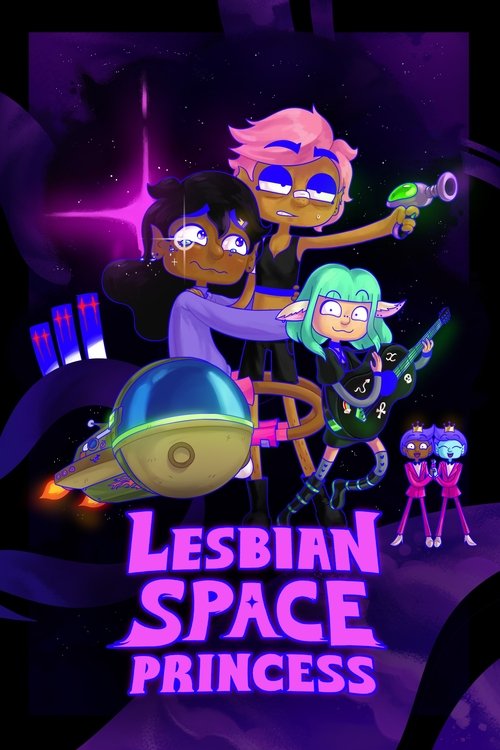
Lesbian Space Princess is an Australian adult animated science-fiction comedy, the debut feature written and directed by Emma Hough Hobbs and Leela Varghese. It follows Saira, a sheltered, chronically anxious princess of the queer utopian planet Clitopolis, whose two-week relationship with the swaggering bounty hunter Kiki ends in a very public breakup at her own birthday party.

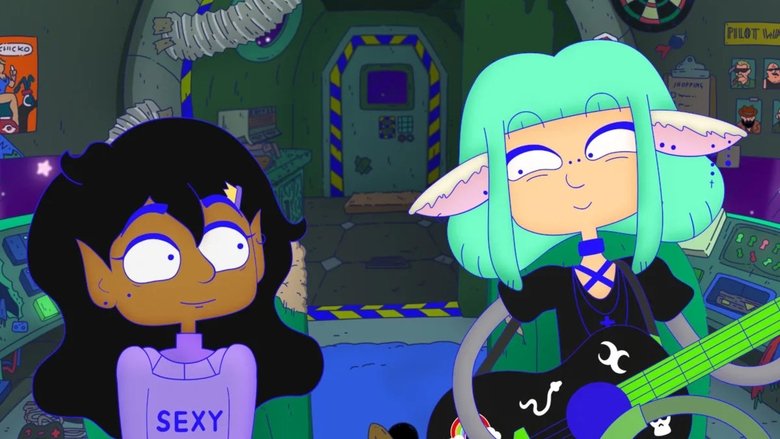
When Kiki is abducted by a trio of aliens called the Straight White Maliens, Saira is forced out of the only world she has ever known and into a galactic rescue mission. Along the way she picks up unlikely companions — a jaded former gay-pop idol turned goth spacefarer named Willow, and the fearless drag performer Blade — while trying to summon a power she has never been able to access.

Running 87 minutes and pitched, in the directors' own words, as something that "looks like a cartoon but feels like an anime," the film wraps a sincere story about self-worth and anxiety inside deliberately silly world-building, sex-positive gags and a dense layer of queer in-jokes. It premiered in the Panorama section of the 75th Berlinale in February 2025.
Core Meaning

The film's central argument is that you cannot be rescued into self-worth by someone else loving you. Saira begins as a woman who has outsourced her entire sense of value to a girlfriend, and the quest structure — usually a machine for winning back the beloved — is repurposed as a machine for dismantling that belief. Her magical weapon, the labrys, literally will not materialise while she doubts herself, making self-esteem the film's only functioning technology.

Alongside this, the directors have been explicit about a second aim: making a feature-length animation in which queer, and specifically BIPOC queer, characters are simply seen — centred, funny, horny, neurotic and heroic — rather than explained or justified to a straight audience. The villains are a joke precisely because the film refuses to treat the straight gaze as a serious cosmic force; their power turns out to be entirely dependent on wanting to be wanted.

The result is a film that argues for identity as pleasure rather than defence: the happy ending is not a couple, but a person who is content alone.

Thematic DNA

Self-love as the real quest 30%
Anxiety, insecurity and clinginess in love 22%
Queer joy and visibility on its own terms 20%
Satire of straight, white entitlement 16%
Chosen family and the friends you pick up on the way 12%

Self-love as the real quest

Saira's arc inverts the rescue narrative. She crosses the galaxy to save Kiki, but the obstacle is never distance or firepower — it is her own conviction that she is unlovable. Her labrys dematerialises the instant her self-doubt returns, so the climax can only be resolved by an internal shift, not an external victory. The film ends with her single and content, explicitly refusing the reward of reunion.

Anxiety, insecurity and clinginess in love

The breakup that launches the plot is caused by Saira's smothering neediness, and the film is unusually honest that her anxiety hurts other people as well as herself. Kiki is not punished for leaving; the narrative treats her boundary as legitimate. Saira's growth is measured by her capacity to tolerate not being chosen.

Queer joy and visibility on its own terms

Clitopolis is a fully realised queer utopia rather than a closet to escape, and the supporting cast — the non-binary spacefarer Willow, the drag performer Blade, Saira's two mothers Queen Leanne and Queen Anne — exist without coming-out arcs. The directors framed the project as filling a gap: a feature animation dense with queer references made from a queer and BIPOC perspective.

Satire of straight, white entitlement

The antagonists, the Straight White Maliens, are a broad comic caricature of aggrieved masculinity whose entire scheme depends on a device for compelling female attention. Their defeat is not martial but diagnostic: they realise they overvalued being desired by women, and pair off with each other. The satire lands as ridicule rather than menace, which is itself the point.

Chosen family and the friends you pick up on the way

Willow and Blade are the film's corrective to romance-as-salvation. They give Saira competence, perspective and mockery in roughly equal measure, and the found-family unit she assembles is what actually survives the ending, while the romance does not.

Character Analysis

Princess Saira

Shabana Azeez

Archetype: Reluctant hero / anxious coming-of-age protagonist Key Trait: Insecure, tender-hearted, catastrophically anxious

Motivation

Initially, to win Kiki back and prove she is lovable; ultimately, to stop needing that proof at all.

Character Arc

Begins as a sheltered 23-year-old defined entirely by her relationship, is publicly dumped, and undertakes a rescue mission that becomes an accidental education in self-reliance. She ends the film happily single, having stopped treating another person's approval as proof of her worth.

Kiki

Bernie Van Tiel

Archetype: Love interest / catalyst Key Trait: Cool, blunt, unsentimental bounty hunter

Motivation

Self-preservation and freedom; she does not want to be someone else's entire emotional infrastructure.

Character Arc

Ends the two-week relationship publicly and harshly, is abducted as bait, and — crucially — refuses to reconcile even after being rescued, denying Saira the ending she thinks she wants and forcing the film's real resolution.

All 5 characters and cast

Symbols & Motifs

The labrys

Meaning:

The double-headed axe is a long-standing emblem of lesbian feminism; here it is literalised as a weapon that only exists when its wielder believes in herself. It symbolises identity as an act of self-recognition rather than an inheritance.

Context:

Saira's labrys is 'unawakened' at the start, is the prize the Maliens want in exchange for Kiki, vanishes when her self-doubt resurfaces at the climax, and is re-summoned to end the fight.

Clitopolis

Meaning:

A gleefully unsubtle joke name that doubles as a symbol of the protected queer bubble — safe, affirming, and also infantilising. Leaving it is the price of growing up.

Context:

The home planet Saira has never left, framed as a utopia at the start and as a home she returns to on new terms at the end.

The chick magnet

Meaning:

A machine built to force women's attention — the perfect literalisation of entitlement, and of the belief that desire can be extracted rather than earned. Its failure exposes the emptiness of the wish behind it.

Context:

The Maliens' doomsday device, powered by Saira's labrys in the climax; it malfunctions catastrophically instead of working, prompting the villains' change of heart.

Space travel as emotional distance

Meaning:

The gulf between planets stands in for the gulf between Saira and other people; every leg of the journey is a demand that she leave a comfort zone.

Context:

The episodic structure moves Saira from the safety of Clitopolis outward to hostile, unfamiliar worlds, each populated by people who do not already love her.

The abandoned moon crystal mine

Meaning:

A place of extracted value and burnout — an apt origin for a former pop idol, symbolising what happens when a person is mined for their persona until nothing is left.

Context:

Where Saira finds and rescues Willow, the ex-gay-pop star now living as a goth spacefarer.

Philosophical Questions

Can you be loved into believing you are worth loving?

The film answers no, and structures its entire plot around the refusal. Saira is given every opportunity to be validated externally — a rescue, a grand gesture, a reunion — and each is withheld until the only remaining source of worth is herself.

Is a boundary an act of cruelty?

Kiki's public breakup is genuinely harsh, and the film lets it be. But it also declines to villainise her for not taking Saira back, holding both truths at once: you can be hurt by someone who is not doing anything wrong.

What is a utopia actually for?

Clitopolis is safe, affirming and, for Saira, a place where she has never had to test herself. The film asks whether a protected space is a destination or a base camp — and answers by making her leave it before she can meaningfully return.

Does evil deserve to be feared or ridiculed?

By rendering straight, white entitlement as buffoonish rather than terrifying, the film makes a deliberate choice about how oppression is best confronted on screen, and lets its villains be dismantled by their own absurdity rather than by violence.

Alternative Interpretations

The ending as triumph. The most straightforward reading takes Saira's return to Clitopolis, single and content, as a genuine victory — a romance that ends by rejecting romance, insisting that the healthiest outcome for someone who has never existed outside a relationship is to learn to exist alone.

Full ending explanation

Cultural Impact

Arriving as one of the very few feature-length animations built from the ground up for a queer audience, the film's significance is partly structural: the directors have described making it precisely because that gap existed, and because they wanted a queer story told from a BIPOC perspective rather than a mainstream one. Its festival run confirmed the appetite — a Panorama premiere at the 75th Berlinale followed by the Teddy Award, with the jury citing "a deliciously subversive vision of a future that is so unabashedly queer in both form and content."

At home in Australia it became a notable awards-season story, drawing seven AACTA nominations including Best Film and winning two — an unusual showing for an independent adult animation. Released in Australia on 11 September 2025 and picked up for the United States by Cineverse, it travelled well beyond the festival circuit, and lines from the film circulated online as memes, giving it a small second life in queer internet culture.

Its lineage runs through adult television animation and magical-girl anime rather than studio family features, and its lasting argument to the industry is commercial as much as artistic: that an animated feature can be explicitly, unapologetically queer in form — jokes, references, world-building — and still win major prizes.

Audience Reception

Critical reception was broadly positive, with the film's biggest institutional endorsements coming from festivals — the Teddy Award at the Berlinale and seven AACTA nominations including Best Film, converting into two wins. Praise has clustered around its energy, the density and specificity of its queer humour, the voice work (Shabana Azeez's anxious, sincere Saira and the Aunty Donna villains in particular), and the sheer novelty of a feature animation aimed unapologetically at this audience.

The main criticism is a mismatch between the transgressive packaging and a familiar interior: several reviewers found it fundamentally conventional in its narrative conceits, with sensibilities called thoroughly inoffensive and a portrayal of lesbianism likened to Heartstopper — daring in title, safe in structure. General audiences have been correspondingly split, with an IMDb user rating around 6.1 suggesting that viewers drawn in by the premise did not all find the execution as radical as advertised.

Verdict: a warm, joke-dense, genuinely groundbreaking piece of representation whose classic coming-of-age skeleton is either its accessible strength or its unambitious limitation, depending on what the title led you to expect.

Interesting Facts

  • The film is the debut feature of co-writers and co-directors Emma Hough Hobbs and Leela Varghese, who directed it together.
  • The directors have said the project began with the title: "it all started with the title, we built the movie around it."
  • Their stated animation ethos was that the film "looks like a cartoon but feels like an anime."
  • It is an Australian adult animated science-fiction comedy running 87 minutes.
  • The world premiere was in the Panorama section of the 75th Berlin International Film Festival on 16 February 2025.
  • It won the Teddy Award at the Berlinale, with the jury praising "a deliciously subversive vision of a future that is so unabashedly queer in both form and content."
  • The Straight White Maliens are voiced by members of the Australian comedy troupe Aunty Donna.
  • Drag performer Kween Kong voices the character Blade.
  • The film was released in Australia on 11 September 2025, and was distributed in the United States by Cineverse.
  • It received seven nominations at the 2025 AACTA Awards, including Best Film, and took home two wins.

Easter Eggs

The labrys as Saira's weapon

The double-headed axe has been an emblem of lesbian feminism since the 1970s. Making it the princess's magical sword turns a piece of real-world queer iconography into literal narrative power.

Aunty Donna voicing the villains

Casting members of the beloved Australian sketch troupe as the Straight White Maliens is both a comedy-nerd cameo and a tonal signal: the antagonists are there to be laughed at, not feared.

Kween Kong as Blade

Bringing a well-known Australian drag performer into the voice cast roots the film's fictional galaxy in a real, recognisable queer performance scene.

"Clitopolis" and the film's whole naming scheme

Planet and faction names function as running puns aimed squarely at a queer audience — jokes that reward viewers already fluent in the culture rather than pausing to explain themselves.

Cartoon surface, anime grammar

The deliberate blend the directors describe — Western cartoon shapes with anime emotional beats and reaction framing — is an ongoing visual reference to the magical-girl and space-opera anime traditions the story is riffing on.

Frequently Asked Questions

Explore More About This Movie

Dive deeper into specific aspects of the movie with our detailed analysis pages

Comments (0)

Leave a comment

No comments yet. Be the first to share your thoughts!

Similar Movies