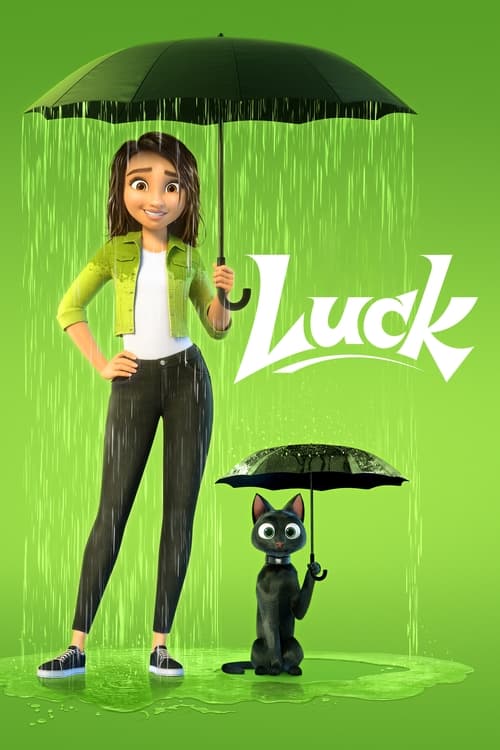
Luck
"Sometimes all you need is for everything to go wrong."
Overview
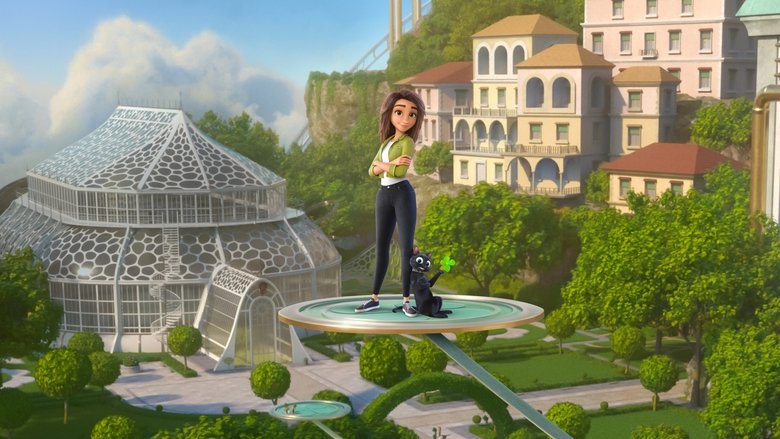
Sam Greenfield is the self-proclaimed unluckiest person in the world. Having just aged out of the foster care system without being adopted, she moves into her first apartment, where her series of unfortunate mishaps continues. Her only wish is to secure a lucky penny for her young friend Hazel, who is still in the orphanage, to help her find a "forever family." After discovering a lucky penny and promptly losing it down a toilet, Sam follows a mysterious black cat named Bob into the magical Land of Luck.
Inside this secret world, Sam discovers a complex bureaucracy where magical creatures—leprechauns, dragons, and unicorns—manufacture good luck for humans. However, she also learns of the Land of Bad Luck, a mirror world located beneath. Disguising herself as a leprechaun, Sam teams up with Bob to steal a penny, but their clumsy heist accidentally jams the machinery of fate. To fix the mess, they must navigate the balance between the two lands, eventually realizing that a life without bad luck might not be as perfect as it seems.
Core Meaning
The film's central message challenges the binary perception of fortune. It suggests that bad luck is not a failure of the universe, but a necessary component of life that builds resilience and leads to unexpected connections. Director Peggy Holmes emphasizes that while we cannot control the randomness of luck, we can control how we "pivot" and adapt. Ultimately, the film posits that love and found family are the only true "luck" that matters.
Thematic DNA
The Necessity of Balance (Yin and Yang)
The film visually and narratively splits the world into Good Luck (green, orderly) and Bad Luck (purple, chaotic). The plot reveals that trying to eliminate bad luck entirely—as the Dragon attempts to do—threatens the very existence of the world. True harmony requires both.
Resilience and Pivoting
Sam's superpower isn't luck, but her ability to handle disaster. While "lucky" creatures are helpless when things go wrong, Sam knows how to "pivot" and adapt. This reframes misfortune as a training ground for capability and strength.
Found Family
Sam starts the film alone, believing she missed her chance at a family. By the end, she realizes that family isn't just about being adopted by parents, but the bond she forms with Bob and Hazel. It redefines "forever family" as those who stick by you.
Selflessness vs. Self-Interest
Sam's journey is driven entirely by her desire to help Hazel, not herself. This selflessness is contrasted with Bob's initial desire to hide his true nature to protect his own comfortable life. Sam's altruism eventually inspires the entire Land of Luck.
Character Analysis
Sam Greenfield
Eva Noblezada
Motivation
To find a lucky penny for her friend Hazel so Hazel doesn't age out of the foster system alone.
Character Arc
Sam begins as a girl defined by her victimhood to bad luck. Through her journey, she learns that her experience with misfortune has made her more capable than the "lucky" creatures. She moves from seeking a magical fix to accepting her life's unpredictability.
Bob
Simon Pegg
Motivation
To avoid banishment and maintain his comfortable life in the Land of Luck.
Character Arc
A black cat who fakes being a "good luck" Scottish cat to fit in. He starts as a selfish survivor hiding a secret but learns through Sam that owning his true identity (a bad luck English cat) is better than living a lie.
Babe the Dragon
Jane Fonda
Motivation
To make the human world a happier place by eradicating misfortune.
Character Arc
The CEO of Good Luck who believes she can create a perfect world by eliminating all bad luck. She must learn the hard lesson that a world without challenge is fragile and dangerous.
Symbols & Motifs
The Lucky Penny
It symbolizes hope and external validation. Initially, characters believe the penny is the source of happiness, but they learn that relying on a talisman is less powerful than their own actions.
Sam finds a penny, loses it, and spends the movie trying to replace it for Hazel, only to realize Hazel didn't need it to be happy.
Green vs. Purple
A visual code for Good Luck vs. Bad Luck. The strict separation of these colors represents the initial worldview that these forces must be kept apart, which the film deconstructs.
The Land of Luck is lush green and gold, while the Land of Bad Luck is purple and industrial. The climax involves these colors mixing.
The Two-Sided Coin
Represents the duality of life. You cannot have heads without tails; good luck is defined by the existence of bad luck.
The entire world design is based on the two sides of a coin, and the "Randomizer" machine physically mixes the two sides to create fate.
Memorable Quotes
It's one of the benefits of bad luck. It teaches you to pivot.
— Rootie
Context:
Spoken by Rootie (the root vegetable bartender) in the Land of Bad Luck when Sam is surprised by how well the bad luck creatures handle mishaps.
Meaning:
This is the thematic thesis of the film. It reframes bad luck from a negative force into a teacher of adaptability and resilience.
Forever family. It's the people who are always there for you, no matter what happens.
— Sam Greenfield
Context:
Sam explaining to Hazel (and reminding herself) what she is truly looking for.
Meaning:
Redefines the concept of family from biological or legal ties to emotional consistency and support.
I am a bad luck black cat. And I always will be.
— Bob
Context:
The climax where Bob reveals his true identity to the Captain and the Dragon to fix the Randomizer.
Meaning:
The moment of self-acceptance where Bob stops hiding his nature to save the day.
Philosophical Questions
Is suffering necessary for a meaningful life?
The film explores this through the mechanics of the Randomizer. Without the "bad luck" stones, the machine fails. This parallels the philosophical argument that contrast is needed to appreciate joy, and that adversity is the primary driver of personal growth and resilience.
Do we make our own luck, or is it random?
While the film establishes a literal "factory" that creates random luck, the resolution suggests that how we react to these random events (agency) matters more than the events themselves (determinism). Sam creates her own "good fortune" through her choices, effectively overriding the random assignment of luck.
Alternative Interpretations
The Toxic Positivity Allegory: The Dragon's desire to sever the connection to Bad Luck can be interpreted as a critique of toxic positivity—the refusal to acknowledge negative emotions or experiences. The film argues that a life of "only good vibes" is structurally unstable and eventually catastrophic.
The Class Struggle Metaphor: The Land of Good Luck is shiny, upper-class, and privileged, while the Land of Bad Luck is underground, industrial, and working-class. The "bad luck" creatures are the ones who actually keep the machinery running when things break, suggesting a commentary on the resilience of the working class versus the fragility of the elite.
Cultural Impact
Luck is primarily notable for being the debut film of Skydance Animation and the first major project led by John Lasseter following his controversial exit from Pixar. This context dominated much of the critical conversation, with reviewers analyzing it closely for "Pixar-like" qualities. While it did not achieve the massive cultural footprint of a Disney/Pixar blockbuster, it performed well on Apple TV+, reportedly becoming one of their most-viewed animated films. It sparked discussions about the "algorithmization" of animated storytelling, as critics noted its similarities to Inside Out and Monsters, Inc. in how it visualized abstract concepts as bureaucratic workplaces.
Audience Reception
Audience reception was generally mixed to positive, often diverting from professional critics who were harsher. Praised: Viewers loved the high-quality animation, the heartwarming message about adoption, and the voice acting, particularly Simon Pegg as Bob. The "Bad Luck" world's creative design was also a highlight. Criticized: Many found the plot overly complicated and the world-building rules confusing. Comparisons to Inside Out were frequent, with audiences feeling it lacked the emotional depth of the Pixar films it emulated. Verdict: A safe, visually pleasing family film that resonates more with children than adults seeking deep narrative complexity.
Interesting Facts
- This was the first feature film produced by Skydance Animation.
- The film was produced by John Lasseter, the former head of Pixar, marking his return to feature animation after leaving Disney.
- Bob the cat speaks with a Scottish accent when pretending to be lucky (as black cats are lucky in Scotland) but reverts to an English accent when revealed as unlucky (where they are seen as bad luck).
- Production took place remotely during the COVID-19 pandemic, with the crew working over Zoom.
- Jane Fonda's character, the Dragon, was designed with six limbs to appear more alien and ancient.
- The 'Randomizer' machine is visually inspired by clockwork mechanisms and Rube Goldberg machines.
Easter Eggs
AutoFlush 9000
The aggressive toilet Sam battles in her apartment is named the 'AutoFlush 9000' and features a glowing red eye, a direct reference to HAL 9000 from 2001: A Space Odyssey.
Four-Leaf Clover Electronics
The electronics used by the characters (like the tablet Sam uses) have a logo of a four-leaf clover with a bite taken out of it, a clear parody of the Apple logo (Apple TV+ distributed the film).
Lux Coffee
The coffee shop chain seen in the human world has a logo resembling a horseshoe that looks suspiciously like the Starbucks siren logo.
Tesla Car Doors
The vehicles in the Land of Luck have 'falcon-wing' doors that open upwards, a visual nod to the Tesla Model X design.
⚠️ Spoiler Analysis
Click to reveal detailed analysis with spoilers
Frequently Asked Questions
Explore More About This Movie
Dive deeper into specific aspects of the movie with our detailed analysis pages
Comments (0)
No comments yet. Be the first to share your thoughts!