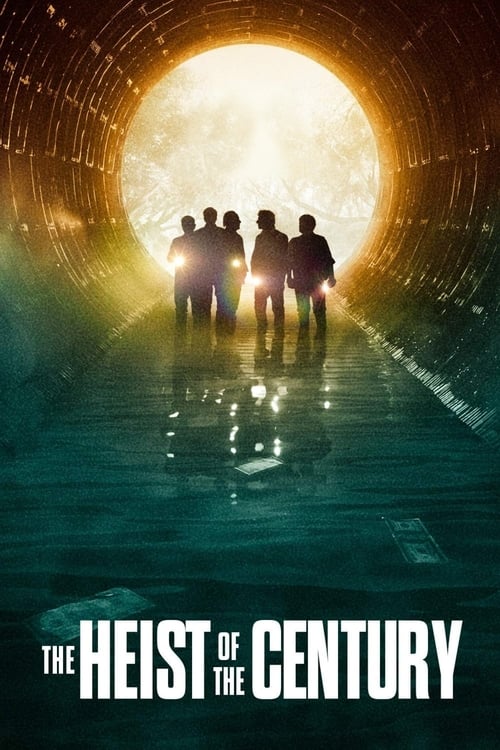
The Heist of the Century
El robo del siglo
"The Story Of The Theft That Made History"
Overview
Based on the true story of the 2006 Banco Río robbery in Acassuso, Argentina, The Heist of the Century follows the eccentric Fernando Araujo, an artist and martial arts instructor who conceives the perfect crime not for money, but for the aesthetic mastery of the act itself. Epiphany strikes him on a rainy night: rob a bank without violence, using toy weapons and a meticulously engineered tunnel escape route while police surround the building.
Araujo assembles a motley crew, including the charismatic professional thief Mario Vitette Sellanes to act as the "face" of the operation, and Sebastian "The Martian," an engineer to build the tunnel. As Vitette charms the police negotiator with philosophy and demands for pizza, the team empties safe deposit boxes underground. The film balances the tension of the heist with the comedic dynamics of the group, leading to a spectacular getaway that leaves authorities baffled, only for their perfect plan to be threatened by a loose thread back home.

Core Meaning
The film posits that ingenuity triumphs over brute force. Director Ariel Winograd explores the idea of the heist as a form of artistic expression, suggesting that a crime committed without violence and with supreme intelligence transcends mere theft to become a cultural statement. It challenges the establishment by exposing its vulnerabilities through wit rather than aggression.
Thematic DNA
The Art of Crime
Fernando Araujo views the heist not as a financial transaction but as a masterpiece. The use of toy weapons serves as a brushstroke in his painting, proving that perception is more powerful than reality. The crime is designed to be "beautiful" rather than harmful.
Perception vs. Reality
The entire operation relies on theatricality. Vitette plays a character ("The Man in the Grey Suit") to distract the police, while the "real" action happens underground. The police see a hostage crisis; the robbers see a stage play.
Betrayal and Human Flaws
Despite the perfection of the technical plan, the group's downfall comes from a human emotional error: the mistreatment of a spouse. It highlights that no amount of engineering can account for the unpredictability of human relationships.
Character Analysis
Fernando Araujo
Diego Peretti
Motivation
To create a work of art that transcends the definition of crime; to pull off the "perfect" non-violent robbery.
Character Arc
Starts as an eccentric marijuana-smoking artist seeking a purpose. He evolves into a meticulous leader who treats the heist as his magnum opus, finding validation not in the money but in the successful execution of his vision.
Mario Vitette Sellanes
Guillermo Francella
Motivation
The thrill of the game and the financial payout to fund his lifestyle and daughter's future.
Character Arc
A seasoned career criminal who initially doubts Araujo's wild plan but becomes its executioner. He finds joy in the performance, acting as the bridge between the criminals and the outside world.
Sebastián "El Marciano" (The Martian)
Pablo Rago
Motivation
The technical challenge and loyalty to his friend Araujo.
Character Arc
The pragmatic technician who grounds Araujo's lofty ideas in reality. He builds the dam and the tools necessary to breach the bank from below.
Miguel Sileo
Luis Luque
Motivation
To resolve the hostage situation peacefully and catch the criminals.
Character Arc
A competent police negotiator who is ultimately outplayed. He represents the "system" that is tricked by the thieves' theatrical performance.
Symbols & Motifs
The Note
Symbolizes the anti-establishment philosophy and the non-violent nature of the crime. It elevates the theft to a poetic act of rebellion.
Left in the empty vault for the police to find: "In a neighborhood of rich people, without weapons or grudges, it's just money, not love."
Toy Weapons
Represents the illusion of power and the triumph of wit over violence. They turn the robbery into a game where the rules are rewritten by the thieves.
Used throughout the heist to control the hostages and police, only revealed to be plastic replicas after the robbers have escaped.
The Rain/Puddle
Symbolizes inspiration and fluidity. The initial idea comes to Araujo as he watches rain, connecting the flow of water to the flow of the underground escape route.
In the opening scene, Araujo has his epiphany while watching a car splash water, realizing he can use the storm drains.
Memorable Quotes
En barrio de ricachones, sin armas ni rencores, es solo plata y no amores.
— The Note (Written by Araujo)
Context:
Found by the police hanging in the empty vault after the robbers have already escaped.
Meaning:
The film's manifesto. It declares that the crime is victimless (stealing from the rich/insured banks) and non-violent, framing the robbers as folk heroes rather than villains.
El arte de ganar es saber cuándo retirarse.
— Mario Vitette Sellanes
Context:
Spoken during the planning/execution phase, highlighting his experience compared to the others.
Meaning:
Reflects the professional criminal's code and the theatrical nature of their heist—knowing when the "show" is over.
Yo no soy un ladrón, soy un artista.
— Fernando Araujo
Context:
Araujo explaining his philosophy behind the plan to the skeptical crew.
Meaning:
Encapsulates Araujo's entire motivation. He dissociates himself from common criminality, viewing his actions as a high-concept performance.
Philosophical Questions
Is a crime immoral if it is non-violent and victimizes a corrupt system?
The film invites the audience to root for the robbers by emphasizing that the money is insured and the victims are "rich." It challenges the binary of good vs. evil, suggesting that "robbing a thief" (the bank) might be a form of justice or art.
Does intent alter the nature of an action?
Araujo claims to be an artist, not a criminal. The film explores whether the aesthetic beauty and intellectual complexity of the plan elevate it above a common crime, or if that is just a delusion of grandeur.
Alternative Interpretations
Some critics view the film not just as a heist movie but as a critique of masculinity and ego. The thieves' downfall is not caused by police competence but by the hubris of ignoring the emotional needs of those around them (specifically De la Torre's wife). Alternatively, the film can be seen as a meta-commentary on filmmaking: Araujo is the director, Vitette is the actor, the bank is the set, and the police are the audience, easily manipulated by a compelling narrative.
Cultural Impact
The Heist of the Century solidified the 2006 Banco Río robbery as a modern Argentine legend. The film tapped into a deep-seated anti-establishment sentiment in Argentina, where distrust of banks (especially post-2001 economic crisis) is high. The robbers are frequently viewed as "folk heroes" or "gentlemen thieves" because they outsmarted a corrupt system without hurting anyone. The film's success revitalized interest in the case and influenced a wave of "true crime" productions in Latin America, showcasing a lighter, more comedic tone compared to the gritty violence usually associated with the genre.
Audience Reception
The film was a massive commercial and critical success. Audiences praised the chemistry between Guillermo Francella and Diego Peretti, the two titans of Argentine cinema. Viewers appreciated the lighthearted, comedic tone that avoided unnecessary darkness. Critics lauded the pacing and the faithful yet entertaining adaptation of real events. Some minor criticism was directed at the depiction of the female characters, specifically the "bitter wife" trope that leads to their capture, though this follows the true historical events.
Interesting Facts
- The real Fernando Araujo was one of the screenwriters for the film, ensuring the details of the planning were authentic.
- The film was one of the highest-grossing movies in Argentine history upon its release.
- The 'Power Cannon' used to open the safety deposit boxes was a custom hydraulic tool designed specifically for the actual robbery.
- The real Mario Vitette Sellanes opened a jewelry store in Uruguay after serving his sentence, a cheeky nod to his criminal past.
- The robbery is studied in law enforcement circles due to its unique combination of hostage negotiation as a distraction and a subterranean escape.
Easter Eggs
Real Araujo's Involvement
The fact that the actual mastermind wrote the script is a meta-layer of the film, reinforcing the theme of the heist as a "work of art" that he is now curating for the screen.
Bank Location
The film meticulously recreates the Banco Río in Acassuso, and the exterior shots emphasize the "barrio de ricachones" (rich neighborhood) context essential to the thieves' moral justification.
⚠️ Spoiler Analysis
Click to reveal detailed analysis with spoilers
Frequently Asked Questions
Explore More About This Movie
Dive deeper into specific aspects of the movie with our detailed analysis pages
Comments (0)
No comments yet. Be the first to share your thoughts!