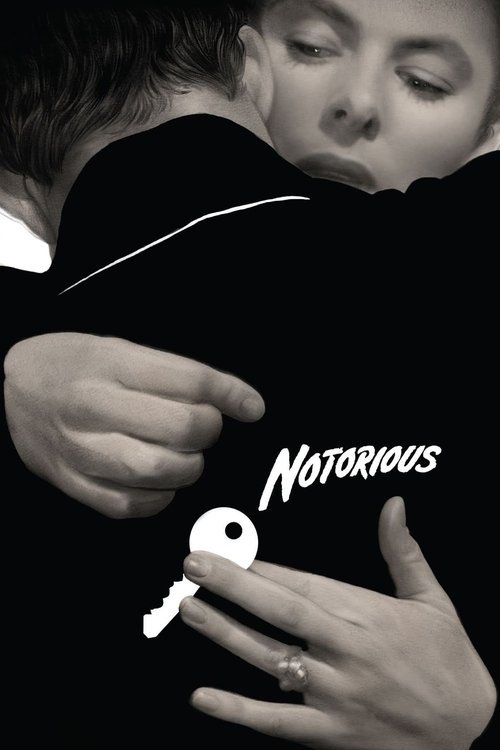
Notorious
"Deep their love! Great the risk!"
Overview
In the aftermath of World War II, Alicia Huberman (Ingrid Bergman), the American daughter of a convicted German spy, is recruited by government agent T.R. Devlin (Cary Grant) to infiltrate a ring of Nazis hiding in Rio de Janeiro. Despite her notorious reputation as a party girl, Alicia accepts the mission to prove her patriotism, falling in love with the cynical Devlin in the process. However, their budding romance is shattered when Devlin's superiors order Alicia to seduce Alexander Sebastian (Claude Rains), a French Nazi sympathizer who was once infatuated with her.
Heartbroken by Devlin's apparent indifference to her assignment, Alicia marries Sebastian to gain access to his inner circle and secrets. As she uncovers the truth about glowing sand hidden in wine bottles within Sebastian's cellar, she finds herself trapped in a deadly game. Sebastian and his domineering mother discover her true identity and begin slowly poisoning her, leading to a suffocating climax where Devlin must finally choose between his professional duty and his love for Alicia.
Core Meaning
At its heart, Notorious is a dark exploration of the conflict between love and duty, and the destructive power of mistrust. Hitchcock uses the framework of a spy thriller to tell a perverse love story where the heroes are cruel and the villains are sympathetic. The film examines how political machinations exploit personal intimacy, asking whether the ends (national security) justify the means (pimping out the woman you love). It is a story about a woman trying to wash away the sins of her father, only to be muddied by the men who claim to save her.
Thematic DNA
Love vs. Duty
The central conflict drives the narrative, particularly for Devlin, who suppresses his feelings for Alicia to serve his country. His cold professionalism acts as a barrier, causing him to hurt Alicia repeatedly rather than admit his vulnerability.
Trust and Betrayal
Trust is the currency of the film's relationships. Alicia desperately seeks Devlin's trust to redeem herself, while Sebastian's fatal flaw is his absolute trust in Alicia. The betrayal of this trust leads to the film's tragic outcomes.
The Redemption of the "Fallen Woman"
Alicia is introduced as a drunk and a "notorious" woman. The film follows her painful journey to redeem herself through patriotism and suffering, ultimately requiring rescue by the man who judged her most harshly.
The Domineering Mother
Madame Sebastian represents the archetypal Hitchcockian mother figure—controlling, suspicious, and ultimately the true power behind her son. She contrasts with Alicia, representing a darker, non-romantic form of female influence.
Character Analysis
Alicia Huberman
Ingrid Bergman
Motivation
To redeem her family name and prove her worthiness of love to Devlin.
Character Arc
Alicia transforms from a self-destructive, cynical party girl into a brave patriot and martyr for love. Her journey is one of seeking validation and redemption, first through alcohol, then through espionage, and finally through survival.
T.R. Devlin
Cary Grant
Motivation
Duty to the US government, conflicting with his repressed love for Alicia.
Character Arc
Devlin starts as a cold, judgmental agent who hides his emotions behind duty. His arc is internal; he must learn to overcome his pride and mistrust to save the woman he loves, transitioning from her handler to her savior.
Alexander Sebastian
Claude Rains
Motivation
Love for Alicia and fear of his Nazi associates (and his mother).
Character Arc
Sebastian is a sympathetic antagonist. He genuinely loves Alicia, which makes him vulnerable. His discovery of her betrayal destroys him, turning him from a doting husband into a trapped, desperate man awaiting execution by his own peers.
Symbols & Motifs
The Unica Key
The key to the wine cellar represents access to the truth and the transference of power. It is a phallic symbol of control that passes from Sebastian to Alicia, and finally to Devlin.
The famous tracking shot begins at a wide angle of the party and zooms in to an extreme close-up of the key hidden in Alicia's hand, highlighting its pivotal importance to the plot.
Wine Bottles / Uranium
The wine bottles are the ultimate MacGuffin. While they contain uranium ore (the plot driver), their true significance is as a vessel for secrets and the pretext for the characters' interactions.
Devlin accidentally breaks a bottle in the cellar, revealing the black sand (uranium) inside, which serves as the tangible proof of the Nazi plot.
Poisoned Coffee
The coffee cup symbolizes domestic betrayal and the perversion of care. Something meant to nourish and comfort is turned into a weapon of silent murder.
The camera emphasizes the coffee cup in the foreground as Alicia drinks it, visually signaling her danger as the poison takes effect.
Memorable Quotes
Dry your eyes, baby, it's out of character.
— T.R. Devlin
Context:
Spoken by Devlin when Alicia shows emotion, reinforcing his cynicism early in their relationship.
Meaning:
This line encapsulates Devlin's cruelty and his refusal to accept Alicia's genuine emotions, viewing her only through the lens of her "notorious" past.
I'm married to an American agent.
— Alexander Sebastian
Context:
Sebastian says this to his mother after discovering the missing key and the broken bottle in the wine cellar.
Meaning:
The moment of realization and total defeat. It signifies not just political failure, but personal heartbreak and the sealing of his death warrant.
I was a fat-headed guy, full of pain.
— T.R. Devlin
Context:
Spoken in the final scene as he rescues Alicia from her sickbed, finally dropping his guard.
Meaning:
Devlin's ultimate confession and apology. He finally admits that his cold behavior was a defense mechanism against his own hurt feelings.
Philosophical Questions
Do the ends justify the means?
The film asks if it is morally acceptable to exploit a woman's sexuality and endanger her life for the sake of national security. Devlin's struggle with this question is central to the film's emotional weight.
Can love exist without trust?
Devlin loves Alicia but does not trust her; Sebastian trusts Alicia but she does not love him. The film suggests that genuine love requires a vulnerability and faith that Devlin only finds when it is nearly too late.
Alternative Interpretations
The 'Pimp' Narrative: Some modern critics interpret the film not as a romance, but as a dark story about a man (Devlin) essentially pimping out a woman (Alicia) for the state, exploring themes of misogyny and exploitation within patriarchy.
Sebastian as the Hero: Another reading views Alexander Sebastian as the true tragic hero; he is the only character who loves unconditionally and honestly, while the 'heroes' lie and manipulate him.
The Erotic Thriller: Critics have noted that the plot about uranium is meaningless (a MacGuffin) and the film is truly about the sexual politics of the bedroom—impotence, jealousy, and the 'key' to sexual secrets.
Cultural Impact
Notorious is widely regarded as one of Hitchcock's greatest artistic achievements and a maturation of his style. Released in 1946, it was one of the first films to address the post-WWII reality of Nazis fleeing to South America and the dawn of the atomic age (via the uranium plot). Culturally, it marked a shift in the spy genre from pure action to psychological complexity. Critics like François Truffaut and Roger Ebert have praised it for its perfect structure and the 'perverse' nature of its love story. It solidified Ingrid Bergman's status as a top-tier dramatic actress and Cary Grant's ability to play darker, more ambiguous roles. The film's visual techniques, particularly the crane shot and the intimate camerawork, have influenced generations of filmmakers.
Audience Reception
Upon release, Notorious was a major box office and critical success, earning praise for the chemistry between Grant and Bergman and the terrifying performance of Claude Rains. Audiences were captivated by the suspense and the romantic tension. In modern times, it holds a near-perfect rating on review aggregators (often 100/100). Contemporary viewers still praise the sophisticated script and visual elegance, though some find Devlin's cold treatment of Alicia difficult to watch, sparking discussions about the film's gender politics. It is universally seen as a 'perfect' Hitchcock film.
Interesting Facts
- Alfred Hitchcock managed to circumvent the Hays Code ban on kisses longer than three seconds by having Cary Grant and Ingrid Bergman break the kiss every few seconds to speak or nuzzle, creating a continuous 2.5-minute scene of intimacy.
- The 'MacGuffin' of uranium ore hidden in wine bottles was so accurate that the FBI reportedly put Hitchcock under surveillance for three months to see where he got the information.
- Ingrid Bergman and Cary Grant found the famous 'walking kiss' scene incredibly awkward to film, but it became one of the most erotic scenes in cinema history.
- Claude Rains was several inches shorter than Ingrid Bergman, so he had to stand on a box or walk on a ramp in certain scenes to appear taller.
- The famous shot of the key involved a continuous crane move from the top of the stairs down to a close-up of the key in Bergman's hand; it remains one of the most celebrated camera moves in history.
- Producer David O. Selznick originally wanted the film to be about a woman training to be a spy, but Hitchcock insisted on the romantic angle.
- Leopoldine Konstantin, who played Madame Sebastian, was a famous Austrian actress who spoke very little English and learned her lines phonetically.
Easter Eggs
Hitchcock's Cameo
Alfred Hitchcock makes his signature cameo appearance at the party in Sebastian's mansion. He is seen drinking a glass of champagne and then quickly departing as Grant and Bergman enter the frame (around the 64-minute mark).
The Unica Key
The key used in the film is a real key brand ('Unica'). While not a hidden reference to another film, the specific focus on this object elevates a mundane item to mythic status, a technique Hitchcock perfected.
⚠️ Spoiler Analysis
Click to reveal detailed analysis with spoilers
Frequently Asked Questions
Explore More About This Movie
Dive deeper into specific aspects of the movie with our detailed analysis pages
Comments (0)
No comments yet. Be the first to share your thoughts!