Skip to content
Mad Men
A cool, smoke-hazed period drama in which a handsome ad man sells America its dreams while quietly coming apart, like a crisp white shirt hiding a wound that never closes.
Mad Men

Mad Men

"Where the truth lies."

19 July 2007 — 17 May 2015 United States of America 7 season 92 episode Ended 8.1 (1,582)

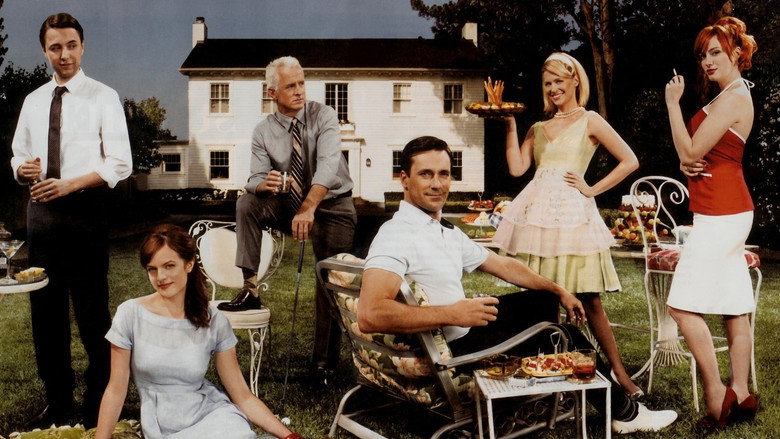
Cast: Jon Hamm, Elisabeth Moss, Vincent Kartheiser, January Jones, Christina Hendricks

Drama Identity and Reinvention Gender, Power and the Workplace Advertising, Consumerism and the American Dream Social Change and Historical Upheaval Loneliness and the Search for Meaning

Overview

Mad Men, created by Matthew Weiner and produced by Lionsgate Television for AMC, premiered on July 19, 2007. It is set in the glamorous, ruthless world of Madison Avenue advertising in the 1960s. At its center is Don Draper (Jon Hamm), a brilliant creative director at Sterling Cooper. He can put any product into words that move people, but he guards the facts of his own life closely.

Over seven seasons and 92 episodes, the series follows Don and the people around him through a whole decade of American upheaval. Peggy Olson (Elisabeth Moss) starts as a secretary and aims much higher. Pete Campbell (Vincent Kartheiser) is an ambitious account man. Betty Draper (January Jones) lives a picture-perfect suburban life that is falling apart. Joan Holloway (Christina Hendricks) is the office manager who knows how everything works. Mergers, rival agencies, marriages and divorces move the story along, while the civil rights movement, assassinations, the counterculture and the space age hit these characters' private lives.

The show is less about plot twists than slow, novelistic change. It watches people try to reinvent themselves, and then asks whether a person can really change or only change the packaging.

Core Meaning

At heart, Mad Men is about the gap between image and self. Don Draper sells fantasies of happiness, belonging and nostalgia because he has built his own life as an advertisement. The series uses the 1960s to show how American identity, desire and even rebellion get packaged and sold.

Its main question is whether real change is possible. Across the decade the characters chase freedom, success and love, and each achievement leaves them looking for the next one. In the finale, a moment of real spiritual openness appears to become one of the most famous commercials ever made. The ending sums up the show's ambivalent view: the search for authenticity and the machinery of commerce may be inseparable. Weiner has argued this need not be read cynically, since something pure can still come out of a commercial impulse.

Thematic DNA

Identity and Reinvention 28%
Gender, Power and the Workplace 22%
Advertising, Consumerism and the American Dream 20%
Social Change and Historical Upheaval 15%
Loneliness and the Search for Meaning 15%

Identity and Reinvention

The main engine of the series. Don's identity is itself a fabrication, and the show keeps returning to his fear of being exposed. As the seasons pass, reinvention spreads to everyone: Peggy remakes herself as a professional, Joan renegotiates her value, and Betty tries on new roles. By the final season reinvention has become a kind of compulsion, and the finale asks whether one more transformation is enlightenment or just a new pitch.

Gender, Power and the Workplace

The pilot shows an office where women are secretaries and objects. Over the decade, Peggy's rise to copywriter and creative leader and Joan's hard-won partnership and later independence trace the slow, painful arrival of second-wave feminism. The show is frank about the costs these gains carried, and Betty's story is the dark suburban mirror of that progress.

Advertising, Consumerism and the American Dream

Ads in the show are both the characters' trade and a lens on the culture. Pitches such as the Carousel sell emotion rather than products. As the agency grows, merges and is finally absorbed, the series tracks how corporate America turns even nostalgia, love and counterculture ideals into marketing, which ends in the Coca-Cola 'Hilltop' ad of the finale.

Social Change and Historical Upheaval

Each season moves through the 1960s: the Kennedy assassination, the civil rights movement, Vietnam, the deaths of King and Robert Kennedy, and the moon landing. The characters often react late or badly. The show uses this to explore how privileged people experience history as background noise, until it reaches into their offices and homes.

Loneliness and the Search for Meaning

Behind the martinis and affairs, nearly every character is isolated. Don's womanizing and drinking, Pete's discontent, and Roger's LSD experiments are all attempts to fill a void. The final seasons make this search explicitly spiritual and end at a retreat on the California coast.

Character Analysis

Don Draper

Jon Hamm

Archetype: Antihero Key Trait: Magnetic self-invention hiding a deep emptiness

Motivation

At first, keeping his secret and holding onto the image of success. Later it becomes a desperate search for authenticity, connection and some version of home.

Character Arc

He begins as the untouchable creative genius with a perfect suburban family and a buried past. Through seasons of affairs, divorce, a second marriage, alcoholism and professional exile, his carefully built identity erodes. In the final season he drifts west, sheds his possessions and position, and reaches an uncertain moment of peace at a California retreat. Then the show hints that he turns this experience into his greatest ad.

Peggy Olson

Elisabeth Moss

Archetype: The Protégé / Rising Hero Key Trait: Relentless ambition and resilience

Motivation

First to prove herself in a man's world. Over time this becomes a desire for real creative authority, and eventually a life that holds both work and love.

Character Arc

She arrives as Don's naive new secretary in the pilot and becomes the agency's first female copywriter. She fights for credit, pay and respect, clashes with and learns from Don, and finally becomes an assured creative leader. She is the show's clearest picture of progress.

All 5 characters and cast

Symbols & Motifs

The Falling Man (opening credits)

Meaning:

A businessman's collapse: the fear of falling from grace, of exposure, of losing control. Weiner said: "the American businessman jumps out the window... I wanted to say that's what's going inside of this man."

Context:

Every episode opens with a black-and-white silhouette falling past skyscrapers covered in ads, set to RJD2's "A Beautiful Mine." He passes a whisky glass (alcoholism), female bodies (womanizing) and a diamond ring with the line "It's the gift that never fails!" (materialism). At the end he is sitting calmly on a couch, which foreshadows the question of whether Don ever hits bottom.

Advertising Pitches

Meaning:

Confessions in disguise. Don's best pitches reveal his own longing for home, family and belonging, which he can't express directly.

Context:

Used across the series, most famously in the Season 1 Carousel pitch for Kodak and in the finale's implied creation of the Coca-Cola ad.

Cigarettes and Alcohol

Meaning:

The era's comfortable self-destruction: pleasures sold as sophistication that quietly kill.

Context:

They are constant in every office and home, starting with the pilot's Lucky Strike campaign. Their role changes as health awareness grows and as Don's drinking moves from glamorous to pathological in the middle seasons.

Doors, Windows and Offices

Meaning:

Status, access and entrapment. Who gets an office, and whose door is closed, marks the shifting balance of power.

Context:

Peggy's fight for her own office, the partners' offices after each merger, and Don's repeated retreats behind closed doors all use architecture to express hierarchy.

The Hilltop Coke Ad

Meaning:

Ambiguity itself: the meeting of spiritual transcendence and commercial co-option, of sincerity and salesmanship.

Context:

The last image of the series. The real 1971 "I'd Like to Buy the World a Coke" commercial follows Don's meditative smile, which suggests his enlightenment turns into advertising. Weiner confirmed that viewers who inferred Don created the ad were right.

Episode Highlights

The Wheel

S1E13

The Season 1 finale is remembered for the Kodak "Carousel" pitch. Don turns a slide projector into a time machine of family nostalgia while his own family life is quietly failing.

Significance:

It establishes the show's central irony: Don can sell the idea of home beautifully but cannot live in one. It set the tone and emotional ambition for the rest of the series.

Guy Walks Into an Advertising Agency

S3E6

A visit from the British parent company turns into one of the show's most shocking and darkly comic set pieces when an office party involving a riding lawnmower goes horribly wrong.

Significance:

It shows the absurdity and fragility of corporate power and the tension with the British owners, which sets up the rebellion in the season finale.

Shut the Door. Have a Seat

S3E13

Faced with another sale of the agency, Don, Roger, Bert and Lane get themselves fired and form their own firm, recruiting a hand-picked team in a heist-like finale. Meanwhile Don's marriage to Betty reaches its end.

Significance:

Widely considered one of the series' best episodes. It restarts the show by creating Sterling Cooper Draper Pryce and changing both the workplace and the domestic storylines.

The Suitcase

S4E7

Don and Peggy spend a long night together at the office. Their conflict and confessions build to Don's grief over the death of the one person who truly knew him.

Significance:

Often called the finest episode of the series. It defines the mentor-protégé bond at the show's emotional center and marks Don's lowest personal point.

Person to Person

S7E14

The series finale settles the fates of the main characters and leaves Don at a coastal retreat. His meditative smile leads straight into the real 1971 Coca-Cola "Hilltop" ad.

Significance:

It closes the show's long inquiry into reinvention with a deliberately ambiguous final image that is still debated as enlightenment, co-option, or both.

Philosophical Questions

Can a person truly change, or only rebrand themselves?

Don reinvents himself again and again through new names, new wives, new agencies and new cities, and each time he falls back into old patterns. The finale's move from meditation to advertisement leaves open whether transformation is real or just another campaign.

Is authenticity possible in a consumer society?

The characters' deepest feelings keep turning into pitches and products. The show asks whether any emotion stays untouched by the market, or whether selling feelings is simply a modern way of sharing them.

What do we owe the past we try to escape?

Don's buried origins, the nostalgia in the Carousel pitch, and the show's own look back at the 1960s all ask whether denying the past frees us or damns us to repeat it.

How does history shape private lives?

By setting intimate dramas against assassinations, protests and the moon landing, the series explores how individuals absorb, ignore or are reshaped by the forces of their era, often without realizing it.

How It Ends

Alternative Interpretations

The ending is the most debated element of the series:

Full ending explanation

Cultural Impact

Mad Men premiered on AMC in 2007, at a time when the network was not known for original drama. Weiner came out of The Sopranos writers' room, and the show extended that series' model of the morally complicated antihero and novelistic cable drama. It helped make AMC a prestige destination during the peak of what critics call television's Golden Age.

Its 1960s setting worked as a mirror for the present, and David Chase saw that quality in the original script. It prompted wide discussion of sexism, race and consumer culture, then and now. The series also shaped fashion, design and style with its mid-century suits, dresses and interiors. The opening title sequence, a tribute to Saul Bass and Hitchcock, became one of the most recognizable on television.

The finale drew acclaim and a great deal of debate, and the show's standing as one of the best series of the 21st century has remained intact.

Audience Reception

The searches returned little aggregated audience data, so this section only summarizes the critical consensus they did show. Mad Men is widely counted among the best dramas of the 21st century. Critics singled out standout episodes: the Season 3 finale \"Shut the Door. Have a Seat\" is often called one of the best of the whole series and one of the great season finales of its decade, and \"The Suitcase\" regularly tops episode rankings.

Praise centered on the writing, Jon Hamm's and Elisabeth Moss's performances, and the period detail. The main point of contention was the finale's Coca-Cola ending. Some found it brilliantly ambiguous, and others read it as a cynical or overly neat punchline. Weiner himself acknowledged the debate around it. Overall, the finale earned both acclaim and extensive discussion, and the show's reputation has held up.

Interesting Facts

  • Matthew Weiner wrote the script that became the Mad Men pilot while he was a staff writer on the Ted Danson sitcom Becker.
  • David Chase was impressed by how Weiner's script dealt with current issues through a 1960s setting, and it got Weiner a writing job on The Sopranos.
  • The series was produced by Lionsgate Television and premiered on AMC on July 19, 2007.
  • Lionsgate reportedly received about $2.71 million per episode from AMC, while each episode cost about $2.84 million to produce.
  • The actors did not smoke real tobacco. They used herbal cigarettes that contained no tobacco or nicotine.
  • Makeup artist Lana Horochowski had to keep Jon Hamm clean-shaven in every take and sometimes shaved him up to three times on a long shooting day.
  • The pilot was shot in New York in about 10 days, and every other episode was filmed in Los Angeles, often at real locations.
  • The opening title sequence was designed by Steve Fuller and Mark Gardner at Imaginary Forces and uses an instrumental edit of RJD2's "A Beautiful Mine."
  • Weiner said he had planned since around Season 3 to end the series with Don in a lotus position at an ashram-like setting.

Easter Eggs

The opening credits pay homage to Hitchcock

The falling-man title sequence directly references Saul Bass's skyscraper opening for North by Northwest (1959) and the falling figure on the Vertigo (1958) poster, which ties Don to Hitchcock's anxious, identity-shifting heroes.

Hidden imagery in the falling-man sequence

The silhouette falls through a whisky glass, past images of women, and past a diamond ring ad reading "It's the gift that never fails!". These are small emblems of Don's drinking, womanizing and the materialism he sells.

The real 1971 Coca-Cola "Hilltop" commercial in the finale

The show ends with an actual historical ad, which folds its fictional hero into real advertising history. Weiner confirmed the implication that Don created it.

Frequently Asked Questions

Explore More About This Movie

Dive deeper into specific aspects of the movie with our detailed analysis pages

Comments (0)

Leave a comment

No comments yet. Be the first to share your thoughts!

Similar Movies