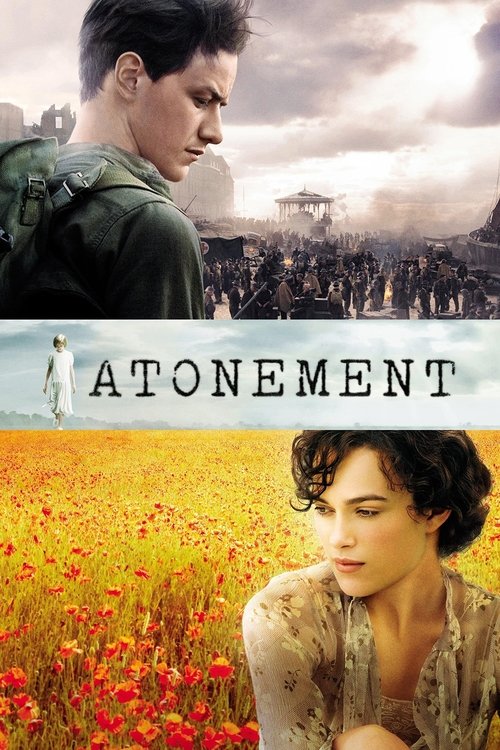
Atonement
"Torn apart by betrayal. Separated by war. Bound by love."
Overview
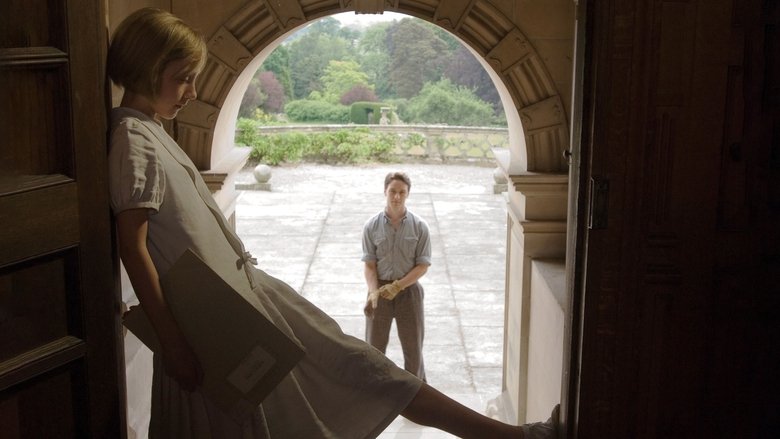
Set in the sweltering English summer of 1935, Atonement begins at the opulent Tallis country estate, where 13-year-old aspiring writer Briony Tallis observes a series of sexually charged interactions between her older sister, Cecilia, and the housekeeper's brilliant son, Robbie Turner. Misunderstanding the adult nature of their burgeoning romance and fueled by her own vivid imagination, Briony falsely accuses Robbie of a terrible crime he did not commit. This catastrophic lie sends Robbie to prison and irrevocably tears the family apart.
As World War II engulfs Europe, Robbie is released from prison on the condition that he joins the British army, ultimately finding himself stranded during the chaotic evacuation of Dunkirk. Meanwhile, an estranged Cecilia works as a wartime nurse in London, holding onto the hope of Robbie's return. Briony, now older and finally grasping the devastating weight of her childhood actions, forsakes her education to become a nurse as well, seeking a path to redemption.
Spanning six decades, the film intricately explores the rippling consequences of a single deceitful moment. Through shifting perspectives and a narrative that blurs the lines between reality and fiction, the story builds toward a profound, heartbreaking climax that challenges the very nature of forgiveness, memory, and the power of storytelling.
Core Meaning
The central message of Atonement revolves around the immense power and danger of storytelling, alongside the crushing permanence of guilt. Director Joe Wright and author Ian McEwan explore how a naive, self-serving narrative—born from a child's inability to comprehend adult complexities—can irreparably destroy real lives. The film questions the limits of redemption and whether true atonement is ever actually achievable. Ultimately, it suggests that while art and fiction can offer a form of solace or a rewritten 'happy ending,' they are often just a self-serving mechanism for the creator, unable to reverse the tragic finality of the past.
Thematic DNA
Guilt and Penance
Revealed through Briony's lifelong attempt to undo her lie. She punishes herself by abandoning a Cambridge education to work as a wartime nurse, and ultimately spends her life writing a novel to seek forgiveness for an unforgivable sin.
The Power and Danger of Fiction
Briony's vivid imagination and desire to impose narrative structure on reality leads to the tragedy. Later, fiction is used to offer a false sense of peace, highlighting how storytelling can both destroy lives and offer hollow comfort.
Class Prejudice
Robbie's swift condemnation by the Tallis family highlights the rigid British class system. Despite his Cambridge education, he is easily discarded and assumed guilty simply because he is the housekeeper's son.
Lost Innocence
The transition from the idyllic, sun-drenched summer of 1935 to the brutal, desaturated realities of World War II mirrors the characters' abrupt entry into a world of pain, mature consequences, and irreversible damage.
Character Analysis
Briony Tallis
Saoirse Ronan / Romola Garai / Vanessa Redgrave
Motivation
Initially driven by a desire for control, attention, and a childish need to protect her sister. Later in life, she is entirely driven by the desperate need to atone for her devastating lie.
Character Arc
Transforms from a precocious, imaginative 13-year-old who views life as a melodramatic play, into a guilt-ridden wartime nurse, and finally an elderly novelist seeking peace.
Robbie Turner
James McAvoy
Motivation
His primary motivation is his enduring love for Cecilia, clinging to her letters and the promise of their reunion as his sole reason to survive the horrors of the French retreat.
Character Arc
Begins as a hopeful, educated young man full of promise, only to be unjustly stripped of his future, branded a criminal, and plunged into the nightmarish reality of WWII.
Cecilia Tallis
Keira Knightley
Motivation
Fueled by her unwavering belief in Robbie's innocence and her deep, unyielding love for him, waiting for the day their story can resume.
Character Arc
Evolves from a privileged, stifled upper-class aristocrat into an independent, fiercely loyal woman who cuts all ties with her wealthy family to stand by the man she loves.
Symbols & Motifs
The Typewriter
Symbolizes the power of words to both create and destroy, as well as the author's control over reality.
Its rhythmic clacking is ingeniously integrated directly into the film's musical score, reflecting Briony's omnipresent narrative voice and her lifelong attempt to rewrite history.
The Green Dress
Symbolizes blossoming sexuality, the stifling heat of repressed desires, and an idealized, pristine memory of a world right before its catastrophic fall.
Worn by Cecilia during the fateful dinner in 1935, it stands out vibrantly against the hothouse atmosphere of the Tallis estate, becoming a haunting visual memory for Robbie.
Water
A motif representing cleansing, transition, and ultimately, danger and death.
Appears during the pivotal fountain incident, Robbie's desperate hallucination for hydration at Dunkirk, and tragically, Cecilia's death in a flooded underground tube station.
The Broken Vase
Represents the irreversible fracturing of relationships and the futility of trying to fix something once it is permanently broken.
Uncle Clem's priceless vase shatters during a tense standoff between Robbie and Cecilia at the fountain, setting off the chain of events that leads to Briony's misunderstanding.
Memorable Quotes
Come back. Come back to me.
— Cecilia Tallis
Context:
Whispered by Cecilia as Robbie is being taken away by the police in handcuffs, and later repeated in her letters and Robbie's memories at Dunkirk.
Meaning:
A desperate plea that becomes Robbie's lifeline and mantra during the war. It symbolizes their enduring love and the tragic hope of a reunion that sustains them both.
Dearest Cecilia, the story can resume. I will return. Find you, love you, marry you and live without shame.
— Robbie Turner
Context:
Spoken in voiceover as Robbie mentally drafts a letter to Cecilia while struggling to survive the grueling retreat through war-torn France.
Meaning:
Demonstrates Robbie's tragic optimism and the beautiful life he was unjustly denied. It highlights the film's theme of interrupted narratives and stolen futures.
I gave them their happiness.
— Older Briony
Context:
Spoken during the final television interview by the elderly Briony, revealing that her novel's happy ending was a complete fabrication.
Meaning:
Reveals the ethical ambiguity of Briony's atonement. She uses fiction to grant the lovers the life they never had, but it also serves as a self-soothing lie that highlights the limits of her penance.
How old do you have to be to know the difference between right and wrong?
— Robbie Turner
Context:
Said by Robbie during an imagined confrontation with an 18-year-old Briony, expressing his profound anger over the years stolen from him.
Meaning:
A bitter indictment of Briony's actions and the family's willingness to believe a child over him. It questions accountability and the loss of innocence.
Not anymore it isn't.
— Robbie Turner
Context:
Spoken to Cecilia at the fountain after she angrily tells him he has broken the most valuable thing they own (Uncle Clem's vase).
Meaning:
Foreshadows the impending destruction of the Tallis family's pristine, privileged world and the irreversible damage to come.
Philosophical Questions
Can art or fiction ever truly provide atonement for real-world sins?
The film asks whether writing a novel that grants victims a happy ending is a genuine act of penance or merely a self-serving illusion. It challenges the idea that narrative closure can substitute for real-world justice or alleviate the permanence of a fatal mistake.
How does perspective alter our understanding of objective truth?
By showing the fountain scene twice—first from the lovers' perspective, then from Briony's naive point of view—the film explores how subjective interpretations and preconceived biases can fatally distort reality.
At what age are we morally responsible for the consequences of our actions?
Briony's lie is committed when she is only 13, driven by childish misunderstanding and jealousy. The film wrestles with whether her youth excuses her actions, and how a childhood mistake can exact an adult toll.
Alternative Interpretations
While the surface narrative suggests that Briony's final novel is a genuine, agonizing act of penance, many critics and viewers interpret her 'atonement' as an act of profound selfishness and arrogance. From this perspective, Briony never truly atones; instead, she uses Robbie and Cecilia's tragedy one last time for her own literary acclaim, playing god by giving them a fictitious happy ending merely to soothe her own guilty conscience. Her claim that she 'gave them their happiness' can be read as a final, narcissistic manipulation of reality.
Another interpretation questions the reliability of the entire film's structure. Since the elderly Briony reveals she wrote the story we just watched, it implies that the intensely romantic moments between Cecilia and Robbie—such as the library scene or Robbie's surreal, feverish final moments in Dunkirk—are entirely fabricated by Briony's imagination based on her adult understanding of love and war. Therefore, the depth of Robbie and Cecilia's actual relationship remains a mystery, accessible only through the biased, guilt-ridden lens of the woman who destroyed it.
Cultural Impact
Atonement stands as a definitive post-modern period drama that successfully merged the classic British 'heritage film' aesthetic with complex meta-fictional storytelling. Released during a time when sweeping romantic epics were becoming scarce, the film proved that emotionally devastating narratives could still captivate modern audiences and critics alike. It received widespread acclaim, earning seven Academy Award nominations, including Best Picture, and taking home the Oscar for Best Original Score.
Visually, the film left an indelible mark on pop culture and fashion, largely due to Keira Knightley's iconic green dress, which continues to be referenced in fashion and film studies as a masterclass in costume design. Furthermore, Joe Wright's bravura 5.5-minute continuous tracking shot at Dunkirk became a benchmark in modern cinematography, frequently studied in film schools and compared to later war epics like Christopher Nolan's Dunkirk and Sam Mendes's 1917. By masterfully weaving the subjective nature of truth with the trauma of World War II, Atonement cemented its legacy as a tragically beautiful meditation on the limitations of art in the face of irreversible human suffering.
Audience Reception
Audience reception to Atonement was highly polarized by its emotional weight and narrative structure. The film was widely praised for its breathtaking cinematography, Dario Marianelli's innovative score, and the powerhouse performances of James McAvoy, Keira Knightley, and Saoirse Ronan. Viewers were particularly captivated by the palpable chemistry between the leads and the technical marvel of the Dunkirk tracking shot, which many cited as one of the greatest cinematic sequences of the decade.
However, the film's final twist proved highly controversial. Many audience members felt devastated, betrayed, and deeply frustrated by the revelation that the lovers' reunion was entirely fictitious. While cinephiles and critics appreciated the ending's meta-fictional brilliance and its faithful adaptation of Ian McEwan's novel, general audiences often found it to be a bitter, depressing gut-punch. Briony Tallis became widely regarded by viewers as one of cinema's most loathsome characters, sparking intense debates about whether her final literary act was a beautiful tribute or a final act of selfishness.
Interesting Facts
- The famous Dunkirk beach evacuation sequence was filmed in a single, continuous 5.5-minute tracking shot using over 1,000 extras, necessitated by a limited shooting schedule and budget.
- The rhythmic clacking of a vintage typewriter was ingeniously incorporated directly into Dario Marianelli's Academy Award-winning score to represent Briony's omnipresent narrative control.
- Keira Knightley's backless emerald green dress, designed by Jacqueline Durran, has been frequently voted by fashion publications as one of the greatest film costumes of all time.
- The word 'atonement' is never actually spoken aloud by any character throughout the film's runtime.
- Saoirse Ronan, who played the 13-year-old Briony, was intentionally only allowed to read her character's scenes so she would remain completely ignorant of the full consequences of Briony's actions, mirroring the character's naive perspective.
Easter Eggs
Stained-glass window of Saint Matilda
When young Briony watches Robbie being arrested, she looks through a stained-glass window depicting Saint Matilda. Saint Matilda is the patron saint of the falsely accused, serving as a subtle visual nod to Robbie's innocence.
Anthony Minghella's cameo
The late Oscar-winning director Anthony Minghella (The English Patient) makes a brief cameo appearance as the television interviewer speaking to the elderly Briony in the film's final scene.
Le Quai des brumes screening
During the continuous Dunkirk sequence, a cinema screen on the beach is showing the 1938 French film Le Quai des brumes (Port of Shadows), which mirrors the fatalistic and doomed romance of Robbie and Cecilia.
The opening and closing dollhouses
The film opens with a shot of Briony's childhood dollhouse and ends with her fictional creation of a seaside cottage for the lovers. This frames the entire story as Briony continuously playing god with people's lives in her miniature, controllable worlds.
⚠️ Spoiler Analysis
Click to reveal detailed analysis with spoilers
Frequently Asked Questions
Explore More About This Movie
Dive deeper into specific aspects of the movie with our detailed analysis pages
Comments (0)
No comments yet. Be the first to share your thoughts!