Skip to content
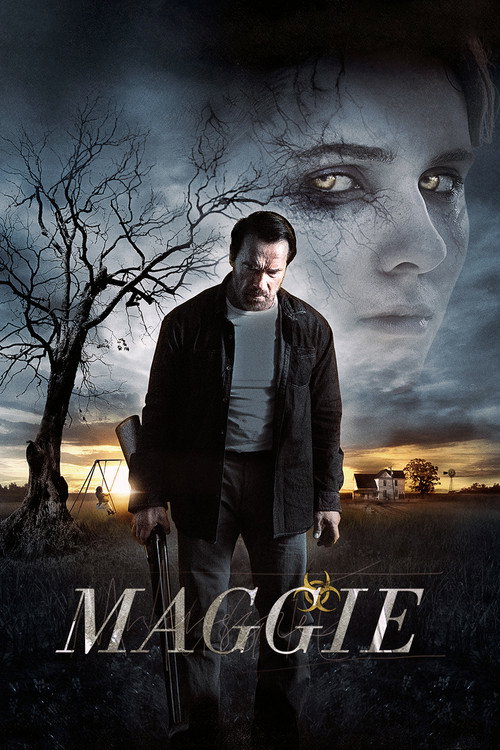
Maggie
A hushed apocalypse told at the speed of grief: a farmer keeps vigil over his infected daughter while autumn light drains from the fields, and love becomes the last thing left to bury.
Maggie

Maggie

"Don't Get Bitten."

08 May 2015 Switzerland 95 min 5.4 (1,710)

Director: Henry Hobson

Cast: Arnold Schwarzenegger, Abigail Breslin, Joely Richardson, Douglas M. Griffin, J.D. Evermore

Drama Science Fiction Horror Terminal illness as horror Fatherhood and the limits of protection Dignity, autonomy and the right to choose one's death Loss of innocence and a vanishing rural world Community, quarantine and institutional cruelty
Budget: $4,000,000
Box Office: $187,112

Overview

Set in a present-day American Midwest where a viral outbreak known as Necroambulism has been driven barely under control, Maggie opens on a country whose horror is bureaucratic rather than explosive. Cities are burning their crops, hospitals are overwhelmed, and families are being pulled apart as the infected are gathered into quarantine. Into that exhausted world drives Wade Vogel, a small-town farmer who has spent weeks searching for his teenage daughter after she ran away to the city.

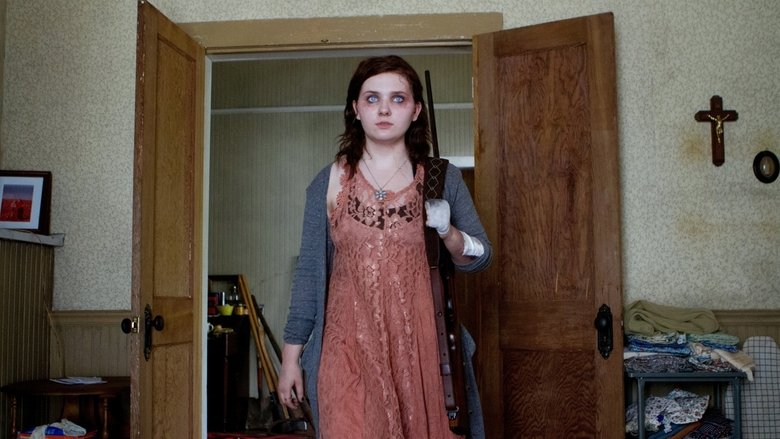
He finds her bitten. A doctor tells him what the timeline looks like, and Wade is permitted to take her home on a promise: when the turn comes, she goes into quarantine. What follows is not a siege picture but a vigil. Maggie returns to the farmhouse, to her stepmother Caroline and to the younger children who are quietly sent away, and tries to live inside the shrinking room of the time she has left — seeing friends, sitting on the porch, arguing with her father about what is going to happen and who is going to do it.

Directed by Henry Hobson in his feature debut and written by John Scott 3, the film uses the zombie premise almost entirely as a metaphor for terminal illness. Arnold Schwarzenegger, in one of the most restrained performances of his career, plays a man whose enormous physical capability is useless against the only problem that has ever mattered to him, while Abigail Breslin carries the film's interior half: fear, embarrassment, tenderness, and the slow arithmetic of deciding how you want to go.

Core Meaning

Maggie takes the most externalized horror subgenre there is and turns it inward. The infection is never really about monsters; it is about watching someone you love die slowly, in the house where you raised them. Hobson's interest is in the interval — the weeks between diagnosis and death, when the person is still entirely themselves and already partly gone.

The film's argument is twofold. First, that love is measured by what you are willing to stay for: Wade's heroism is not rescue but presence, the refusal to hand his daughter to the state or to the merciful bullet until the last possible moment. Second, that dignity is a matter of authorship — the film quietly insists that the most humane thing available to a dying person may be the right to choose the terms of their own ending, and it spares both father and daughter the obscenity of that choice being made for them by a system.

Underneath runs an elegy for a vanishing America: the family farm, rural childhood, the idea that a father can protect his own. The virus is just the accelerant on a fire that was already burning.

Thematic DNA

Terminal illness as horror 30%
Fatherhood and the limits of protection 25%
Dignity, autonomy and the right to choose one's death 20%
Loss of innocence and a vanishing rural world 15%
Community, quarantine and institutional cruelty 10%

Terminal illness as horror

The Necroambulist virus functions as an unmistakable stand-in for a terminal diagnosis. Maggie is given a prognosis and a timeline by a doctor, sent home for palliative care, and told that at a certain point she must be surrendered to quarantine. Her symptoms arrive as decline rather than menace — darkening veins, dulling senses, a wound that will not heal — and the family's experience is the familiar one of hospice: hushed rooms, awkward visitors, and the unbearable politeness of people who know.

Fatherhood and the limits of protection

Wade is built like a man who can solve things by force, and the film systematically denies him any problem force can solve. He drives into a burning city to find her, brings her home against advice, and then can do nothing but sit with her. Schwarzenegger's stillness is the thesis: the strongest man in the frame is helpless, and his love expresses itself only as endurance, as chores done quietly, as refusing to leave the room.

Dignity, autonomy and the right to choose one's death

The film circles three possible endings for Maggie — state quarantine, a father's mercy killing, or her own hand — and treats the question as a genuine moral problem rather than a thriller beat. Wade is pressured by neighbors and law enforcement toward the second option; the film's sympathy ultimately lies with Maggie's ownership of the decision, framing self-determination as the one thing the disease cannot take.

Loss of innocence and a vanishing rural world

Everything in the film is in the process of disappearing: childhood, the family farm, small-town life, the harvest itself. Fields are burned as a containment measure; children are sent away to relatives; teenagers hold a last, doomed gathering. Maggie's adolescence — first crushes, first independence — is being amputated at exactly the moment it begins, and the countryside around her is dying at the same rate she is.

Community, quarantine and institutional cruelty

The outbreak is managed, not raging, and that management is its own horror. Doctors, sheriffs and neighbors all carry the same unspoken arithmetic, and kindness is constantly shadowed by surveillance. The state's quarantine is described in terms that make it sound less like medicine than disposal, and the pressure on Wade comes as much from the people around him as from the virus in his daughter.

Character Analysis

Wade Vogel

Arnold Schwarzenegger

Archetype: The protector-hero stripped of his power; a grieving patriarch Key Trait: Inarticulate, immovable devotion

Motivation

To keep his daughter out of quarantine and beside him for as long as possible, and to spare her both the state's disposal and, if he can, his own hand.

Character Arc

Begins as a man on a mission — searching the quarantined city, retrieving his daughter, bargaining with doctors — and is gradually reduced from rescuer to witness. His arc is the surrender of agency: from insisting he can manage her illness at home, to resisting every institutional and neighborly demand that he 'handle it,' to finally accepting that the ending is not his to write.

Maggie Vogel

Abigail Breslin

Archetype: The doomed innocent / tragic heroine of her own death Key Trait: Quiet, protective courage

Motivation

To remain herself, to shield the people she loves from what she is becoming, and to decide for herself how and when it ends.

Character Arc

Runs to the city to spare her family and comes home infected; moves through denial and shame into a clear-eyed reckoning with what is coming. As her body fails she gathers what remains of adolescence — friends, a first sense of being loved — and then makes the film's decisive choice, protecting her father from having to be her executioner.

All 3 characters and cast

Symbols & Motifs

The burning fields

Meaning:

Containment as annihilation — the idea that saving something can require destroying it. The crops are the family's livelihood and the film's image of a future being pre-emptively cancelled.

Context:

Smoke from burned harvests hangs over the landscape throughout, a permanent haze that explains the film's sunless grey light. The fields die on the same schedule as Maggie, making the farm itself a body in decline.

The wound on Maggie's arm

Meaning:

A clock rather than an injury. It is the visible, worsening measure of time remaining, and the thing that makes her illness public and unhideable.

Context:

Maggie tends and conceals it in a series of private, almost ritual moments; its blackening progress replaces conventional plot tension with the dread of a countdown.

The farmhouse

Meaning:

The last defensible space of family and memory — and, as the children are sent away and rooms empty out, a house being hollowed into a hospice.

Context:

Wade brings Maggie home instead of surrendering her, so the entire third act plays out in kitchens, porches and bedrooms; domestic space, not open country, is where the horror lives.

The roof

Meaning:

Elevation as agency. Climbing above the house is Maggie's one act of rising, the moment she stops being a patient and becomes the author of her own ending.

Context:

In the final sequence Maggie leaves her father sleeping, climbs onto the roof at dawn, and steps off — the film's only real physical action, performed by its weakest character.

Maggie's dead mother

Meaning:

Grief already survived, and the peace that lies on the far side of dying. She represents the innocence the illness is taking back.

Context:

Her absence shapes the family (Caroline is a stepmother), and she returns in Maggie's final vision of herself as a small child playing among flowers — the film's only image of unclouded light.

Hands and touch

Meaning:

Intimacy rendered dangerous. Contagion turns every embrace into a risk, so affection must be constantly negotiated.

Context:

Wade repeatedly reaches for his daughter and repeatedly must decide whether to; the film's tenderness is built from hesitations before contact rather than from dialogue.

Philosophical Questions

When does a person stop being themselves?

The Necroambulist virus makes the question literal: Maggie's body and appetites change while her mind, memory and love remain intact, and the film refuses to name a moment of transition. Wade treats her as his daughter until the very end; the state treats her as already lost from the day of diagnosis. The film suggests personhood is conferred by relationship rather than biology — she is Maggie because someone is still there to call her that.

Does anyone have the right to choose the time of their own death?

The film stages this as a competition between three claimants to the decision: the state (quarantine), the father (mercy), and Maggie herself. By giving her the final act and framing it with her most peaceful imagery, the film comes down on the side of autonomy — while making clear how much the surrounding pressure narrowed what 'choice' could mean.

What is love worth when it cannot save anyone?

Wade's strength is systematically rendered irrelevant; every skill he has is useless. What remains is attendance — driving, waiting, sitting, not leaving. The film proposes that this is not a lesser form of love but the essential one, and that the desire to fix a dying person can be a way of abandoning them.

Can an act of mercy and an act of murder be the same act?

The pressure on Wade to kill his daughter is presented as both compassionate and monstrous, depending only on who is speaking. The film never resolves the ambiguity; it simply arranges events so that Wade is never required to find out what he would have done, which is arguably the greatest kindness Maggie extends to him.

Is a society that quarantines its sick protecting itself or discarding them?

The outbreak is under control, which means the machinery of containment is functioning — and the film shows that machinery as cold, euphemistic and final. Doctors are kind but scripted, neighbors are sympathetic but watchful. The horror is not the infected; it is how quickly ordinary people agree on who is no longer worth keeping.

Alternative Interpretations

The euthanasia reading. The most common interpretation treats the entire film as an argument about assisted dying. Maggie's leap is a suicide that the film frames as merciful and self-authored — she takes the burden off her father, denies the state its quarantine, and dies as herself. Under this reading the film is unambiguously on her side.

Full ending explanation

Cultural Impact

Maggie arrived at the crest of the 2010s zombie boom — the era of The Walking Dead, World War Z and The Last of Us — and defined itself against it. Rather than the siege-and-survival template, it belongs to a small, growing strain of intimate, domestic zombie cinema that uses infection as a metaphor for illness, dementia and euthanasia, a lineage that also includes films like Contracted, What We Become and later Cargo. Its casting is the point: putting the era's defining action icon inside a film where nobody can be saved by force was itself a piece of cultural commentary.

The film premiered at the Tribeca Film Festival in April 2015 and was marketed as Schwarzenegger's move into independent drama. Critics were split but broadly respectful: it holds a 61% Tomatometer on Rotten Tomatoes from 135 reviews, with the critics' consensus reading, "Maggie lurches a bit clumsily at times, but is partially redeemed by strong performances and an unexpectedly thoughtful tone." Its commercial footprint was tiny — a theatrical gross of roughly $1.6 million — so its influence has been reputational rather than box-office: it is now most often cited as the proof that Schwarzenegger could act in a minor key, a reappraisal that fed into the later, more melancholic phase of his career.

Its afterlife also runs through the pandemic years. Watched after 2020, the film's depiction of quarantine notices, overwhelmed clinics, burned crops and neighbors informing on neighbors reads far less like genre invention and far more like recent memory, and it has been revisited on those terms.

Audience Reception

The split is unusually stark. Critics gave the film a 61% Tomatometer score across 135 reviews, while the Rotten Tomatoes audience score sits at just 32% from more than 10,000 ratings; on IMDb it holds roughly 5.6/10. The gap is essentially a genre-expectation problem: marketed as an Arnold Schwarzenegger zombie film, it delivers a slow, grey, nearly action-free chamber drama.

Praised: almost universally, the performances. Schwarzenegger's restraint — stoic, gentle, physically contained — was treated as a genuine revelation and the strongest argument for the film's existence, and Abigail Breslin drew praise for conveying fear, sadness and flickers of hope without melodrama. Reviewers also admired the film's willingness to reconceive the zombie premise as a family drama about terminal illness, and Hobson's controlled, sunless visual scheme.

Criticized: pacing above all. Detractors found it ponderous and static, thin on incident, and accused it of mistaking slowness for depth; the moody grading was called monotonous by some. The critics' consensus itself concedes the film "lurches a bit clumsily at times." Audiences arriving for a Schwarzenegger horror vehicle frequently reported boredom and a sense of bait-and-switch, which explains the harsh popular score.

Verdict: a flawed, sincere, deliberately unexciting film whose reputation rests on two performances and one good idea — and which is far better received by viewers who know in advance that it is a hospice drama wearing a zombie mask.

Interesting Facts

  • Maggie is Henry Hobson's feature directorial debut; before it he was a title-sequence designer, having created main titles for AMC's The Walking Dead and Naughty Dog's video game The Last of Us — both zombie-adjacent projects.
  • The screenplay is credited to John Scott 3.
  • The film premiered at the Tribeca Film Festival on April 23, 2015.
  • Production was troubled: Hobson has said two directors of photography departed the project, and financing the film proved difficult.
  • Reported budget figures conflict across sources — one account puts the eventual budget at around $6 million, while other listings cite roughly $1.4 million; the film took in about $1.6 million theatrically.
  • By either figure it stands as one of the smallest-budgeted films Arnold Schwarzenegger has appeared in since the original The Terminator in 1984.
  • The role is widely described as Schwarzenegger's indie-film debut and the most restrained performance of his career, with almost none of the action-star register he is known for.
  • Hobson shot the film in a palette of greys and drained hues and deliberately keeps the sun off screen for nearly the entire running time.
  • The fictional disease is named the Necroambulist virus, and the outbreak is referred to as Necroambulism — the film treats it as a managed public-health crisis rather than an ongoing apocalypse.

Frequently Asked Questions

Explore More About This Movie

Dive deeper into specific aspects of the movie with our detailed analysis pages

Comments (0)

Leave a comment

No comments yet. Be the first to share your thoughts!

Similar Movies