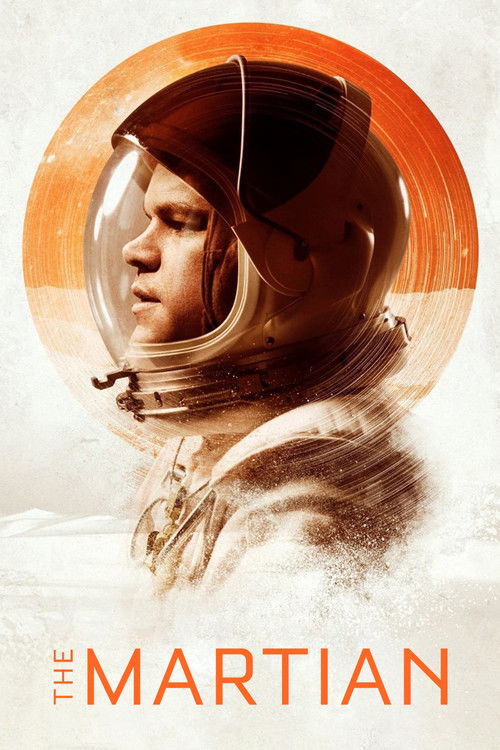
The Martian
A vibrant survival anthem set against the rusty grandeur of Mars. Amidst the terrifying silence of an alien desert, a lone botanist's unwavering optimism and ingenuity bloom like a green sprout in red dust.
The Martian

The Martian

"Help is only 140 million miles away"

30 September 2015 United States of America 141 min ⭐ 7.7 (20,787)
Director: Ridley Scott
Cast: Matt Damon, Jessica Chastain, Kristen Wiig, Jeff Daniels, Michael Peña
Drama Adventure Science Fiction
Resilience and Perseverance The Power of Science and Logic Global Unity and Cooperation Isolation vs. Connection
Budget: $108,000,000
Box Office: $631,058,917

Overview

During a manned mission to Mars, Astronaut Mark Watney (Matt Damon) is presumed dead after a fierce storm and left behind by his crew. But Watney has survived and finds himself stranded and alone on the hostile planet. With only meager supplies, he must draw upon his ingenuity, wit, and spirit to subsist and find a way to signal to Earth that he is alive.

Millions of miles away, NASA and a team of international scientists work tirelessly to bring "the Martian" home, while his crewmates concurrently plot a daring, if not impossible, rescue mission. As these stories of incredible bravery unfold, the world comes together to root for Watney's safe return.

Core Meaning

The Triumph of Human Intellect and Spirit. Ridley Scott's film acts as a love letter to scientific competence and human cooperation. Unlike many sci-fi films that focus on the dangers of technology or aliens, The Martian posits that the universe is indifferent, not malicious, and that humanity's greatest tool against the void is our collective intelligence, optimism, and refusal to give up. It emphasizes that problems, no matter how insurmountable they seem, can be solved one calculation at a time.

Thematic DNA

Resilience and Perseverance 30%
The Power of Science and Logic 25%
Global Unity and Cooperation 25%
Isolation vs. Connection 20%

Resilience and Perseverance

The central theme driving the narrative. Watney refuses to succumb to despair, breaking down insurmountable problems into manageable tasks. His mantra, "You solve one problem... and you solve the next one," embodies the spirit of survival not through brute force, but through persistent, rational action.

The Power of Science and Logic

Science is portrayed not as abstract theory but as a practical, life-saving toolkit. From botany to chemistry to orbital dynamics, knowledge is the superhero power of the film. Watney's ability to "science the sh*t out of this" is what keeps him alive, celebrating STEM fields as heroic endeavors.

Global Unity and Cooperation

The film moves beyond national borders, showing how the plight of one man unites the world. The collaboration between NASA and the Chinese National Space Administration (CNSA), as well as the crowds gathering in Times Square and Beijing, highlights a hopeful vision of humanity putting aside politics for a humanitarian cause.

Isolation vs. Connection

While physically the most isolated man in history, Watney remains socially connected through his logs and eventually his communication with Earth. The film contrasts the vast, silent emptiness of the Martian landscape with the crowded, noisy, and collaborative bustle of Mission Control, emphasizing that humans are fundamentally social creatures.

Character Analysis

Mark Watney

Matt Damon

Archetype: The Robinson Crusoe / The Competent Hero
Key Trait: Unflappable Optimism

Motivation

Survival. To stay alive long enough to be rescued, driven by a pragmatic refusal to die and a desire to return to his life on Earth.

Character Arc

Starts as a stranded victim but quickly transforms into a proactive survivor. He maintains his sanity through humor and video logging. His journey is less about internal emotional change and more about the external triumph of his will and intellect against nature.

Commander Melissa Lewis

Jessica Chastain

Archetype: The Responsible Leader
Key Trait: Decisive Leadership

Motivation

Duty and Loyalty. She is driven by the protective instinct for her crew, refusing to leave a man behind.

Character Arc

Carries the heavy guilt of leaving a crew member behind. Her arc is defined by her decision to commit mutiny to return for Watney, redeeming her initial command decision (even though it was the correct protocol) by risking everything to bring him home.

Teddy Sanders

Jeff Daniels

Archetype: The Bureaucrat
Key Trait: Pragmatism

Motivation

Preservation of NASA. He wants to save Watney, but not at the expense of the agency's long-term viability.

Character Arc

Represents the caution of the institution. He is not a villain, but a pragmatist who must weigh the life of one man against the future of the entire space program. He remains consistent in his risk-aversion, serving as a foil to the "cowboy" attitude of the crew.

Rich Purnell

Donald Glover

Archetype: The Eccentric Genius
Key Trait: Socially Awkward Brilliance

Motivation

Solving the Puzzle. He is driven by the pure intellectual challenge of orbital mechanics.

Character Arc

A brilliant astrodynamicist who steps out of the shadows to provide the "Eureka" moment. He challenges the bureaucratic stagnation with raw, undeniable mathematical truth.

Symbols & Motifs

The Potato Plant

Meaning:

Life and Colonization. The tiny green sprout emerging from the red Martian soil symbolizes hope, resilience, and the imposition of life onto a dead world. It represents Watney's claim to the planet—as he notes, growing crops makes him a "colonizer."

Context:

Used throughout the second act as a visual progress bar of Watney's survival. Its eventual freezing and death marks the film's lowest emotional point, symbolizing the fragility of his existence.

The Pathfinder Probe

Meaning:

Connection to the Past. Digging up the 1997 Sojourner rover represents using the foundation of past scientific achievements to solve present problems. It symbolizes the continuity of human exploration.

Context:

Watney travels to the old landing site to retrieve it, using its primitive camera to establish the first text-based communication with NASA.

The Tether

Meaning:

Trust and Connection. In the climax, the tether represents the lifeline between individuals. It signifies that no matter how far out you go, you are bound to the rest of humanity.

Context:

During the final EVA rescue, the tether is the literal and metaphorical line Commander Lewis uses to catch Watney, re-establishing his physical bond with other humans.

Memorable Quotes

I'm gonna have to science the shit out of this.

— Mark Watney

Context:

Spoken to the camera in a video log after Watney assesses his meager supplies and realizes the impossibility of his situation.

Meaning:

The film's thesis statement. It encapsulates the refusal to give up and the reliance on knowledge rather than luck or force to solve problems.

Technically, I colonized Mars. In your face, Neil Armstrong!

— Mark Watney

Context:

Spoken while looking at his potatoes successfully growing in the Hab.

Meaning:

Highlights Watney's humor and the historical significance of his survival. By growing crops, he moves from a visitor to a settler.

Every human being has a basic instinct: to help each other out... This is so fundamentally human that it's found in every culture without exception.

— Mark Watney

Context:

Voiceover at the end of the film as we see the montage of the rescue operation and the world watching.

Meaning:

This quote serves as the moral core of the film, explaining why billions of dollars and international efforts are spent to save just one person.

Project Elrond... because it's a secret meeting where the fate of the world is decided. Also, his name is 'Glorfindel'.

— Vincent Kapoor & Mark Watney (referenced)

Context:

During the secret meeting where they discuss the Rich Purnell maneuver, explicitly referencing Lord of the Rings (with Sean Bean present).

Meaning:

A pop-culture bridge that humanizes the scientists. It frames their high-stakes meeting in the language of geek culture, bonding the characters and the audience.

Philosophical Questions

The Value of a Single Life (The Trolley Problem)

The film poses a massive utilitarian question: Is it ethical to risk the lives of five crew members and spend billions of dollars to save one man? The film argues for the intrinsic, almost sacred value of the individual, suggesting that the effort itself defines our humanity.

Man vs. Nature or Man within Nature?

Is Watney fighting a war against Mars, or learning to coexist with it? While he says "F*** you Mars," his survival depends on understanding and manipulating the natural laws of the planet, suggesting a relationship of respect and mastery rather than pure conquest.

Alternative Interpretations

Competence Porn vs. Spiritual Journey. While most view the film as a celebration of problem-solving (competence porn), some critics interpret Watney's journey as a secular spiritual rebirth. He is "dead" (buried in sand), descends into the "underworld" (Mars), and is "resurrected" through faith (in science) and the collective will of humanity. Another reading focuses on the Anti-Bureaucratic message, where the "men on the ground" (the crew and engineers) must bypass the cautious leadership (NASA administrators) to achieve greatness.

Cultural Impact

The Martian is credited with revitalizing the "competence porn" subgenre and bringing a wave of optimism to science fiction, which had been dominated by dystopian narratives. It significantly boosted public interest in NASA's "Journey to Mars" program, with the agency using the film's release to promote real-world missions. Culturally, it championed the "STEM hero," showing that math and botany could be just as cinematic and thrilling as gunfights. It was a massive critical and commercial success, grossing over $630 million and receiving 7 Academy Award nominations.

Audience Reception

The film was universally acclaimed by both critics and general audiences (Rotten Tomatoes: 91%). Viewers praised the refreshing lack of angst and melodrama; Watney doesn't have a tragic backstory or a weeping family back home, which allowed the focus to remain on the survival process. The humor was a major selling point, making hard science accessible. Some criticism was directed at the lack of character development for the supporting cast and the scientific inaccuracy of the initial storm, but the consensus was that it was a thrilling, smart, and visually stunning blockbuster.

Interesting Facts

  • The filming of Mars exterior scenes took place in Wadi Rum, Jordan, the same location used for 'Lawrence of Arabia' and 'Prometheus'.
  • NASA was consulted extensively for the film to ensure scientific accuracy, including the design of the spacecraft and habitats.
  • The 'Project Elrond' scene is a meta-joke: Sean Bean, who plays Mitch Henderson, played Boromir in 'The Lord of the Rings', who attended the Council of Elrond.
  • Matt Damon recorded his video logs largely in chronological order and often alone on set to capture the genuine feeling of isolation and progression.
  • A page of the script was actually launched into space on board NASA's Orion spacecraft during its Exploration Flight Test-1 in 2014.
  • Ridley Scott sketched the 'Iron Man' visual concept himself on the script page.
  • The windstorm that strands Watney is one of the few scientific inaccuracies; the Martian atmosphere is too thin to cause such force, but Andy Weir admitted he needed a catalyst for the plot.
  • Donald Glover (Rich Purnell) slipped and fell during his first take in the scene where he explains the maneuver; he stayed in character and got up, which Ridley Scott loved and kept in the film.

Easter Eggs

Project Elrond / Sean Bean

When the NASA team discusses the secret rescue plan, they name it "Project Elrond" from Lord of the Rings. Sean Bean (Mitch Henderson) is in the scene; he played Boromir in the actual Council of Elrond scene in Fellowship of the Ring.

The 16-character Hex Code

The system Watney uses to communicate with Pathfinder involves a hexadecimal alphabet. This is a real computing system, accurate to how early rovers communicated.

Iron Man Reference

Watney proposes flying like "Iron Man" by cutting his glove. This is a direct reference to the Marvel superhero, reflecting Watney's pop-culture reliance.

⚠️ Spoiler Analysis

Click to reveal detailed analysis with spoilers

Frequently Asked Questions

Explore More About This Movie

Dive deeper into specific aspects of the movie with our detailed analysis pages

Comments (0)

Leave a comment

No comments yet. Be the first to share your thoughts!