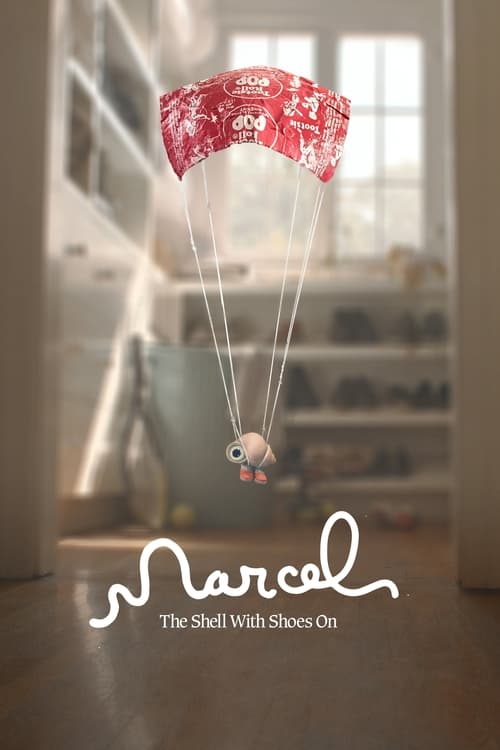
Marcel the Shell with Shoes On
A bittersweet, heartwarming mockumentary blending stop-motion and live-action. It evokes a tender sense of childlike wonder and poignant grief as a tiny shell navigates a massive world, symbolizing the fragile yet resilient nature of connection.
Marcel the Shell with Shoes On

Marcel the Shell with Shoes On

"Everybody loves Marcel."

24 June 2022 United States of America 90 min ⭐ 7.6 (673)
Director: Dean Fleischer Camp
Cast: Jenny Slate, Dean Fleischer Camp, Isabella Rossellini, Joe Gabler, Shari Finkelstein
Drama Animation Family Comedy
Grief and Loss The Importance of Community The Dual Nature of the Internet Resourcefulness and Everyday Magic
Budget: $6,000,000
Box Office: $6,909,209

Overview

Marcel the Shell with Shoes On (2022) is a feature-length mockumentary expanding on the beloved 2010 YouTube shorts created by Jenny Slate and Dean Fleischer Camp. The film seamlessly blends stop-motion animation with live-action to tell the story of Marcel, an endearing, one-inch-tall shell with a single googly eye and pink shoes. Marcel lives in an Airbnb with his aging grandmother, Nana Connie, and his pet ball of lint, Alan, after a mysterious tragedy separated them from the rest of their sprawling shell community.

When a recently divorced documentary filmmaker named Dean moves into the house, he becomes fascinated by Marcel's resilient, resourceful way of life and begins filming him. Using everyday objects in inventive ways—like a hollowed-out tennis ball for a rover and honey to walk on walls—Marcel captivates millions when Dean uploads the videos to the internet. As Marcel becomes an unexpected viral sensation, he uses this newfound fame to launch a search for his long-lost family.

However, the journey is fraught with emotional challenges. Marcel must balance his desire to reunite with his community with his immediate responsibilities as a caretaker for Connie, whose health and memory are slowly declining. The film navigates the delicate intersections of viral fame, existential loneliness, and the profound beauty of everyday life, crafting a poignant meditation on grief and hope.
Core Meaning

At its core, Marcel the Shell with Shoes On is a profound meditation on grief, resilience, and the universal need for community. Through the perspective of a physically tiny and vulnerable protagonist, director Dean Fleischer Camp explores how we cope with sudden loss and the terrifying prospect of change. The film suggests that while grief and isolation can make us feel microscopic in a vast universe, our connections to others give us strength. Ultimately, it carries the message that experiencing deep sorrow is the price we pay for profound love, and that opening ourselves back up to the world is an essential part of surviving and truly living.

Thematic DNA

Grief and Loss 30%
The Importance of Community 30%
The Dual Nature of the Internet 20%
Resourcefulness and Everyday Magic 20%

Grief and Loss

The film explores grief not as a dramatic spectacle, but as a quiet, everyday reality. Marcel and Dean are both mourning the loss of their families (through separation and divorce), and they must learn to process the melancholic void left behind while continuing to survive.

The Importance of Community

Marcel repeatedly states that it takes a community to survive and thrive. His isolation drives the plot, highlighting that humans (and shells) are inherently social creatures who need a tribe to share experiences, support each other, and simply not be alone in a massive world.

The Dual Nature of the Internet

The film critiques parasocial relationships and viral fame. While the internet offers a tool for Marcel to broadcast his plea for help, it mostly brings empty, performative fandom in the form of influencers taking selfies outside his home without offering genuine assistance.

Resourcefulness and Everyday Magic

Through Marcel's eyes, mundane household objects become vital tools. This theme emphasizes finding joy, utility, and beauty in the little things, encouraging viewers to appreciate the often-overlooked details of daily life and adapt creatively to challenges.

Character Analysis

Marcel

Jenny Slate

Archetype: The Innocent Hero
Key Trait: Resourceful and eternally curious

Motivation

To care for his aging grandmother while holding onto the hope of reuniting with his lost family.

Character Arc

Marcel begins as a fearful but optimistic survivor who hides behind routine to avoid further loss. Through his journey, he learns to embrace the terrifying prospect of change and risk everything to find his family.

Nana Connie

Isabella Rossellini

Archetype: The Wise Mentor
Key Trait: Wise, nurturing, and brave

Motivation

To ensure Marcel does not let fear stop him from living a full, adventurous life after she is gone.

Character Arc

Connie accepts her declining health and memory with grace. Instead of clinging to Marcel, she selflessly feigns strength to push him toward the wider world and his ultimate destiny.

Dean

Dean Fleischer Camp

Archetype: The Observer and Ally
Key Trait: Melancholy but empathetic

Motivation

To distract himself from his divorce by documenting Marcel, eventually becoming genuinely invested in helping his tiny friend.

Character Arc

Dean starts as a depressed, recently divorced filmmaker hiding behind his camera. By interacting with Marcel, he gradually heals from his heartbreak and learns to step back into his own life.

Symbols & Motifs

The Hollow Shell and The Wind

Meaning:

The wind blowing through Marcel's shell represents his connection to the broader universe and the music of life. It also symbolizes the empty space left by grief, which can still produce something beautiful.

Context:

At the end of the film, Marcel stands by the window of the laundry room to let the wind blow through his shell, creating a resonant, whistling sound that signifies his acceptance of his place in the world.

The Tennis Ball Rover

Meaning:

It symbolizes Marcel's ingenuity, mobility, and his protective barrier against a giant, dangerous world.

Context:

Marcel uses a hollowed-out tennis ball to safely navigate the vast floor space of the Airbnb, protecting him from Dean's dog and allowing him to travel quickly.

Nana Connie's Garden

Meaning:

Connie's garden represents the cycle of life, nurturing, and the acceptance of mortality. It shows how life flourishes through care and connection with nature.

Context:

Connie spends her time tending to the garden and befriending insects. It is where she finds her peace, and ultimately, it serves as her resting place when she passes away.

Memorable Quotes

My name is Marcel, and I'm partially a shell, as you can see on my body, but I also have shoes, and a face. So, I like that about myself.

— Marcel

Context:

Marcel introduces himself to Dean's camera at the beginning of the documentary.

Meaning:

This quote establishes Marcel's core identity, innocent self-acceptance, and inherent charm.

Guess why I smile a lot? Uh, 'cause it's worth it.

— Marcel

Context:

Marcel explains his general outlook on life during an interview with Dean.

Meaning:

A profound statement of optimism that encapsulates Marcel's enduring positivity despite his immense losses.

Let's forget about being afraid. Just take the adventure.

— Nana Connie

Context:

Connie tells this to Marcel when he is hesitant to do the 60 Minutes interview out of fear of how change might affect them.

Meaning:

A thematic thesis of the film, encouraging taking risks and embracing life despite the inevitability of pain and loss.

I'm not just one piece rattling around in this place. I'm part of a whole.

— Marcel

Context:

Marcel reflects on his place in the world, especially near the film's poignant conclusion.

Meaning:

A realization of his connection to the universe and the broader community, escaping the confines of his isolation.

Sometimes people say that my head is too big for my body. And then I say, 'Compared to what?'

— Marcel

Context:

Marcel casually shares anecdotes about his life and perspective with the documentarian.

Meaning:

Shows Marcel's quick wit and his refusal to be judged by arbitrary standards.

Philosophical Questions

What is the true nature of community, and can we survive without it?

The film explores whether basic survival is enough to constitute a 'good life.' Marcel manages to survive alone with his grandmother, but he expresses a deep existential ache for a larger tribe, suggesting that community is essential for emotional and spiritual fulfillment.

Is the pain of grief a valid reason to avoid the risk of living?

Through Nana Connie's declining health and Marcel's fear of change, the film asks if we should shelter ourselves to prevent further loss. Connie’s ultimate advice—to 'just take the adventure'—argues that the inevitability of death and sorrow should not paralyze us from experiencing the beauty of life.

Does modern digital connectivity create genuine human connection?

The film critiques the illusion of online community. Marcel gains millions of internet fans, but quickly realizes they are largely passive consumers or self-interested influencers, contrasting viral fame with the tangible, messy reality of true interpersonal relationships.

Alternative Interpretations

While the film is largely straightforward, some viewers and critics interpret the entire narrative as a psychological projection of the filmmaker, Dean. In this reading, Marcel and his tiny world are manifestations of Dean's own inner child and his feelings of extreme smallness, vulnerability, and isolation following his divorce. Reuniting Marcel with his family symbolizes Dean successfully piecing his own fragmented emotional state back together and finding the courage to re-enter society. Another interpretation focuses on Marcel's community as an allegory for displaced peoples and gentrification; the shells are native inhabitants of a space who are carelessly swept away in the chaotic, destructive wake of human disputes, forcing the survivors to preserve their culture and memories in isolation.

Cultural Impact

Marcel the Shell with Shoes On made a significant cultural impact by successfully transitioning a 2010 viral YouTube phenomenon into a critically acclaimed feature film over a decade later. It defied expectations that internet novelties could not sustain feature-length emotional depth. The film was universally praised by critics, scoring an Academy Award nomination for Best Animated Feature, and became a beloved hit for indie studio A24, marking their first foray into family-friendly entertainment. Culturally, Marcel became a symbol of radical softness and earnestness in a highly cynical digital age. The film resonated deeply with audiences navigating the collective grief and isolation of the post-pandemic era, as its themes of finding community and repurposing one's life hit a poignant chord. Its masterful blend of live-action and stop-motion also pushed the boundaries of hybrid filmmaking, praised by cinematographers for its meticulous 'lyrical documentary' lighting and integration.

Audience Reception

Audience reception for Marcel the Shell with Shoes On was overwhelmingly positive, with viewers universally praising the film's immense heart, gentle humor, and profound emotional intelligence. Fans of the original 2010 shorts were delighted by how organically the world was expanded without losing its intimate, lo-fi charm. Jenny Slate's vocal performance and Isabella Rossellini's warm portrayal of Nana Connie received widespread acclaim. The primary emotional beat that resonated with audiences was the film's realistic, quiet depiction of grief and the agonizing experience of watching a loved one's health decline. Some minor criticisms noted the slow, methodical pacing, which may not appeal to viewers expecting a traditional, fast-paced animated children's movie. However, the general verdict heralded it as a rare, life-affirming masterpiece that manages to elicit both genuine laughter and profound tears.

Interesting Facts

  • The film serves as both a prequel and a sequel to the original YouTube shorts created in 2010 by Jenny Slate and Dean Fleischer Camp.
  • The narrative mirrors reality: creators Jenny Slate and Dean Fleischer Camp were married when they created the original shorts, but divorced in 2016. The film took seven years to make and reflects the melancholic aftermath of a breakup.
  • Dean Fleischer Camp's actual dog, Arthur, provided the audio for the dog in the film, but a different dog had to be cast for the on-screen role because Arthur wasn't considered 'movie star material' by trainers.
  • The film blends practical stop-motion animation with live-action cinematography. Marcel was less than 1-inch tall, and animators had to match the lighting and camera movements perfectly to the live-action plates.
  • Nana Connie was named after Jenny Slate's real-life grandmother, Constance.
  • The film was incredibly well-received and was nominated for the Academy Award for Best Animated Feature.

Easter Eggs

Lesley Stahl and Shari Finkelstein make appearances as themselves.

The real-life 60 Minutes journalist and producer legitimize Marcel's obsession with the show and ground the mockumentary firmly in the real world.

Archival footage of Conan O'Brien and Brian Williams.

The film uses real-world clips of television hosts discussing the original 2010 YouTube viral videos to show the scale of Marcel's internet fame within the movie's universe.

The documentarian's identity.

The director, Dean Fleischer Camp, plays the off-screen documentarian, 'Dean.' A blurry shot of a clapperboard reveals his last name is the same, further blurring the line between fiction and reality.

⚠️ Spoiler Analysis

Click to reveal detailed analysis with spoilers

Frequently Asked Questions

Explore More About This Movie

Dive deeper into specific aspects of the movie with our detailed analysis pages

Comments (0)

Leave a comment

No comments yet. Be the first to share your thoughts!