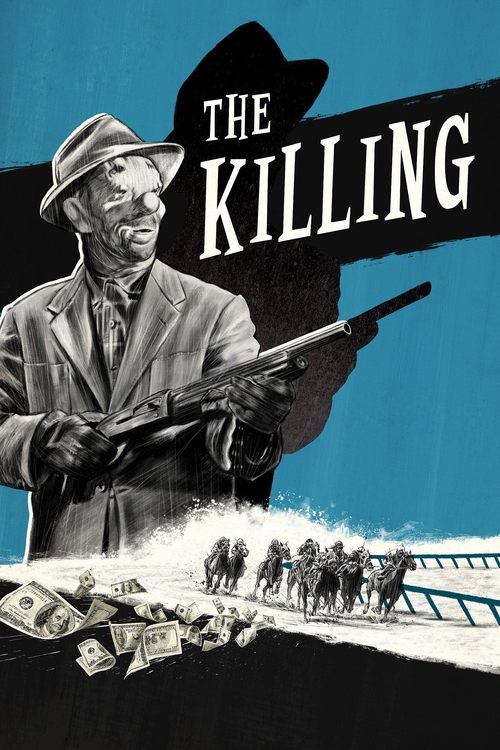
The Killing
"In all its fury and violence..."
Overview
In a masterful display of tension and precise storytelling, The Killing follows Johnny Clay, a hardened ex-convict who decides to pull off one final, massive score before settling down. His plan is to rob a high-stakes horse race of two million dollars. Rather than using seasoned criminals, Johnny recruits a team of desperate, seemingly ordinary men—a corrupt cop, a henpecked betting-window teller, a financially strapped bartender, and a lonely financier. Each man is a vital cog in an elaborate machine, assigned a highly specific task without knowing the full scope of the operation.
What sets the film apart is its groundbreaking, non-linear narrative structure. The story loops back on itself repeatedly, replaying the chronological timeline of the heist from the differing perspectives of the conspirators. This fractured approach builds relentless suspense, transforming the racetrack into an inescapable labyrinth where timing is paramount. The clinical, documentary-style narration counts down the minutes, creating a creeping sense of fatalistic doom.
However, despite Johnny's flawless logistics and clockwork precision, the operation's vulnerability lies in its human components. Unpredictable passions—driven by a manipulative wife, a violent opportunist, and an absurd stroke of terrible luck—threaten to dismantle the perfect crime. The film is a dark, cynical exploration of how even the most brilliant human endeavors are ultimately at the mercy of a chaotic and indifferent universe.
Core Meaning
At its core, The Killing explores the profound futility of human endeavor when faced with the overwhelming chaos of an indifferent universe. Stanley Kubrick uses the heist framework to deliver a deeply philosophical and pessimistic message: no matter how meticulously a person plans, calculates, and attempts to control their destiny, they cannot account for the sheer unpredictability of human nature and random chance.
The film suggests that man's desire to impose order and logic upon the world is an ultimate illusion. The master plan is defeated not by police brilliance or a flaw in the timeline, but by the irrationality of human emotions—greed, lust, and betrayal—and, ultimately, by cosmic absurdity in the form of a stray poodle and a gust of wind. The director underscores a fatalistic worldview where humanity is perpetually trapped in a losing game of chess against fate itself.
Thematic DNA
The Illusion of Control and Fate
Johnny Clay's heist is a triumph of logic, constructed with the precision of a master clockmaker. Yet, the film repeatedly demonstrates that true control is impossible. Fate intervenes through absurd, uncontrollable elements—a dropped horseshoe, a malfunctioning lock, a poorly made suitcase, and a dog on an airport tarmac. These random occurrences highlight the cosmic irony that destiny cannot be manipulated by human intellect.
Human Frailty and Greed
The mechanical perfection of the robbery is sabotaged by the deeply flawed, organic nature of the perpetrators. George Peatty's pathetic need for his wife's affection leads him to leak the plan, while Sherry Peatty's unadulterated greed and lust drive her to plot a secondary theft. The film posits that human emotions are inherently corrupting forces that will inevitably shatter any system of pure logic.
Time and Inevitability
Time is portrayed as a rigid, inescapable trap. The innovative non-linear structure, coupled with the relentless, clinical voiceover announcing the exact times of events, creates a claustrophobic atmosphere. The characters are locked into a deterministic loop; as the audience watches the same moments unfold from different angles, the sense of an unavoidable, tragic outcome becomes suffocating.
The Subversion of the American Dream
Unlike traditional gangsters, Johnny's crew consists of working-class men—a bartender, a police officer, a cashier—who have been failed by society. Burdened by sick wives, loan sharks, and inadequate wages, they turn to crime out of a desperate desire for upward mobility. The film acts as a cynical critique of post-war capitalism, where the promise of the American Dream can only be chased through illicit, self-destructive means.
Character Analysis
Johnny Clay
Sterling Hayden
Motivation
To execute the ultimate score so he can marry his loyal girlfriend, Fay, and permanently escape the criminal lifestyle.
Character Arc
Johnny begins as a stoic, supremely confident ex-convict who believes his intellect can conquer fate. He remains cool under pressure as his plan unfolds perfectly. However, his arc ends in absolute existential defeat; when his loot is blown away by airplane propellers, he transitions from an active mastermind to a passive, apathetic observer, accepting his arrest with a shrug.
Sherry Peatty
Marie Windsor
Motivation
Unadulterated greed and a desperate need to escape her suffocating, impoverished marriage.
Character Arc
Sherry begins as a deeply bitter, manipulative wife who despises her weak husband. Upon discovering the heist, she pivots to violent opportunism, plotting with her lover to steal the loot from the gang. Her arc culminates in a bloody shootout, where her greed leads to the death of her lover, and ultimately, her own murder at the hands of her betrayed husband.
George Peatty
Elisha Cook Jr.
Motivation
A desperate, all-consuming need to win the respect and affection of his unfaithful wife.
Character Arc
George is a pathetic, bullied man who joins the heist solely to buy his wife's love. As the narrative progresses, he realizes he has been played for a fool. His arc shifts tragically from desperate submission to explosive, vengeful violence as he slaughters the rival gang, stumbles home mortally wounded, and kills his wife before dying.
Marvin Unger
Jay C. Flippen
Motivation
Deep, self-sacrificing devotion and loyalty to Johnny Clay.
Character Arc
Marvin acts as the financial backer of the heist. He harbors a deep, seemingly unrequited romantic affection for Johnny, hoping the two of them can run away together after the job. His devotion is continually brushed aside, and he tragically ends up as collateral damage, killed in the shootout caused by Sherry's betrayal.
Symbols & Motifs
The Cheap Suitcase
The oversized, second-hand suitcase symbolizes Johnny's fatal hubris and the inherent vulnerability of human ambition. It represents the single, mundane oversight in an otherwise brilliant mastermind's multi-million dollar scheme.
Purchased hastily from a pawn shop, the suitcase is used to transport the $2 million to the airport. Its flimsy locks burst open on the tarmac when it falls from a cart, violently scattering the money and destroying Johnny's future.
The Horseshoe
The horseshoe serves as a classic symbol of luck, but in the bleak noir universe of the film, it represents rejected grace, bad karma, and ironic fate.
A Black parking attendant offers a good-luck horseshoe to the racist sniper, Nikki Arcane, who rejects it with a slur. Shortly after, Nikki's escape is thwarted when another horseshoe punctures his car tire, leading directly to his death.
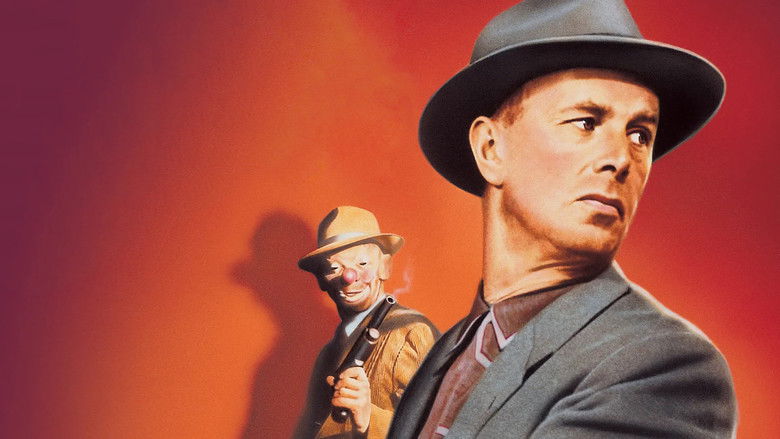
The Clown Mask
The mask represents the absurdity of the criminal endeavor and the necessary stripping of individual identity. It transforms the calculating human being into an anonymous, grotesque cog within the machinery of the heist.
Johnny wears the clown mask during the actual robbery in the money-counting room, providing a surreal, darkly comedic contrast to his ruthless efficiency and the deadly serious nature of the crime.
The Chess Board
Chess symbolizes strategic planning, intellect, and the manipulation of others as mere pawns in a larger game. It reflects both the director's own worldview and the protagonist's cold calculations.
Johnny meets the wrestler, Maurice, at a smoky chess club to recruit him. Johnny plays his accomplices just as he would chess pieces, sacrificing them for the ultimate checkmate, yet he forgets that human pawns have free will.
Memorable Quotes
Anytime you take a chance, you better be sure the rewards are worth the risk. Because they could put you away just as fast for a $10 heist as they can for a million dollar job.
— Johnny Clay
Context:
Johnny explains his reasoning for aiming for the monumental two-million-dollar racetrack score to his girlfriend, Fay.
Meaning:
This quote encapsulates the pragmatic, calculated philosophy of the career criminal. It highlights the logical, risk-reward assessment that drives Johnny's massive ambition.
What's the difference?
— Johnny Clay
Context:
The very last line of the film. Johnny says this to Fay when she begs him to run from the approaching detectives after the money has blown away across the tarmac.
Meaning:
The ultimate expression of nihilism and surrender. It underscores the film's core theme: the absolute futility of struggling against an absurd, uncaring universe once fate has decided to crush you.
You like money. You've got a great big dollar sign there where most women have a heart.
— George Peatty
Context:
George confronts his wife, Sherry, during an argument about her lack of affection and her overwhelming obsession with material wealth.
Meaning:
A blunt, tragic assessment of Sherry's true nature. It highlights the central destructive force of greed that ultimately unravels the entire criminal enterprise.
It isn't fair. I never had anybody but you. Not a real husband. Not even a man. Just a bad joke without a punch line.
— Sherry Peatty
Context:
Sherry viciously belittles George in their apartment, driving him further into his desperate need to prove himself by joining the heist.
Meaning:
This cruel dialogue reveals the toxic, emasculating dynamic of their marriage. It explains the depth of George's tragic motivation and establishes Sherry as a ruthless femme fatale.
Philosophical Questions
Is humanity ever truly in control of its own destiny?
The film meticulously constructs a scenario where human intellect attempts to master time and space. Johnny's plan is logically flawless, accounting for every second. Yet, it is entirely dismantled by random, irrational chance (a horseshoe, a stray dog). The film posits that true control in a chaotic, indifferent universe is nothing more than a tragic illusion.
Does the mechanization of modern life strip away our humanity?
Throughout the heist, characters are treated merely as functional cogs in a larger machine; they do not even know the full plan. To achieve success, they must abandon their individuality and become mechanical. However, the film shows that when base human nature (passion, jealousy, greed) inevitably reasserts itself, the machine spectacularly breaks down.
What holds more moral weight: a victimless crime against an institution, or intimate human betrayal?
Johnny rationalizes shooting a racehorse as "not murder at all" and focuses on stealing institutionally insured money, viewing it as a clean, victimless crime. However, the film contrasts this cold logic with the devastating, bloody violence that stems from intimate betrayal within the Peattys' marriage, questioning where true moral decay actually lies.
Alternative Interpretations
Subversion of the Hays Code: During the 1950s, the strict moral guidelines of the Hays Code dictated that criminals could not be shown getting away with their crimes; evil had to be punished. On the surface, the film complies, as Johnny loses the money and faces arrest. However, many critics interpret the ending as Kubrick maliciously mocking the Code. By having the heist ruined not by justice or police work, but by a ridiculous, farcical accident (a poodle running onto the tarmac causing the wind to blow the money away), Kubrick fulfills the censorship requirements through deep, sarcastic absurdity rather than genuine moral retribution.
The Queer Subtext of Marvin Unger: Many film scholars point to a strong homosexual subtext in the character of Marvin Unger. Marvin finances the heist out of seemingly unrequited devotion to Johnny. In one notable scene, Marvin sits affectionately on Johnny's bed and wistfully suggests that the two of them run away together to "let the old world take a couple of turns." In an era where overt homosexuality was banned on screen, this interpretation posits that Marvin's tragic arc is driven by suppressed love rather than financial greed.
Cultural Impact
Historical Context and Cinema Influence: Released in 1956, The Killing violently broke the boundaries of traditional chronological storytelling in Hollywood. By presenting overlapping perspectives and fractured timelines, Kubrick introduced a complex narrative style that was far ahead of its time. The film is universally recognized as a seminal masterpiece of the film noir genre, redefining the mechanics of the heist movie by focusing heavily on the procedural elements and the inevitability of failure.
Influence on Modern Filmmakers: The film's legacy is perhaps most visible in the work of modern auteurs, most notably Quentin Tarantino. Tarantino has explicitly cited The Killing as the primary structural inspiration for his groundbreaking films Reservoir Dogs and Pulp Fiction, heavily borrowing its non-linear approach and focus on the grim aftermath of a crime gone wrong.
Critical Reception and Legacy: Though initially ignored by mainstream audiences and dumped as a B-movie double feature, critics immediately recognized its brilliance. Time magazine praised its tight script and direction. Culturally, it cemented Stanley Kubrick's reputation as a prodigy and a master filmmaker, effectively launching his legendary Hollywood career. The image of the stolen cash blowing wildly in the airplane propellers has since become one of cinema's most iconic visual metaphors for the futility of greed.
Audience Reception
Aggregated Criticisms and Praises: Modern and contemporary audiences widely praise The Killing for its incredibly tight script, breathless pacing, and the innovative, non-linear storytelling that keeps viewers on edge despite knowing the doomed outcome. Lucien Ballard's crisp, deep-focus cinematography and the gritty, pulp-dialogue performances of Sterling Hayden and Marie Windsor are frequently highlighted as high-water marks of the noir genre.
Main Points of Contention: The primary criticism, shared by Kubrick himself, is the heavy-handed, clinical voiceover narration. Added at the behest of studio executives who feared test audiences were confused by the jumping timeline, the narrator is often seen as an unnecessary crutch that slightly dates the film. Additionally, modern audiences sometimes find the blatant racism expressed by the sniper character, Nikki Arcane, deeply uncomfortable, though it serves to highlight his villainy.
Overall Verdict: The Killing is overwhelmingly regarded as a masterclass in tension, a foundational text of neo-noir and non-linear cinema, and an essential, flawless early entry in Stanley Kubrick's legendary filmography.
Interesting Facts
- Stanley Kubrick was only 27 years old when he directed the film, which was his third feature and first major critical success.
- The film's groundbreaking non-linear structure initially confused test audiences, leading the studio to force Kubrick to recut it chronologically. When this proved even more confusing, the original non-linear cut was restored.
- Sterling Hayden was paid $40,000 for his lead role, while Stanley Kubrick took no fee as the director of the film.
- During the making of the film, Sterling Hayden was actually under active FBI surveillance due to his past communist affiliations.
- The film was produced on an extremely modest budget of around $320,000 and was shot in just 24 days.
- Kola Kwariani, who plays the brawling chess player Maurice, was a real-life professional wrestler and chess player whom Kubrick knew from his days hustling chess games in New York.
- United Artists effectively dumped the film by releasing it as the second half of a double feature, but it so impressed Kirk Douglas that he hired Kubrick to direct Paths of Glory.
Easter Eggs
Lenny Bruce Poster
As Johnny leaves the store after purchasing the fateful cheap suitcase, an advertising poster on the wall just beyond his car promotes a burlesque show featuring a then-unknown comedian named Lenny Bruce.
Stanley K. the Racehorse
During the race where the characters gather for a meeting, one of the horses running is named "Stanley K" as a sly, self-referential nod to director Stanley Kubrick.
Timothy Carey's Funhouse Reflection
When the sniper Nikki (Timothy Carey) is shot, his face is reflected in a distorted, carnival-style mirror. The distortion makes him look remarkably equine, echoing the whinnying face of the horse he cruelly assassinated moments earlier.
⚠️ Spoiler Analysis
Click to reveal detailed analysis with spoilers
Frequently Asked Questions
Explore More About This Movie
Dive deeper into specific aspects of the movie with our detailed analysis pages
Comments (0)
No comments yet. Be the first to share your thoughts!