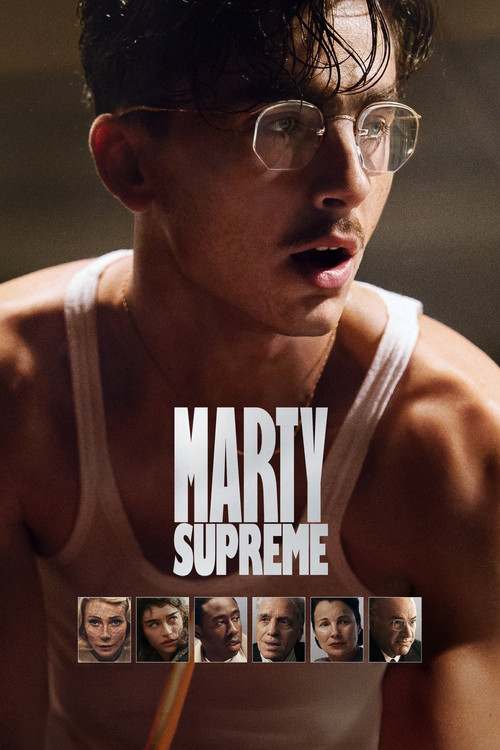
Marty Supreme
"Dream big."
Overview
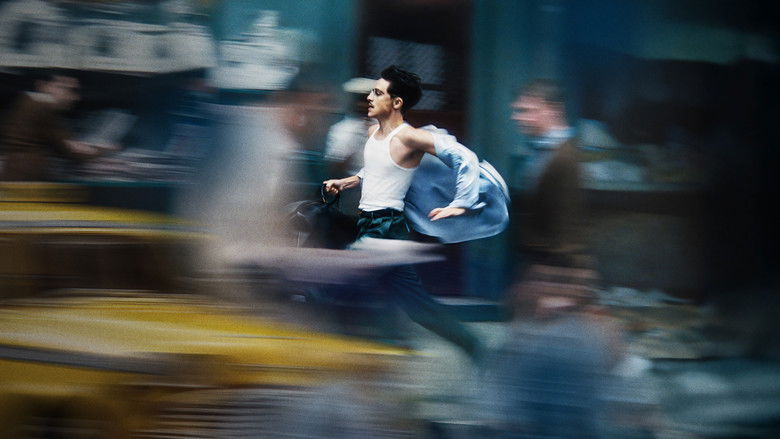
Set in the bustling, neon-lit grit of 1950s New York City, Marty Supreme follows Marty Mauser (Timothée Chalamet), a shoe salesman with a divine belief in his own destiny as the world's greatest table tennis player. Feeling suffocated by his pedestrian life and overbearing mother, Marty hustles his way into the underground ping pong circuit. His ambition is a destructive force that propels him through a series of chaotic misadventures, including an illicit affair with his married childhood friend Rachel and a calculated seduction of wealthy socialite Kay Stone to fund his dreams of global domination.
The film moves at a breakneck pace, capturing Marty's ascent from local hustler to international competitor. As he travels to London and eventually Japan, Marty's obsession alienates those closest to him. He faces off against bureaucratic villains like Milton Rockwell and formidable athletic rivals like Koto Endo. The narrative is a relentless series of high-stakes games—both on and off the table—where the line between winning a match and losing one's soul becomes increasingly blurred.

Core Meaning
At its heart, Marty Supreme is a deconstruction of the American Dream as a form of pathology. Director Josh Safdie uses the niche, high-speed world of table tennis to explore how pure, unadulterated ambition can manifest as a sickness. The film suggests that greatness requires a level of delusion and selfishness that is incompatible with a normal, moral life. It posits that the true "winner" is often the one willing to burn every bridge to keep the ball in play, questioning whether the glory of the podium is worth the wreckage left in the wake.
Thematic DNA
The Toxicity of Ambition
Marty's drive is depicted not as a virtue but as a compulsive need that destroys his relationships. His willingness to steal from family and exploit lovers illustrates that for him, success is a zero-sum game where everyone else is a pawn.
Self-Mythologizing
Marty constantly rewrites his own narrative, refusing to accept reality. The film explores how charisma and confidence can bend the truth, allowing characters to live in a delusion of their own making until reality inevitably crashes in.
Transactional Relationships
Every interaction Marty has is weighed by what he can gain. His romance with Kay Stone is a strategic move for funding, and his connection to Rachel is maintained only as long as she supports his ego, highlighting the commodification of human connection.
The Chaos of Destiny
The visual motif of the bouncing ball represents the erratic, uncontrollable nature of fate. Despite Marty's attempts to control his path, the film shows that luck and chaos play as much a role as talent.
Character Analysis
Marty Mauser
Timothée Chalamet
Motivation
To escape mediocrity and prove to the world (and himself) that he is 'supreme' and destined for greatness.
Character Arc
Starts as a small-time dreamer feeling trapped; rises through ruthless manipulation; faces a crisis of conscience where he must choose between selling out for security or winning for pride; ends with a pyrrhic victory that cements his identity.
Kay Stone
Gwyneth Paltrow
Motivation
To feel relevant and desired again, escaping the boredom of her wealthy, retired life.
Character Arc
Initially appears as a trophy wife and target for Marty's grift, but reveals herself to be a shrewd operator who understands the transactional nature of their affair better than he does.
Milton Rockwell
Kevin O'Leary
Motivation
To possess and monetize success; to maintain control over the 'game'.
Character Arc
Remains a static force of corporate malevolence, serving as the ultimate obstacle that tries to buy and control Marty's talent.
Rachel Mizler
Odessa A'zion
Motivation
Love and a desire for excitement beyond her conventional marriage.
Character Arc
moves from a willing accomplice in Marty's life to a casualty of his selfishness, ultimately forcing him to confront the human cost of his ambition.
Symbols & Motifs
The Ping Pong Ball
Symbolizes the fragile, high-speed nature of Marty's ego and the concept of conception/destiny.
Used in the opening credits to resemble a fertilized egg and throughout the film as the singular point of focus that dictates Marty's entire existence.
The Shoe Store
Represents the suffocating, mundane reality of the working class that Marty is desperate to escape.
Marty works here for his uncle; the cramped, dull environment contrasts sharply with the glitz of the tournaments and the Ritz hotel.
The Vampire
A metaphor for the extractive nature of capitalism and the 'gatekeepers' of success.
Milton Rockwell explicitly compares himself to a vampire who has lived for centuries, feeding on the ambitions of young dreamers like Marty.
Vintage Anamorphic Lenses
Visual distortion representing the warped perspective of the protagonist.
The cinematography uses specific vintage lenses that blur the edges of the frame, isolating Marty in the center and mimicking his tunnel vision.
Memorable Quotes
I was born in 1601. I'm a vampire. I've been around forever.
— Milton Rockwell
Context:
Rockwell delivers this chilling monologue to Marty, explaining why he will always win and why Marty is just another passing fad.
Meaning:
A metaphorical declaration of how the wealthy elite feed on the youth and talent of every generation.
That doesn't even enter my consciousness.
— Marty Mauser
Context:
Said when confronted with the overwhelming odds and the likely possibility of his defeat.
Meaning:
Encapsulates Marty's absolute refusal to acknowledge failure or reality; his superpower is his delusion.
I have a purpose. And if you think that's some sort of blessing, it's not. It means I have an obligation.
— Marty Mauser
Context:
Marty trying to explain to his family why he cannot simply live a normal life.
Meaning:
Reframes his selfish ambition as a burden or a holy calling, justifying his terrible behavior.
You go out and win that game, you're gonna be here forever too. And you'll never be happy.
— Milton Rockwell
Context:
The final ultimatum given to Marty before his match against Endo.
Meaning:
A curse disguised as advice; winning the championship means becoming part of the soulless system Rockwell controls.
I'm Hitler's worst nightmare.
— Marty Mauser
Context:
Marty making an inappropriate joke at a swanky dinner party, showcasing his lack of social grace.
Meaning:
A dark, humorous assertion of his Jewish identity and his resilience, showing his tendency to aggrandize his own existence.
Philosophical Questions
Is greatness compatible with happiness?
The film consistently juxtaposes Marty's euphoric highs on the table with his miserable, chaotic personal life, suggesting one cannot exist with the other.
Do we choose our destiny, or does it choose us?
Marty believes he is 'chosen,' but the film leaves it ambiguous whether he is actually special or just obsessively willing to destroy himself for a delusion.
Alternative Interpretations
The Purgatory Theory: Some critics argue that the entire film is a form of purgatory or fever dream, evidenced by the 'vampire' speech and the cyclical nature of Marty's failures. He is doomed to repeat his hustle forever.
The Anti-Rocky: Unlike traditional sports movies where the underdog victory validates the struggle, this film can be interpreted as a tragedy where 'winning' the final match actually cements Marty's isolation and inability to connect with human beings, trapping him in his own ego.
Cultural Impact
Released in late 2025, Marty Supreme immediately reignited interest in mid-century New York aesthetics and the sport of table tennis, similar to how The Queen's Gambit popularized chess. Critics praised it as a return to form for 'cinema of anxiety,' cementing Timothée Chalamet's status as a versatile character actor capable of shedding his heartthrob image for something grittier and more manic. The film's unique casting, blending Hollywood A-listers with reality TV stars like Kevin O'Leary and musicians like Tyler, The Creator, sparked conversations about the blurring lines of celebrity culture. It is viewed as a key text in the post-Safdie brothers era, proving Josh Safdie's singular vision remains potent solo.
Audience Reception
Praised: Audiences were electrified by the film's pacing and Timothée Chalamet's transformative, high-energy performance. The visual style and Daniel Lopatin's score were highlighted as immersive and unique.
Criticized: Some viewers found the relentless anxiety and the unlikable nature of the protagonist exhausting. The ending polarized audiences, with some finding it abrupt or morally ambiguous.
Verdict: A polarizing but undeniably well-crafted film that is considered a 'stressful masterpiece' by fans of the genre.
Interesting Facts
- Kevin O'Leary's famous 'vampire' speech was not in the original script; it was suggested by O'Leary himself during filming.
- Josh Safdie considered an ending that flashed forward to the 1980s showing an older Marty at a Tears for Fears concert, but decided to keep the ending in the 50s.
- The character of Marty Mauser is loosely based on real-life table tennis legend Marty Reisman, who was known for his hustle and showmanship.
- Cinematographer Darius Khondji used vintage Panavision C Series anamorphic lenses to create the film's distinct period look, often shooting actors in extreme close-up.
- Production wrapped with a scene between Odessa A'zion and Fran Drescher, emphasizing the domestic conflict.
- Real-life table tennis champion Koto Kawaguchi was cast as the antagonist Koto Endo despite having no prior acting experience.
- Timothée Chalamet performed many of his own table tennis stunts after extensive training, though some digital enhancements were used for impossible shots.
Easter Eggs
Cameo by Abel Ferrara
The legendary director plays Ezra Mishkin, a nod to the gritty, independent New York cinema lineage that the Safdie brothers descend from.
Tears for Fears reference
Though the flash-forward was cut, the synthesizer score by Daniel Lopatin pays homage to the emotional texture of 80s pop, creating anachronistic resonance.
The 'Marty Supreme' Ball
Marty pitches a novelty orange ball with his face on it; this references the real Marty Reisman's history of self-promotion and merchandising.
⚠️ Spoiler Analysis
Click to reveal detailed analysis with spoilers
Frequently Asked Questions
Explore More About This Movie
Dive deeper into specific aspects of the movie with our detailed analysis pages
Comments (0)
No comments yet. Be the first to share your thoughts!