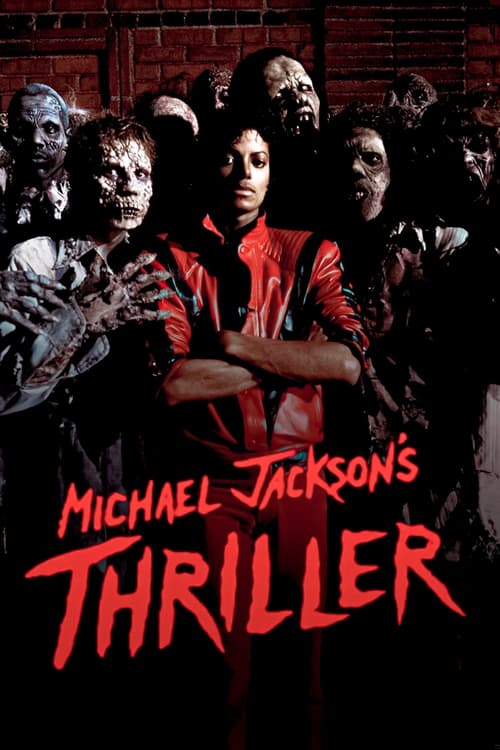
Michael Jackson's Thriller
"No one's gonna save you from the beast about to strike"
Overview
"Michael Jackson's Thriller" is a short film that begins with a scene reminiscent of 1950s horror movies. Michael and his girlfriend, played by Ola Ray, are on a date when their car runs out of gas in a dark, wooded area. Michael gives her a ring, but then warns her he's "not like other guys" before transforming into a werecat under the full moon and attacking her. The scene then abruptly cuts to a 1980s movie theater where Michael and Ola are watching this very film. Ola is frightened and leaves, and Michael follows, teasing her by singing the verses of "Thriller" as they walk down a foggy street.
Their walk takes them past a graveyard, from which zombies begin to rise, prompted by a sinister narration from horror icon Vincent Price. Michael and Ola find themselves surrounded by the undead. In a shocking twist, Michael transforms into a zombie himself and leads the horde in a highly synchronized and now-iconic dance sequence. The terrified girlfriend flees and is chased into a derelict house. The zombies, with Michael at the forefront, break in and corner her.
Core Meaning
"Michael Jackson's Thriller" is a multi-layered work that explores the transition from innocence to experience and the duality of human nature. On the surface, it's a tribute to classic horror films, but at its core, it delves into themes of adolescent anxieties, burgeoning sexuality, and the fine line between fantasy and reality. Director John Landis has suggested that the transformations Michael undergoes—from a boy-next-door to a werecat and a zombie—can be seen as metaphors for the frightening and uncontrollable changes of puberty. The film-within-a-film structure constantly forces the audience to question what is real, suggesting that the horrors we imagine can be just as potent as those we experience. Ultimately, the film is a celebration of the horror genre while also serving as a complex allegory for personal transformation and the thrill of confronting one's own fears.
Thematic DNA
Transformation and Duality
The most prominent theme is transformation, both literal and metaphorical. Michael's character physically transforms into monstrous figures—a werecat and a zombie. This duality reflects a common horror trope and also serves as a metaphor for the changes of adolescence and the darker, primal instincts that lie beneath a civilized exterior. The film plays with the idea that the charming, boy-next-door figure can harbor a monstrous side, blurring the lines between good and evil.
Fear and Coming of Age
The short film uses the horror genre to explore youthful anxieties and the rite of passage from innocence to experience. Director John Landis viewed the werecat transformation as a metaphor for puberty, with its confusing and dramatic physical and emotional changes. The entire narrative can be seen as an allegory for confronting adolescent fears, including those related to sexuality and the unknown. The playful yet genuinely scary tone captures the thrilling and terrifying nature of growing up.
Blurring Reality and Fantasy
"Thriller" masterfully plays with the audience's perception of reality. It begins with a film-within-a-film, immediately establishing a meta-narrative. The girlfriend is scared by the movie, only to find herself in a seemingly real-life horror scenario. The ending, where she wakes up from a supposed dream only for Michael to turn to the camera with glowing yellow eyes, leaves the audience in a state of ambiguity, questioning what was real and what was fantasy.
Performance as Power
In the face of terror, Michael's character doesn't just succumb to his monstrous transformation; he masters it through performance. The iconic zombie dance is a moment of empowerment, turning a horrifying situation into a display of choreographed artistry. This suggests that art and performance can be a way to control and express one's inner demons, transforming fear into a source of power and spectacle.
Character Analysis
Michael
Michael Jackson
Motivation
Initially, his motivation appears to be simple youthful romance. However, as the horror elements unfold, his motivation becomes more ambiguous. In the film-within-a-film, he is a predator. In the main narrative, he teases his girlfriend with the thrill of fear, and later leads the zombies. A potential interpretation of the song's lyrics is that he's using the scary scenario to get his date to "cuddle close together," a form of playful manipulation.
Character Arc
Michael's character undergoes a series of transformations that drive the narrative. He begins as a charming, boy-next-door type in two different eras (the 50s and 80s). His arc involves embracing a darker, monstrous side, first as a werecat and then as a zombie. However, instead of being a purely villainous monster, he becomes the charismatic leader of the undead, turning horror into a spectacular performance. His final glance at the camera suggests this darker side is an integral, perhaps permanent, part of him, representing a complex integration of innocence and experience.
Ola
Ola Ray
Motivation
Her motivation is straightforward: survival. Once the scary movie becomes too real, and later when the zombies appear, her sole objective is to escape the terrifying situation and get to safety. She is driven by a primal fear of the monstrous events unfolding around her.
Character Arc
Ola's character serves as the audience's surrogate, reacting with believable fear to the supernatural events. She transitions from a confident young woman on a date to a terrified victim. Her arc follows the classic horror movie trope of the "final girl," who is pursued by the monster(s). She doesn't have a significant developmental arc beyond reacting to the escalating horror around her, embodying the vulnerability and terror central to the genre.
The Narrator
Vincent Price
Motivation
His motivation is to create a sense of terror and suspense. As a classic horror icon, his very voice invokes the genre's history. His spoken-word performance is designed to explain the rules of this horrific world and to ensure the audience understands the grave danger the characters are in.
Character Arc
Vincent Price's character is not physically present but serves as a disembodied, omniscient narrator. His role is to heighten the atmosphere of dread and to officially usher in the supernatural horror. He doesn't have an arc but acts as a master of ceremonies for the macabre, delivering a chilling rap that sets the stage for the zombies' arrival and articulates the inescapable nature of the "Thriller."
Symbols & Motifs
The Full Moon
The full moon is a classic horror symbol that traditionally triggers transformations, most notably into werewolves. In "Thriller," it symbolizes the unleashing of primal instincts and hidden desires. It is the catalyst for Michael's first transformation, representing an uncontrollable force of nature that reveals his hidden, monstrous side.
It appears during the 1950s-style film-within-a-film, right before Michael transforms into a werecat. Its presence immediately signals a shift from a romantic moment to one of classic horror.
The Zombie Dance
The synchronized dance of the zombies represents a subversion of horror. Instead of being mindless, terrifying creatures, they become performers in a grand, artistic spectacle. It symbolizes the power of music and dance to unify and to transform something frightening into something captivating and even joyful. It also highlights Michael's control over the forces of darkness, leading them rather than being consumed by them.
This is the centerpiece of the film, occurring after Michael and his girlfriend are surrounded by zombies in the street. Michael joins them, leading a complex, iconic dance routine before they resume their pursuit of his girlfriend.
Michael's Red Jacket
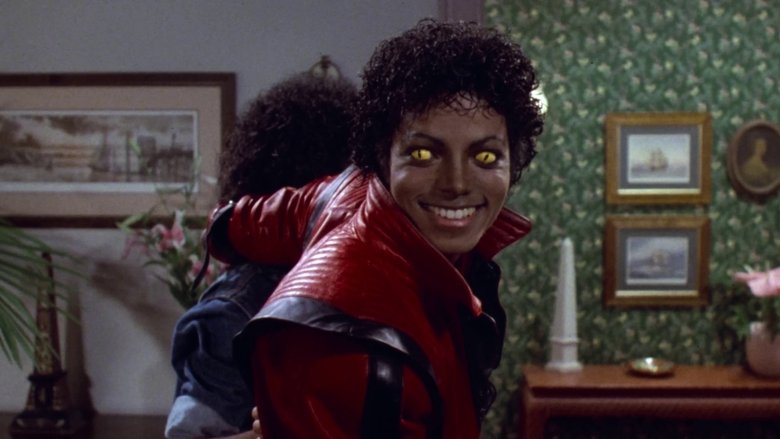
The vibrant red jacket, designed by Deborah Nadoolman Landis, has become an iconic piece of fashion history. In the context of the film, the color red often symbolizes danger, passion, and blood. It makes Michael stand out amidst the dark, gloomy settings and the pale, decaying zombies, signifying his status as the central figure who is both part of the horror and the hero of the spectacle.
Michael wears this jacket during the main 1980s storyline, including the famous zombie dance sequence. Its bright color is a stark contrast to the muted tones of the graveyard and the zombies' decaying clothes.
The Movie Theater
The movie theater serves as a framing device and a symbol of the boundary between fiction and reality. It represents a safe space where horror can be consumed as entertainment. By having the characters watch a horror film that mirrors their later experiences, the video breaks the fourth wall and questions the safety of that boundary.
After the opening werecat scene, the film cuts to Michael and Ola in a movie theater, revealing the previous events were a film they were watching. Ola's fear prompts them to leave, leading them from the fictional horror on screen to a seemingly real one outside.
Memorable Quotes
Due to my strong personal convictions, I wish to stress that this film in no way endorses a belief in the occult.
— Disclaimer Text
Context:
This text appears on a title card at the very beginning of the short film, before any action takes place.
Meaning:
This opening disclaimer was added by Michael Jackson to appease leaders of his Jehovah's Witness faith, who were concerned that the video promoted demonology. It creates a fascinating layer of meta-commentary before the film even begins, highlighting the real-world conflict between Jackson's faith and his artistic expression.
I'm not like other guys.
— Michael
Context:
Spoken during the 1950s film-within-a-film sequence, right after Michael gives his girlfriend a ring and just before the full moon appears, triggering his transformation.
Meaning:
This line serves as a classic piece of foreshadowing and a massive understatement. It's delivered with an air of innocence, but it ominously precedes his monstrous transformation into a werecat. The line encapsulates the film's central theme of hidden duality—the idea that something monstrous can lurk beneath a seemingly normal exterior.
Darkness falls across the land, the midnight hour is close at hand. Creatures crawl in search of blood, to terrorize your neighborhood.
— The Narrator (Vincent Price)
Context:
This narration begins as Michael and Ola walk past the graveyard, just before the corpses begin to rise from their graves.
Meaning:
This is the beginning of Vincent Price's iconic spoken-word performance. It functions as a classic horror trope, with a "voice of God" narration that sets a gothic, terrifying scene. Written by Rod Temperton, the rap is a perfect homage to classic horror and elevates the short film from a simple music video to a cinematic event. It explicitly signals the shift from a playful, romantic evening to a full-blown supernatural nightmare.
Philosophical Questions
What is the true nature of a 'monster'?
The film explores the concept of the monster as something that resides within us. Michael is not attacked by an external force; the monster is a part of him that is unleashed. However, his monstrous forms are not purely evil. As a zombie, he becomes a charismatic leader and artist. This raises questions about whether monstrosity is inherently evil or simply a manifestation of a primal, untamed aspect of our nature. The film challenges the simple binary of human versus monster, suggesting a more complex and integrated reality.
Where is the line between fantasy and reality?
"Thriller" deliberately blurs this line from the beginning with its film-within-a-film structure. The audience is constantly asked to re-evaluate what is real within the narrative's context. The dream sequence that turns out to be not-quite-a-dream further complicates this. The film suggests that the fears and fantasies we create in our minds (or watch on a screen) can have a powerful and tangible impact on our reality, and that the boundary between the two is more permeable than we think.
Alternative Interpretations
While the most common interpretation of "Thriller" centers on it being a tribute to horror films and an allegory for puberty, several alternative readings exist. One interpretation views the entire narrative as a metaphor for the anxieties of a young Black man navigating American society. Michael's transformation into a "monster" can be seen as a representation of racial stereotypes and the demonization of Black masculinity. In this reading, the choreographed dance is an act of communal strength and defiance, turning a perceived threat into a powerful, unified expression of identity.
Another interpretation focuses on the lyrics of the song itself, rather than the video's narrative. Some analyses suggest the song is about a man using the tropes of a scary movie to manipulate his date into seeking physical comfort from him. Lines like "I'll save you from the terror on the screen" and the goal to "cuddle close together" suggest a more calculated, playful seduction, where the horror is a manufactured tool for romance. This reading views the story less as a supernatural event and more as a clever, and perhaps slightly mischievous, dating tactic.
Finally, the ending's ambiguity has led to various theories. The reveal that it was "just a dream," followed by Michael's glowing eyes, suggests a cyclical narrative. This could be interpreted as a commentary on the inescapable nature of our inner demons or a critique of the audience's inability to distinguish between the performer's persona and their true self. The horror, in this case, might not be over; it may have just begun, or it may be an inseparable part of Michael's identity.
Cultural Impact
The cultural impact of "Michael Jackson's Thriller" cannot be overstated; it fundamentally transformed the music industry and popular culture. Released on December 2, 1983, it shattered the conventions of what a music video could be, elevating the medium from a simple promotional tool to a legitimate cinematic art form. Director John Landis brought feature film production values, a narrative plot, character development, and elaborate special effects to the music video format, creating a 14-minute "short film" that was an event in itself.
Historically, "Thriller" played a crucial role in breaking racial barriers on television. In the early 1980s, MTV was notoriously reluctant to play videos by Black artists. The monumental success and undeniable quality of "Thriller" and other videos from the album, like "Billie Jean" and "Beat It," forced the network's hand, opening the doors for a generation of Black musicians. This helped establish Michael Jackson as a global icon who transcended race and genre, becoming the undisputed "King of Pop."
The film's influence on cinema and music videos is immense and enduring. It proved that music videos could be a significant revenue stream, with the accompanying documentary, "Making Michael Jackson's Thriller," becoming the best-selling VHS tape of its time. Countless artists and directors have since been influenced by its narrative ambition and cinematic scale. The choreography, particularly the zombie dance, has become one of the most recognizable routines in pop culture history, endlessly replicated in flash mobs, weddings, and films. In 2009, its significance was officially recognized when it became the first and only music video to be inducted into the National Film Registry by the Library of Congress.
Audience Reception
Upon its premiere on MTV on December 2, 1983, "Michael Jackson's Thriller" was met with unprecedented anticipation and overwhelming acclaim from audiences. Viewers were captivated by its cinematic quality, groundbreaking special effects, and iconic choreography. The public demand was so immense that MTV began airing the 14-minute video multiple times an hour. The short film was a ratings juggernaut, and its popularity had a direct and massive impact on album sales, doubling them and helping to cement "Thriller" as the best-selling album of all time. The accompanying documentary, "Making Michael Jackson's Thriller," also sold over a million copies on VHS, a testament to the public's fascination. The zombie dance became a global phenomenon, with people of all ages learning the steps. The film was universally praised for its ambition and execution, solidifying Jackson's status as a global superstar. There was very little criticism from audiences at the time, as the film was seen as a monumental achievement in entertainment.
Interesting Facts
- The 14-minute short film cost approximately $500,000 to make, which was an unprecedented budget for a music video at the time. Michael Jackson's record label, Epic Records, refused to fund it, so a documentary called "Making Michael Jackson's Thriller" was created and sold to MTV and Showtime to finance the project.
- Michael Jackson, a devout Jehovah's Witness at the time, faced pressure from his church leaders who believed the video promoted demonology. He almost had the master tapes destroyed, but was convinced not to. The opening disclaimer was added as a compromise.
- Director John Landis was hired by Jackson after he saw Landis's horror-comedy film "An American Werewolf in London" (1981). The special effects makeup artist from that film, Rick Baker, was also brought on to create the transformations for "Thriller."
- The iconic red leather jacket with its distinctive V-shaped black stripes was designed by Deborah Nadoolman Landis, the director's wife. She also designed Indiana Jones's jacket in "Raiders of the Lost Ark."
- The song "Thriller" was originally titled "Starlight" and had a completely different lyrical concept. Songwriter Rod Temperton was asked by producer Quincy Jones to come up with something more suited for Michael Jackson's love of horror movies.
- Horror legend Vincent Price, who performed the spoken-word section, reportedly recorded his part in just a couple of takes.
- Ola Ray, who played Michael's girlfriend, was a Playboy Playmate of the Month in June 1980.
- The video was so popular that MTV would often air it multiple times per hour to meet audience demand.
- In 2009, "Michael Jackson's Thriller" became the first music video to be selected for preservation in the National Film Registry by the Library of Congress for being "culturally, historically, or aesthetically significant."
- The zombie dance was choreographed by Michael Peters, who had previously choreographed Jackson's "Beat It" video.
Easter Eggs
During the movie theater scene, one of the characters in the on-screen film says, "See you next Wednesday."
This is a recurring inside joke and Easter egg in director John Landis's films. He includes the phrase, which is the title of a screenplay he wrote as a teenager, in most of his movies, including "An American Werewolf in London," "The Blues Brothers," and "Trading Places."
⚠️ Spoiler Analysis
Click to reveal detailed analysis with spoilers
Frequently Asked Questions
Explore More About This Movie
Dive deeper into specific aspects of the movie with our detailed analysis pages
Comments (0)
No comments yet. Be the first to share your thoughts!