Skip to content
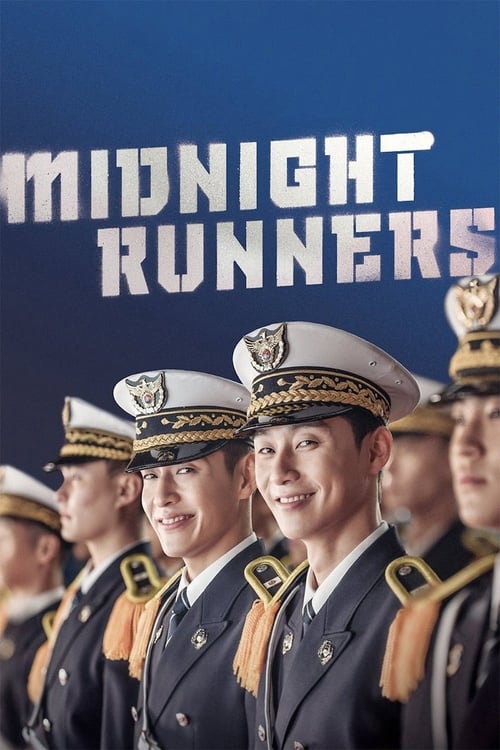
Midnight Runners
A buoyant buddy-cop adrenaline rush shot through neon-lit Seoul nights, where youthful bravado turns into real courage. Laughter and dread run side by side, like two cadets sprinting down a dark alley toward something they can't yet see.
Midnight Runners

Midnight Runners

청년경찰

"Trainees by day, detectives by night."

09 August 2017 South Korea 109 min 7.5 (263)

Director: Jason Kim

Cast: Park Seo-jun, Kang Ha-neul, Sung Dong-il, Park Ha-seon, Go Joon

Crime Action Thriller Comedy Justice versus bureaucracy Friendship and bromance Youthful idealism and growing up Rules versus conscience Social crime and vulnerability

Overview

Midnight Runners (청년경찰, literally "Young Cop") is a 2017 South Korean action comedy written and directed by Jason Kim (Kim Joo-hwan). It follows Ki-joon (Park Seo-joon) and Hee-yeol (Kang Ha-neul), best friends and students at the Korean National Police University. They bond through the academy's strict training, haircuts, drills and rules.

On a night out, the two witness a young woman being abducted in front of them. They report it by the book, but the police are slow to act. The cadets aren't legally allowed to investigate, and doing so could get them expelled. They decide to act on their own anyway.

The film starts as slapstick and academy comedy. It then moves into a mystery and a race against time with real action set pieces and a darker social crime at its center. Sung Dong-il and Park Ha-sun play the mentors who watch over them.
Core Meaning

The film argues that being a good police officer means more than following procedure. Sometimes doing the right thing means bending the rules. One reviewer put it as a message that rules matter but life should be lived with nuance. The "grown-ups" are shown as bureaucratic and overloaded, while the young cadets keep the plain instinct to help someone in danger.

Jason Kim wraps this in a crowd-pleasing, feel-good package. Comedy disarms the audience, so the moral lands without feeling like a lecture. The film is also an affectionate portrait of friendship, and a gentle critique of institutions that forget why they exist.

Thematic DNA

Justice versus bureaucracy 30%
Friendship and bromance 25%
Youthful idealism and growing up 20%
Rules versus conscience 15%
Social crime and vulnerability 10%

Justice versus bureaucracy

The police respond slowly because of caseloads and orders. The cadets' outrage contrasts with their professor's reasoning that all victims count equally. The film shows an institution caged by procedure, and the heroes' impulse to act directly.

Friendship and bromance

Ki-joon and Hee-yeol have private jokes, a secret handshake and complementary personalities, one impulsive and one cautious. Their loyalty drives the story and the comedy.

Youthful idealism and growing up

Two aimless recruits are tested by a real crime. They start out unserious about police work and become people who take responsibility. Told to leave things to the grown-ups, they refuse.

Rules versus conscience

Their academy status forbids investigating and risks expulsion. They choose to act, and the film says moral duty can outweigh the letter of the rule.

Social crime and vulnerability

Critics note the film's turn into human trafficking and organ harvesting. Its victims are ordinary young women whom nobody is hurrying to save.

Character Analysis

Ki-joon

Park Seo-joon

Archetype: Hero, the impulsive man of action Key Trait: Brave and instinctive

Motivation

To do what's right and help a person in need, even when the rules forbid it.

Character Arc

He begins as a fashion-conscious, somewhat unserious cadet. He grows into a committed protector who puts himself at risk for a stranger.

Hee-yeol

Kang Ha-neul

Archetype: Hero, the cautious thinker Key Trait: Analytical and diligent

Motivation

To follow the academy's teachings in spirit, saving the victim while using his brains.

Character Arc

He starts out careful and by the book. He ends up using his knowledge and courage in the field.
All 4 characters and cast

Symbols & Motifs

The police academy uniform and haircut

Meaning: Institutional conformity and the identity the cadets have to earn.
Context: The film opens with entrance-ceremony haircuts. The boys' fussing over their hair shows their vanity and immaturity, which the story later strips away.

The secret handshake

Meaning: The intimacy and loyalty of the friendship.
Context: The pair share a cute secret handshake that recurs in the lighter moments, and it anchors the comedy emotionally.

The pink parka

Meaning: Innocence and vulnerability, and the stakes of the rescue.
Context: The abducted girl is spotted in a pink parka just before the boys watch her being taken, so the colour marks the moment the night turns serious.

Night and the club district

Meaning: The glamorous surface of the city, and the danger underneath it.
Context: The boys feel excluded at the upscale Club Octagon, then stumble onto a crime in the same streets.

Running

Meaning: Urgency, youth and moral commitment.
Context: The English title evokes the race against time as the cadets chase leads on foot, running circles around the block, and later chase the kidnappers.

Philosophical Questions

Is it right to break the rules to do the right thing?

The cadets risk expulsion to rescue a stranger. The film sides with conscience but acknowledges the cost, and it suggests the answer depends on the situation.

Can institutions treat every life as equally important and still save them all?

The professor argues that all victims are equal and the squad can't drop its current cases. The boys feel that fairness is being used to excuse inaction.

What does it mean to be a protector?

Their training teaches them to help those in need. Only when they act on it, at personal risk, do they become the officers they are meant to be.

How It Ends

Alternative Interpretations

Some read the film as a warm defence of the police. One reviewer noted it paints a rosier picture of the force and described the police as heroes caged by bureaucracy. Others read it as sharp criticism of the legal and social system, since officials fail the victim until amateurs step in. A third reading sees a coming-of-age story that follows a familiar fight-movie structure: start the path, meet an enemy you can't beat, train, then win.

Full ending explanation

Cultural Impact

The film was a surprise hit. Early anticipation was reportedly lukewarm, with trailers aimed at female audiences through the good-looking leads. It then became one of the biggest Korean hits of 2017. It helped make Park Seo-joon a leading man and cemented the Park Seo-joon and Kang Ha-neul pairing.

It was seen as a refreshing break from the dark, violent crime films Korea often exports. One critic compared it to Lethal Weapon and Rush Hour. It also spawned several remakes (Telugu and Japanese), which shows how well the premise travels.

Audience Reception

Audiences praised the chemistry between the leads, the laughs and the mix of comedy with action and drama. They liked the simple, easy-to-follow story. Users on IMDb gave it 7.3, and Plex lists an audience rating of 7.8 out of 10. Critics were also warm. Rotten Tomatoes reviews call it entertaining and action-packed with a big heart, though not truly special or likely to appeal beyond fans of the genre or cast. Reviewers praised its blend of comedy and action alongside human trafficking and organ harvesting. Criticism centres on the familiar formula and the sharp tonal shift into dark territory. The overall verdict is that it is a crowd-pleasing, well-executed buddy-cop film.

Interesting Facts

  • The film was released in South Korea on 9 August 2017, with a running time of 109 minutes.
  • It was produced by Kim Jae-joong under Movie Rock, with a budget of about US$7 million, and distributed by Lotte Entertainment.
  • It grossed about US$39.7 million worldwide.
  • Five weeks after release it had passed 5.61 million admissions, making it the 7th highest-grossing Korean film of 2017.
  • It was Park Seo-joon's first leading film role, and he won two Best New Actor awards for it.
  • The film made the Korean Association of Film Critics' top 10 list for the year.
  • The film was screened in 12 countries, and its rights were sold to six countries at the Hong Kong International Film & TV Market.
  • Remakes followed. The Telugu film Saakini Daakini came out on 16 September 2022, and the Japanese drama Detective Novice aired in 2020.
  • Jason Kim directed this film after his 2013 debut Koala, and later co-wrote the Netflix series Bloodhounds.

Frequently Asked Questions

Explore More About This Movie

Dive deeper into specific aspects of the movie with our detailed analysis pages

Comments (0)

Leave a comment

No comments yet. Be the first to share your thoughts!

Similar Movies