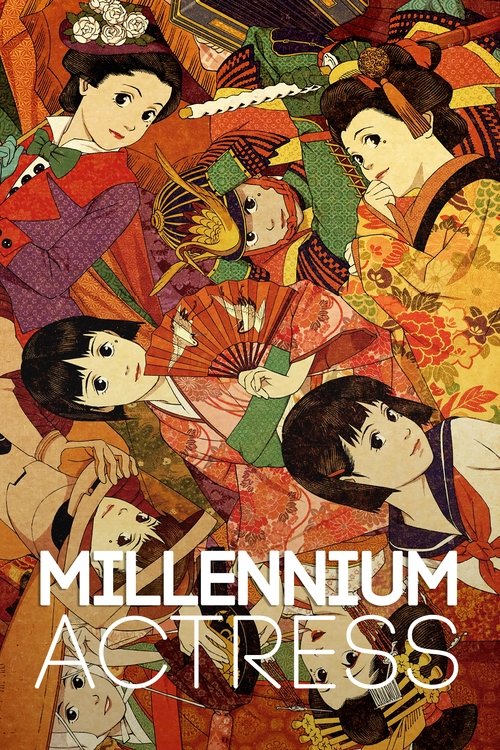
Millennium Actress
千年女優
"The magic of movies, the mystery of memory."
Overview
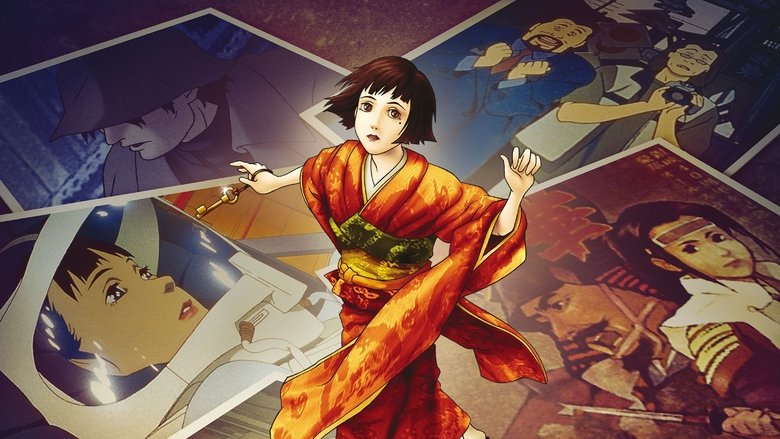
"Millennium Actress" tells the story of Chiyoko Fujiwara, a legendary actress who has been living in seclusion for 30 years. When a documentary filmmaker, Genya Tachibana, and his cameraman Kyoji Ida are granted an interview, they are drawn into Chiyoko's memories of her life and career. As Chiyoko recounts her story, the lines between her personal history and the roles she played in films begin to blur.
The narrative unfolds as a seamless blend of reality, memory, and cinema, with Genya and Kyoji often finding themselves as participants in the events of Chiyoko's past. Chiyoko's lifelong journey is fueled by her unwavering love for a mysterious artist she met as a teenager during the Sino-Japanese War. He left her with a key that she believes will unlock "the most important thing," and she becomes an actress in the hope that he will one day see her on screen and they can be reunited. Her quest takes her through various eras of Japanese history and cinematic genres, from samurai epics to futuristic sci-fi adventures.

Core Meaning
The core meaning of "Millennium Actress" is that the journey and the act of pursuing a passion are more significant than the destination or the achievement of a goal. Chiyoko's life is defined by her relentless chase after the mysterious painter, a pursuit that fuels her illustrious acting career and gives her life meaning. The film suggests that our memories and identities are a blend of reality and the stories we tell ourselves, and that love and obsession can be powerful creative forces. Ultimately, as Chiyoko reveals in the film's final moments, "After all, what I really love is the pursuit of him." This line encapsulates the idea that the process of striving, longing, and creating is where the true value of life resides.
Thematic DNA
The Blurring of Reality and Fiction
Director Satoshi Kon is renowned for his exploration of the porous boundary between the real and the imagined, and "Millennium Actress" is a prime example of this theme. The film's narrative structure seamlessly weaves together Chiyoko's actual life events, her subjective memories, and the plots of the movies she starred in. The documentary filmmakers, Genya and Kyoji, are literally drawn into her recollections, becoming active participants in scenes from her past and her films. This blending of different realities highlights how art and life imitate each other, and how our personal narratives are shaped by both our experiences and the fictions we consume and create.
Love and Obsession
Chiyoko's life is driven by an obsessive, all-consuming love for a man she met only once. This unrequited love becomes the central motivation for her entire acting career, as she hopes that by becoming famous, he will be able to find her. The film portrays this obsession not as a destructive force, as in Kon's previous film "Perfect Blue," but as a positive, life-affirming passion that fuels her creativity and gives her life purpose. Her unwavering devotion, while bordering on obsession, is presented as a pure and powerful emotion that transcends time and circumstance.
The Nature of Memory
"Millennium Actress" delves into the subjective and often unreliable nature of memory. Chiyoko's recollections are not presented as straightforward flashbacks but as a fluid and dynamic tapestry where different time periods and events bleed into one another. Her memories are intertwined with the roles she has played, suggesting that our past is not a fixed record but a story we continually retell and reshape. The film illustrates how memories can be molded by our desires, emotions, and even the fictions that have influenced our lives.
A Homage to Japanese Cinema
The film is a love letter to the history of Japanese cinema, with Chiyoko's career spanning various significant eras and genres. There are visual and thematic references to the works of iconic directors like Akira Kurosawa and Yasujirō Ozu, as well as nods to chanbara (sword-fighting) films, kaiju (monster) movies reminiscent of Godzilla, and sci-fi epics. Through Chiyoko's journey, the audience is taken on a tour of Japan's rich cinematic heritage, celebrating the power and artistry of filmmaking.
Character Analysis
Chiyoko Fujiwara
Miyoko Shoji (old), Mami Koyama (adult), Fumiko Orikasa (young)
Motivation
Chiyoko's primary motivation is to find the mysterious artist who gave her a key and return it to him. This singular goal propels her into an acting career and dictates the course of her entire life. Her love for him is the wellspring of her artistic passion and her resilience in the face of adversity.
Character Arc
Chiyoko's arc is not one of dramatic change but of steadfast dedication. From a young girl who experiences love at first sight, she becomes a celebrated actress, using her fame as a means to find the man she loves. Her journey is a cyclical one of pursuit, loss, and renewed hope. As an elderly woman, she comes to the profound realization that the chase itself, the act of loving and pursuing her ideal, was the true essence and joy of her life, rather than the man she was chasing.
Genya Tachibana
Shozo Iizuka
Motivation
Genya's motivation is twofold: to create a documentary honoring the career of the actress he idolizes, and to return the lost key to her, which he has kept for decades. He also harbors a deep, respectful love for Chiyoko and feels a sense of responsibility to protect her, both in her memories and in the present.
Character Arc
Genya begins as a devoted fan and filmmaker seeking to document the life of his idol. As the story progresses, it's revealed that he has a deeper, personal connection to Chiyoko, having worked as a studio assistant and even saved her life during an earthquake on the set of her final film. He transitions from a passive observer to an active participant in her memories, often taking on heroic roles to protect her. By the end, he becomes the guardian of her story and the one who facilitates her final, peaceful reflection on her life's journey.
Kyoji Ida
Masaya Onosaka
Motivation
Kyoji's motivation is primarily professional: he is there to film a documentary. He is driven by a desire to get the job done and is often comically exasperated by the surreal events he finds himself in. His pragmatic nature provides a humorous counterpoint to Genya's and Chiyoko's romanticism.
Character Arc
Kyoji starts as a cynical and detached cameraman, often questioning the fantastical nature of Chiyoko's story and Genya's emotional involvement. He serves as the audience's anchor to reality, frequently pointing out the absurdity of being pulled into the past. However, as he witnesses the depth and sincerity of Chiyoko's lifelong love story, his cynicism gradually gives way to a grudging respect and understanding. He remains the pragmatic observer but is clearly moved by the tale he is documenting.
The Man with the Key (The Painter)
Koichi Yamadera
Motivation
His motivation is to fight for his political beliefs against the wartime government and to return to his hometown in Hokkaido to paint. He gives Chiyoko the key as a promise of his return and a symbol of what is most important to him.
Character Arc
The painter is less of a fully developed character and more of an idealized figure who sets Chiyoko's story in motion. He is a political dissident and an artist who values freedom and creativity. While his physical presence in the film is brief, his ideals and the memory of him serve as the catalyst for Chiyoko's entire life. He represents a perfect, unattainable love that inspires a lifetime of art and pursuit.
Symbols & Motifs
The Key
The key symbolizes Chiyoko's hope, desire, and the driving force of her life's journey. It represents her love for the painter and her unending quest to reunite with him. The key is said to unlock "the most important thing," which for Chiyoko is the possibility of this reunion. It also serves as a tangible link to her past and the catalyst for her memories, literally unlocking the story of her life for the interviewers.
The painter gives Chiyoko the key before he flees, and she keeps it with her throughout her life as a cherished memento. Its presence reminds her of her vow, and at times when she loses it or it is taken from her, she loses her sense of purpose. When Genya returns the key to her at the beginning of the film, it triggers her flood of memories, setting the entire narrative in motion.
The Spinning Wheel Woman (The Wraith)
The mysterious old woman with the spinning wheel represents Chiyoko's self-doubt, her fear of aging, and the inevitable passage of time. She embodies Chiyoko's internal conflict – her hatred for the pain her endless pursuit causes her, and her love for the man she chases. The woman's prophecy that Chiyoko will be tormented by her love forever reflects Chiyoko's own understanding of her fate. Some interpretations suggest the old woman is a personification of Chiyoko's own future self, lamenting and yet cherishing her youthful obsession.
The woman appears to Chiyoko at various points in her life, often during moments of hardship or despair. She offers Chiyoko a "tea of longevity" to prolong her suffering of eternal love. Her cryptic words, "I hate you more than I can bear, and I love you more than I can bear," vocalize Chiyoko's own conflicting feelings about her lifelong quest.
The Moon
The moon symbolizes hope and the distant, almost unattainable nature of Chiyoko's love. The painter tells her that he will meet her on the night of the full moon, and this celestial body becomes a recurring motif of her longing and her hope for their reunion. Her final film, which is set in space, represents the culmination of her journey, as she travels to the moon in a final, symbolic act of pursuit.
Chiyoko is often shown gazing at the moon throughout the film, especially during moments of reflection or anticipation. The painter's promise ties the moon directly to her quest. The science fiction film she stars in at the end of her career has her journeying to the moon, bringing her symbolic chase to its ultimate destination.
The Lotus Flower
The lotus flower represents purity and the enduring nature of Chiyoko's love. Genya's production company is named after the lotus, and he explains that the flower symbolizes "simple purity." This aligns with the innocent and unwavering devotion that Chiyoko maintains for the painter throughout her life, despite the passage of decades and the blurring of her memories. The flower's ability to bloom in murky waters also mirrors Chiyoko's ability to maintain her pure love through the turmoil of her life and the chaos of history.
The lotus flower appears as a visual motif at several key moments in the film. Genya's production company is named "Lotus Studio." The space station in Chiyoko's final film is also designed to resemble an unfolding lotus flower, visually connecting her ultimate journey with the purity of her lifelong quest.
Memorable Quotes
After all, what I really love is the pursuit of him.
— Chiyoko Fujiwara
Context:
Spoken on her deathbed, as she is metaphorically blasting off into space in her final film role. It is her last reflection on her life's purpose, delivered with a smile, signifying her contentment and peace with her life's journey.
Meaning:
This final line of the film encapsulates its central theme. Chiyoko realizes that the journey of chasing her love, the longing and the hope that fueled her life and career, was more important and fulfilling than actually finding the man himself. It's a poignant and powerful statement about finding meaning in the process rather than the outcome.
I hate you more than I can bear. And I love you more than I can bear.
— The Spinning Wheel Woman
Context:
This is said by the ghostly old woman who appears to Chiyoko at various times. She is a manifestation of Chiyoko's own psyche, personifying her conflicting feelings about her endless chase.
Meaning:
This quote represents the internal conflict within Chiyoko. It's the voice of her own self-awareness, acknowledging the pain and futility of her obsession (the hate) while also recognizing that this same obsession gives her life meaning and passion (the love). It speaks to the paradoxical nature of a lifelong, unrequited love.
This key is the most important thing. It opens the most important thing there is.
— The Man with the Key
Context:
The painter says this to Chiyoko when he gives her the key before he has to flee. These words ignite Chiyoko's imagination and set her on her lifelong quest to discover what it unlocks.
Meaning:
This line establishes the central mystery and MacGuffin of the film. The ambiguous nature of "the most important thing" allows the key to represent different things throughout the story: the painter's art supplies, Chiyoko's memories, and ultimately, the hope and motivation to live a passionate life.
Philosophical Questions
Is the journey more important than the destination?
The film's entire narrative builds to this conclusion. Chiyoko spends her life on a singular quest, only to realize in her final moments that the process of that quest—the love, the longing, the creativity it inspired—was the true meaning of her existence. The film argues that a life lived with passion and purpose, even if the ultimate goal is never reached, is a life well-lived.
What is the relationship between art and life?
\"Millennium Actress\" portrays art and life as inextricably linked. Chiyoko's life experiences fuel her acting, while the roles she plays shape her memories and her understanding of her own life. The film's visual style, which blends her real life with her movies, suggests that there is no clear line between the two. Art is not just a reflection of life, but an active force that helps to create and define it.
How do our memories define who we are?
The film challenges the idea of memory as a reliable record of the past. Chiyoko's memories are fluid, subjective, and interwoven with fiction. This suggests that our identity is not based on an objective history, but on the stories we tell ourselves about our past. We are, in essence, the sum of our remembered and imagined experiences.
Alternative Interpretations
While the film's primary interpretation centers on the beauty of the journey over the destination, other readings exist. One perspective is that Chiyoko's entire story is a form of escapism. Unable to cope with the reality that the painter was likely killed shortly after she met him, she constructs a lifelong fantasy of pursuit, using her film roles to live out this quest. Her retreat from the world for 30 years could be seen as her finally abandoning the fantasy when confronted with her own aging.
Another interpretation focuses on the character of Genya Tachibana. He can be seen not just as a fan, but as a representation of the audience's relationship with cinema. He is so enamored with Chiyoko's story that he inserts himself into it, becoming a character in her life. This perspective suggests the film is also about how we, as viewers, consume and become part of the stories we love, and how cinema shapes our own memories and identities.
Finally, some view the film as a metaphor for Japan's own 20th-century history. Chiyoko's life, beginning with the Great Kantō earthquake of 1923 and spanning through war, defeat, post-war recovery, and economic boom, mirrors the tumultuous journey of modern Japan. Her personal quest for a lost love can be seen as a metaphor for Japan's search for its own identity in the wake of profound historical changes.
Cultural Impact
\"Millennium Actress\" is widely regarded as a masterpiece of animation and a significant work in the career of director Satoshi Kon. While his debut film, \"Perfect Blue,\" explored the dark side of celebrity and obsession, \"Millennium Actress\" is seen as its thematic counterpart, focusing on the positive, creative, and life-affirming aspects of a similar obsession. The film's innovative narrative structure, which seamlessly blends reality, memory, and cinema, has been praised for its complexity and emotional resonance, influencing other filmmakers who explore similar themes of subjective reality. The film also serves as an accessible and moving introduction to the history of Japanese cinema for international audiences, referencing various genres and iconic filmmakers. Critically acclaimed upon its release, it won numerous awards and solidified Kon's reputation as a visionary director who pushed the boundaries of animated storytelling. Though not a massive box office success, its influence has grown over time, and it remains a beloved classic among anime fans and cinephiles for its artistic ambition and profound emotional depth.
Audience Reception
\"Millennium Actress\" was met with widespread critical acclaim and is adored by audiences who appreciate its unique narrative structure and emotional depth. Viewers consistently praise Satoshi Kon's masterful editing and seamless transitions, which create a mesmerizing and dream-like viewing experience. The film's poignant love story and its ultimate message about the value of the journey resonate deeply with many, often leaving a lasting emotional impact. The beautiful animation and its celebration of Japanese film history are also frequently highlighted as major strengths. Points of criticism are rare, but some viewers new to Kon's style occasionally find the constant shifting between reality and fiction initially confusing or hard to follow. However, the vast majority of audience reviews are overwhelmingly positive, with many considering it a masterpiece of animated filmmaking and one of Satoshi Kon's best works.
Interesting Facts
- The character of Chiyoko Fujiwara is loosely based on real-life Japanese actresses Setsuko Hara and Hideko Takamine.
- Satoshi Kon's initial idea for the film began with a single sentence: \"An old woman who was once touted as a great actress is supposed to be recounting her life story, but her memories get confused and the various roles she played in the past begin to blend into it, creating a tumultuous story.\"
- The film was originally planned after the distribution company for Kon's previous film, \"Perfect Blue,\" went bankrupt, stalling his plans to adapt the novel \"Paprika.\"
- Satoshi Kon was reportedly very displeased with the American-drawn DVD cover by Dreamworks Pictures, stating \"that isn't Chiyoko!\" and refusing to sign promotional materials with that artwork.
- The film shared the Grand Prize at the 5th Japan Media Arts Festival with Hayao Miyazaki's \"Spirited Away.\"
Easter Eggs
Numerous scenes in the film pay homage to classic Japanese movies and directors.
These references serve as a love letter to Japanese cinema history. They include nods to Akira Kurosawa's films like \"Throne of Blood\" (the arrow scene), \"Ran,\" and \"Yojimbo.\" There are also spoofs of \"Godzilla\" (with a robotic lizard) and visual styles reminiscent of Yasujirō Ozu's quiet domestic dramas.
A scene in Chiyoko's final science fiction film features a moon base design that strongly resembles the one in Stanley Kubrick's \"2001: A Space Odyssey.\"
This is a direct visual homage to a landmark film in science fiction cinema, broadening the film's celebration of cinematic history beyond just Japanese movies.
The documentary that Genya is making about Chiyoko is mentioned to be called \"The Seven Ghosts.\"
This is a clear reference to Akira Kurosawa's masterpiece, \"The Seven Samurai,\" further cementing the film's deep connection to and reverence for Japanese cinematic classics.
⚠️ Spoiler Analysis
Click to reveal detailed analysis with spoilers
Frequently Asked Questions
Explore More About This Movie
Dive deeper into specific aspects of the movie with our detailed analysis pages
Comments (0)
No comments yet. Be the first to share your thoughts!