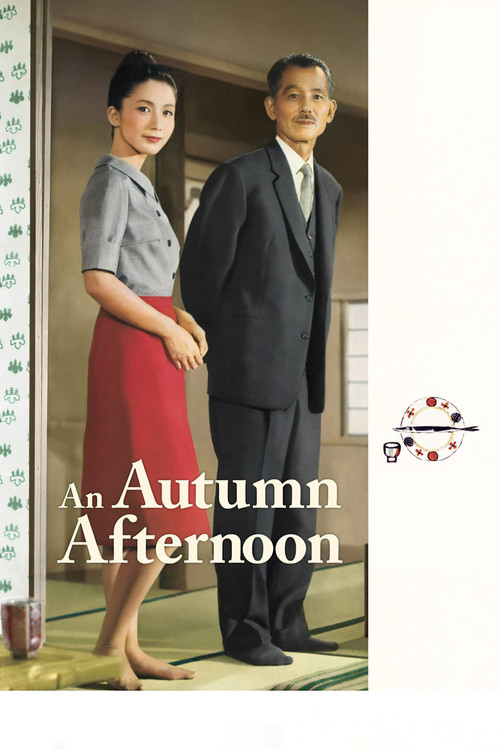
An Autumn Afternoon
秋刀魚の味
Overview
Shuhei Hirayama (Chishū Ryū), an aging widower and a former naval captain, lives a comfortable life in 1962 Tokyo with his 24-year-old daughter Michiko (Shima Iwashita) and his younger son Kazuo. His days are defined by routine: managing a factory, and evenings spent drinking and reminiscing with his old school friends, Kawai and Horie. Their conversations often drift to their children and the societal expectation of marriage.
A reunion with his old, impoverished teacher, Sakuma (Eijirō Tōno), profoundly affects Hirayama. He finds Sakuma running a small noodle shop, burdened by regret for having kept his own daughter from marrying so she could care for him, leaving her a lonely spinster. This encounter serves as a cautionary tale, awakening in Hirayama a sense of duty to arrange a marriage for Michiko. This decision forces him to confront his own selfishness and the impending loneliness he will face in an empty home, setting in motion a quiet, heartbreaking journey of parental love and letting go.

Core Meaning
The core meaning of "An Autumn Afternoon" revolves around the themes of change, acceptance, and the bittersweet nature of family life. Director Yasujirō Ozu poignantly explores the quiet melancholy of a father who, out of love and a sense of duty, arranges his daughter's marriage, thereby ensuring her future happiness at the cost of his own companionship. The film is a meditation on the cyclical nature of life—children growing up and leaving the nest—and the quiet dignity in accepting loneliness as an inevitable part of life's progression. It suggests that true parental love involves letting go, even when it brings personal sadness. The "taste of sanma" (the original Japanese title, referring to the Pacific saury fish) evokes a sense of autumn and a corresponding bitterness, reflecting the father's mixed feelings about his daughter's departure and the onset of his own later years.
Thematic DNA
The Inevitability of Change and Transition
The central theme is the unavoidable passage of time and the transitions it brings. This is most powerfully conveyed through Michiko's marriage, which signifies the end of an era for her father, Hirayama. Ozu contrasts the traditional, slower way of life of the older generation with the encroaching modernity of postwar Japan, represented by their children's consumerist desires for things like refrigerators and golf clubs. The characters often reflect on their past, their youth during the war, and how things have changed, underscoring a sense of nostalgia and the relentless march forward.
Family, Duty, and Sacrifice
The film delves deeply into the Japanese concept of familial duty. Hirayama feels it is his duty to see his daughter married, even though it will leave him lonely. Michiko, in turn, feels a duty to care for her father. The ultimate sacrifice is Hirayama's; he prioritizes his daughter's societal and personal fulfillment over his own comfort. This is starkly contrasted with the cautionary tale of his old teacher, whose daughter sacrificed her own chances at marriage for his sake, a fate Hirayama is desperate for Michiko to avoid.
Loneliness and Old Age
Loneliness is a pervasive undercurrent throughout the film. Hirayama's impending solitude is the emotional core of the narrative. His evenings spent drinking with friends are a way to stave off this loneliness, but the conversations invariably return to family and the eventual quiet of an empty home. The film doesn't present loneliness as a dramatic tragedy but as a quiet, dignified, and inevitable part of the human condition, particularly in old age. Ozu's static shots often linger on empty spaces in the home after Michiko has left, visually emphasizing Hirayama's isolation.
Marriage as a Social Institution
Marriage is portrayed less as a romantic union and more as a social and familial duty. Hirayama and his friends discuss arranging marriages for their children in a very practical, almost business-like manner. Michiko's own feelings are secondary to the understanding that marriage is the expected and proper course for a young woman of her age. The film explores the tension between personal desire and societal expectation within the framework of traditional Japanese values.
Character Analysis
Shuhei Hirayama
Chishū Ryū
Motivation
His primary motivation is to fulfill his duty as a father by ensuring his daughter's future happiness and security through marriage, as is socially expected. He is driven by the fear that she will end up like his teacher's daughter—a lonely spinster who sacrificed her life for her parent.
Character Arc
Hirayama begins the film content with his domestic life, seemingly oblivious to the need for change. The encounter with his old teacher acts as a catalyst, forcing him to confront his paternal duty. His arc is one of reluctant acceptance. He actively arranges his daughter's marriage, pushing her towards a future that will bring him loneliness. The journey is internal, moving from comfortable stasis to the painful but necessary act of letting go, culminating in a quiet, dignified resignation to his solitude.
Michiko Hirayama
Shima Iwashita
Motivation
Michiko is motivated by a deep-seated sense of duty and love for her father. She understands the societal expectation for her to marry and does not wish to be a burden. Her primary motivation is to fulfill her role as a good daughter, even if it means suppressing her own feelings.
Character Arc
Michiko's arc is one of quiet submission to fate and filial piety. Initially, she is content and devoted to caring for her father. While it is revealed she is fond of a young man named Miura, she ultimately accepts the arranged marriage her father proposes after learning Miura is already engaged. Her development is subtle, marked by a growing melancholy and resignation as she sacrifices her own potential happiness for her father's wishes and societal norms. She transitions from a carefree young woman to a bride facing an unknown future.
Koichi Hirayama
Keiji Sada
Motivation
Koichi is motivated by the aspirations of the modern, middle-class salaryman. He wants the material comforts of a Western lifestyle, like golf clubs, while also managing the finances of his own nuclear family. He loves his father and sister but is primarily focused on his own household.
Character Arc
Koichi represents the younger, more Westernized generation of postwar Japan. His minor arc revolves around consumerist desires, such as wanting to buy a new refrigerator and a set of golf clubs, which creates gentle friction with his wife, Akiko. He serves as a contrast to his father's more traditional values and acts as an intermediary in Michiko's marriage affairs, but he does not undergo significant personal change.
Seitarō Sakuma (The 'Gourd')
Eijirō Tōno
Motivation
In the film, his motivation is simply to drink and lament his past mistakes. He expresses deep regret for not marrying off his daughter, Tomoko, which has condemned both of them to a lonely, difficult life. His honesty and sorrow are what motivate Hirayama to act.
Character Arc
Sakuma, Hirayama's old teacher nicknamed 'The Gourd', is a static character whose personal tragedy serves as the catalyst for the entire plot. Living in poverty and regret, his life is a stark warning to Hirayama of what can happen when a father selfishly holds onto a daughter. His arc is complete before the film begins; he exists to show the consequences of inaction.
Symbols & Motifs
The Taste of Sanma (Mackerel Pike)
The original Japanese title, Sanma no Aji, translates to "The Taste of Sanma." Sanma is a fish associated with autumn, and its taste is considered somewhat bitter. This symbolizes the bittersweet feelings Hirayama experiences—the happiness for his daughter's marriage mixed with the sadness of his impending loneliness, mirroring the melancholy of the autumn season of life.
While the fish itself never appears in the film, the title itself sets the entire emotional tone. It's an abstract symbol that permeates the film's atmosphere, representing the complex, bittersweet emotions tied to aging, family, and letting go.
Empty Spaces (Pillow Shots)
Ozu frequently uses shots of empty rooms, corridors, and objects after characters have left the frame. This technique, known as a "pillow shot," symbolizes absence, loss, and the quiet loneliness that pervades the characters' lives. These empty spaces are filled with the emotional residue of the events that have just transpired.
This is most poignant at the end of the film. After Michiko's wedding, Ozu repeatedly cuts to shots of the now-empty rooms of the Hirayama household. Hirayama is seen in his kitchen, alone and hunched over. The lingering shots of the empty living room where Michiko once was powerfully convey the void she has left behind.
The Color Red
In his later color films, Ozu strategically used the color red to draw the viewer's attention and often to signify a point of emotional intensity within his otherwise muted color palettes. It acts as a visual accent that breaks the calm surface of the scene.
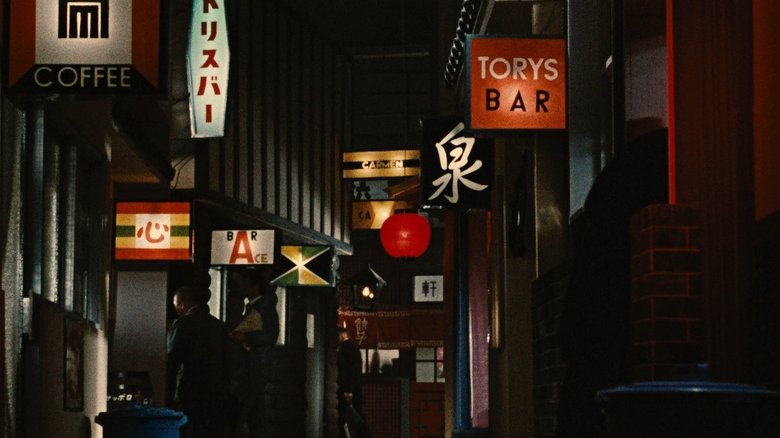
Ozu places red objects—a teapot, a sign, a piece of clothing—in otherwise neutrally toned scenes. For example, a bright red lampshade or container in the bar or a red sweater. These splashes of color punctuate the visual composition and subtly heighten the emotional undercurrent of the moment.
The 'Warship March'
The military tune Hirayama hums and sings at the end is the "Gunkan Māchi," a famous Imperial Japanese Navy march. It symbolizes a retreat into nostalgia and memory as a coping mechanism for his present loneliness. It juxtaposes a song of nationalistic, youthful fervor with a moment of profound personal solitude in postwar Japan.
After Michiko's wedding, a drunk and melancholy Hirayama is alone in his now-quiet house. He drunkenly sings snatches of the march, a sound from his past as a naval officer, underscoring his final, lonely state.
Memorable Quotes
一人ぼちは、寂しいもんじゃ。
— Sakuma, the 'Gourd'
Context:
After a class reunion, Hirayama takes his drunken former teacher, Sakuma, home. There he meets the teacher's unmarried, middle-aged daughter. Sakuma confesses his regret and sadness, a raw admission that deeply affects Hirayama and sets the main plot in motion.
Meaning:
Translated as "It's lonely to be alone" or "In the end, we spend our lives alone, all alone." This line is the emotional core of the film. Spoken by Hirayama's old teacher, it articulates the central fear of the film: the profound loneliness of old age. It is this raw confession of regret that serves as the catalyst for Hirayama's decision to marry off Michiko.
Alone, eh?
— Shuhei Hirayama
Context:
In the final scene, Hirayama has returned home drunk after Michiko's wedding. The house is silent and empty. He stumbles into his kitchen, speaks this line to himself, and begins to hum the 'Warship March,' retreating into nostalgia to cope with his loneliness.
Meaning:
This is Hirayama's final line in the film, a quiet, devastating acknowledgment of his new reality. After fulfilling his duty and ensuring his daughter's future, he is confronted with the profound emptiness she has left behind. The simple, understated question encapsulates the entire emotional weight of his sacrifice and the film's theme of inevitable solitude.
Philosophical Questions
Is selfless action truly selfless if it leads to one's own suffering?
The film explores this through Hirayama's central decision. He acts out of a selfless love for his daughter, believing he is securing her happiness. However, this action directly leads to his own profound loneliness. Ozu doesn't provide an easy answer. He presents the action as both necessary and heartbreaking, questioning the very nature of parental sacrifice. The film suggests that in this traditional framework, there is no other choice, and the resulting sadness must be borne with quiet dignity.
How does one reconcile personal happiness with societal and familial duty?
This question is embodied by Michiko. She has a hint of a personal desire—an unspoken affection for Miura—but this is quickly subsumed by her duty as a daughter to accept the marriage her father arranges. The film meticulously portrays a world where personal desire is secondary to the smooth functioning of the family and society. It asks whether true contentment can be found in fulfilling one's prescribed role, or if this fulfillment always comes with a sense of quiet resignation and lost opportunity.
Can we ever escape the cycle of life and the loneliness it inevitably brings?
The film presents life as a repeating cycle: parents raise children, the children leave to start their own families, and the parents are left alone. Hirayama sees his own future in the lonely figure of his old teacher. He knows what awaits him, yet he pushes his daughter along the same path. Ozu's calm, cyclical narrative style suggests that this is an immutable law of nature. The film doesn't offer an escape but instead advocates for a form of acceptance, finding a bittersweet beauty in this inevitable, sorrowful process.
Alternative Interpretations
While the film's meaning appears straightforward, some alternative readings exist. One interpretation focuses on a subtle critique of conformity. Hirayama and Michiko both bow to societal pressure; he pushes her into a marriage she may not want, and she accepts it out of duty. From this perspective, the film's ending is not just sad but tragic—a commentary on how rigid social expectations can stifle individual happiness, even when the actions are motivated by love. Hirayama's final solitude can be seen as a direct consequence of his inability to imagine an alternative life for his daughter beyond the conventional path of marriage.
Another reading focuses on the film's engagement with post-war Japanese identity. Hirayama's nostalgia for his naval days and the humming of the 'Warship March' can be interpreted as an elegy for a lost national identity. His personal loneliness mirrors Japan's own complicated transition from a militaristic empire to a pacifist, commercial nation. The film, in this light, is not just a family drama but a quiet reflection on a nation's changing soul, where the comforting certainties of the past have given way to a prosperous but spiritually emptier present.
Cultural Impact
"An Autumn Afternoon" serves as the culmination of Yasujirō Ozu's career and a final, poignant statement on his enduring themes. Released in 1962, the film captures a Japan caught between tradition and the rapid modernization of the post-war economic miracle. The generational divide is palpable: Hirayama and his friends are relics of a pre-war Imperial Japan, while their children are more Westernized, embracing consumerism. The film reflects the societal shift in family structures, moving from multi-generational households to the nuclear family, and the loneliness that this transition could create for the older generation.
Critically, the film was well-received in Japan and is now considered a masterpiece of world cinema. For Western audiences, it was one of the films that solidified Ozu's reputation as a master of minimalist, deeply humanistic filmmaking. His influence is vast; filmmakers like Wim Wenders, Jim Jarmusch, and Claire Denis have cited Ozu's pacing, compositional style, and focus on everyday life as major inspirations. The film's quiet, contemplative style has influenced countless directors who seek to find drama in the mundane and emotion in restraint. Its themes of parental sacrifice, the bittersweet passage of time, and the quiet acceptance of loneliness are universal, ensuring its enduring relevance.
Audience Reception
Audiences and critics alike have overwhelmingly praised "An Autumn Afternoon" as a beautiful and poignant masterpiece. Viewers frequently highlight the film's emotional power, which is achieved through subtlety and restraint rather than melodrama. The performance of Chishū Ryū as Hirayama is universally lauded for its depth and nuance, conveying a universe of feeling with the smallest of gestures. Many viewers find the film's depiction of the father-daughter relationship to be incredibly moving and relatable, regardless of their cultural background.
The main points of criticism, particularly from some modern Western viewers, tend to revolve around the film's slow pace and seemingly uneventful plot. Some find the static camera and long takes to be alienating. Another, more substantive criticism, points to the passive role of the female characters, especially Michiko, who seems to have little agency in her own life's major decisions. However, even those who find the pacing slow often concede that the film's emotional impact by the end is undeniable, leaving a lasting impression of profound, quiet sadness.
Interesting Facts
- This was Yasujirō Ozu's final film. He died of cancer on his 60th birthday, December 12, 1963, a year after the film's release.
- The film's original Japanese title, "Sanma no Aji," translates to "The Taste of Sanma" (Pacific Saury), a fish that is a seasonal delicacy in autumn in Japan. The fish itself never appears in the film.
- "An Autumn Afternoon" was Ozu's sixth and last film shot in color. He began using color late in his career with Agfacolor film, which gave his work a distinctive, rich palette.
- The lead actor, Chishū Ryū, was a frequent collaborator of Ozu's, appearing in 52 of his 54 films.
- The film contains direct references to World War II, as Hirayama, a former naval captain, and his friends reflect on their time in the service and joke about what would have happened if Japan had won the war.
- Ozu's signature visual style is prominent, including his use of a static camera positioned at a low height (the so-called "tatami shot"), which is said to mirror the eye-level of a person seated on a traditional Japanese mat.
Easter Eggs
Recurring Actors as Thematic Archetypes
Ozu was known for using a regular troupe of actors, often referred to as his 'Ozu family.' For viewers familiar with his work, seeing Chishū Ryū, who played the aging father in "Late Spring" and "Tokyo Story," reprise a similar paternal role creates a powerful intertextual resonance. It's not an 'easter egg' in the modern sense, but a deliberate artistic choice that deepens the thematic continuity across his filmography, making it seem as if we are watching variations of the same essential family story unfold over and over.
Subtle Continuity Gags
Though known for his meticulous compositions, Ozu was not above playful visual jokes. In one scene, a soy sauce bottle subtly changes position between shots. This minor break in continuity is believed to be a deliberate, quiet gag, similar to something one might find in a Jacques Tati film, rewarding the attentive viewer with a small, humorous imperfection in an otherwise perfectly ordered world.
⚠️ Spoiler Analysis
Click to reveal detailed analysis with spoilers
Frequently Asked Questions
Explore More About This Movie
Dive deeper into specific aspects of the movie with our detailed analysis pages
Comments (0)
No comments yet. Be the first to share your thoughts!