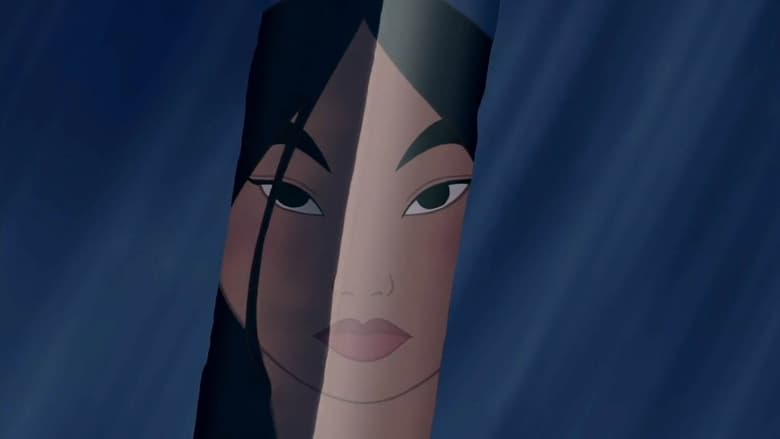
Mulan
"Courage. Family. Honor."
Overview
Based on the ancient Chinese legend of Hua Mulan, Disney's "Mulan" tells the story of a spirited young woman who struggles to fit into the traditional roles expected of her. When the ruthless Huns, led by the formidable Shan Yu, invade China, the Emperor decrees that one man from every family must serve in the Imperial Army. To save her ailing and honored veteran father, Fa Zhou, from this fate, Mulan makes a courageous decision.
Disguising herself as a man named "Ping," she secretly takes her father's place in the army. Accompanied by her demoted-guardian dragon, Mushu, who provides comic relief and questionable guidance, Mulan must navigate the rigorous training under the command of the disciplined Captain Li Shang. She and her fellow recruits, Yao, Ling, and Chien-Po, gradually transform from a ragtag group into skilled soldiers. Mulan must rely on her wits and inner strength to overcome the challenges of war, conceal her true identity, and bring honor to her family and her country.

Core Meaning
The core meaning of "Mulan" revolves around the idea that true honor comes not from conforming to societal expectations or traditions, but from being true to oneself and acting with courage and love. The film challenges rigid gender roles and patriarchal structures, suggesting that strength, bravery, and worth are not defined by gender. Mulan's journey is one of self-discovery; she initially acts to protect her father but ultimately finds her own strength and proves that one person, guided by loyalty and love, can make a significant difference. The film champions the idea that breaking with tradition can lead to a more profound and authentic form of honor.
Thematic DNA
Honor and Family Duty
The concept of honor is central to "Mulan," representing the driving force behind many characters' actions. Initially, honor is presented as conforming to societal roles: for Mulan, being a good bride, and for her father, serving in the army. Mulan's primary motivation for joining the army is to protect her father and uphold her family's honor. However, the film redefines honor. By the end, Mulan earns the highest honor not by fitting in, but by using her unique strengths to save China. Her father expresses that his greatest honor is simply having her for a daughter, shifting the theme from societal approval to familial love and personal integrity.
Defying Gender Roles and Feminism
"Mulan" directly confronts traditional gender stereotypes. The film opens with Mulan failing to meet the standards of an ideal wife, as dictated by the matchmaker. Her journey as a soldier in a hyper-masculine environment forces her to suppress her femininity, yet it's her unique perspective and intelligence—traits not valued in women at the time—that ultimately lead to victory. She proves that qualities like bravery, strategic thinking, and leadership are not exclusive to men. The film was praised for breaking new ground for Disney heroines who don't need a man to save them and whose romantic interests are secondary to their personal achievements.
Identity and Self-Discovery
Mulan's journey is profoundly internal. The song "Reflection" captures her struggle with a dual identity: the person she is expected to be versus who she is inside. By impersonating a man, she physically hides her true self, yet this experience allows her to discover her true potential. She admits at one point, "Maybe I didn't go for my father. Maybe what I really wanted was to prove I could do things right, so when I looked in the mirror, I'd see someone worthwhile." Her transformation is complete when she saves China as Mulan, integrating both her "Ping" and Mulan identities into one heroic whole.
War and Sacrifice
Unlike many animated films, "Mulan" does not shy away from the grim realities of war. The Huns are portrayed as a genuinely menacing force. A pivotal scene shows Mulan and the soldiers discovering a decimated village and the slaughtered imperial army, including Captain Shang's father, which starkly illustrates the devastating consequences of the conflict. Mulan's decision to join the army is an act of personal sacrifice, risking her life for her father. This theme is reinforced when Shang spares her life, sacrificing the law for his conscience, and when Mulan risks everything again to warn the Emperor of the surviving Huns.
Character Analysis
Fa Mulan
Ming-Na Wen (speaking), Lea Salonga (singing)
Motivation
Initially, her motivation is purely selfless: to save her elderly father from having to go to war. As her journey progresses, it evolves into a desire to prove her own self-worth and find her place in the world, culminating in a duty to protect her friends, the Emperor, and all of China from the Hun invasion.
Character Arc
Mulan begins as an awkward young woman who feels like a disappointment because she can't conform to the role of a demure, perfect bride. Driven by love for her father, she transforms herself into a soldier, "Ping," initially struggling but eventually excelling through perseverance and intelligence. After her identity is revealed and she is cast out, she hits her lowest point. However, she rises above this shame to become the savior of China, embracing her true self and proving her worth on her own terms, ultimately becoming a confident and celebrated hero.
Mushu
Eddie Murphy
Motivation
His primary motivation is to regain his status as a respected family guardian among the ancestors. He believes that by making Mulan a war hero, he will prove his own worth and be promoted back to his pedestal.
Character Arc
Mushu starts as a disgraced and demoted family guardian, reduced to the role of a gong-ringer. His initial motivation for helping Mulan is selfish; he hopes her success will get him reinstated as a guardian by the ancestors. Throughout their journey, he provides comic relief and often-flawed guidance but grows to genuinely care for Mulan. By the end, he helps her save the day not for personal gain, but out of loyalty and friendship. His arc is completed when he is reinstated as a guardian, having earned it through his newfound selflessness.
Captain Li Shang
BD Wong (speaking), Donny Osmond (singing)
Motivation
Shang is driven by a strong sense of duty and honor, both to his country and his family's military name. He is determined to train his recruits into a capable army and defeat the Huns, especially after learning of his father's death at their hands.
Character Arc
Shang begins as a newly appointed, by-the-book army captain, eager to prove himself and live up to the legacy of his father, the General. He is a demanding leader who initially dismisses "Ping" (Mulan). He grows to respect Ping as a capable soldier and friend. The discovery of Mulan's identity creates a conflict between his duty (the law requires her execution) and his heart. By sparing her life, he shows significant growth. He ultimately learns to value a person's character over tradition and gender, as shown when he follows her to her home at the end.
Shan Yu
Miguel Ferrer
Motivation
Shan Yu's motivation is straightforward conquest and power. He seeks to prove his strength by conquering China and defying its Emperor. He is driven by a desire to dominate and shows no capacity for mercy or compromise, viewing any obstacle simply as something to be destroyed.
Character Arc
Shan Yu is a static character who serves as the embodiment of ruthless ambition and brute force. He does not undergo any development. His presence is defined by his singular goal: to conquer China. From his first appearance breaching the Great Wall to his final confrontation with Mulan, his character remains consistently menacing and cruel, acting as the primary obstacle Mulan must overcome.
Symbols & Motifs
Mulan's Hair
Mulan's long hair represents her connection to traditional femininity and the expectations placed upon her. The act of cutting it with her father's sword is a powerful symbol of her severing ties with that life and embracing a new, masculine identity to become a soldier. It's a pivotal moment of transformation and a visual declaration of her intent to forge her own destiny.
After deciding to take her father's place in the army, Mulan goes to her family's shrine. In a silent, powerful sequence, she uses her father's sword to cut her long hair short, leaving it in place of her comb on the dressing table, signifying the exchange of her old role for a new one.
The Emperor's Crest and Shan Yu's Sword
These two objects represent the highest forms of honor in the film. Shan Yu's sword symbolizes Mulan's victory over China's greatest enemy, an honor earned through her strength and strategic mind. The Emperor's Crest represents the official recognition and gratitude of the entire nation, an honor bestowed by the highest authority. When her father sets them aside to embrace her, it symbolizes that familial love is the ultimate honor, superseding even national acclaim.
After Mulan defeats Shan Yu, the Emperor bestows his personal crest upon her and gives her Shan Yu's sword as trophies of her victory in front of the entire Imperial City. She brings these items home to her father, who gently puts them aside, saying, "The greatest gift and honor is having you for a daughter."
Magnolia Blossoms
Magnolia blossoms symbolize Mulan herself. Her name, Mulan (木蘭), means "magnolia." Early in the film, her father compares her to a late-blooming blossom, suggesting she has unrealized potential. The Emperor echoes this at the end, stating, "The flower that blooms in adversity is the most rare and beautiful of all," directly linking her to this symbol of strength and beauty flourishing under difficult circumstances.
The flower is first seen in the Fa family garden. Mulan's father uses a blooming magnolia to comfort her after her failure with the matchmaker. The symbol reappears throughout, culminating in the Emperor's final, iconic quote to Shang, cementing the metaphor.
Memorable Quotes
The flower that blooms in adversity is the most rare and beautiful of all.
— The Emperor
Context:
After Mulan has saved China, the Emperor says this to Li Shang, encouraging him to pursue Mulan. It is the Emperor's final assessment of her character and a piece of wisdom that elevates her actions beyond mere military victory.
Meaning:
This quote encapsulates the film's central theme. It's a metaphor for Mulan herself, who thrives and reveals her true strength and beauty not in the manicured garden of traditional society, but on the harsh battlefield. It redefines worth, suggesting that true value is forged through challenges.
No matter how the wind howls, the mountain cannot bow to it.
— The Emperor
Context:
Shan Yu, having captured the Emperor in the palace, arrogantly demands that the Emperor bow to him. The Emperor calmly and defiantly delivers this line, refusing to show submission even with his life on the line.
Meaning:
This quote symbolizes unwavering strength, integrity, and defiance in the face of immense pressure. The Emperor, representing the steadfastness of China itself, refuses to submit to the brute force of Shan Yu, demonstrating that true power lies in resilience, not aggression.
When will my reflection show who I am inside?
— Mulan
Context:
After failing her meeting with the matchmaker and feeling she has brought dishonor upon her family, Mulan sings this song alone in her family's shrine, looking at her reflection in the polished ancestral tablets.
Meaning:
This poignant lyric from the song "Reflection" captures Mulan's inner conflict and struggle with her identity. She feels a profound disconnect between the dutiful daughter her family expects her to be and the person she feels she truly is. It's the central question of her character arc.
Dishonor on you, dishonor on your cow!
— Mushu
Context:
Mushu says this in frustration while trying to pose as Mulan's fearsome guardian dragon to impress the other soldiers, but his shadow is revealed to be comically small. It's a moment of pure slapstick that highlights his character's inflated ego.
Meaning:
This is one of Mushu's most iconic and comedic lines. While played for laughs, it humorously underscores the immense importance of honor and the fear of bringing shame (dishonor) upon one's family, a central theme of the film, by taking it to a ridiculous extreme.
You said you trust Ping. Why is Mulan any different?
— Mulan
Context:
Mulan, after being expelled from the army, returns to the Imperial City to warn Shang that the Huns have survived. When he refuses to believe her because she is a woman, she delivers this powerful line, appealing to the respect she earned as Ping.
Meaning:
This line is the thematic climax of Mulan's struggle for acceptance. She directly challenges Shang's prejudice, forcing him and the audience to confront the core issue: is a person's worth determined by their gender or their actions and character? It crystallizes the film's message about looking beyond superficial labels.
Philosophical Questions
What is the true nature of honor?
The film explores whether honor is an external concept, bestowed by society and family, or an internal one, rooted in personal integrity. Initially, honor is tied to rigid traditions—a daughter's obedience, a soldier's duty. Mulan's journey challenges this. She breaks laws and traditions (dishonor) to do what is right (honor). The film suggests that true honor is not about conforming but about acting with courage, love, and self-sacrifice. The Emperor's final praise and her father's loving acceptance cement the idea that the greatest honor comes from being true to oneself and one's loved ones.
Does one's identity define their capability?
"Mulan" poses the question of whether societal labels—specifically gender—determine a person's potential. Mulan is initially deemed unfit for the role of a wife and, as a woman, is forbidden from being a soldier. However, by disguising herself, she proves that she is not only a capable soldier but a brilliant strategist who surpasses all her male counterparts. The film repeatedly shows that Mulan's ingenuity and courage are what lead to victory, not her gender. Her climactic question to Shang, "You said you trust Ping. Why is Mulan any different?", directly forces this issue, arguing that capability is based on character and skill, not on a socially constructed identity.
Alternative Interpretations
While "Mulan" is widely celebrated as a feminist film, some alternative interpretations offer a more critical perspective. One view argues that the film ultimately reinforces patriarchal structures. Mulan achieves success by excelling in a male-dominated world and adopting masculine traits. After saving China, she declines a position on the Emperor's council—a seat of political power—and returns home, where her story is completed by the arrival of a male love interest, Li Shang. This reading suggests that while a woman can be a temporary hero, her ultimate place is within the traditional domestic sphere.
A queer reading of the film is also prominent, focusing on the relationship between Shang and "Ping." Shang develops a deep respect and clear admiration for Mulan while she is disguised as a man, leading to interpretations of a homoerotic subtext in their dynamic. His anger upon discovering her gender is seen not just as a reaction to her deception but as a complex response to his own feelings. This perspective views the film as an exploration of gender performance and non-traditional attraction, even if it resolves within a heterosexual framework.
Cultural Impact
Released during the latter part of the Disney Renaissance, "Mulan" was a significant step for the studio. It was praised for its bold themes of female empowerment, honor, and sacrifice, presenting a heroine who was a warrior and a role model, not a damsel in distress. Mulan's character broke the traditional Disney princess mold; she wasn't born royalty, nor did she marry into it, and her story was driven by familial love and self-discovery rather than romance. The film received positive reviews in the West, with critics lauding its animation, story, and complex characters. It earned an Academy Award nomination for its musical score and won several Annie Awards, including Best Animated Feature.
However, its reception in China was more complex. While some appreciated the telling of a beloved legend, many critics and audiences felt the film was a "Westernized" take on the story. Criticisms included the characterization of Mulan as too individualistic in contrast to the traditional story's focus on filial piety, the comedic portrayal of the guardian dragon Mushu, and certain cultural inaccuracies, such as the Emperor bowing to Mulan. Despite this mixed reception in China, "Mulan" had a lasting global impact, influencing a generation with its message of female strength and becoming a beloved classic in the Disney canon. It paved the way for more independent heroines in subsequent Disney films.
Audience Reception
Audience reception for "Mulan" has been overwhelmingly positive since its 1998 release. Viewers consistently praise the film for its compelling and empowering protagonist, who is celebrated for her bravery, intelligence, and relatable journey of self-discovery. The vibrant animation, engaging plot, and memorable musical score, particularly the songs "Reflection" and "I'll Make a Man Out of You," are frequently highlighted as standout elements. Eddie Murphy's performance as Mushu is often cited as a comedic highlight, providing a perfect balance to the film's more serious themes of war and honor.
Points of criticism are relatively minor but sometimes include the feeling that Mushu's modern, anachronistic humor can occasionally feel out of place with the film's ancient Chinese setting. While lauded in the West, the film's reception in China was lukewarm, with some Chinese viewers criticizing it for what they perceived as cultural inaccuracies and a Westernized interpretation of their cherished legend. Overall, however, "Mulan" is held in high regard globally and is considered a top-tier film from the Disney Renaissance era.
Interesting Facts
- Mulan was the first Disney animated feature film to be primarily produced at Disney's animation studio in Florida.
- The film's art style was intentionally designed to evoke Chinese watercolor paintings, with a simpler, less detailed look compared to previous Disney films like 'The Lion King'.
- Action star Jackie Chan voiced Captain Li Shang in the Mandarin, Cantonese, and Taiwanese Mandarin dubs of the film. He also filmed a music video for his version of "I'll Make a Man out of You".
- The sequence where Mulan decides to take her father's place was originally a song, but it was changed to a powerful, mostly silent scene to better reflect the gravity of her decision.
- The directors of the film, Tony Bancroft and Barry Cook, have a cameo as the two fireworks operators that Mushu scares near the end of the movie.
- To ensure authenticity, a group of artistic supervisors spent three weeks in China before production, sketching, and taking photos of landmarks and cultural elements.
- The role of Mulan was spoken by Ming-Na Wen, but the singing voice was provided by Lea Salonga, who was also the singing voice for Princess Jasmine in 'Aladdin'.
- Mulan's habit of touching her hair was an idiosyncrasy of her voice actress, Ming-Na Wen, that animators noticed during recording sessions and incorporated into the character.
Easter Eggs
The names of the Disney animators who worked on the film are written in ancient Chinese script on the ancestral stones in the Fa family temple.
This is a clever way for the creators to leave their mark on the film, embedding their own names into the very fabric of the family honor Mulan fights for. It's a tribute hidden in plain sight, rewarding viewers who can read the script or those who look up the film's behind-the-scenes details.
⚠️ Spoiler Analysis
Click to reveal detailed analysis with spoilers
Frequently Asked Questions
Explore More About This Movie
Dive deeper into specific aspects of the movie with our detailed analysis pages
Comments (0)
No comments yet. Be the first to share your thoughts!