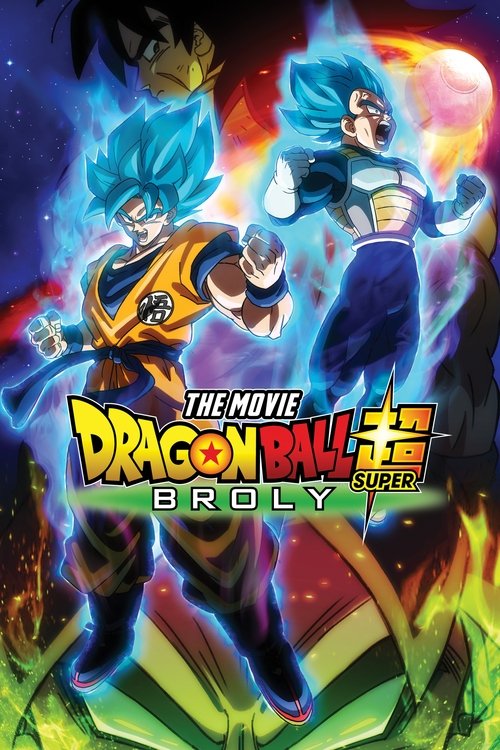
Dragon Ball Super: Broly
ドラゴンボール超 ブロリー
"A new adventure to become the strongest begins."
Overview
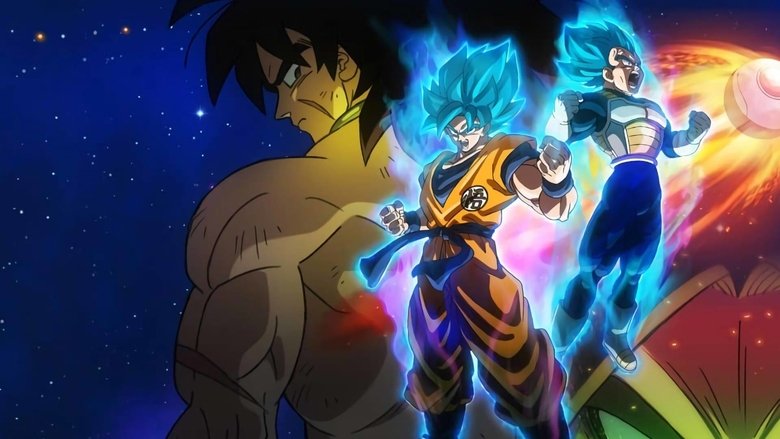
Forty-one years before the events of Dragon Ball Super, the Saiyan home world, Planet Vegeta, is under the tyrannical rule of King Cold, who passes his empire down to his even more ruthless son, Frieza. King Vegeta, proud of his prodigious son, Prince Vegeta, discovers another Saiyan infant, Broly, whose latent power level unnervingly exceeds his own son's. Fearing a future threat to his lineage, King Vegeta exiles Broly to the desolate planetoid Vampa. Broly's father, Paragus, follows his son, becoming stranded with him and vowing to one day exact revenge on the king.
In the present day, following the Tournament of Power, Goku and Vegeta continue their training. Their peaceful existence is interrupted when Frieza, revived and seeking the Dragon Balls to wish for a seemingly trivial desire, recruits a now adult and battle-hardened Broly and Paragus into his Frieza Force. The paths of these three Saiyans—Goku, the low-class warrior sent to Earth; Vegeta, the proud prince; and Broly, the exiled prodigy—are set to collide on Earth in a cataclysmic battle that will push their powers to their absolute limits and unearth the tragic history that binds them.
Core Meaning
The core meaning of Dragon Ball Super: Broly revolves around the theme of nature versus nurture and the corrupting influence of revenge. The film posits that one's inherent power or predetermined destiny does not define their character. Broly, born with immense potential, is depicted as a gentle soul who is twisted into a tool of destruction by his father's obsessive quest for vengeance. In contrast, Goku, a 'low-class' Saiyan, becomes a hero through the positive relationships and values he learns on Earth. The director, Tatsuya Nagamine, aimed to reintroduce Broly as a sympathetic, multi-layered character, moving away from the purely villainous portrayal of the original, non-canonical films. The message is one of empathy and the potential for redemption, suggesting that even those forged in hatred can find a different path through connection and understanding.
Thematic DNA
The Sins of the Father
The film is heavily driven by the legacies and ambitions of fathers being passed down to their sons. King Vegeta's jealousy and paranoia lead to Broly's exile, planting the seeds of conflict decades later. Paragus's all-consuming desire for revenge against King Vegeta molds Broly into a weapon, stripping him of his autonomy. Even Goku's story is reframed with a new look at his father, Bardock, who, alongside his wife Gine, makes a conscious, loving decision to save their son from Frieza's impending genocide. This theme explores how the actions, ambitions, and failures of one generation directly shape the destinies and conflicts of the next.
Nature vs. Nurture
This is a central theme, embodied by the contrast between Goku and Broly. Broly is a being of immense innate power, a 'natural' prodigy, but his development is stunted and controlled by an abusive upbringing. He is a gentle soul by nature, but nurtured to be a monster. Goku, on the other hand, is a Saiyan with a less remarkable natural power level, but through kindness, training, and the positive influence of his friends on Earth, he grows to become one of the universe's greatest heroes. The film argues that one's upbringing and the connections they form are more influential in shaping their identity than their inherent abilities or 'destiny'.
Empathy and Friendship
For the first time, Broly is portrayed as a character capable of forming bonds. His friendships with the Frieza Force members Cheelai and Lemo are pivotal. They see past his immense power and recognize the gentle, tormented individual within. Their empathy for him ultimately leads to his salvation, as Cheelai uses the Dragon Balls to wish him away from certain death at the hands of Gogeta. The film concludes with Goku offering friendship to Broly, not as a defeated enemy, but as a fellow Saiyan, suggesting a future of mutual growth and understanding over conflict.
The Corrupting Influence of Revenge
Paragus's character is a cautionary tale about the destructive nature of vengeance. His entire life after being stranded on Vampa is dedicated to a single goal: revenge on King Vegeta, and by extension, his son. This obsession leads him to abuse and control his own son, viewing him not with love, but as an instrument for his hatred. Frieza also embodies this theme, manipulating Paragus's desire for revenge for his own ends. The film shows that this pursuit of vengeance ultimately leads to destruction and self-destruction, as Frieza callously murders Paragus to fuel Broly's rage.
Character Analysis
Broly
Bin Shimada
Motivation
Initially, Broly's motivation is simply to obey his father, Paragus. He fights because he is commanded to, his rage being a product of his conditioning and the pain of the battle. His deeper, underlying motivation is a desire for connection and peace, as seen in his friendship with Ba and his later bond with Cheelai and Lemo.
Character Arc
Broly begins as a victim of circumstance, exiled due to his innate power and raised as a tool for revenge by his abusive father. He is socially naive and gentle by nature, but prone to uncontrollable rage when forced to fight. Through his interactions with Cheelai and Lemo, he experiences kindness for the first time. The battle with Goku and Vegeta forces his power to grow exponentially, but also pushes him into a berserker state. By the end, saved from destruction and freed from his father's influence, he is set on a path towards self-control and potential friendship with Goku, completing his arc from a weapon to a person with a future.
Son Goku (Kakarot)
Masako Nozawa
Motivation
Goku's primary motivation is to test his limits and fight powerful opponents. However, this is always tempered by his desire to protect the Earth and his friends. When he realizes Broly is not inherently evil, his motivation evolves to wanting to help a fellow Saiyan control his incredible power.
Character Arc
Goku's arc in the film is one of reaffirming his identity and extending his compassionate worldview. The film revisits his origins, emphasizing his parents' love in sending him to Earth. Throughout the fight with Broly, Goku recognizes that Broly is not truly evil but is being manipulated. Instead of seeking to destroy his powerful new foe, Goku's goal shifts to wanting to stop him and, ultimately, to connect with him. He ends the film by offering friendship and training, not only acknowledging Broly's power but also embracing his own Saiyan heritage by telling Broly to call him 'Kakarot'.
Vegeta
Ryo Horikawa
Motivation
Vegeta is motivated by his desire to be the strongest and to protect his family. He is deeply proud of his Saiyan heritage, which fuels his initial confrontation with Broly. His ultimate motivation becomes the pragmatic need to defeat a threat that is beyond his individual capabilities, leading to the fusion with Goku.
Character Arc
Vegeta's arc is one of confronting his past and accepting cooperation. The film opens with his own history, being a proud prince whose destiny is intertwined with Broly's exile by his father. He initially faces Broly with his typical Saiyan pride and arrogance. However, Broly's overwhelming power forces Vegeta to swallow his pride and, for the first time in canonical history, willingly perform the Fusion Dance with Goku to become Gogeta. This act signifies a significant step in his character development, prioritizing survival and victory over his personal rivalry.
Frieza
Ryusei Nakao
Motivation
Frieza is motivated by a combination of revenge against Goku for his past defeats and a general lust for power and control. His immediate goal is to use the Dragon Balls for a selfish wish, but he quickly pivots to using Broly as a weapon to eliminate his Saiyan nemeses.
Character Arc
Frieza does not have a significant arc of development in this film; rather, he serves as the primary catalyst for the conflict. He manipulates Broly and Paragus, using their desire for revenge to finally get his own against Goku and Vegeta. His actions are driven by petty desires, such as wishing for a slight increase in height. He demonstrates his classic cruelty by murdering Paragus simply to trigger Broly's Super Saiyan transformation. He ends the film beaten but alive, his hatred for the Saiyans only intensified.
Symbols & Motifs
Paragus's Control Collar
The shock collar Paragus places on Broly is a direct symbol of control, abuse, and the suppression of one's true nature. It represents Paragus's fear of his son's power and his refusal to nurture it, opting instead for brutal domination. The collar is the physical manifestation of the psychological chains Paragus has bound his son with, turning him into a tool rather than allowing him to become a person.
The collar is present on Broly for a significant portion of the film. Paragus uses a remote to activate it whenever Broly's power begins to surge beyond his control, causing Broly immense pain. Cheelai's decision to steal and destroy the remote is a turning point, symbolizing the beginning of Broly's liberation from his father's oppressive influence.
The Ear of Ba
The green fur pelt that Broly wears around his waist symbolizes his capacity for friendship, his gentle nature, and his deep-seated trauma. It is the ear of a giant creature named Ba, who was his only friend on the hostile planet Vampa. This memento represents a time of innocence and connection before it was violently taken from him by his father.
Broly explains to Cheelai and Lemo that Ba was a creature he befriended while growing up on Vampa. However, Paragus, viewing the friendship as a distraction from training, shot Ba's ear off, scaring the creature away and ending their friendship. Broly wears the fur as a constant reminder of the only friend he ever had, showcasing his gentle heart despite his fearsome power.
The Icy Battlefield
The desolate, arctic landscape where the final battle takes place symbolizes the coldness of revenge and the isolation of the characters. It is a harsh, unforgiving environment, reflecting the brutal nature of the conflict. The shattering ice and exploding glaciers visually represent the immense, world-breaking power being unleashed, creating a stark contrast between the fiery energy of the Saiyans and the frozen wasteland.
After the initial confrontations, the main fight between Goku, Vegeta, and Broly moves to an arctic region on Earth. The majority of the film's spectacular fight sequences occur here, with the environment being continuously destroyed by their immense power, turning a pristine wilderness into a chaotic battleground.
Memorable Quotes
I'm Goku. But Broly, you can call me Kakarot.
— Son Goku
Context:
This line is spoken at the very end of the film. Goku has traveled to the planet Vampa to give Broly, Cheelai, and Lemo supplies. Before he departs, he formally introduces himself, making a clear distinction between his Earth name and his Saiyan birth name, offering the latter to Broly as a gesture of kinship.
Meaning:
This is a pivotal moment for Goku's character. For most of the series, he has rejected his Saiyan name, 'Kakarot,' as it was associated with the destructive nature of his race. By offering this name to Broly, he is not only showing a sign of respect and friendship but also fully embracing his own heritage. It signifies the beginning of a new relationship built on mutual respect between two of the most powerful Saiyans in existence.
He's not a bad guy. I can tell.
— Son Goku
Context:
Goku says this to Vegeta during their fight against Broly. Despite the overwhelming destruction Broly is causing, Goku perceives the innocence and lack of malice behind his rage, realizing that Broly is being forced to fight against his will.
Meaning:
This quote encapsulates Goku's pure-hearted nature and his ability to see the good in others, even in the midst of a battle. It is the moment the audience understands that Goku sees Broly not as a villain to be destroyed, but as a victim who needs to be saved from his own uncontrollable power and from those manipulating him.
I'll raise my son to be a mighty warrior and some day, I'll have my revenge against King Vegeta.
— Paragus
Context:
Paragus declares this after being stranded on the desolate planet Vampa with the young Broly. Having been betrayed and left for dead, he channels all of his hatred and energy into a singular, corrupting purpose that will define both his and Broly's lives for the next several decades.
Meaning:
This quote perfectly summarizes Paragus's character and the central theme of 'sins of the father'. It reveals that his motivation is not love for his son, but a deep-seated lust for revenge. He sees Broly not as a person, but as a weapon to be forged and aimed at the son of the man who wronged him.
Philosophical Questions
Is greatness a gift or a curse?
The film explores this question through Broly, who is born with a power level that is off the charts. This 'gift' immediately makes him a target, leading to his exile and a life of suffering and abuse. His immense power is not a source of pride or joy, but of pain and isolation, controlled and exploited by others. The film suggests that innate talent or power, without the proper guidance, environment, and emotional maturity, can become a destructive curse, both for the individual and for those around them.
Can one escape the cycle of violence and revenge inherited from the previous generation?
This question is at the heart of the conflict. The entire plot is set in motion by King Vegeta's act of violence against an infant, which spawns Paragus's lifelong quest for revenge. Paragus, in turn, perpetuates this cycle by inflicting violence upon his own son. The film's optimistic conclusion, with Goku extending a hand of friendship to Broly, suggests that this cycle can be broken. It proposes that empathy, understanding, and choosing connection over conflict can create a new path, free from the inherited hatreds of the past.
What is the true nature of power: is it brute force or controlled strength?
Dragon Ball Super: Broly contrasts two forms of power. Broly represents raw, untamed, emotional power. His strength is instinctual and grows with his rage, but he has no control over it, making him a danger to everyone, including himself. In contrast, Goku and Vegeta have spent their lives training to control their power, mastering different forms and techniques. The fusion into Gogeta represents the pinnacle of controlled strength—the combination of two masters of their abilities. The film ultimately shows that while raw power is formidable, it is control, discipline, and the will behind the power that truly defines a warrior.
Alternative Interpretations
While the film's primary interpretation is quite direct, several fan theories and alternative readings offer different perspectives:
- Broly as a symbol of repressed trauma: One interpretation views Broly's uncontrollable rage not just as a Saiyan trait, but as a physical manifestation of his lifelong abuse and trauma. His transformations are seen as dissociative episodes, where he loses his sense of self due to the immense emotional pain inflicted by his father. His eventual calming down at the end is therefore not just a defeat, but the beginning of a healing process now that his abuser is gone.
- Broly's Wrath State as a canonical Super Saiyan 4: A popular fan theory posits that Broly's green-tinted 'Wrathful' form, which channels the power of a Great Ape in his humanoid state, is Akira Toriyama's official reinterpretation of the Super Saiyan 4 transformation from the non-canonical Dragon Ball GT. Both forms draw on the primal power of the Oozaru, have distinct visual cues (like altered eye color), and grant immense strength, leading fans to believe this is a canonical nod to the beloved GT-exclusive form.
- The film as a critique of Saiyan culture: Some viewers interpret the film as a critique of the hyper-masculine and power-obsessed culture of the Saiyans. King Vegeta's actions are driven by pride and fear of being surpassed, while Paragus embodies the toxic desire to achieve greatness through his child, regardless of the cost. Goku's eventual friendship with Broly represents a new, more empathetic path forward for the Saiyan race, one that values connection over pure strength and dominance.
Cultural Impact
Dragon Ball Super: Broly had a significant cultural impact both within the franchise and in the broader anime landscape. Firstly, it officially integrated Broly, a fan-favorite character from non-canonical 90s films, into the main storyline. This move was celebrated by fans and demonstrated a willingness by the creators to listen to and incorporate elements beloved by the community. The film's critical and commercial success was monumental; it became the highest-grossing Dragon Ball film ever and one of the highest-grossing anime films of all time in the United States, showcasing the enduring and growing global appeal of the franchise. The high-quality animation was widely praised, setting a new visual benchmark for the series and influencing future productions. The film's narrative, which provided a more sympathetic and tragic backstory for Broly, sparked widespread discussion among fans about themes of trauma, abuse, and nature versus nurture, adding a layer of psychological depth not always prominent in the series. Ultimately, Broly revitalized the theatrical presence of the franchise and set the stage for future canonical stories, including the subsequent film Dragon Ball Super: Super Hero and new arcs in the manga, ensuring Dragon Ball's continued relevance in popular culture.
Audience Reception
The audience reception for Dragon Ball Super: Broly was overwhelmingly positive. Fans across the globe lauded the film for its spectacular, high-octane fight sequences, with many calling them the best in the entire history of the franchise. The updated animation and art style were frequently praised for their fluidity and visceral impact. A significant point of praise was the reimagining of Broly's character; audiences appreciated the shift from a one-dimensional villain screaming 'Kakarot' to a sympathetic, tragic figure with a coherent and moving backstory. The decision to officially bring Broly and Gogeta into the Dragon Ball canon was met with widespread excitement. The film's humor, particularly the scenes involving the failed Fusion Dance attempts, was also well-received. Criticisms were minor and few, with some viewers feeling the first act's exposition was slightly rushed. Overall, theaters reported packed, enthusiastic crowds, with many instances of cheering and applause, solidifying the film as a massive success and a celebrated event for the Dragon Ball community.
Interesting Facts
- This film is the first in the 'Dragon Ball Super' series and marks the first time that series creator Akira Toriyama has had major creative control over a movie featuring Broly, officially making the character part of the Dragon Ball canon.
- The original draft of the screenplay written by Akira Toriyama was reportedly over three hours long. Director Tatsuya Nagamine had to cut it down to the final 100-minute runtime.
- The film officially canonizes Goku's mother, Gine, who was first introduced in the 'Dragon Ball Minus' bonus manga chapter.
- This is the first time in the franchise's canonical timeline that Vegeta willingly performs the Fusion Dance with Goku. Their fusion, Gogeta, had previously only appeared in the non-canonical movie 'Fusion Reborn' and in 'Dragon Ball GT'.
- The movie was a massive box office success, grossing over $124 million worldwide and becoming the highest-grossing film in the Dragon Ball franchise at the time.
Easter Eggs
Beerus the Babysitter and the Sneeze
While Goku and Vegeta are away, Bulma leaves her infant daughter Bulla in the care of the God of Destruction, Beerus. Later, when Goku mentions that Broly might be even stronger than Beerus, the scene cuts to Beerus sneezing. This is a reference to a common Japanese superstition that if you sneeze, someone is talking about you.
Failed Fusion Homage
When Goku and Vegeta first attempt the Fusion Dance, they fail, resulting in a very fat version of Gogeta (named Veku in promotional materials). This is a direct homage to a similar failed fusion sequence in the non-canonical 1995 film Dragon Ball Z: Fusion Reborn, where Veku made his first appearance.
Vegeta's Brother is Canon
During a conversation, Vegeta mentions that he has a younger brother. This is a reference to Tarble, a character who was introduced in the 2008 OVA Dragon Ball: Yo! Son Goku and His Friends Return!!. This line of dialogue officially confirms Tarble's existence within the main Dragon Ball canon.
Goku's Biting Habit
During his fight with Broly, Goku briefly bites his opponent's arm. This is a recurring comedic quirk of Goku's, who has been shown to bite powerful foes when in a desperate situation since the original Dragon Ball series, having previously bitten Frieza and Majin Buu.
⚠️ Spoiler Analysis
Click to reveal detailed analysis with spoilers
Frequently Asked Questions
Explore More About This Movie
Dive deeper into specific aspects of the movie with our detailed analysis pages
Comments (0)
No comments yet. Be the first to share your thoughts!