
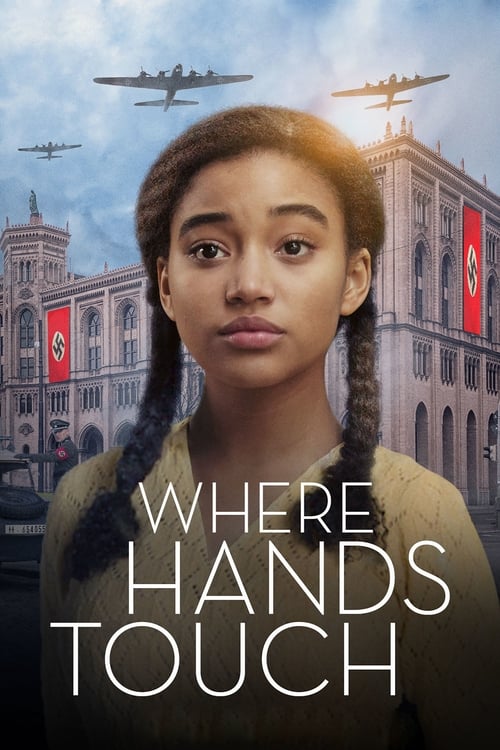
Where Hands Touch
Overview
"Where Hands Touch" is a 2018 war drama directed by Amma Asante. The film is set in 1944 Germany and tells the story of Leyna, a 15-year-old biracial girl, the daughter of a German mother and a Black French soldier. Leyna, portrayed by Amandla Stenberg, navigates the perils of her existence in a society that persecutes those deemed 'non-pure'.
Her life takes a complicated turn when she meets Lutz (George MacKay), the son of a prominent SS officer and a member of the Hitler Youth. They embark on a clandestine and dangerous romance, a relationship that defies the hateful ideology surrounding them. As the war intensifies, Leyna and her family face increasing persecution. Leyna is eventually sent to a labor camp, where her and Lutz's love is tested in the most extreme circumstances.
The film explores themes of identity, survival, and the complexities of love in a time of immense hatred and oppression. It is a fictional story inspired by the historical reality of Afro-Germans who lived under the Nazi regime.

Core Meaning
The core meaning of "Where Hands Touch" revolves around the exploration of identity and humanity in the face of dehumanizing ideology. Director Amma Asante sought to shed light on the little-known history of Afro-Germans during the Holocaust, demonstrating that their experiences were complex and multifaceted. The film posits that love and human connection can emerge even in the most oppressive of environments, challenging simplistic narratives of good and evil.
Asante also explores the insidious nature of propaganda and how it can shape the beliefs of a nation's youth, as seen through the character of Lutz. The film serves as a cautionary tale about the dangers of nationalism and the importance of questioning the narratives of those in power. Ultimately, "Where Hands Touch" is a testament to the resilience of the human spirit and the enduring power of love to transcend societal boundaries, even in the darkest of times.
Thematic DNA
Identity and Belonging
The theme of identity is central to Leyna's journey. As a biracial girl in Nazi Germany, she exists in a liminal space, neither fully accepted by the society she was born into nor able to escape its persecution. She grapples with her German heritage, a country that simultaneously claims her and rejects her. This internal conflict is highlighted by her initial desire to be seen as a loyal German, even as the regime's ideology marks her as an outcast. Her relationship with Lutz, a member of the dominant and oppressive group, further complicates her sense of self and belonging.
Love in a Time of Hate
The forbidden romance between Leyna and Lutz is a core element of the film, illustrating the power of human connection to defy societal-imposed hatred. Their relationship is portrayed as a small act of rebellion against the dehumanizing ideology of the Nazi regime. However, this theme has also been a source of controversy, with some critics arguing that it romanticizes a member of the Hitler Youth and downplays the power imbalance inherent in their relationship. The film attempts to navigate this complex terrain by showing Lutz's gradual disillusionment with the Nazi cause, prompted by his love for Leyna and his witnessing of the regime's brutality.
Survival and Resilience
"Where Hands Touch" is fundamentally a story of survival. Leyna, her mother Kerstin, and other persecuted individuals are constantly forced to make difficult choices to ensure their safety. The film depicts the daily anxieties and brutalities faced by those targeted by the Nazis, from the fear of being discovered to the horrors of the labor camps. Leyna's pregnancy becomes a powerful symbol of hope and the continuation of life in the face of death and destruction. Her resilience in the face of unimaginable hardship underscores the strength of the human spirit.
The Corruption of Youth
The film explores how the Nazi regime indoctrinated and corrupted a generation of young people. Lutz, as a member of the Hitler Youth, initially espouses the party's ideology. His character arc demonstrates the internal conflict of a young person grappling with the dissonance between what he has been taught and the reality of the regime's cruelty. Leyna's younger brother, Koen, also begins to internalize the Nazi's racist teachings, creating a painful rift within their family. This theme serves as a warning about the vulnerability of youth to extremist ideologies.
Character Analysis
Leyna
Amandla Stenberg
Motivation
Leyna's primary motivation is survival and the desire for a sense of belonging. Initially, she is motivated by a youthful desire for normalcy and acceptance within German society. As the film progresses, her motivation shifts to protecting her own life and the life of her unborn child, fueled by a fierce will to live.
Character Arc
Leyna begins the film as a relatively naive teenager who, despite the persecution she faces, still identifies as German and wants to belong. Her experiences, particularly her relationship with Lutz and her imprisonment in a labor camp, force her to confront the brutal reality of her situation. She transforms from a girl seeking acceptance into a hardened survivor who must make impossible choices to protect herself and her unborn child. Her journey is one of painful disillusionment but also of burgeoning strength and self-acceptance.
Lutz
George MacKay
Motivation
Initially, Lutz is motivated by a sense of patriotic duty and a desire to please his father. His love for Leyna becomes a competing and ultimately overriding motivation, compelling him to act against the regime he once served.
Character Arc
Lutz starts as a loyal member of the Hitler Youth, seemingly embracing the Nazi ideology. His character arc is one of gradual awakening and disillusionment. His love for Leyna forces him to question the hateful rhetoric he has been taught. Witnessing the atrocities of the regime firsthand, particularly in the labor camp, solidifies his rejection of Nazism. He ultimately sacrifices himself in an attempt to save Leyna, completing his transformation from a follower to a dissenter.
Kerstin
Abbie Cornish
Motivation
Kerstin's sole motivation is the safety and survival of her children, particularly Leyna, who is the most vulnerable. Every action she takes is driven by her maternal instinct to protect them from the horrors of the Nazi regime.
Character Arc
Kerstin is a mother fiercely dedicated to protecting her children in a hostile environment. Her arc is one of constant struggle and sacrifice. She makes difficult and morally ambiguous decisions to keep Leyna safe, including obtaining false papers stating Leyna has been sterilized. Her character highlights the impossible choices faced by ordinary people living under a totalitarian regime.
Heinz
Christopher Eccleston
Motivation
Heinz is motivated by a cynical desire to survive the war and to protect his son. He encourages Lutz to conform to the Nazi ideology as a means of survival, even though he himself seems to harbor doubts about the regime.
Character Arc
Heinz, Lutz's father, is a high-ranking SS officer who is privately disillusioned with the war and the Nazi regime. He represents a segment of German society that went along with the Nazis out of a sense of self-preservation. His arc is tragic, as his attempts to protect his son from the horrors of the war ultimately fail. In the end, he is forced to make a monstrous choice, killing his own son to prevent him from deserting with Leyna.
Symbols & Motifs
Leyna's Hair
Leyna's natural, curly hair is a visible marker of her African heritage and, therefore, her 'otherness' in Nazi Germany. It symbolizes her identity that she cannot hide and the constant target it makes her. Her mother's attempts to straighten it or cover it represent the pressure to assimilate and the danger of being different.
Throughout the film, Leyna's hair is a focal point of both racist taunts and moments of intimacy. In the labor camp, the shaving of her head is a brutal act of dehumanization, stripping her of a key part of her identity.
The Hidden Jazz Record
Lutz's father owns a forbidden American jazz record by Billie Holiday. Jazz music, created by African Americans, was deemed 'degenerate' by the Nazis. The record symbolizes a hidden world of humanity, art, and emotion that exists in defiance of the regime's sterile and hateful ideology. It represents a connection to a culture that the Nazis sought to eradicate.
Lutz shares the music with Leyna in secret, and it becomes a part of the soundtrack to their clandestine romance. It is a small but significant act of rebellion and a symbol of their shared humanity that transcends the racial divides imposed by their society.
Leyna's Pregnancy
Leyna's pregnancy is a powerful symbol of hope, resilience, and the future in the face of death and destruction. It represents the continuation of life and the ultimate failure of the Nazi's genocidal project to erase those they deemed 'undesirable'. The child is a product of love that crossed forbidden racial lines, embodying a future where such divisions might not exist.
Discovered while she is in the labor camp, Leyna's pregnancy becomes her primary motivation for survival. It is a secret she must protect at all costs, and her determination to bring her child into the world is a testament to her strength and will to live.
Memorable Quotes
There are days when you wonder what your role is in this country and what your future is in it.
— Opening text, a quote from James Baldwin
Context:
This quote is displayed on screen at the very beginning of the film, before the narrative begins. It serves as a thematic introduction to the story that is about to unfold.
Meaning:
This quote, which opens the film, sets the central theme of identity and belonging. It encapsulates Leyna's struggle to understand her place in a country that both defines and rejects her. The use of a quote from an African American writer also draws a parallel between the experiences of Black people in Nazi Germany and in other parts of a racially unjust world.
They hang people who look like you in America.
— Lutz
Context:
Lutz says this to Leyna during one of their secret meetings, after she expresses a desire to go to America. It is a sobering moment that brings a harsh dose of reality to their youthful romance.
Meaning:
This line is significant as it highlights the global nature of racism and shatters any illusion that America represents a safe haven for Leyna. It underscores the bleak reality that persecution based on race is not unique to Nazi Germany. It also adds a layer of complexity to Lutz's character, showing a surprising awareness of racial injustice outside of his own country.
Germany told us the world is against us, and yet all I see is Germany killing its own people.
— Leyna
Context:
Leyna says this to Lutz in the labor camp, as they discuss the possibility of escape. It is a moment of profound clarity for her, where she fully grasps the hypocrisy and brutality of the Nazi regime.
Meaning:
This quote marks a turning point in Leyna's understanding of her identity and the nature of the Nazi regime. It signifies her complete disillusionment with the nationalistic propaganda she has been exposed to. She recognizes that the true enemy is not an external force, but the destructive ideology that is tearing her country apart from within.
Philosophical Questions
Can love truly exist and be pure in a context of extreme oppression and power imbalance?
The film explores this question through the relationship between Leyna and Lutz. Their love blossoms in a society that has systematically stripped Leyna of her rights and humanity. The film presents their connection as a genuine and powerful force, but it also raises questions about whether their love can ever be truly equal given their vastly different social positions. The controversy surrounding the film stems from this very question, with some viewers finding the romance to be a powerful symbol of defiance, while others see it as a naive and even dangerous portrayal of love that ignores the oppressive context in which it exists.
To what extent is an individual responsible for their actions when they are part of an oppressive regime?
"Where Hands Touch" delves into this question through the character of Lutz. As a member of the Hitler Youth, he is a cog in the Nazi machine. The film charts his journey from a seemingly committed follower to someone who questions and ultimately rejects the regime's ideology. This raises questions about his culpability. Is he a victim of indoctrination, or is he responsible for his participation in an evil system? The film does not offer easy answers, instead presenting a nuanced portrait of a young man caught in the moral quagmire of his time. The audience is left to grapple with the complexities of guilt, complicity, and the possibility of redemption.
What does it mean to belong to a nation that rejects you?
This is the central philosophical question of Leyna's existence. She identifies as German, yet the state and many of her fellow citizens see her as an 'other' to be persecuted. The film explores the psychological turmoil of this experience, as Leyna struggles to reconcile her love for her homeland with its hatred for her. Her journey raises profound questions about the nature of national identity. Is it defined by blood and race, as the Nazis claimed, or by culture, birth, and personal affiliation? Leyna's story challenges the very notion of a homogenous national identity and highlights the painful experience of being an outsider in one's own home.
Alternative Interpretations
The most significant area of alternative interpretation in "Where Hands Touch" revolves around the central romance between Leyna and Lutz. While the film presents their love story as a testament to human connection in the face of hatred, many critics and viewers have offered alternative readings.
One interpretation is that the romance, rather than being a story of pure love, is a complex and problematic exploration of power dynamics. In this view, Leyna's attraction to Lutz is not just a matter of the heart, but is also influenced by her desire for protection and a sense of belonging in a society that has rejected her. Lutz, as a member of the dominant group, holds a position of power over Leyna, and their relationship can be seen as a reflection of the unequal power structures of Nazi Germany.
Another interpretation, and a major point of controversy, is that the film inadvertently humanizes Nazism by presenting a 'good Nazi' in the character of Lutz. Critics of this view argue that any attempt to portray a member of the Hitler Youth in a sympathetic light is morally fraught, regardless of his eventual redemption. They suggest that the focus on the romance distracts from the larger atrocities of the Holocaust and risks trivializing the experiences of its victims.
Conversely, some interpret the film's portrayal of Lutz not as a romanticization, but as a complex study of indoctrination and moral awakening. This reading suggests that the film is not excusing Lutz's involvement with the Nazis, but is instead exploring how a young person can be swayed by a powerful ideology and how personal relationships can challenge and ultimately change one's beliefs. From this perspective, the film is a cautionary tale about the dangers of blind obedience and the importance of individual conscience.
Cultural Impact
"Where Hands Touch" had a significant cultural impact primarily by bringing the forgotten history of Afro-Germans during the Nazi era to a mainstream audience. Director Amma Asante has a track record of illuminating overlooked Black histories in European contexts, as seen in her previous films "Belle" and "A United Kingdom". With "Where Hands Touch," she continued this important work, challenging the predominantly white narrative of World War II films.
The film generated considerable controversy and debate, particularly around its central romance between a biracial girl and a member of the Hitler Youth. Critics and audiences were divided, with some praising the film for its nuanced portrayal of complex characters and its exploration of uncomfortable historical truths, while others accused it of romanticizing Nazism and being historically insensitive. This debate, however, sparked important conversations about how history is portrayed on screen, the ethics of humanizing perpetrators of atrocities, and the complexities of love and complicity in oppressive regimes.
The film's release also coincided with a period of rising nationalism and racial tensions globally, making its themes of identity, persecution, and the dangers of hateful ideologies particularly resonant with contemporary audiences. While not a box office success, "Where Hands Touch" has found a place in discussions about Black history, World War II, and the ethical responsibilities of filmmaking. It serves as an important educational tool and a catalyst for dialogue about a chapter of history that has been largely ignored.
Audience Reception
Audience reception for "Where Hands Touch" has been deeply divided, mirroring the mixed critical reviews. Many viewers praised the film for shining a light on the overlooked history of Afro-Germans in Nazi Germany and for its powerful performances, particularly by Amandla Stenberg. These audiences often found the central love story to be a moving and poignant depiction of humanity's endurance in the face of horrific circumstances.
However, a significant portion of the audience found the romance between Leyna and Lutz to be problematic and even offensive. The idea of a romantic relationship between a biracial girl and a member of the Hitler Youth was a major point of contention, with many viewers arguing that it humanized a Nazi and was an inappropriate focus for a film set during the Holocaust. This led to accusations that the film was romanticizing Nazism and being tone-deaf to the historical atrocities.
The film's ending also sparked debate among audiences. Some found the conclusion, where Leyna survives and is reunited with her mother, to be a hopeful and fitting end to her story of resilience. Others felt that the ending was too neat and that it downplayed the immense suffering and loss of the Holocaust. Overall, "Where Hands Touch" proved to be a polarizing film, with audiences having strong and often conflicting reactions to its controversial subject matter and narrative choices.
Interesting Facts
- It took director Amma Asante 12 years to bring "Where Hands Touch" to the screen. She was inspired to write the story after seeing a historical photograph of an Afro-German schoolgirl in Nazi Germany.
- The film was shot in Belgium and on the Isle of Man. The production team chose Belgium to recreate the look of pre-bombed Berlin.
- Amandla Stenberg, who plays Leyna, turned 18 on the day she arrived on location to begin filming.
- Director Amma Asante conducted extensive research for the film, including interviewing Afro-German survivors of the Holocaust.
- The film's production company was offered the chance to film in a real concentration camp, but Asante declined, feeling it would be disrespectful to the memory of the victims.
- The controversial romantic storyline was, according to Asante, necessary to explore the theme of reproductive autonomy, as the forced sterilization of 'Rhineland Bastards' was a key part of their persecution.
⚠️ Spoiler Analysis
Click to reveal detailed analysis with spoilers
Frequently Asked Questions
Explore More About This Movie
Dive deeper into specific aspects of the movie with our detailed analysis pages
Comments (0)
No comments yet. Be the first to share your thoughts!