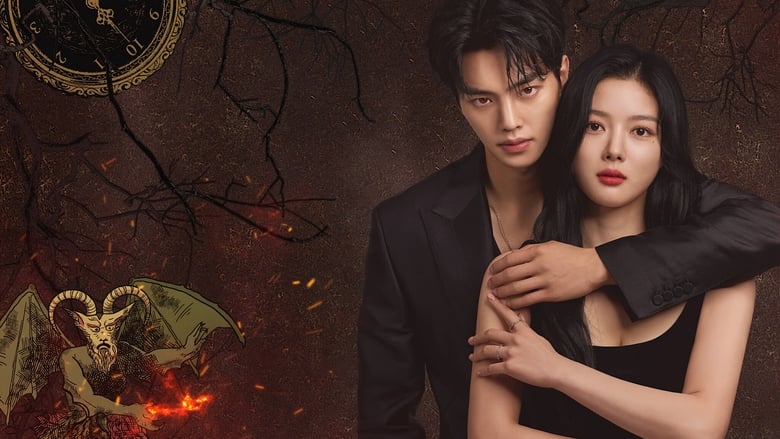

My Demon
마이데몬
"A demon who lost his powers becomes a bodyguard to a demonic human."
Overview
"My Demon" tells the story of Jeong Gu-won, a powerful, 200-year-old demon who sustains his immortality by making tempting deals with desperate humans. He is arrogant, looks down on mortals, and has grown weary of his existence. His life takes a dramatic turn when he encounters Do Do-hee, the sharp, cynical, and workaholic CEO of Mirae F&B. Do-hee, an orphan adopted by the head of a massive conglomerate, is distrustful of everyone around her and cynical about love.
During a perilous encounter, Gu-won's demonic powers—symbolized by a cross tattoo on his wrist—are accidentally transferred to Do-hee. To prevent his own extinction, Gu-won must stay close to her to access his abilities. This necessity forces them into a contract marriage, initially as a mutually beneficial arrangement to protect Do-hee from her scheming adoptive family and to keep Gu-won from combusting. As they navigate corporate intrigue and supernatural threats, their fake relationship blossoms into a genuine, profound romance, complicated by a tragic connection from their past lives and the very nature of their beings.

Core Meaning
The core meaning of "My Demon" revolves around the themes of choice, salvation, and the transformative power of love. The series posits that fate is not a predetermined path but rather a culmination of the choices one makes. It explores the idea that even a being defined by damnation, like a demon, can find redemption and a form of salvation through genuine love and self-sacrifice. The narrative suggests that humanity, with all its flaws and desires, is what gives life meaning, and that true happiness is found not in eternal life or supernatural power, but in the finite, precious moments spent with a loved one. Ultimately, the series conveys that love is a force powerful enough to defy destiny, challenge the divine, and redefine one's very existence.
Thematic DNA
Fate vs. Free Will
The series constantly questions whether the characters' lives are predetermined or a result of their own choices. The tragic love story of Yi-sun and Wolsim in the Joseon era seems to destine Gu-won and Do-hee for a similar heartbreaking end. However, characters repeatedly assert their determination to create their own happy ending, suggesting that fate is merely a "web woven by a myriad of choices." The finale reinforces this, as divine intervention allows them to be together, not because of destiny, but as a reward for Gu-won's selfless choices and Do-hee's unwavering love.
Love and Sacrifice
Love is consistently portrayed as an act of ultimate sacrifice. Do-hee is willing to give up her company and inheritance to protect Gu-won. In turn, Gu-won makes the ultimate sacrifice by using his power to resurrect Do-hee, knowing it will cause his own combustion and eternal disappearance. This theme culminates in the idea that their love is proven not by grand gestures but by their willingness to face annihilation for each other, which ultimately earns them a second chance.
The Nature of Good and Evil
The series blurs the lines between divinity and damnation. Gu-won, the demon, argues that "all evil ultimately stems from human desires," positioning himself as a mere facilitator rather than the source of corruption. The primary antagonist, Noh Suk-min, is a human driven by pure greed and cruelty, committing acts far more monstrous than the demon himself. Conversely, the character of God is shown to be aloof and transactional, operating on bets and deals rather than pure compassion. This challenges the audience's perception of who the true villains and saviors are.
Humanity and Mortality
Gu-won's 200-year existence as an immortal is depicted as lonely and meaningless. It is only through his relationship with the mortal Do-hee that he experiences genuine emotions like love, fear, and sacrifice. The series suggests that the finite nature of human life is what makes it precious. Gu-won's journey is one of rediscovering the humanity he lost, ultimately choosing a life intertwined with a mortal's fleeting existence over his cold, empty eternity.
Character Analysis
Jeong Gu-won / Seo Yi-sun
Song Kang
Motivation
His primary motivation is survival. Initially, he must protect Do-hee to preserve his own life and powers. This selfish goal slowly transforms into a genuine desire to protect her for her own sake. As he falls in love, his motivation shifts entirely to ensuring her happiness and safety, even at the cost of his own existence. He is also haunted by the memories of his past life as a human, Seo Yi-sun, and the tragic death of his lover, which drives his fear of history repeating itself.
Character Arc
Initially, Jeong Gu-won is a narcissistic, cold, and powerful 200-year-old demon who views humans as insignificant. His entire existence is based on transactional deals for souls. After losing his powers to Do Do-hee, he is forced into a state of vulnerability for the first time in centuries. His arc is a journey of rediscovering his lost humanity. Through his contractual and eventual real marriage to Do-hee, he learns empathy, love, and selflessness. He transforms from a predator into a protector, culminating in his ultimate sacrifice: choosing to cease to exist in order to save her life. His resurrection by a deity doesn't revert him to his old self; instead, he embraces his love for Do-hee, choosing a finite, meaningful existence with her over a lonely eternity.
Do Do-hee / Wolsim
Kim You-jung
Motivation
Initially, her motivation is to survive the attacks from her adoptive family and secure her position as the heir to the Mirae Group. She enters the contract marriage with Gu-won as a strategic move to gain a bodyguard and a stable position. As her feelings develop, her motivation shifts to protecting Gu-won and building a genuine life with him, valuing their relationship above the corporation and her own safety.
Character Arc
Do Do-hee begins as a guarded, cynical, and emotionally distant CEO, hardened by the loss of her parents and the treacherous environment of her adoptive family. She trusts no one and is entirely focused on her work. Her involvement with Gu-won forces her to open up and rely on someone else. Her arc is about dismantling the emotional walls she built for protection. She evolves from a lone survivor into a person who can love and trust deeply. She proves her strength not just in the boardroom but through her emotional resilience, facing down assassins, corporate enemies, and supernatural threats, ultimately willing to make a deal with God herself to bring back the man she loves.
Joo Seok-hoon
Lee Sang-yi
Motivation
His core motivation is his deep-seated, albeit platonic, love and concern for Do-hee. He wants to protect her from the dangers within their family and from the mysterious Gu-won, whom he initially distrusts. He investigates Gu-won's true nature not out of malice, but out of a desire to ensure Do-hee is safe. He eventually accepts their relationship and channels his motivation into supporting them both.
Character Arc
Joo Seok-hoon is introduced as the nephew of the Mirae Group's chairwoman and a potential rival or antagonist to Do Do-hee. He is the CEO of Mirae Investment and appears to harbor unrequited feelings for her. For much of the series, his actions are ambiguous, making the audience question his loyalty. However, his arc reveals that his primary concern has always been Do-hee's well-being. He evolves from a quiet observer and potential threat into a loyal ally and friend to both Do-hee and Gu-won, ultimately taking over as Chairman of Mirae Group to support her. His journey is one of clarifying his intentions and finding his own place outside the shadow of his family's drama.
Noh Suk-min
Kim Tae-hoon
Motivation
His sole motivation is to gain complete control of the Mirae Group. He believes he is the rightful heir and will eliminate anyone who stands in his way, including his family members. His actions are driven by a profound sense of entitlement, greed, and a complete lack of morality.
Character Arc
Noh Suk-min is the eldest son of the Mirae Group's chairwoman and the primary antagonist. He starts as a seemingly legitimate contender for the company's inheritance but quickly reveals his ruthless and violent nature. His arc is a descent into pure villainy. He is revealed to be the murderer of his own mother and the mastermind behind the attempts on Do-hee's life. He is an abusive husband and father, driven by an insatiable greed for power. His character does not evolve but rather devolves, losing his sanity and ending up imprisoned and haunted by his mother's ghost, a shell of the powerful figure he sought to be.
Symbols & Motifs
The Cross Tattoo
The cross tattoo on Gu-won's wrist symbolizes his demonic power, his life force, and the source of his immortality. It is the tool he uses to make contracts and collect souls. Its transfer to Do-hee represents their intertwined fates and his sudden vulnerability.
The tattoo is the central magical element of the plot. It physically moves from Gu-won's wrist to Do-hee's after he saves her from drowning, binding them together. He needs to hold her wrist to access his powers, creating both romantic and comedic tension. The tattoo's presence on Do-hee makes her a target while also being the key to Gu-won's survival.
The Demon's Watch
Gu-won's pocket watch is a symbol of his contracts and the finite time his human clients have left. It serves as a constant reminder of the deals he makes and the souls he is bound to collect after ten years. It represents his detachment and the transactional nature of his existence before meeting Do-hee.
The watch is frequently shown when Gu-won discusses or finalizes a contract with a human. When a contract's ten-year term is up, the watch signals that it is time to collect the soul. Its ticking is a countdown to damnation for his clients.
Fire
Fire symbolizes Gu-won's demonic nature, his destructive power, and his ultimate fate. It represents both his birth as a demon and the method of his fated extinction. When he breaks the ultimate rule by resurrecting Do-hee, he spontaneously combusts, fulfilling the prophecy of his demonic existence.
Fire appears throughout the series in connection with Gu-won's powers. He is born as a demon in a fiery rage after his human lover is killed. In the climax of Episode 15, after he saves Do-hee, he burns away into ashes, a visual representation of his self-immolation for love.
Memorable Quotes
You humans love to blame fate for everything but fate is nothing more than a web woven by a myriad of choices of your making.
— Noh Suk Nyeo (God)
Context:
This line is spoken by the homeless woman, later revealed to be a deity, who observes and occasionally interacts with Gu-won. It serves as a philosophical underpinning for the entire narrative, especially as Gu-won and Do-hee fight against what seems to be a tragic, repeating fate from their past lives.
Meaning:
This quote encapsulates the series' central theme of choice over destiny. It suggests that individuals are the architects of their own lives and cannot simply blame a predetermined path for their misfortunes or happiness. It empowers the characters' struggles to forge their own happy ending.
While it is true that external forces can lead people astray, all evil ultimately stems from human desires. So the fault cannot lie in the evil spirits alone.
— Jeong Gu-won
Context:
Gu-won often reflects on the nature of his work and the humans he deals with. This line is part of his internal monologue or a conversation explaining his worldview, highlighting his cynical yet perceptive understanding of people.
Meaning:
This quote is Gu-won's justification for his existence as a demon. He argues that he is not the source of evil but merely a merchant who capitalizes on the inherent flaws and greed of humanity. It shifts the moral responsibility from the supernatural tempter to the human who makes the choice.
My life feels as if it's shrouded in mist. Who is a friend and who is a foe? I can't tell.
— Do Do-hee
Context:
This is from an early episode, reflecting Do-hee's mindset after the death of her adoptive mother and as she faces threats from all sides. It establishes her emotional starting point before Gu-won crashes into her life.
Meaning:
This quote perfectly captures Do-hee's initial state of isolation, paranoia, and vulnerability. Surrounded by a family that sees her as an obstacle, she lives in a constant state of distrust, unable to discern who she can rely on, setting the stage for her unlikely alliance with a demon.
If I end up miserable either way, I want us to be miserable together.
— Do Do-hee
Context:
Spoken in Episode 11, this is Do-hee's response to Gu-won's fear that his demonic nature and their cursed fate will only bring her misery, just as it did to his lover in their past life.
Meaning:
This line signifies a major turning point in Do-hee's emotional journey. It's her declaration that she chooses a life with Gu-won, regardless of the potential pain or tragic outcome. She rejects the idea of a safe, lonely existence for a shared life, embracing both the joy and the suffering that comes with their love.
Episode Highlights
Joining Hands With a Demon
This episode is pivotal as it solidifies the central premise. After another attempt on her life, Do-hee formally proposes a contract marriage to Gu-won, realizing she needs his demonic protection to survive. It marks the official start of their fake relationship and cohabitation, setting the stage for all future romantic and comedic developments.
This episode transitions the plot from a chance encounter to a deliberate partnership. It establishes the rules of their arrangement and firmly intertwines their goals: her survival and his need to regain his powers. The dynamic of demon-as-bodyguard is officially established.
The Fateful Choice
Gu-won is seriously injured in an attack meant for Do-hee, making her realize the true danger he is in for her sake. To protect him, Do-hee makes a significant career move, stepping down from the company race. This act of sacrifice marks the point where their feelings for each other begin to outweigh their original, selfish motivations.
This episode deepens their emotional bond significantly. Do-hee's choice to prioritize Gu-won's safety over her lifelong ambition proves her love is genuine, pushing their relationship beyond the contractual obligation and into the realm of true romance.
Breaking Through the Shell
The truth about their past lives as the tragic lovers Seo Yi-sun and Wolsim is fully revealed. This revelation recontextualizes their entire relationship, explaining their deep connection and the sense of a tragic fate hanging over them. It also marks the climax of the first half of the series, shifting the central conflict from corporate succession to a battle against destiny.
The reincarnation trope is fully introduced, adding a layer of historical tragedy and high stakes to their romance. It explains why Gu-won is so afraid of loving Do-hee and sets up the central conflict for the latter half of the series: whether they can avoid repeating their painful past.
The End of Fate
The series reaches its emotional and tragic climax. The main antagonist, Noh Suk-min, reappears and mortally wounds Do-hee. To save her, Gu-won breaks the ultimate demonic taboo: he resurrects a human. As a consequence, he spontaneously combusts and turns to ash in front of a horrified Do-hee, seemingly ending their story in tragedy.
This episode delivers the ultimate act of sacrifice, fulfilling Gu-won's character arc from selfish demon to selfless lover. It creates the series' most powerful cliffhanger and emotional low point, seemingly confirming the tragic fate they fought so hard to avoid.
Our Personal Heaven
In the finale, a grieving Do-hee makes a desperate wish on Christmas to bring Gu-won back. The deity, honoring a previous bet she lost to Gu-won, resurrects him. They are reunited, and the loose ends are tied up: Suk-min is imprisoned, Seok-hoon becomes chairman, and Gu-won and Do-hee are free to live their lives together. The series concludes with them embracing their love, choosing their own happy ending.
The finale provides a satisfying and happy resolution, subverting the tragic fate that seemed inevitable. It reinforces the theme of choice, as their love and sacrifices are what ultimately earn them their 'personal heaven.' It successfully concludes the narrative arcs of all main characters, offering a hopeful and romantic ending.
Philosophical Questions
Are humans inherently flawed, or are they led astray by external temptations?
The series explores this through Gu-won's very existence. He repeatedly states that his role is not to create evil, but to capitalize on the evil that already exists within human desires for greed, power, and revenge. The main human villain, Noh Suk-min, acts with extreme cruelty without any demonic influence, supporting Gu-won's cynical view. The show suggests that while supernatural forces might offer a contract, the choice to sign it—and the darkness that fuels that choice—is entirely human.
What is the true meaning of 'salvation'?
The series presents multiple forms of salvation. Initially, Gu-won's name is a pun on the Korean word for 'savior', and he literally saves Do-hee's life multiple times. However, the deeper exploration reveals that Do-hee is his salvation, saving him from a meaningless, eternal existence by teaching him to love. In the end, their salvation is mutual: he physically saves her from death, and she emotionally saves him from damnation. The series posits that salvation isn't a divine gift but something people, and even demons, can grant each other through love and sacrifice.
Can love truly conquer a predetermined fate?
The reincarnation plotline introduces a powerful element of tragic destiny. Gu-won and Do-hee's past-life counterparts were doomed, suggesting they are fated to repeat this tragedy. The series dedicates its second half to their struggle against this outcome. Gu-won's fear of hurting Do-hee and her determination to stay with him regardless of the consequences form the central conflict. The finale, where divine intervention grants them a happy ending, can be seen in two ways: either love did conquer fate by proving itself worthy of an exception, or fate was never truly fixed, and their choices were always the most powerful force at play.
Alternative Interpretations
One alternative interpretation focuses on the character of God, represented as the homeless woman. Instead of a benevolent, omnipotent being, she can be seen as a bored, manipulative entity who views human and demonic lives as a form of entertainment. She makes bets with Gu-won and brings him back not out of pure compassion, but because he 'won' a previous wager. This reading suggests the universe of "My Demon" is not governed by morality but by whimsy and cosmic games, and the happy ending is less a reward for love and more a fortunate coincidence in a chaotic system.
Another interpretation centers on the idea of salvation. While the narrative presents Gu-won's salvation as finding love with Do-hee, it could also be interpreted as his escape from the meaningless cycle of his demonic duty. His love for Do-hee provides an anchor and a purpose beyond his transactional existence. In this view, Do-hee doesn't just save him from extinction; she saves him from his own personal hell of immortal, purposeless repetition, making his eventual return to a 'job' as a demon a bit ironic, though now tempered with human emotion.
Cultural Impact
"My Demon" premiered in late 2023 and quickly became a popular fantasy rom-com, particularly among international audiences on Netflix. Its success can be attributed to the strong visual appeal and palpable on-screen chemistry between its lead actors, Song Kang and Kim You-jung, which was a major point of discussion among fans and media. The series capitalized on well-loved K-drama tropes such as the contract marriage, enemies-to-lovers, and fated reincarnation, blending them into a visually polished package.
Critically, the reception was mixed. While many praised the chemistry, stunning cinematography, and high-fashion styling, some critics found the writing to be lazy, predictable, and reliant on clichés, especially in the latter half of the series. The plot was at times considered secondary to the romantic visuals. Despite these critiques, the show maintained a strong fanbase who were deeply invested in the central romance. It contributed to the ongoing trend of supernatural romance dramas in Korean television but stood out for its high production value and the star power of its leads. The series concluded with a satisfying happy ending that was well-received by its target audience, solidifying its place as an entertaining, if not groundbreaking, entry in the genre.
Audience Reception
Audience reception for "My Demon" was generally positive, particularly among international viewers on platforms like Netflix. The show was frequently praised for the powerful on-screen chemistry between leads Song Kang and Kim You-jung, whose dynamic was often cited as the series' main draw. The stunning visuals, high-fashion costuming, and polished cinematography also received significant acclaim, with many viewers enjoying the show for its aesthetic appeal.
However, the series also drew criticism. A common complaint was that the writing felt unoriginal and relied heavily on well-worn K-drama tropes, leading some viewers to find the plot predictable, especially in the latter half. Some found the story became draggy after the main couple got together, and the corporate intrigue subplot was considered less compelling than the central romance. Despite these criticisms, the dedicated fanbase remained invested until the end, largely satisfied with the conclusive happy ending that provided emotional closure for the main couple.
Interesting Facts
- To fully embody the character of the demon Gu-won, actor Song Kang lost 10 kilograms (about 22 pounds) through a strict diet.
- The fire effect in Gu-won's introductory scene was created using real fire, not CGI, to symbolize the character's dramatic 'birth' as a demon.
- The filming of the series' opening scene, which lasts less than a minute on screen, took two full days to shoot in the early morning hours before sunrise.
- Actors Song Kang and Kim You-jung did not know how to ride a tandem bicycle for a date scene in Episode 9 and had to film parts of it goofily without the bike moving.
- In the post-shower scene in Episode 5, a blooper reel revealed that Kim You-jung had difficulty not looking at Song Kang's abs, causing some humorous takes.
- Gu-won tossing away Do-hee's drink when she was drunk was an ad-libbed idea from actress Kim You-jung.
- Much of the series was filmed in prominent locations in and around Seoul, including Sungshin Women's University (Sunwol Foundation), Ilsan Lake Park, and the Latitude32 rooftop bar at the Sofitel Ambassador Seoul Hotel (the blind date location).
⚠️ Spoiler Analysis
Click to reveal detailed analysis with spoilers
Frequently Asked Questions
Explore More About This Movie
Dive deeper into specific aspects of the movie with our detailed analysis pages
Comments (0)
No comments yet. Be the first to share your thoughts!