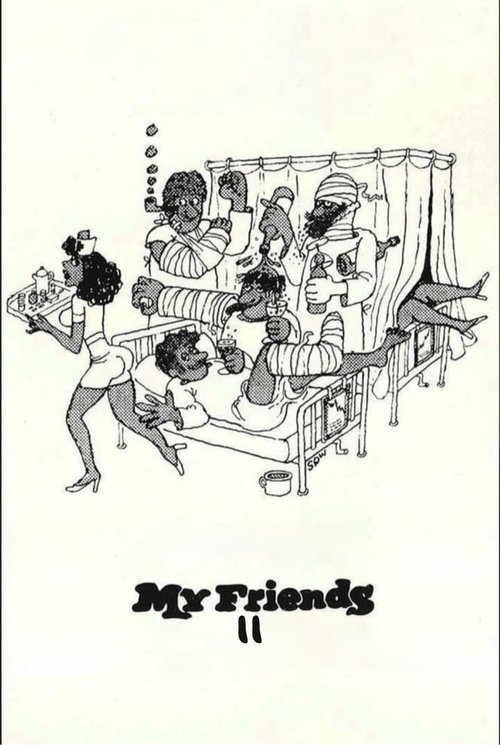
My Friends Act II
Amici miei - Atto II°
Overview
Set seven years after the events of the original film, My Friends Act II opens at a cemetery where the four remaining friends—Mascetti, Melandri, Sassaroli, and Necchi—gather at the grave of their deceased companion, Perozzi. However, their mourning quickly devolves into their characteristic irreverence, as they pull a cruel but hilarious prank on a grieving widower. This sets the tone for a narrative that seamlessly weaves between the present day and nostalgic flashbacks of their past adventures with Perozzi.
The friends continue to orchestrate their elaborate zingarate (gypsy-like pranks) to combat the monotony of aging and their personal failures. Whether they are dealing with Mascetti's crippling debts to a ruthless loan shark, Melandri's disastrous romantic pursuits of a fiercely religious woman, or the chaotic backdrop of the 1966 Florence flood, their bond remains the only constant in their lives.
As the film progresses, the physical and emotional toll of time begins to catch up with the group. The comedy grows darker and more melancholic, culminating in a poignant exploration of how far men will go to deny their own mortality, relying on the shield of brotherhood and laughter to face the inevitable.
Core Meaning
At its core, My Friends Act II is a profound meditation on the fear of aging and death. Director Mario Monicelli uses the framework of the commedia all'italiana to explore how humor and male camaraderie serve as desperate defense mechanisms against life's tragedies. The characters' relentless pranking is not merely childish mischief; it is an existential rebellion.
The director suggests that while time inevitably destroys the body, the human spirit can remain defiantly unconquered. The film carries the bittersweet message that life is essentially an absurd joke, and the only viable response is to laugh at it—even when standing at the edge of the grave.
Thematic DNA
The Inevitability of Aging and Mortality
The characters are constantly haunted by their advancing age, physical ailments, and the death of their friend Perozzi. Their refusal to act their age is a direct, albeit futile, rebellion against their own mortality.
Male Bonding and Brotherhood
The film highlights how male friendship acts as a sanctuary. For these men, their bond is more important than their marriages, careers, or families, serving as their primary emotional support system.
Cynicism as a Coping Mechanism
Through dark humor and cruel pranks, the characters deflect emotional pain. Laughter and cynicism are used as armor to prevent themselves from facing the depressing reality of their failed lives.
Rebellion Against Bourgeois Norms
The group continually mocks societal institutions, including the Church, marriage, and the medical establishment. They operate outside the bounds of polite society, exposing the hypocrisy of the bourgeois lifestyle.
Character Analysis
Lello Mascetti
Ugo Tognazzi
Motivation
To maintain his dignity, sense of superiority, and love for life despite living in absolute poverty and relying heavily on his friends.
Character Arc
Mascetti transitions from a proud nobleman attempting to chase youthful lust, to a physically broken man who must accept his physical limitations while refusing to let his spirit die.
Alfeo Sassaroli
Adolfo Celi
Motivation
To alleviate his profound boredom with his successful, respectable life through orchestrating cruel, elaborate pranks.
Character Arc
Sassaroli remains largely unchanged, serving as the cold, calculating anchor of the group whose wealth and medical authority provide a safety net for their increasingly reckless antics.
Rambaldo Melandri
Gastone Moschin
Motivation
To find true love and companionship, attempting to fill the emotional void that his friendships cannot completely cover.
Character Arc
Melandri continually falls into absurd, doomed infatuations. His arc reveals a man desperate for love, constantly compromising his ideals only to retreat back to the safety of his friends.
Guido Necchi
Renzo Montagnani
Motivation
To escape the monotony of his domestic life and his responsibilities as a local business owner.
Character Arc
Necchi runs the bar that serves as the group's headquarters. He acts as the emotional glue and reliable participant in all their schemes, maintaining the status quo of their endless adolescence.
Giorgio Perozzi
Philippe Noiret
Motivation
To mock the societal expectations of family and career that he deeply despises.
Character Arc
Appearing only in flashbacks, Perozzi's arc is static but revelatory, showcasing how his deep cynicism and fractured family life laid the foundation for the group's current nihilistic outlook.
Symbols & Motifs
The "Supercazzola"
It symbolizes the characters' rejection of societal rules and their desire to disrupt the establishment through pure, chaotic nonsense.
Used repeatedly by Mascetti to confuse authority figures, police officers, and priests, rendering their authority powerless against absurdity.
The Cemetery
It represents the looming shadow of death and the inescapable reality of their aging bodies.
The film opens with the friends at Perozzi's grave, but rather than mourning, they use the sacred ground as a stage for a cruel prank, literally laughing in the face of death.
Mascetti's Wheelchair
It is a stark visual metaphor for the physical decay brought on by old age, contrasting with an unbroken, rebellious inner spirit.
Following a stroke, Mascetti is confined to a wheelchair. In the film's climax, he is fiercely pushed by his friends in a Paralympic race, turning his disability into yet another chaotic joke.
Memorable Quotes
Tarapio tapioco come se fosse antani, la supercazzola prematurata con dominus vobiscum blinda?
— Lello Mascetti
Context:
Mascetti uses this rapid-fire string of gibberish to completely baffle a priest, Don Angelo Bernocchi, during a religious procession.
Meaning:
This is the ultimate evolution of the supercazzola, blending pseudo-religious Latin with utter nonsense. It highlights Mascetti's total irreverence toward the Church.
Ahi ahi ahi! Ci troviamo di fronte ad un tipico caso di defecazio isterica, si ha la chiara e netta sensazione di defecare, ma non esce nulla. Bisogna operare subito!
— Professor Sassaroli
Context:
Sassaroli says this to a loan shark, convincing the perfectly healthy man that he requires an immediate, invasive emergency surgery.
Meaning:
It demonstrates Sassaroli's sadistic use of his medical authority to terrify innocent people for his own amusement and the benefit of the group.
Che cos'è il genio? È fantasia, intuizione, colpo d'occhio e velocità d'esecuzione.
— Guido Necchi
Context:
The phrase is used to describe the instantaneous, flawless execution of a perfectly timed prank, solidifying their mischief as acts of genius.
Meaning:
This quote serves as the thesis statement for the group's pranks, elevating their childish antics to the level of high art and intellectual brilliance.
Philosophical Questions
Is it better to live a safe, responsible life or a chaotic, joy-filled existence that risks ruin?
The film contrasts the deeply flawed but vibrant lives of the pranksters with the mundane, rule-abiding lives of their victims, asking the audience to evaluate the true meaning of a life well-lived.
How can humans cope with the terrifying reality of their own mortality?
By depicting characters who use elaborate jokes and cruelty to mask their terror of death, the film explores laughter and denial as existential survival mechanisms against the inevitable decay of the body.
Alternative Interpretations
While broadly viewed as a bittersweet ode to enduring friendship, a prominent alternative interpretation reads the film as a harsh critique of toxic masculinity and arrested development. From this perspective, the protagonists are not lovable rogues, but deeply selfish, misogynistic men who ruin the lives of their wives, children, and innocent bystanders to avoid taking real responsibility for their own failures.
Another reading focuses on the film's ending. While some viewers interpret Mascetti's final state in a wheelchair as a depressing, pathetic defeat by old age, others read it as a triumphant and defiant victory of the human spirit. Despite his paralyzed body, his mind remains sharp enough to continue orchestrating the ultimate joke against life's cruelty.
Cultural Impact
My Friends Act II cemented the legacy of the Commedia all'italiana, confirming Mario Monicelli as a master of blending uproarious comedy with profound tragedy. The film's impact on Italian pop culture is immeasurable, solidifying terms like "zingarata" (a carefree, disruptive prank) and "supercazzola" (a string of fast-paced, nonsensical words used to confuse someone) into the official Italian lexicon.
Critically, it is regarded as one of the rare sequels that lives up to the original's greatness, maintaining its cynical bite while deepening the emotional resonance. Audiences resonated with its unapologetic depiction of flawed, aging men, making it a massive box-office hit. Its influence can be seen in countless modern comedies that explore male friendships and the existential dread of aging, remaining a timeless cultural touchstone in Italy.
Audience Reception
Audience reception for My Friends Act II has been overwhelmingly positive, with fans often debating whether it surpasses the original. Viewers heavily praised Ugo Tognazzi's masterful performance as the tragicomic Mascetti and the film's unique ability to seamlessly transition from side-splitting laughter to poignant melancholy.
The main points of criticism generally focus on narrative inconsistencies and timeline confusion caused by the intricate flashback structure. Some audiences also found the humor in this second installment to be significantly darker and more cruel than the first. However, the overall verdict remains incredibly strong, with the film universally recognized as a masterful, bittersweet gem of Italian cinema.
Interesting Facts
- Renzo Montagnani took over the role of Guido Necchi from Duilio Del Prete, who played the character in the first film. Interestingly, Montagnani had already dubbed the Italian voice of Philippe Noiret (Perozzi) in the original 1975 movie.
- The legendary train-slapping scene, often referenced in the series and shown in flashbacks, featured real extras who were completely unaware that the actors would lean out and genuinely slap them, resulting in their authentic shocked reactions.
- Marcello Mastroianni was originally considered for the role of Mascetti when the first film was in development, but he declined, fearing he would be overshadowed by the ensemble cast. This paved the way for Ugo Tognazzi to make the character iconic.
- The film features the legendary Italian actor Paolo Stoppa as the loan shark Savino Capogreco, marking one of his final film appearances before his death.
Easter Eggs
Perozzi's Voice in Flashbacks
Because Renzo Montagnani dubbed Philippe Noiret in the first film, there is a specific flashback scene in Act II where Perozzi yells at his son, and astute Italian viewers can clearly hear Montagnani's voice coming from Noiret, even though Montagnani is physically present in the film playing the entirely different character of Necchi.
Alessandro Haber's Cameo
The renowned Italian actor Alessandro Haber makes a memorable, uncredited cameo in the opening scene as the grieving widower Paolo, who falls victim to Sassaroli's cruel prank at the cemetery.
⚠️ Spoiler Analysis
Click to reveal detailed analysis with spoilers
Frequently Asked Questions
Explore More About This Movie
Dive deeper into specific aspects of the movie with our detailed analysis pages
Comments (0)
No comments yet. Be the first to share your thoughts!