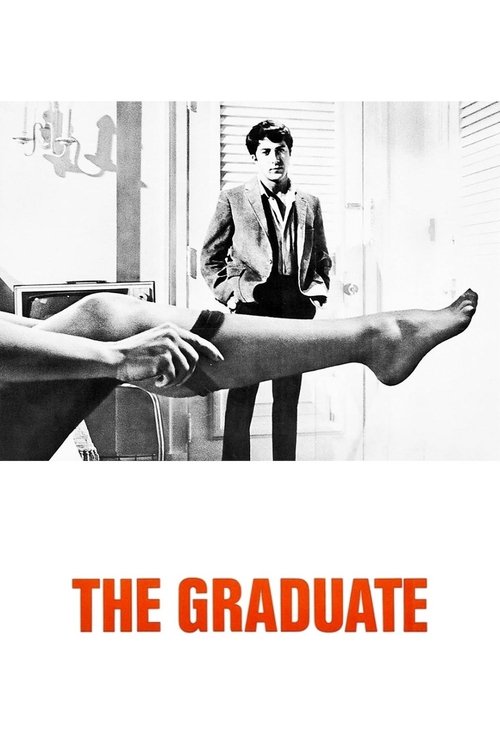
The Graduate
A coming-of-age drama drenched in existential confusion and satirical bite. Benjamin Braddock drifts like a scuba diver submerged in the hollow, synthetic waters of adulthood, searching for an authentic breath before drowning in suburbia.
The Graduate

The Graduate

"This is Benjamin. He’s a little worried about his future."

21 December 1967 United States of America 106 min ⭐ 7.6 (3,612)
Director: Mike Nichols
Cast: Dustin Hoffman, Anne Bancroft, Katharine Ross, Murray Hamilton, William Daniels
Drama Comedy Romance
Conformity vs. Rebellion Alienation and Disillusionment The Artificiality of Adulthood Generational Divide
Budget: $3,000,000
Box Office: $104,945,305

Overview

In 1967, The Graduate perfectly captured the widespread disillusionment and alienation of American youth during a period of intense cultural transition. Benjamin Braddock, a twenty-one-year-old college graduate, returns to his wealthy parents' home in suburban California burdened by an overwhelming sense of apathy and anxiety regarding his future. Surrounded by superficial adults pressing him to conform to their materialistic expectations, Benjamin retreats into a state of emotional paralysis, literally and figuratively floating through life.

His aimless drifting is abruptly interrupted when he is seduced by Mrs. Robinson, the wife of his father's business partner. What begins as a rebellion against the stifling expectations of his parents quickly devolves into a hollow, mechanical affair that only deepens Benjamin's existential dread. The narrative becomes even more complicated when he is pressured into a date with Mrs. Robinson's daughter, Elaine, sparking a genuine connection that forces Benjamin to finally wake up and take desperate, chaotic action to claim his own destiny.
Core Meaning

At its core, The Graduate is a sharp critique of middle-class conformity, materialism, and the generational divide of the 1960s. Director Mike Nichols presents a world where the older generation has traded authenticity for comfort, embodied by the famous advice to invest in "plastics"—a metaphor for the artificiality of their lives. Benjamin's journey is not just about sexual awakening, but a desperate search for meaning in an environment devoid of genuine connection. The film suggests that youthful rebellion, while necessary to break free from societal expectations, is often chaotic and uncertain, leaving the ultimate question of "what comes next?" terrifyingly unanswered.

Thematic DNA

Conformity vs. Rebellion 30%
Alienation and Disillusionment 30%
The Artificiality of Adulthood 20%
Generational Divide 20%

Conformity vs. Rebellion

The film consistently highlights the pressure to conform to suburban, middle-class ideals, represented by Benjamin's parents and their friends. Benjamin's affair and subsequent pursuit of Elaine serve as acts of rebellion against a pre-packaged life, though his rebellion lacks a clear ideological direction.

Alienation and Disillusionment

Benjamin is profoundly disconnected from the world around him. This alienation is felt in his silent, awkward interactions and his retreat into physical isolation. He is struggling with the existential dread of entering an adult world he views as deeply hypocritical.

The Artificiality of Adulthood

The adult world is portrayed as spiritually bankrupt and superficial. The iconic word "Plastics" symbolizes this artificiality. The adults are shown as overbearing, emotionally cold, and trapped in loveless marriages, most notably Mrs. Robinson.

Generational Divide

The massive disconnect between the youth and their parents is a driving force. The adults project their own desires onto Benjamin, entirely failing to understand his internal crisis. This lack of communication highlights the broader cultural shift occurring in the late 1960s.

Character Analysis

Benjamin Braddock

Dustin Hoffman

Archetype: The Disillusioned Youth
Key Trait: Aimless

Motivation

To find authenticity and escape the "plastic," predetermined life mapped out by his parents and their affluent friends.

Character Arc

Benjamin begins as an anxious, passive young man paralyzed by societal expectations. He briefly finds an escape through a hollow affair, but eventually takes frantic, rebellious action to pursue Elaine, transitioning from extreme apathy to obsessive determination.

Mrs. Robinson

Anne Bancroft

Archetype: The Broken Bird / Seductress
Key Trait: Cynical

Motivation

To alleviate the crushing boredom and emotional emptiness of her loveless marriage through a purely physical, transactional affair.

Character Arc

Introduced as a confident, predatory older woman, she is gradually revealed to be a deeply unhappy, trapped alcoholic who gave up her own dreams due to a pregnancy. Her arc ends in bitterness and vengeance when her daughter becomes involved with Benjamin.

Elaine Robinson

Katharine Ross

Archetype: The Ingenue / Catalyst
Key Trait: Innocent

Motivation

To navigate the emotional wreckage caused by the adults in her life and find a genuine, uncorrupted connection.

Character Arc

Initially appearing as the dutiful, perfect daughter, Elaine's worldview is shattered by the revelation of her mother's affair. She ultimately breaks away from her mother's path of forced domesticity by running away with Benjamin.

Symbols & Motifs

Water and the Pool

Meaning:

Water symbolizes Benjamin's feeling of drowning in the expectations of others, as well as his desire to isolate himself from the superficial adult world.

Context:

He is frequently shown submerged in the family pool, drifting aimlessly on a raft, or framed against a fish tank, visually trapped in an artificial environment.

The Scuba Suit

Meaning:

The suit represents the suffocating weight of his parents' expectations and his absolute isolation. It is a physical barrier between him and the outside world.

Context:

Forced by his parents to demonstrate the suit to their friends, Benjamin plunges into the pool and sinks to the bottom, surrounded only by the heavy sound of his own breathing.

Animal Prints

Meaning:

The animal prints symbolize a predatory, instinctual nature, highlighting a character who operates as a hunter in a domestic environment.

Context:

Mrs. Robinson consistently wears leopard and zebra print clothing, and her home features exotic jungle-like foliage, visually communicating her role as a predator ensnaring Benjamin.

Plastics

Meaning:

The word represents the fake, manufactured, and soulless future that the older generation values and wants to force upon the younger generation.

Context:

During his homecoming party, Mr. McGuire pulls Benjamin aside to give him one word of career advice: "Plastics," encapsulating the entire philosophy of the suburban elite.

Memorable Quotes

Mrs. Robinson, you're trying to seduce me. Aren't you?

— Benjamin Braddock

Context:

Spoken when Benjamin is in Mrs. Robinson's house, and she has manipulated him into her bedroom and begun to undress.

Meaning:

This quote shatters the unspoken tension between the two characters, highlighting Benjamin's awkwardness and naivety in the face of Mrs. Robinson's blatant sexual aggression.

I just want to say one word to you. Just one word... Plastics.

— Mr. McGuire

Context:

Said to Benjamin at his graduation party, as unsolicited, supposedly profound career advice.

Meaning:

It encapsulates the ultimate symbol of the 1960s older generation's values: synthetic, cheap, and entirely artificial. It represents everything Benjamin wishes to avoid.

It's like I was playing some kind of game, but the rules don't make any sense to me. They're being made up by all the wrong people.

— Benjamin Braddock

Context:

Benjamin trying to explain his overwhelming feelings of alienation and confusion.

Meaning:

This summarizes the core existential crisis of the youth in the 1960s—feeling forced to participate in a society whose values they fundamentally reject.

Philosophical Questions

What does it mean to live an authentic life?

The film contrasts the "plastic," predetermined life of the older generation with Benjamin's desperate, fumbling search for something real. It asks whether true authenticity can be found in a society built on superficiality.

Is rebellion without a purpose ultimately futile?

Benjamin rejects his parents' world, but he has no alternative vision for his future. The ambiguous ending questions whether merely escaping a flawed system is enough to guarantee happiness or meaning.

Alternative Interpretations

The most debated element of the film is its ending. A traditional, romantic reading views Benjamin and Elaine's escape on the bus as a triumphant victory over the oppressive adult world—a true fairytale ending where love conquers all. However, a more cynical and widely accepted critical interpretation focuses on the lingering final shot where their smiles fade into expressions of uncertainty and dread. In this reading, they haven't solved anything; they have simply rebelled without a plan, and may end up trapped in the same miserable, meaningless marriages as their parents.

Another interpretation views Mrs. Robinson not as a villain, but as the true tragic figure of the story. From this perspective, she is a victim of the patriarchal society of the 1950s—forced into a loveless marriage due to an accidental pregnancy, abandoning her passion for art. Her seduction of Benjamin is seen as a desperate, albeit toxic, attempt to reclaim her lost youth and agency.

Cultural Impact

The Graduate was a monumental cultural milestone that perfectly captured the zeitgeist of 1960s America. Released in 1967, it became the highest-grossing film of the year and acted as a cinematic bridge between the old studio system and the "New Hollywood" era. It gave voice to a generation of Baby Boomers who felt deeply alienated by the materialistic, "plastic" values of their parents.

Its revolutionary use of Simon & Garfunkel's folk-rock soundtrack completely changed how movies used popular music, moving away from traditional orchestral scores to contemporary songs that served as a Greek chorus to the protagonist's internal state. The film skyrocketed Dustin Hoffman to stardom, redefining the Hollywood leading man from a conventional, handsome hero to an awkward, relatable anti-hero.

Critically acclaimed, it earned Mike Nichols an Academy Award for Best Director. The movie's themes of existential dread, sexual awakening, and the generation gap have had a profound, lasting impact on pop culture, with elements like the seduction scene, the leg framing shot, and the ambiguous bus ending being parodied and paid homage to in countless films and television shows.

Audience Reception

Audiences in 1967, particularly the younger demographic, embraced The Graduate fervently, seeing their own anxieties and frustrations reflected on screen. It was praised for its sharp, satirical humor, Dustin Hoffman's incredibly relatable performance, and the groundbreaking soundtrack. The film was seen as a bold, mature exploration of taboo subjects like intergenerational affairs and the deep emptiness of the American Dream.

Some critics and more conservative viewers at the time found the sexual content shocking and viewed Benjamin's actions, particularly his stalking of Elaine in the second half, as problematic. Modern audiences frequently point out that Benjamin's pursuit of Elaine borders on harassment by today's standards. However, the overall verdict remains overwhelmingly positive, with audiences continuously celebrating the film's brilliant cinematography, its incisive commentary on alienation, and its daring, ambiguous conclusion that refuses to provide easy answers.

Interesting Facts

  • Dustin Hoffman was nearly rejected for the role because he didn't look like a stereotypical blonde, tanned Californian; he was an awkward New York stage actor.
  • Anne Bancroft was only six years older than Dustin Hoffman in real life, despite playing a middle-aged woman significantly older than his 21-year-old character.
  • The famous final bus scene was essentially improvised; director Mike Nichols just kept the camera rolling without yelling 'cut', capturing the actors' natural transition from exhilaration to anxious realization.
  • The film was revolutionary for using already-released pop music by Simon & Garfunkel instead of a traditional orchestral score, pioneering the modern movie soundtrack.
  • Benjamin's scuba scene was filmed from inside the suit to emphasize his isolation—an intentional metaphor by Nichols to make the audience feel his suffocation.

Easter Eggs

The Taft Hotel

The hotel where Benjamin and Mrs. Robinson conduct their affair is named the "Taft Hotel"—a subtle nod to conservative, old-fashioned establishment conformity.

The Sound of Silence Visuals

The film subtly references the lyrics of "The Sound of Silence" through visual compositions of loneliness and lack of communication, making the song's themes a recurring visual easter egg throughout the movie.

⚠️ Spoiler Analysis

Click to reveal detailed analysis with spoilers

Frequently Asked Questions

Explore More About This Movie

Dive deeper into specific aspects of the movie with our detailed analysis pages

Comments (0)

Leave a comment

No comments yet. Be the first to share your thoughts!