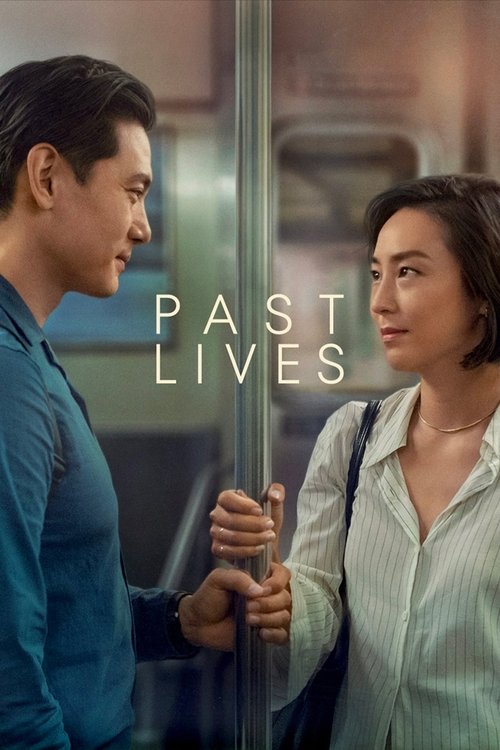
Past Lives
A quiet, aching romance exploring destiny, migration, and the roads not taken. Through the Korean concept of In-Yun, it visualizes the invisible threads binding two childhood sweethearts across continents and decades, culminating in a bittersweet acceptance of the present.
Past Lives

Past Lives

02 June 2023 United States of America 106 min ⭐ 7.7 (2,166)
Director: Celine Song
Cast: Greta Lee, Teo Yoo, John Magaro, Moon Seung-ah, Yim Seung-min
Drama Romance
In-Yun (Fate/Providence) Migration and Identity The Roads Not Taken Language and Communication
Budget: $12,000,000
Box Office: $28,126,646

Overview

Nora and Hae Sung, two deeply connected childhood friends in Seoul, are torn apart when Nora's family emigrates to Canada. Twelve years later, they reconnect online, sharing a brief but intense period of video calls before Nora halts communication to focus on her writing career in New York. Another twelve years pass, and Nora is now happily married to Arthur.

The narrative reaches its emotional peak when Hae Sung visits New York for a fateful week. The trio navigates a delicate dynamic—not a melodramatic love triangle, but a mature confrontation of past and present. Over meals and city walks, they explore the concept of In-Yun (fate) and the reality of the choices that define them.


Core Meaning

Past Lives is a meditation on the closure necessary to fully inhabit one's current life. Director Celine Song uses the film to articulate that gaining a new identity inevitably requires the mourning of a former self. It posits that love is not just about possession or "ending up together," but about honoring the connection (In-Yun) that exists across time, even if it doesn't manifest in the present reality.

Thematic DNA

In-Yun (Fate/Providence) 30%
Migration and Identity 25%
The Roads Not Taken 25%
Language and Communication 20%

In-Yun (Fate/Providence)

The Korean Buddhist concept that every encounter, no matter how small, is the result of connections from past lives. The film uses this to explain the deep, inexplicable bond between Nora and Hae Sung, suggesting their relationship is significant even if it doesn't lead to marriage in this lifetime.

Migration and Identity

Nora's journey illustrates the immigrant experience as a splitting of the self. The film explores the "loss" inherent in immigration—Na Young had to cease existing for Nora to be born. Hae Sung loves the girl who left, while Arthur loves the woman she became.

The Roads Not Taken

The narrative serves as a vessel for the universal "what if." It validates the grief for the lives we didn't lead without invalidating the joy of the life we did choose. It suggests that parallel possibilities exist but are inaccessible.

Language and Communication

Language acts as both a bridge and a barrier. Nora dreams in Korean—a private world Arthur cannot access. The film uses subtitles and silence to convey emotions that transcend spoken words, highlighting the isolation and intimacy of bilingualism.

Character Analysis

Nora Moon (Na Young)

Greta Lee

Archetype: The Realist / The Immigrant
Key Trait: Ambitious resilience

Motivation

To achieve something "big" (a Nobel/Pulitzer prize) and to justify the sacrifice of her emigration by fully living her chosen life.

Character Arc

Starts as an ambitious child leaving Korea, becomes a focused artist in NYC, and finally confronts the emotional weight of her sacrifice. She moves from compartmentalizing her Korean identity to integrating it through her reunion with Hae Sung.

Hae Sung

Teo Yoo

Archetype: The Idealist / The Keeper of Memory
Key Trait: Loyal longing

Motivation

To find the girl he loved and see if she still exists, and ultimately to let her go.

Character Arc

Remains physically and emotionally rooted in Korea/the past. His journey is one of seeking closure. He travels to NY not to steal Nora away, but to verify that her leaving was necessary for her to become who she is.

Arthur

John Magaro

Archetype: The Secure Partner
Key Trait: Empathetic patience

Motivation

To understand and love his wife completely, including the parts of her history and language he cannot access.

Character Arc

He struggles with insecurity, fearing he is the "boring white husband" standing in the way of a destiny romance. He overcomes this by offering Nora total support and space, proving his love is grounded in reality, not fantasy.

Symbols & Motifs

The Diverging Path (Stairs)

Meaning:

Represents the physical and metaphorical divergence of their life trajectories.

Context:

In childhood, Nora walks up a steep set of stairs towards her future (migration), while Hae Sung continues along a flat, straight path. This visual is mirrored in the ending composition.

Jane's Carousel

Meaning:

Symbolizes the cyclical nature of time and a suspended moment of childhood joy amidst adult complexities.

Context:

Nora and Hae Sung sit on the carousel in Brooklyn. For a moment, they are rotating in a loop, cut off from the forward momentum of the real world, allowing them to briefly be children again.

The Statue of Liberty

Meaning:

Represents the immigrant dream but also indifference.

Context:

During their ferry ride, Hae Sung notes that the statue is looking away from them towards the open sea (or France), visually reinforcing that the "American Dream" Nora chased required turning her back on her past.

The Bar

Meaning:

A liminal space where past and present coexist.

Context:

The film opens and closes with a shot of the three characters at a bar. It frames them as specimens observed by outsiders, highlighting the unique, untranslatable nature of their triad.

Memorable Quotes

If you leave something behind, you gain something too.

— Nora's Mom

Context:

Spoken to young Na Young before they leave Korea, explaining why they are emigrating.

Meaning:

The central thesis of the film regarding immigration and choice. It reframes loss as a necessary component of growth.

It's an In-Yun if two strangers even walk by each other in the street and their clothes accidentally brush. Because it means there must have been something between them in their past lives.

— Nora

Context:

Nora explaining the concept to Arthur when they first meet at the artist residency.

Meaning:

Explains the core philosophical concept of the film, elevating even small interactions to cosmic significance.

I liked you for who you are; and who you are is a person who leaves. But for him, you're the person who stays.

— Hae Sung

Context:

Spoken during their final conversation at the bar, validating Nora's life choices.

Meaning:

A devastating acknowledgment of reality. Hae Sung accepts that the quality he loved in her (her drive) is exactly why they cannot be together.

You dream in a language that I can't understand. It's like there's this whole place inside of you where I can't go.

— Arthur

Context:

A quiet bedroom conversation where Arthur voices his insecurities to Nora.

Meaning:

Expresses the inherent loneliness of loving someone with a different cultural background, acknowledging parts of them remain forever inaccessible.

See you then.

— Nora

Context:

The final words spoken to Hae Sung before he gets into the Uber.

Meaning:

A farewell that leaves the door open for the next life, acknowledging their connection is eternal even if not for now.

Philosophical Questions

Do we have soulmates, or do we make them?

The film suggests that In-Yun (fate) brings people together, but commitment (Arthur and Nora's marriage) is an active, daily choice that builds 'layers' of connection over time.

Can you love two people at once?

It proposes that love is not a zero-sum game. Nora loves Hae Sung for the past they shared and Arthur for the life they built. The film asks if we can honor a past love without devaluing a present one.

What is the cost of ambition?

Nora's ambition required her to leave Korea. The film asks if the professional and personal gains of her NY life justify the 'death' of the girl she was in Seoul.

Alternative Interpretations

The Happy Ending vs. Tragedy:
Some viewers see the ending as a tragedy because soulmates are parted. However, a common critical interpretation is that it is a 'happy' ending because Nora fully accepts her present reality. The crying is not regret, but the release of the 'past life' she had been holding onto.

Hae Sung as a Mirror:
Some interpret Hae Sung not as a romantic interest, but as a personification of Nora's abandoned Korean identity. His visit is a confrontation with her past self (Na Young), not a potential affair.

Cultural Impact

Past Lives arrived during a 'golden age' of Asian diaspora cinema (alongside Minari and Everything Everywhere All At Once) but distinguished itself with quietude and realism. Culturally, it:

  • Redefined the Romance Genre: It subverted the 'love triangle' trope by refusing to make the husband a villain or the ex-lover a savior.
  • Validated the 'Good Enough' Life: It struck a chord with millennials and immigrants by validating that choosing a stable, happy life doesn't mean the 'what if' fantasy isn't also mourning-worthy.
  • Mainstreamed 'In-Yun': It introduced the Korean concept of In-Yun to Western audiences, providing a new vocabulary for discussing fate and connection.
  • Critical Success: It received near-universal acclaim (97% on Rotten Tomatoes) and Best Picture/Screenplay nominations at the Academy Awards.

Audience Reception

Praised: Audiences widely celebrated the film's emotional intelligence, the chemistry between the leads, and the respectful depiction of Arthur (the husband). The 'quiet' nature of the storytelling and the lack of manufactured drama were highlighted as refreshing.

Criticized: A small minority of viewers found the pacing too slow or felt Nora was 'cold' and 'detached' for not showing more overt emotion until the end.

Verdict: Generally considered a modern masterpiece of the romance genre, leaving audiences emotionally wrecked but satisfied.

Interesting Facts

  • The film is semi-autobiographical; director Celine Song found herself sitting in a bar in NYC between her American husband and her Korean childhood sweetheart, translating between them, which inspired the opening scene.
  • Director Celine Song prohibited actors Greta Lee (Nora) and Teo Yoo (Hae Sung) from touching during rehearsals to maintain physical distance.
  • Teo Yoo and John Magaro (Arthur) were not allowed to meet until their characters met on screen to capture the genuine awkwardness and tension of the introduction.
  • The film was shot on 35mm Kodak film to give it a timeless, textured quality distinct from digital sharpness.
  • Celine Song is a playwright, and this film marks her feature directorial debut.
  • The concept of 'In-Yun' is a real Korean Buddhist philosophy (Inyeon), often used to describe relationships and destiny.
  • The production built the Skype apartment sets for Nora and Hae Sung next to each other to film the video calls simultaneously for authentic reactions.

Easter Eggs

The 'Singing Man' Sculpture

The sculpture featuring a moving jaw seen in the childhood date scene is 'Singing Man' by Jonathan Borofsky, located at the National Museum of Modern and Contemporary Art in Gwacheon.

Eternal Sunshine Reference

The film references Eternal Sunshine of the Spotless Mind as a movie the characters watch, paralleling themes of memory and the pain of lost love.

The Opening Voiceover

The voices speculating about the trio ('Is that her husband?', 'Is he the tour guide?') represent the audience's own tendency to categorize relationships into simple tropes, which the film then deconstructs.

⚠️ Spoiler Analysis

Click to reveal detailed analysis with spoilers

Frequently Asked Questions

Explore More About This Movie

Dive deeper into specific aspects of the movie with our detailed analysis pages

Comments (0)

Leave a comment

No comments yet. Be the first to share your thoughts!