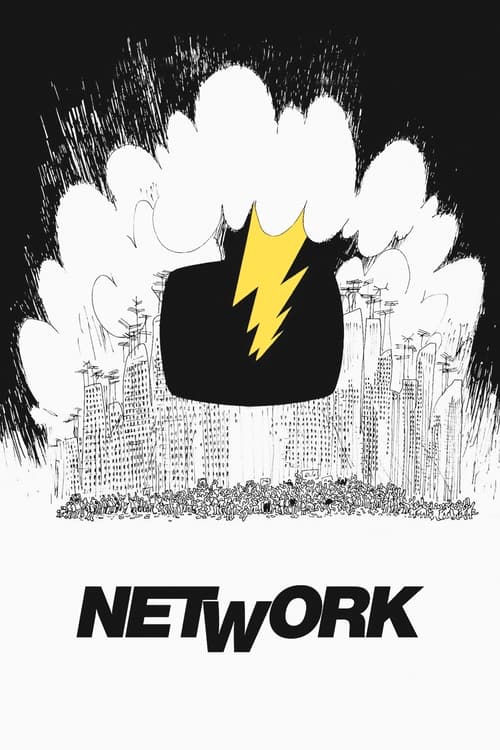
Network
A blistering satirical drama where corporate cynicism ignites public rage; a neon-lit descent into digital madness where the television screen devours the human soul, leaving only flickering illusions in its wake.
Network

Network

"Television will never be the same."

19 November 1976 United States of America 122 min ⭐ 7.8 (1,912)
Director: Sidney Lumet
Cast: Faye Dunaway, William Holden, Peter Finch, Robert Duvall, Ned Beatty
Drama
The Commercialization of Outrage The Dehumanization of Society The Death of Traditional Journalism Corporate Globalization
Budget: $3,800,000
Box Office: $23,700,000

Overview

Network (1976) is a biting satire set within the high-stakes world of corporate television. The story follows Howard Beale, a veteran news anchor for the struggling Union Broadcasting System (UBS), who is informed he will be fired due to declining ratings. In a moment of desperation, Beale announces on live television that he intends to commit suicide during his final broadcast. While the network's old guard is horrified, programming executive Diana Christensen sees an opportunity to exploit Beale’s mental breakdown for unprecedented viewership.

As Beale is rebranded as the "Mad Prophet of the Airwaves," his nightly rants against the decay of society become a national sensation, culminating in his iconic rallying cry: "I'm as mad as hell, and I'm not going to take this anymore!" The film tracks the moral collapse of those around him, particularly news division president Max Schumacher, who watches helplessly as the line between journalism and entertainment is obliterated by corporate greed.
Core Meaning

The core meaning of Network lies in its scathing critique of how corporate interests commodify human experience and outrage. Director Sidney Lumet and writer Paddy Chayefsky argue that television is not a source of truth but a distraction machine that turns genuine pain into a bankable product. The film suggests that in a world governed by global capital, traditional concepts of nationhood, morality, and individual humanity are obsolete, replaced by a "college of corporations" where profit is the only true god.

Thematic DNA

The Commercialization of Outrage 35%
The Dehumanization of Society 25%
The Death of Traditional Journalism 20%
Corporate Globalization 20%

The Commercialization of Outrage

The film illustrates how the media harvests public frustration and anger not to solve problems, but to sell advertising space. Howard Beale's genuine mental health crisis is packaged as a variety show, proving that even dissent can be profitable if it is properly staged.

The Dehumanization of Society

Characters like Diana Christensen are described as "humanoids"—people who have been raised by television and are incapable of actual feeling. This theme explores how a media-saturated culture strips away empathy, leaving behind individuals who view life through the lens of scripts and ratings.

The Death of Traditional Journalism

Through the character of Max Schumacher, the film mourns the loss of news as a public service. The takeover of the news division by the programming department symbolizes the final transition of information into "infotainment," where accuracy is secondary to spectacle.

Corporate Globalization

Arthur Jensen’s monologue reveals a world where borders are irrelevant and only the "primal forces of nature" (international currency) matter. The film suggests that corporations have superseded governments as the primary controllers of human destiny.

Character Analysis

Howard Beale

Peter Finch

Archetype: The Mad Prophet
Key Trait: Prophetic fervor

Motivation

Initially driven by a "divine" voice calling him to tell the truth, but ultimately seeking a way to articulate his despair in a world that no longer listens.

Character Arc

Beale shifts from a depressed, suicidal relic of the past into a national phenomenon. However, his "awakening" is ultimately hollow; once he stops being a profitable puppet, he is discarded and destroyed.

Diana Christensen

Faye Dunaway

Archetype: The Corporate Antagonist
Key Trait: Ruthless ambition

Motivation

To achieve number-one ratings and corporate dominance, regardless of the human cost.

Character Arc

She remains largely static, representing the terrifying final form of the media executive. She is a woman who views her own affair and the murder of her lead talent with the same clinical, ratings-focused detachment.

Max Schumacher

William Holden

Archetype: The Tragic Hero
Key Trait: Moral weariness

Motivation

To protect his old friend Howard and recapture his own sense of youth and relevance through his affair with Diana.

Character Arc

Max attempts to preserve his integrity while being seduced by Diana’s vitality. He eventually realizes he is obsolete in this new world and retreats back to his reality of "pain and love," leaving the network behind.

Arthur Jensen

Ned Beatty

Archetype: The Corporate Deity
Key Trait: Nihilistic authority

Motivation

The preservation of the "global system of systems" and the protection of corporate investments.

Character Arc

Appearing in only one major scene, Jensen functions as the true power behind the curtain. He re-educates Beale, shifting the anchor's message from populism to corporate evangelism.

Symbols & Motifs

The Four Monitors

Meaning:

Represent the fragmentation of reality and the dominance of the network perspective.

Context:

The film opens and closes with four television screens showing different programming, signifying that the viewer’s world is entirely contained within and defined by these boxes.

The Boardroom Table

Meaning:

Symbolizes the cold, unyielding altar of corporate capital.

Context:

Arthur Jensen delivers his messianic speech to Howard Beale across a long, dark, highly polished table, framed like a religious icon to emphasize the divinity of profit.

Stained Glass Windows

Meaning:

Represents the transformation of television into a pseudo-religion.

Context:

As Beale's show evolves, the set design incorporates stained glass, framing the anchor as a literal prophet preaching in a digital cathedral.

Memorable Quotes

I'm as mad as hell, and I'm not going to take this anymore!

— Howard Beale

Context:

Beale tells his audience to go to their windows and scream this into the night as a protest against the general decay of life.

Meaning:

The central rallying cry of the film. It represents the raw, unguided anger of the public, which is ironically immediately turned into a marketable catchphrase.

Television is not the truth! Television is a God-damned amusement park!

— Howard Beale

Context:

Delivered during his show as he tries to explain to the viewers that they are the "real thing" and the tube is the "illusion."

Meaning:

Beale’s attempt to warn the audience that the medium itself is a deception designed to kill boredom and prevent thinking.

You have meddled with the primal forces of nature, Mr. Beale, and I won't have it!

— Arthur Jensen

Context:

Jensen berates Beale in a dark boardroom after Beale’s broadcast successfully blocked a corporate merger with Arab interests.

Meaning:

This quote reframes the world not as a collection of nations but as a business entity, establishing that economics is the only true law.

I'm not sure she's capable of any real feelings. She's television generation. She learned life from Bugs Bunny.

— Max Schumacher

Context:

Max describes Diana to his wife, explaining the terrifying emotional void within the woman he is having an affair with.

Meaning:

A critique of how media consumption stunts emotional development and replaces real experience with scripted tropes.

Philosophical Questions

Does truth exist if it cannot be monetized?

The film explores whether information has any inherent value in a capitalist system if it doesn't generate profit. When Howard Beale starts telling the truth about the corporate system, he becomes a liability and is 'liquidated,' suggesting that profit has replaced truth as the highest societal value.

Can emotions be authentic in a media-saturated environment?

Through Diana, the film asks if we are losing the ability to feel real emotions. If we learn love, anger, and grief from scripts and sitcoms, do those feelings become performative rather than genuine? Diana’s inability to distinguish between her life and her programming provides a chilling answer.

Alternative Interpretations

One common alternative interpretation is that Howard Beale is never actually 'mad.' Instead, his 'madness' is a logical reaction to an insane world, making him the only sane person in the film. From this perspective, the network’s attempts to diagnose and exploit him are the true acts of insanity.

Another reading suggests that the audience's response to Beale—shouting from their windows—is not a sign of empowerment but of further submission. As critic Pauline Kael noted, the audience is simply obeying another voice from the television, proving that they are still 'humanoids' programmed by the medium even when they believe they are rebelling against it.

Cultural Impact

Network is widely considered one of the most prophetic films in cinema history. At the time of its release, critics viewed it as an exaggerated farce; decades later, it is seen as a documentary of the future. It accurately predicted the rise of reality television (seen in Diana’s 'The Mao Tse-Tung Hour'), the 24-hour news cycle, the blurring of entertainment and journalism, and the use of manufactured outrage as a tool for ratings.

The film's impact on pop culture is immense, with Howard Beale's 'Mad as Hell' speech becoming a permanent part of the American political lexicon. It was selected for preservation in the National Film Registry in 2000 and has influenced a generation of writers, including Aaron Sorkin, who cited Chayefsky as a primary influence for The Newsroom and The Social Network.

Audience Reception

Upon release, Network was a critical and commercial smash, though it polarized some reviewers. Critics like Roger Ebert praised it as a supremely well-acted and sharp-eyed attack on the ills of the 1970s. However, others, such as Pauline Kael, found it to be 'hot air' and overly cynical, arguing that its satire was too broad.

Contemporary audiences view the film with a sense of awe at its accuracy. On platforms like IMDb and Rotten Tomatoes, it maintains a legacy as a masterpiece, with viewers frequently noting that what was once satire has become reality. The 'Mad as Hell' scene remains one of the most famous moments in film history, frequently cited in discussions about political populism.

Interesting Facts

  • Peter Finch became the first person to win an Academy Award posthumously, having died of a heart attack just two months after the film's release.
  • Beatrice Straight holds the record for the shortest performance ever to win an acting Oscar, appearing on screen for only five minutes and forty seconds.
  • Director Sidney Lumet used a specific lighting strategy where the film starts with naturalistic lighting and gradually shifts to high-contrast, artificial 'commercial' lighting to reflect the corruption of the characters.
  • Paddy Chayefsky had a rare contract clause that gave him 'final cut' and total control over his dialogue, a power usually reserved for directors.
  • The film was shot in just over two months, largely on location in real New York office buildings to maintain a gritty, authentic feel.
  • The newsroom scenes were actually filmed in a real television studio in Canada because no New York station was willing or able to rent out their facilities for the production.

Easter Eggs

The casting of Kathy Cronkite

Kathy Cronkite, daughter of the legendary news anchor Walter Cronkite, plays Mary Ann Gifford, a character based on the real-life revolutionary Patty Hearst. This was a meta-commentary on the children of the 'establishment' turning against it.

Karen Allen's Debut

A young Karen Allen (of Raiders of the Lost Ark fame) makes her film debut in the opening credits, walking across the screen in a blink-and-you'll-miss-it role.

⚠️ Spoiler Analysis

Click to reveal detailed analysis with spoilers

Frequently Asked Questions

Explore More About This Movie

Dive deeper into specific aspects of the movie with our detailed analysis pages

Comments (0)

Leave a comment

No comments yet. Be the first to share your thoughts!