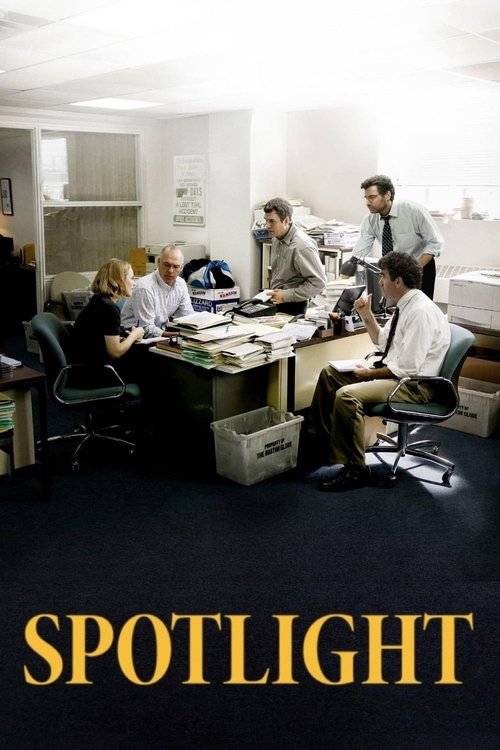
Spotlight
"Break the story. Break the silence."
Overview
Directed by Tom McCarthy, Spotlight is a gripping historical drama that chronicles the true story of the Boston Globe's investigative journalism unit as they uncover a massive scandal of child molestation and systemic cover-up within the local Catholic Archdiocese. The film begins with the arrival of a new editor, Marty Baron, an outsider who challenges the status quo by directing the 'Spotlight' team to investigate a seemingly isolated case of a pedophile priest.
As the four-person team—led by Walter 'Robby' Robinson and featuring reporters Michael Rezendes, Sacha Pfeiffer, and Matt Carroll—delves deeper, they realize the problem is not a few 'bad apples' but a vast, institutionalized network of concealment. The narrative follows their painstaking 'shoe-leather' reporting, from digging through dusty archives to conducting sensitive interviews with survivors, all while navigating the social and legal pressures of a city where the Church is a dominant moral authority.
Core Meaning
The core meaning of Spotlight lies in its exploration of how institutional power survives through the complacency of the community. Director Tom McCarthy emphasizes that the scandal was not just the result of a few individuals' crimes, but of a 'village' that chose to look away. The film serves as a profound defense of independent investigative journalism, suggesting that truth is not just discovered but must be fought for by those willing to challenge the very pillars of their society.
Thematic DNA
Institutional Corruption and Silence
The film exposes how the Catholic Church functioned as a self-protecting entity, prioritizing its reputation over the safety of children. This theme is revealed through the 'shuffling' of priests from parish to parish and the legal gag orders that kept victims quiet.
The Power of the Press
It celebrates the slow, unglamorous, and essential work of journalism. The film avoids sensationalism to show that real change comes from meticulous research, verified facts, and the courage to hold the powerful accountable.
Social Complacency and 'The Village'
A critical theme is the idea that 'it takes a village to abuse a child.' The film indicts the lawyers, judges, and even the newspaper itself for having overlooked or buried the story for decades due to social ties and cultural pressure.
Loss of Faith and Innocence
The characters, many of whom were raised Catholic, undergo a personal crisis as they uncover the truth. Their journey represents a collective loss of innocence for the city of Boston and the broader world.
Character Analysis
Walter 'Robby' Robinson
Michael Keaton
Motivation
Initially motivated by professional duty, he becomes driven by a need for moral atonement and the preservation of the Globe's integrity.
Character Arc
He moves from a position of comfortable seniority to a state of humble self-reflection, eventually admitting his own past failures as an editor who previously overlooked the same story.
Michael Rezendes
Mark Ruffalo
Motivation
Pure journalistic tenacity and a visceral reaction to the suffering of the victims.
Character Arc
A 'lapsed' Catholic who initially believes he might one day return to the Church, but is permanently alienated from the institution as the horrors of the cover-up are revealed.
Sacha Pfeiffer
Rachel McAdams
Motivation
A desire to give voice to the survivors and provide them with the validation they were long denied.
Character Arc
She balances her professional rigor with the personal pain of knowing how her investigation will shatter the faith of her devout grandmother.
Marty Baron
Liev Schreiber
Motivation
Ensuring the newspaper is 'essential' to its readers by tackling the most difficult institutional targets.
Character Arc
As an outsider (Jewish and from Florida), he remains a steady, objective force who doesn't change but rather causes the world around him to shift by demanding accountability.
Symbols & Motifs
The Boston Globe Building
Symbolizes the pillar of truth and democracy, yet also represents the physical weight of history and the archives where truth remains buried until someone looks for it.
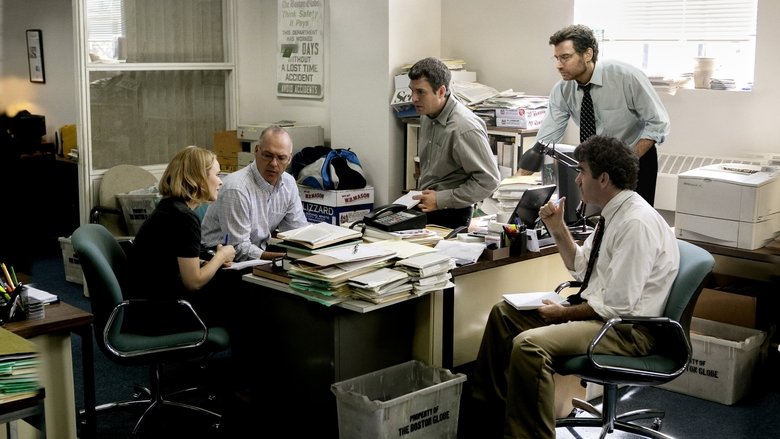
The set was meticulously reconstructed to look exactly like the 2001 offices, emphasizing the grounded, real-world nature of the work.
The 'Spotlight' Logo/Name
Represents the illumination of darkness. To 'spotlight' something is to pull it from the shadows of secrecy into the public eye.
The team works in a cramped basement office, visually reinforcing their role as those who dig beneath the surface of the city's exterior.
The Catholic Catechism
A symbol of institutional authority and the 'rules' of the community that newcomers are expected to follow.
Cardinal Law gives a copy to Marty Baron during their first meeting, which acts as a veiled assertion of the Church's dominance in Boston.
Memorable Quotes
If it takes a village to raise a child, it also takes a village to abuse one.
— Mitchell Garabedian
Context:
Spoken by the victims' attorney to Mike Rezendes, explaining why the scope of the problem is so vast.
Meaning:
The central indictment of the film, suggesting that the abuse was only possible because of systemic, collective negligence.
They knew and they let it happen! To kids! The people who were supposed to protect them!
— Michael Rezendes
Context:
Rezendes shouts this during a heated argument with Robby about when to publish the story.
Meaning:
Expresses the moral outrage and the betrayal of trust that lies at the heart of the scandal.
We're gonna focus on the institution, not the individual. We're going after the system.
— Marty Baron
Context:
Baron instructs the team to look for the pattern of reassignment rather than just focusing on one priest.
Meaning:
Defines the investigative strategy of the film: to prove that the cover-up was an official policy, not just the result of 'bad' individuals.
Philosophical Questions
Can an individual truly remain moral within a corrupt institution?
The film explores this through the characters of lawyers like Jim Sullivan and Eric MacLeish, who consider themselves good men but facilitated the cover-up through legal settlements and silence.
What is the difference between faith and institutional loyalty?
Through Sipe and the reporters' own Catholic backgrounds, the film asks if one can believe in the 'eternal' while condemning the 'men' who run the church.
Alternative Interpretations
While generally viewed as a tribute to journalism, some critics have discussed the ambiguity of the 'outsider' perspective. While Marty Baron's status as a non-Catholic outsider is seen as a strength, some interpret the film as a critique of the limitations of local journalism, suggesting that those embedded in a community are often too compromised to see its flaws. Additionally, the ending has been interpreted not just as a victory, but as a somber acknowledgment of the infinite nature of the problem, as the final list of cities shows that the 'Spotlight' was only the beginning of a global revelation.
Cultural Impact
Spotlight had a significant cultural impact by revitalizing the 'newspaper movie' genre and sparking renewed public discourse on the Catholic Church's handling of abuse. It is frequently cited in journalism schools as the gold standard for depicting the investigative process. Historically, it reflects the transition of the newspaper industry from print to digital, as evidenced by the AOL billboard seen in the film. Critics praised its 'unvarnished' and 'actor-centered' style, which avoided Hollywood melodrama in favor of stark realism. It also led to increased awareness and support for victims' groups like SNAP.
Audience Reception
The film received widespread critical acclaim, holding a 97% on Rotten Tomatoes. Audiences and critics alike praised the ensemble cast's restraint and the film's refusal to rely on cheap emotional beats or 'villainous' caricatures. Some Catholic commentators noted the film's fairness in distinguishing between the faith and the institutional cover-up, though it remains a difficult watch for many. The 'deafening silence' in theaters during the end credits—listing hundreds of cities with similar scandals—is a commonly reported audience reaction.
Interesting Facts
- The real Walter Robinson remarked that Michael Keaton's performance was so accurate it was like 'watching yourself in a mirror.'
- The film's screenplay was featured on the 2013 'Black List' of the best unproduced scripts in Hollywood.
- Spotlight was the first Best Picture winner since 1952 (The Greatest Show on Earth) to win only one other Oscar (Best Original Screenplay).
- Director Tom McCarthy cited Sidney Lumet as a major influence, particularly 'The Verdict' and 'All the President's Men.'
- An entire set was built to recreate the Boston Globe offices because the original offices had changed too much since 2001.
Easter Eggs
The real Michael Rezendes cameo
The real-life reporter Michael Rezendes can be seen in the background during the scene where the team attends a baseball game.
Richard Jenkins voice cameo
Actor Richard Jenkins, a frequent collaborator of Tom McCarthy, provides the uncredited voice of Dr. Richard Sipe, the psychotherapist who reveals the 6% statistic.
⚠️ Spoiler Analysis
Click to reveal detailed analysis with spoilers
Frequently Asked Questions
Explore More About This Movie
Dive deeper into specific aspects of the movie with our detailed analysis pages
Comments (0)
No comments yet. Be the first to share your thoughts!