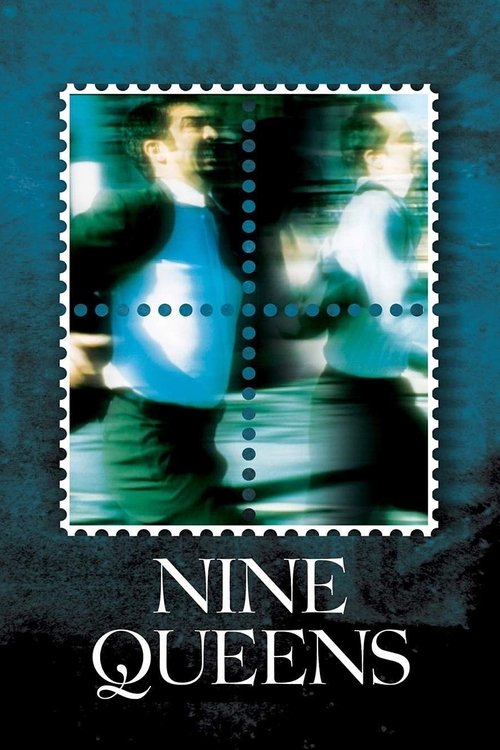
Nine Queens
Nueve reinas
"If you think you've got it figured out... you've been conned."
Overview
Nine Queens (Nueve reinas) follows two con artists, the seasoned and cynical Marcos (Ricardo Darín) and the seemingly naive rookie Juan (Gastón Pauls), who meet by chance in a convenience store. After Marcos intervenes in Juan's clumsy attempt at a small-time scam, he takes the younger man under his wing for a day, introducing him to the 'art' of swindling on the streets of Buenos Aires.
The duo stumbles upon a once-in-a-lifetime opportunity: a scheme to sell a sheet of rare, counterfeit stamps—the titular 'Nine Queens'—to a wealthy Spanish collector who is about to be deported. As the clock ticks, they must navigate a labyrinth of obstacles, including Marcos's estranged sister Valeria, suspicious associates, and their own mutual distrust.
As the stakes rise, the line between partner and adversary blurs. The plot twists and turns through a series of double-crosses, leading to a climax where nothing is as it seems, and the ultimate con is revealed to be far more complex than a simple sale of stamps.

Core Meaning
At its heart, Nine Queens is a cynical examination of trust and morality within a collapsing society. Director Fabián Bielinsky uses the structure of a heist film to critique the 'every man for himself' mentality that permeated Argentina prior to the 2001 economic crisis.
The film suggests that in a corrupt system, honesty is a liability and 'viveza criolla' (native cunning) is the only survival mechanism. However, it ultimately subverts this by showing that even the most masterly manipulator can be outplayed when underestimated. It serves as a meta-commentary on cinema itself, where the audience is the final 'mark'—willingly deceived by the director's sleight of hand.
Thematic DNA
Trust vs. Deception
The central tension of the film. Every character is playing a role, and every interaction is a potential lie. The film asks whether trust is possible in a world driven by greed, constantly forcing the audience to guess who is conning whom.
Viveza Criolla (Cunning)
A cultural concept in Argentina referring to the ability to use wit and deception to gain an advantage. Marcos embodies this trait, priding himself on his ability to outsmart 'civilians,' while the film explores the consequences of a society that valorizes this behavior.
Economic Instability and Corruption
Set against the backdrop of a failing economy, the film portrays a world where institutions (like banks) are just as predatory as street criminals. The desperate pursuit of money drives all characters, foreshadowing the real-life Corralito crisis.
Family and Retribution
While initially appearing as a nuisance to Marcos, family ties turn out to be the hidden engine of the plot. The theme reveals that while Marcos sees family as another resource to exploit, others view it as a bond worth fighting—and scheming—for.
Character Analysis
Marcos
Ricardo Darín
Motivation
Greed and Ego. He wants the 'big score' to solve his financial troubles and validate his superiority over others.
Character Arc
Starts as the dominant, experienced predator who believes he is teaching a rookie. He is arrogant, cynical, and believes he is in total control. His arc is a descent from mastery to victimhood, as he unknowingly becomes the target of the very con he thinks he is leading.
Juan
Gastón Pauls
Motivation
Revenge and Justice. He seeks to reclaim the family inheritance Marcos stole from his father and siblings.
Character Arc
Appears as a naive, small-time crook with a conscience. Throughout the film, he seems to be learning the ropes and questioning Marcos's morality. The twist reveals his arc was a performance; he was the mastermind orchestrating Marcos's downfall from the start.
Valeria
Leticia Brédice
Motivation
Restitution. Getting back what Marcos stole from her and her younger brother.
Character Arc
Initially presented as Marcos's hostile sister who wants him out of her hotel. She seems to be a victim of his schemes. The end reveals she was an active participant in the counter-con to recover her family's money.
Symbols & Motifs
The Nine Queens (The Stamps)
They represent the ultimate MacGuffin: an object of immense perceived value that is ultimately fake. They symbolize the illusion of wealth and the greed that blinds the characters (and the audience) to the reality of the situation.
Used throughout the film as the prize everyone is chasing. The fact that they are counterfeit stamps of a failed republic (Weimar) adds a layer of irony regarding worthless currency.
The Certified Check
Symbolizes the hollow promise of the financial system. It looks official and valuable, but in the face of systemic collapse (the bank run), it is just a piece of paper.
Marcos receives this as payment at the climax, believing he has won, only to find it useless when the bank crashes—a prophetic nod to the 2001 crisis.
The $100 Bill Scam
Represents the mechanics of the con on a micro scale: confusing the victim to steal from them while making them think they are being helped.
The opening scene where Juan tries to scam the cashier. It establishes the theme of 'the setup' which is later applied to the entire movie's plot.
Memorable Quotes
Putas no faltan, lo que faltan son financistas.
— Marcos
Context:
Marcos says this while trying to convince Juan (and himself) that compromising morals for money is standard practice in the world they inhabit.
Meaning:
'Whores aren't missing, what's missing are financiers.' This cynical line encapsulates Marcos's worldview: everyone has a price and is willing to sell themselves; the only scarcity is people with the money to pay.
Están ahí, pero no los ves.
— Marcos
Context:
Marcos is teaching Juan how to spot thieves in the street, pointing out that criminals blend perfectly into the crowd.
Meaning:
'They are there, but you don't see them.' Refers to pickpockets and thieves. It serves as a meta-commentary on the film's plot: the real con artists are right in front of Marcos (Juan and the team), but he—and the audience—fail to see them.
Este país se va a la mierda.
— Marcos
Context:
Muttered by Marcos in reaction to a small inconvenience (a stolen chocolate bar), illustrating his constant negativity and the general mood of the nation.
Meaning:
'This country is going to hell.' A common refrain that captures the palpable social and economic anxiety of late-90s Argentina. It grounds the film in its specific historical context.
Philosophical Questions
Is justice possible outside the law?
The film suggests that the legal system is broken or inaccessible. Juan and Valeria must resort to an elaborate, illegal con to achieve justice and reclaim their inheritance. This raises the question of whether 'two wrongs make a right' in a corrupt society.
What is the nature of trust?
Nine Queens presents a world where trust is a weakness to be exploited. It asks whether human connection is possible without vulnerability, and if the 'social contract' still exists when everyone is trying to survive at the expense of others.
Alternative Interpretations
While the primary reading is a straightforward 'con the conman' plot, some critics view the film as a meta-cinematic allegory. In this reading, Marcos represents the skeptical audience, believing he knows the rules of the game (cinema/genre), while Juan represents the Director, manipulating the reality Marcos perceives. The 'Nine Queens' are the film itself—a constructed illusion that we buy into.
Another interpretation focuses on the socio-political critique: Marcos is not just a crook but a symbol of the neoliberal policies of the 90s (Menem era)—arrogant, individualistic, and predatory. His downfall at the hands of a collective (Juan, Valeria, and their team) represents a fantasy of social justice where the people reclaim what was stolen by the corrupt elite.
Cultural Impact
Nine Queens is widely considered a masterpiece of the New Argentine Cinema and a cultural touchstone. Released in 2000, it captured the zeitgeist of an Argentina on the brink of collapse. The film's depiction of a society eroding under the weight of corruption and mistrust resonated deeply with audiences facing the 2001 crisis.
It launched Ricardo Darín into international stardom, cementing his status as Argentina's premier actor. The film's success proved that Argentine cinema could produce slick, genre-driven commercial hits that still retained artistic integrity and social commentary. It influenced a wave of Latin American crime thrillers and remains the benchmark for the genre in the region.
Audience Reception
The film holds a legendary status, with a 92% score on Rotten Tomatoes and high praise on IMDB. Audiences and critics alike laud the tightly woven script, the chemistry between Darín and Pauls, and the shocking twist ending.
Praised aspects: The realistic portrayal of Buenos Aires, the pacing, and the satisfying conclusion where the 'villain' gets his comeuppance.
Criticisms: Some minority reviews find the ending too contrived, relying on too many coincidences to be plausible. However, most viewers forgive this for the sheer entertainment value.
Interesting Facts
- Ricardo Darín was initially rejected for the role of Marcos because the director thought he had too 'nice' of an image. Darín insisted on the role to prove he could play a villain.
- The film was shot on a very low budget, often using 'guerrilla filmmaking' techniques with hidden cameras in real crowds.
- The final scene at the warehouse was reshot weeks after filming wrapped because director Fabián Bielinsky wasn't satisfied with the original version.
- The title 'Nine Queens' refers to the Weimar Republic stamps, but also alludes to a poker hand, fitting the theme of gambling and bluffing.
- The film was released just before the 2001 Argentine economic crisis, making the subplot about the bank failing and the check becoming worthless eerily prophetic.
- Director Fabián Bielinsky wrote the script in roughly eight weeks (some sources say 9 weeks) and entered it into a contest to get it produced.
- Two remakes exist: 'Criminal' (2004) starring John C. Reilly and Diego Luna, and the Indian film 'Bluffmaster!' (2005).
Easter Eggs
Juan's Whistle
Throughout the film, Juan asks about a catchy tune ('Il Ballo del Mattone' by Rita Pavone). At the very end, he is seen whistling this exact tune, signaling his victory and the fact that he was 'directing' the events the whole time.
The Toilet Scam
The scam involving the old man (Sandler) collapsing in the bathroom was inspired by a real-life con that director Fabián Bielinsky's uncle fell victim to.
The 'Bank Run' Extras
The scene where the bank closes its doors and people protest outside features extras who look genuinely distressed. This scene unintentionally previewed the real 'Corralito' protests that would happen in Argentina months later.
⚠️ Spoiler Analysis
Click to reveal detailed analysis with spoilers
Frequently Asked Questions
Explore More About This Movie
Dive deeper into specific aspects of the movie with our detailed analysis pages
Comments (0)
No comments yet. Be the first to share your thoughts!