No manches, Frida
"The students are bad, the teachers are worse."
Overview
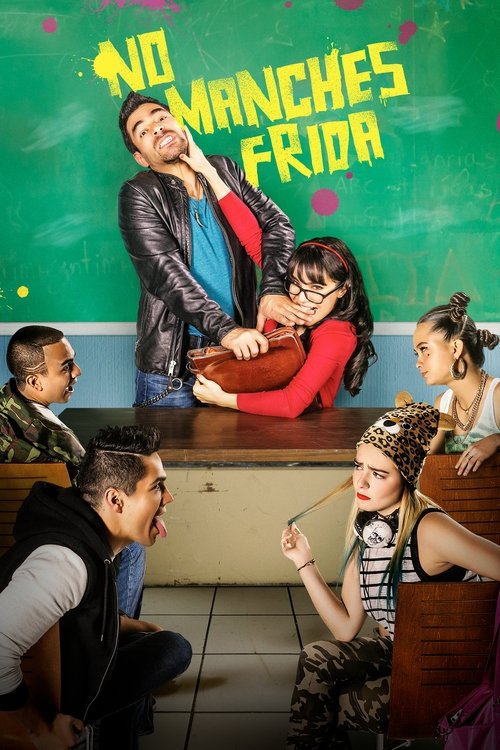
No manches, Frida is a comedy that follows the story of Zequi (Omar Chaparro), a bank robber who is released from prison only to discover that his accomplice buried his stolen loot in a vacant lot that has since been turned into the gymnasium of Frida Kahlo High School. Desperate to retrieve the money, Zequi falsifies documents to get hired as a substitute teacher, planning to dig up the cash at night while surviving the school day.
Once inside, Zequi is assigned to Class 4B, a notorious group of rebellious students who have terrorized and driven away every previous teacher. While his original goal is purely criminal, Zequi's unorthodox and often aggressive methods—born from prison life rather than pedagogy—surprisingly begin to resonate with the unruly teens. Along the way, he clashes with and eventually falls for Lucy (Martha Higareda), an earnest but pushover teacher who sees potential in him that he doesn't see in himself.
Core Meaning
The film explores the idea that unconventional methods can sometimes achieve what traditional systems cannot. At its heart, it is a story about redemption and connection, suggesting that "bad" people are often just misunderstood or misdirected, much like the "bad" students in Class 4B. The director highlights that authenticity—even if rough and unpolished—is more effective than hollow authority, and that education is a two-way street where teachers and students save each other.
Thematic DNA
Redemption and Transformation
Zequi starts as a criminal focused solely on money, but through his interaction with the students and Lucy, he transforms into a genuine mentor. The school becomes a literal and metaphorical place of rehabilitation, turning a convict into a role model.
Unconventional Education
The film posits that the strict, by-the-book approach of the educational system often fails at-risk youth. Zequi's street-smart pedagogy—which includes intimidation and "real talk"—succeeds in disciplining Class 4B where polite teaching failed, challenging standard educational norms.
Don't Judge a Book by Its Cover
This applies to both Zequi and the students. The teachers see Zequi as a colleague despite his tattoos and behavior, and Zequi eventually sees the students not as "losers" but as kids with potential. The theme is reinforced by the contrast between Zequi's criminal exterior and his growing internal care.
Love as a Catalyst
Lucy's faith in Zequi (even when based on lies) pushes him to be better. Her romantic influence softens his edges, while his toughness gives her the confidence to stand up for herself, showing that love balances opposing natures.
Character Analysis
Ezequiel "Zequi" Alcántara
Omar Chaparro
Motivation
Initially: To dig up his buried loot. Later: To prove himself worthy of Lucy's love and the students' respect.
Character Arc
Starts as a selfish ex-con wanting only his money. He fakes being a teacher, but slowly begins to care for the students' well-being and falls for Lucy. He evolves from a criminal to a protector and legitimate mentor figure.
Miss Lucy
Martha Higareda
Motivation
To truly educate and help her students, and to find a partner who gives her strength.
Character Arc
She begins as a timid, by-the-rules teacher who is walked all over by students. Through Zequi's influence, she gains confidence and learns to command respect, while teaching him softness.
Jenny
Rocío García
Motivation
To help Zequi get the money (though she often messes up).
Character Arc
Remains largely static, serving as comic relief and the catalyst for the plot (by burying the money in the wrong place). She represents the criminal life Zequi is trying to leave behind.
Symbols & Motifs
The Buried Money
It symbolizes Zequi's past and false hope. It represents the easy way out and his criminal identity. As he digs deeper for it, he inadvertently digs roots into the school community, eventually valuing the people above the cash.
Physically located under the school gymnasium, forcing Zequi to literally destroy the school's foundation to access his past, while simultaneously building a new future above it.
The Gymnasium
A space of transformation and physical exertion. It is where the physical comedy happens and where Zequi is most physically active in his deception, bridging his two worlds.
Built directly over the loot, it stands as the obstacle between Zequi and his crime, representing the institution of education blocking his return to crime.
Class 4B
They symbolize misunderstood potential and the mirror image of Zequi. They are the "outcasts" of the school system, just as he is an outcast of society.
The specific group of students Zequi teaches; their chaotic energy matches his own, making them the only ones who can truly understand him.
The "Suicide" Jump
Represents the absurdity and desperation of the teachers' situation, setting the tone for the film's dark comedy.
In the opening, a teacher jumps out of a window, landing on a juice box that looks like blood. It symbolizes how the school breaks people, paving the way for Zequi's tougher approach.
Memorable Quotes
No manches, Frida!
— Various Characters
Context:
Used as a meta-reference and general expression of shock throughout the film.
Meaning:
The title phrase (a sanitized version of "No mames") expresses disbelief and exasperation. It captures the film's tone of absurdity and the characters' reactions to the chaos around them.
Ustedes son el grupo más pendejo de toda la escuela.
— Zequi
Context:
Zequi addresses Class 4B for the first time, establishing dominance immediately.
Meaning:
Translates to "You are the stupidest group in the whole school." It establishes Zequi's blunt, non-PC teaching style that paradoxically wins the students' respect because it's honest.
La clave para la rehabilitación es la educación.
— Zequi
Context:
Spoken when Zequi is trying to sound professional or explain his presence, foreshadowing his actual rehabilitation.
Meaning:
"The key to rehabilitation is education." A deeply ironic statement given Zequi is a fake teacher, but it becomes the film's sincere moral by the end.
Philosophical Questions
Do the ends justify the means in education?
Zequi uses bullying, paintball guns, and insults to control his class. The film asks whether results (student engagement/discipline) justify ethically dubious methods, challenging the boundaries of 'appropriate' teaching.
Can people truly change, or do they just redirect their nature?
Zequi doesn't stop being aggressive or manipulative; he just redirects those traits toward a positive goal (teaching). This suggests that redemption isn't about erasing who you are, but repurposing your flaws.
Alternative Interpretations
While ostensibly a comedy about redemption, some critics interpret the film as a cynical critique of the education system. It suggests that the only way to manage modern youth is through the methods of a criminal (intimidation, bribery, physical dominance), implying that traditional humanist education is dead. Another reading views Zequi not as a redeemed hero but as a trickster figure who succeeds specifically because he refuses to follow societal rules, validating 'street smarts' over institutional learning.
Cultural Impact
No manches, Frida represents a significant moment in the "New Era" of Mexican commercial cinema, characterized by high production values and cross-border appeal (targeting both Mexican and US Hispanic audiences). Produced by Pantelion Films, it solidified the profitability of remaking successful European comedies for Latin American audiences. While critics often dismissed it as derivative and reliant on stereotypes, its massive box office success ($11.5 million in the US alone) proved the hunger for Spanish-language content in mainstream US theaters. It helped cement Omar Chaparro and Martha Higareda as the definitive power couple of modern Mexican rom-coms.
Audience Reception
The film received a polarized reception. Audiences, particularly in Mexico and the US Hispanic market, praised the chemistry between Chaparro and Higareda and the laugh-out-loud slapstick humor, making it a crowd-pleaser. However, critics and some viewers criticized the misogynistic undertones, the reliance on crude humor (bullying, sexual objectification), and the lack of originality as a remake. Despite critical drubbing for its script and direction, the 'fun factor' won out for the general public.
Interesting Facts
- The film is a nearly shot-for-shot remake of the 2013 German blockbuster 'Fack ju Göhte'.
- Martha Higareda, who plays Lucy, also served as a producer for the film.
- The title 'No manches' is a polite Mexican slang substitute for 'No mames', meaning 'No way' or 'You're kidding'.
- It became one of the highest-grossing Spanish-language films released in the United States.
- Omar Chaparro had to undergo physical training to perform the physical comedy and 'tough guy' scenes believable.
- The fictional school is named 'Frida Kahlo High', contrasting the rebellious students with a serious cultural icon.
- A sequel, 'No manches Frida 2', was released in 2019 due to the massive box office success.
Easter Eggs
Reference to 'La Chilindrina'
A character makes a reference to 'La Chilindrina' (a famous character from the iconic show El Chavo del 8), connecting the film to broader Mexican pop culture nostalgia.
The Juice Box Blood
In the opening scene, the 'blood' from the teacher's suicide jump is revealed to be a crushed juice box. This is a direct visual nod to the same gag in the original German film Fack ju Göhte.
⚠️ Spoiler Analysis
Click to reveal detailed analysis with spoilers
Frequently Asked Questions
Explore More About This Movie
Dive deeper into specific aspects of the movie with our detailed analysis pages
Comments (0)
No comments yet. Be the first to share your thoughts!