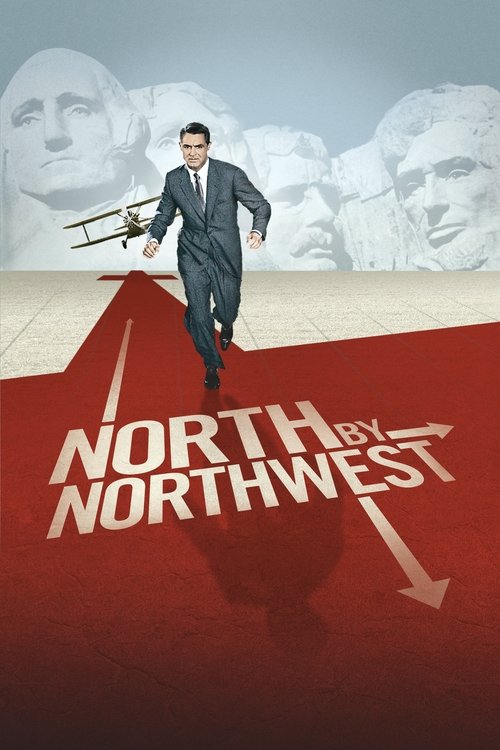
North by Northwest
"It's a deadly game of "tag" and Cary Grant is "it"!"
Overview
"North by Northwest" (1959) is a quintessential Alfred Hitchcock thriller that plunges an unsuspecting man into a world of espionage and danger. The film follows Roger O. Thornhill (Cary Grant), a suave New York advertising executive who is mistakenly identified as a government agent named George Kaplan. This case of mistaken identity leads to his abduction by a ruthless spy, Phillip Vandamm (James Mason), and his perilous journey across the country to clear his name and uncover the truth.
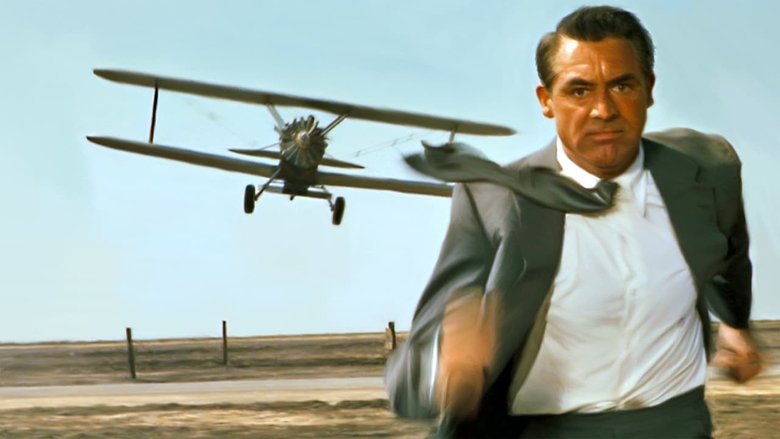
As Thornhill evades both Vandamm's henchmen and the police, who believe him to be a murderer, he encounters the enigmatic and beautiful Eve Kendall (Eva Marie Saint) on a train to Chicago. Their relationship becomes a complex web of romance, suspicion, and betrayal, adding another layer of intrigue to Thornhill's desperate quest. The film is renowned for its iconic set pieces, including a tense confrontation at the United Nations, a thrilling chase sequence involving a crop duster plane in a desolate field, and a dramatic climax on the faces of Mount Rushmore.
Core Meaning
The core meaning of "North by Northwest" revolves around the fragility and arbitrary nature of identity in the modern world. Director Alfred Hitchcock explores how easily a person's life and sense of self can be dismantled by forces beyond their control. Roger Thornhill's journey is not just a physical one, but an existential quest to reclaim his identity after it is stolen by a simple misunderstanding. The film suggests that in an era of Cold War paranoia and powerful, faceless organizations, the individual is vulnerable and can be forced into roles they never chose. Ultimately, Thornhill must abandon his superficial advertising persona and become the resourceful, heroic figure he was mistaken for in order to survive, suggesting that true identity is forged through action and adversity rather than social standing.
Thematic DNA
Mistaken Identity and the Fragility of Self
This is the central theme that drives the entire narrative. Roger Thornhill, an ordinary ad-man, is stripped of his identity and forced into the role of a non-existent government agent, George Kaplan. The film demonstrates how tenuous one's identity is, defined by mere appearances and misunderstandings. Thornhill's struggle to prove who he is to villains, authorities, and even his own mother highlights the terrifying ease with which a person's life can be unraveled. His journey becomes a process of shedding his superficial former self and discovering a more courageous and authentic identity through action.
Appearance vs. Reality
Hitchcock masterfully plays with the audience's perceptions throughout the film. Nothing is as it seems: the charming Eve Kendall is a double agent, the respectable art dealer Vandamm is a ruthless spy, and the government that should protect its citizens is manipulative and callous. The non-existent George Kaplan, a complete fabrication, wields more influence than the very real Roger Thornhill. This theme is underscored by the constant role-playing the characters must engage in, creating a world where discerning truth from deception is a matter of life and death.
The Individual Against the Institution
Thornhill finds himself caught between two powerful and amoral organizations: Vandamm's international spy ring and a clandestine U.S. intelligence agency. Both are willing to sacrifice him for their own ends. The government agency, led by the pragmatic Professor, is portrayed as being just as ruthless in its methods as the villains. Thornhill's plight symbolizes the helplessness of the ordinary citizen when confronted by the overwhelming and impersonal machinery of state power and organized crime, a particularly resonant theme during the Cold War.
Love and Deception
The romantic relationship between Roger and Eve is born from and complicated by deception. Eve first helps Roger, then betrays him, and is later revealed to be an undercover agent whose life is in danger. Their courtship is an elaborate dance of suspicion, witty banter, and genuine attraction. Their journey from distrust to a life-risking alliance explores whether love and trust can blossom in a world built on lies. The resolution of their relationship alongside the spy plot suggests that personal connection is the ultimate prize in a cold, impersonal world.
Character Analysis
Roger O. Thornhill
Cary Grant
Motivation
Initially, his motivation is simple survival and clearing his name. He is desperate to prove his true identity and return to his comfortable, ordinary life. As the film progresses and he falls for Eve Kendall, his motivation shifts to protecting her, even at the risk of his own life, driving him to confront Vandamm directly in the film's climax.
Character Arc
Roger Thornhill begins as a slick, self-absorbed, and somewhat superficial Madison Avenue advertising executive, twice-divorced and attached to his mother. When he is thrust into a world of espionage, he is initially hapless and out of his depth. However, as the danger escalates, he is forced to become resourceful, courageous, and cunning. His journey transforms him from a man who creates illusions for a living into a man of action who must navigate a deadly reality, ultimately becoming the heroic agent he was mistaken for.
Eve Kendall
Eva Marie Saint
Motivation
Her primary motivation is to serve her country by gathering intelligence on Vandamm. However, this is complicated by her developing feelings for Roger Thornhill. She is torn between her duty, which requires her to deceive and endanger Roger, and her desire to protect him, which puts her own life and mission at risk.
Character Arc
Eve Kendall is introduced as a cool, seductive, and mysterious woman who may or may not be trustworthy. She initially appears to be Vandamm's mistress and complicit in his schemes, betraying Thornhill. Her arc is one of revelation, as she is exposed as a U.S. government agent who has infiltrated Vandamm's organization. Her cool exterior is a necessary performance to maintain her cover, but beneath it, she is vulnerable and caught in a dangerous game. She transitions from a figure of suspicion to a damsel in distress who is ultimately saved by, and united with, Thornhill.
Phillip Vandamm
James Mason
Motivation
Vandamm's motivation is to smuggle microfilm containing government secrets out of the country. He is driven by his political allegiances and the business of espionage. He is also motivated by a desire for control and is infuriated by Thornhill's persistent ability to elude him, making their conflict personal.
Character Arc
Phillip Vandamm is a polished, intelligent, and ruthless foreign spy who deals in government secrets. He remains a consistently menacing and sophisticated antagonist throughout the film. His character does not have a significant arc; he is the unyielding force of evil that Thornhill must overcome. His cunning is matched only by his cruelty, as seen in his casual willingness to eliminate anyone who stands in his way, including Eve once he discovers her betrayal.
Clara Thornhill
Jessie Royce Landis
Motivation
Her motivation is simply that of a society mother concerned with appearances and her son's seemingly erratic behavior. She wants to get to the bottom of the 'nonsense' so they can get back to their normal lives of theater dates and social obligations.
Character Arc
Clara Thornhill serves primarily as a comedic foil and a representation of Roger's old, coddled life. She does not have a developmental arc. Initially, she is completely dismissive and skeptical of her son's incredible story, believing he's been drinking or is making it all up. Her humorous disbelief underscores the absurdity of Roger's situation and his isolation, as not even his own mother will believe him. Her presence reinforces Roger's need to break away from his dependent past.
Symbols & Motifs
The Crop Duster Plane
The crop duster symbolizes a threat emerging from the mundane and unexpected. In a wide-open, sunlit field where one should feel safe, a common agricultural tool becomes a terrifying instrument of death. It represents the film's core idea that danger can erupt from anywhere, turning the ordinary into the menacing and highlighting the protagonist's profound isolation and vulnerability.
In one of the film's most iconic scenes, Roger Thornhill is lured to a deserted bus stop in the middle of prairie land. After a long, tense wait in complete silence, a crop duster plane appears in the distance, seemingly dusting crops where there are none, before it turns and relentlessly attacks him.
Mount Rushmore
The monumental faces of the presidents symbolize the grand, unyielding, and public face of American democracy and history. The climactic chase across these faces represents the clash between national ideals and the dirty, clandestine realities of Cold War espionage. It brings the hidden conflict out onto the surface of a national shrine, reducing a political struggle to a perilous human drama on a massive scale.
The film's climax takes place on and around the Mount Rushmore National Memorial. Roger Thornhill and Eve Kendall are pursued by Vandamm's henchmen across the giant, carved faces of the presidents as they try to escape.
George Kaplan
George Kaplan, the man who doesn't exist, is a symbol of manufactured identity and the power of illusion. He is a 'MacGuffin'—a plot device that motivates the characters but has no real substance. His non-existence highlights the film's theme of appearance versus reality; a complete fiction is the catalyst for all the real-world danger and forces Thornhill to become the hero Kaplan was invented to be.
From the beginning, Thornhill is mistaken for George Kaplan, a fictional government agent created by the CIA to distract Vandamm. Thornhill's entire ordeal is a result of him trying to prove he is not this imaginary person, a quest that ultimately leads him to embody the very role he's been forced into.
The Train
The train serves as a space of transition, intimacy, and deception. It is where Roger and Eve's romantic and duplicitous relationship begins. More symbolically, the final shot of the train entering a tunnel, immediately following Roger and Eve's embrace in a sleeper car, is a famously suggestive Freudian symbol for sexual intercourse, a cheeky final wink from Hitchcock that bypassed the censors of the era.
Roger Thornhill meets Eve Kendall on the 20th Century Limited train while fleeing the police. They share a romantic dinner and she hides him in her compartment. The film concludes with a shot of the train plunging into a tunnel right after the newly-married Thornhills are shown together in their bunk.
Memorable Quotes
That's funny, that plane's dusting crops where there ain't no crops.
— Man at bus stop
Context:
Roger Thornhill has been sent to a desolate crossroads in the prairie. After a long wait, another man gets off a bus and they exchange a few words. The man looks off into the distance and makes this observation just before the crop duster plane begins its attack on Thornhill.
Meaning:
This seemingly innocuous line of dialogue is a masterclass in building suspense. It signals that something is deeply wrong and unnatural in the seemingly peaceful landscape, transforming a mundane observation into a chilling premonition of the terror to come. It marks the precise moment the scene turns from quiet anticipation to imminent danger.
I never discuss love on an empty stomach.
— Eve Kendall
Context:
During their first meeting in the dining car of the 20th Century Limited train, Roger Thornhill makes a pass at Eve Kendall. She responds with this line, coolly deflecting yet simultaneously encouraging his advances.
Meaning:
This witty and suggestive line perfectly encapsulates Eve's character: sophisticated, alluring, and in control. It's a piece of flirtatious dialogue that bristles with sexual tension. The line was famously a way for Hitchcock to circumvent the censors; the original line was "I never make love on an empty stomach," but the dubbed version retains all of the seductive implication.
In the world of advertising, there's no such thing as a lie. There is only the expedient exaggeration.
— Roger O. Thornhill
Context:
At the beginning of the film, Thornhill is in a taxi with his secretary, dictating a message and explaining his philosophy on advertising as he expertly navigates his busy, slick life before his abduction.
Meaning:
This quote, delivered early in the film, establishes Thornhill's character as a man whose profession is built on clever deception and manipulation of the truth. It's deeply ironic, as he is about to be plunged into a world of espionage where the lies are deadly and the exaggerations are anything but expedient for him. It sets up his character arc from a purveyor of harmless untruths to a victim of lethal ones.
War is hell, Mr. Thornhill. Even when it's a cold one.
— The Professor
Context:
The Professor, the head of the U.S. intelligence agency, says this to Thornhill in a forest clearing after revealing the truth about Eve's identity as an undercover agent. He is explaining why they must allow her to leave with Vandamm, despite the immense danger.
Meaning:
This line encapsulates the cold, pragmatic, and morally ambiguous stance of the government intelligence agency. The Professor uses it to justify the agency's ruthless methods, including their willingness to endanger Eve Kendall's life and sacrifice Thornhill. It speaks to the high stakes of the Cold War, where the lines between right and wrong are blurred in the name of national security.
Philosophical Questions
What constitutes a person's identity?
The film relentlessly explores whether identity is an inherent quality or a social construct. Roger Thornhill knows who he is, but the world around him, from villains to the police, insists he is someone else. His credentials, his mother's testimony, and his own protests are useless against the fabricated reality imposed upon him. This raises the question of whether our identity is defined by our own self-knowledge or by how others perceive us. The film suggests that in the face of overwhelming external pressure, an individual's perceived identity can completely supplant their real one, forcing them to either succumb or radically transform themselves to survive.
Can order and morality be maintained in a world of chaos and deception?
"North by Northwest" presents a world where traditional institutions of order—the police, the government—are either inept or morally compromised. Thornhill is a man living in an orderly world of schedules and advertising campaigns who is suddenly plunged into total chaos. The U.S. intelligence agency, supposedly a force for good, operates with the same deceit and disregard for human life as the spies they are fighting. The film questions whether it's possible to adhere to a moral code when surrounded by duplicity, and it suggests that survival in such a world requires one to adopt the very methods of deception they are fighting against.
Alternative Interpretations
While largely a straightforward thriller, "North by Northwest" has invited several alternative readings. One common interpretation views the film as a Cold War allegory, with Roger Thornhill representing the naive, apolitical American citizen forcibly awakened to the grim realities of international espionage. In this reading, the suave but villainous Vandamm represents the sophisticated threat of foreign powers, while the coldly pragmatic Professor embodies a morally ambiguous American government willing to sacrifice individuals for the 'greater good.'
Another interpretation views Thornhill's journey in psychological terms, as a man escaping from an Oedipal attachment to his domineering mother. His adventure forces him to mature, break away from her influence, and form an adult relationship with a capable woman, Eve. The entire spy plot can be seen as an elaborate and dangerous rite of passage, transforming him from a 'mama's boy' into a self-reliant hero.
Furthermore, Martin Landau, who played the henchman Leonard, famously chose to portray the character as homosexual and jealous of Vandamm's affection for Eve. This subtle subtext, though not explicit due to the era's production codes, adds a layer of psychological complexity to the villain's entourage and Leonard's motivation for exposing Eve.
Cultural Impact
"North by Northwest" was a major critical and commercial success upon its release in 1959 and is now widely regarded as one of Alfred Hitchcock's greatest films and a landmark in the thriller genre. It set a new standard for action-suspense films with its innovative blend of tension, witty humor, and romance on a grand, scenic scale.
Its influence on cinema is profound, most notably shaping the spy genre. The film's formula of a charming, debonair hero caught in a web of international intrigue, complete with exotic locations and spectacular action set-pieces, is seen as a direct precursor to the James Bond series, which began three years later. Created during the height of the Cold War, the film tapped into contemporary anxieties about clandestine government agencies, secret plots, and the loss of individual identity in a paranoid world.
The film cemented Hitchcock's reputation as the 'Master of Suspense' and showcased his stylistic trademarks: the 'wrong man' theme, the 'MacGuffin' plot device (the microfilm), and meticulously storyboarded sequences. The crop duster attack and the Mount Rushmore climax have become two of the most iconic and frequently homaged sequences in film history. In 1995, "North by Northwest" was selected for preservation in the United States National Film Registry by the Library of Congress as being 'culturally, historically, or aesthetically significant'.
Audience Reception
"North by Northwest" was met with widespread acclaim from both audiences and critics upon its 1959 release, and its reputation has only grown over time. Audiences were thrilled by its exhilarating pace, stunning VistaVision cinematography, and charismatic performances, particularly from Cary Grant. The film was praised for being a highly entertaining and sophisticated adventure that masterfully blended suspense, witty dialogue, and breathtaking action sequences. The iconic set pieces, like the crop duster chase and the Mount Rushmore climax, were immediately recognized as cinematic triumphs.
While overwhelmingly positive, some minor contemporary criticisms pointed to the plot's implausibility and considered the Mount Rushmore finale 'a bit overdrawn.' However, most viewers and critics accepted the film on its own terms as a stylish and masterful piece of escapist entertainment. Today, it is consistently ranked among the greatest films ever made and is celebrated as a perfect example of Hitchcock's directorial genius and a high point in the thriller genre.
Interesting Facts
- The title 'North by Northwest' is deliberately nonsensical; there is no such direction on a compass. Hitchcock himself said, 'It's a fantasy. The whole film is epitomized in the title.'
- The film is often referred to as 'the first James Bond film' due to its blend of suspense, exotic locations, a suave hero, and a spy-fi plot, which directly influenced the Bond series. The helicopter chase in 'From Russia with Love' (1963) was inspired by the crop duster scene.
- Alfred Hitchcock was denied permission to film inside the United Nations headquarters. He used a hidden camera in a truck across the street to film Cary Grant walking in, and the interiors were meticulously recreated on a soundstage.
- The iconic crop duster scene was not filmed in Indiana but near Bakersfield, California. Cary Grant's diving into a ditch was filmed on a studio set against a projection screen.
- Actress Jessie Royce Landis, who played Roger Thornhill's mother, was only seven years older than Cary Grant.
- Hitchcock had to re-dub a line for Eva Marie Saint. Her original line, 'I never make love on an empty stomach,' was deemed too risqué by the censors and was changed to 'I never discuss love on an empty stomach.'
- James Stewart was eager to play the lead role, but Hitchcock felt he 'looked too old' after the box office disappointment of 'Vertigo' and cast Cary Grant instead, even though Grant was four years older than Stewart.
- The climactic scenes on Mount Rushmore were mostly filmed on a detailed studio mock-up, as the production was forbidden from filming scenes of violence on the actual monument.
- The film's opening title sequence, designed by Saul Bass, was the first to feature extended use of kinetic typography, where text moves dynamically on screen.
Easter Eggs
Alfred Hitchcock's Cameo Appearance
In what became his signature, director Alfred Hitchcock makes a brief appearance near the very beginning of the film. Just after his own directorial credit appears on screen, he is seen trying to catch a city bus, only to have the doors slam in his face. This playful cameo allowed Hitchcock to insert his authorial stamp and engaged audiences who made a sport of spotting him in his films.
The Boy Covering His Ears
In the Mount Rushmore cafeteria scene, just before Eve Kendall 'shoots' Roger Thornhill with a blank-loaded gun, a young boy in the background can be seen plugging his ears in anticipation of the loud noise. For years, this was considered a continuity error. However, many analysts now believe it was a deliberate 'meta' joke by Hitchcock, winking at the audience by having a character on-screen acknowledge the artifice of the staged shooting.
⚠️ Spoiler Analysis
Click to reveal detailed analysis with spoilers
Frequently Asked Questions
Explore More About This Movie
Dive deeper into specific aspects of the movie with our detailed analysis pages
Comments (0)
No comments yet. Be the first to share your thoughts!