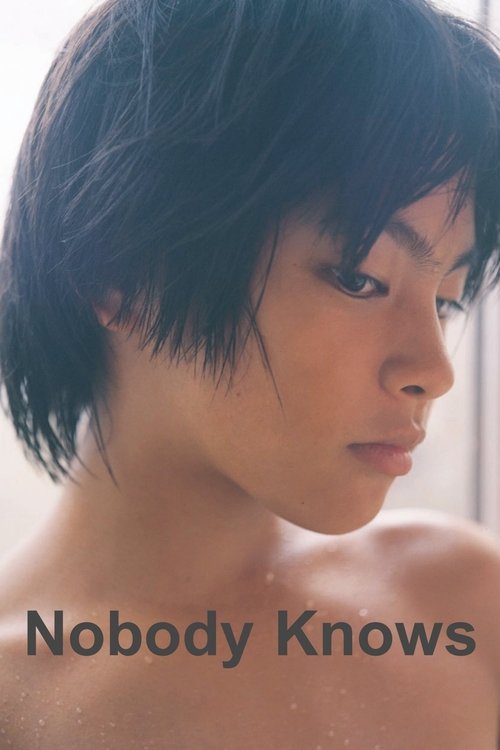
Nobody Knows
A quiet drama of heartbreaking resilience, painting a portrait of childhood survival through the hazy light of a Tokyo summer.
Nobody Knows

Nobody Knows

誰も知らない

07 August 2004 Japan 141 min ⭐ 8.0 (591)
Director: Hirokazu Kore-eda
Cast: Yuya Yagira, Ayu Kitaura, Hiei Kimura, Momoko Shimizu, Hanae Kan
Drama
Child Abandonment and Neglect Resilience and Survival The Loss of Innocence The Nature of Family

Overview

"Nobody Knows" (誰も知らない) is a 2004 Japanese drama directed by Hirokazu Kore-eda. The film is a fictionalized account of the 1988 Sugamo child abandonment case. It follows four young half-siblings – Akira, Kyoko, Shigeru, and Yuki – who are left to fend for themselves in a small Tokyo apartment after their mother, Keiko, leaves them.

Initially, their mother's absence is framed as a temporary work trip, but as weeks turn into months, it becomes clear she is not returning. Twelve-year-old Akira is forced to become the head of the household, managing their dwindling funds and caring for his younger siblings, all while keeping their existence a secret from the landlord and the outside world, as they are not allowed to attend school. The film quietly observes their daily lives, capturing their resourcefulness, moments of childhood joy, and the gradual, heartbreaking decline of their circumstances as they become increasingly isolated.


Core Meaning

At its core, "Nobody Knows" is a profound meditation on societal neglect, resilience, and the ambiguous nature of family. Director Hirokazu Kore-eda sought not to sensationalize the tragic true story but to explore the inner lives of the children. The film refrains from passing judgment on the mother, instead portraying her as another victim of circumstance in a society with inadequate support for single mothers. The central message is an indictment of a society that allows its most vulnerable members to fall through the cracks, unseen and unheard. It questions the very definition of family, suggesting that the fierce, makeshift bond the children forge in their isolation is as valid and powerful as a conventional one. The film's title is deeply ironic; while ostensibly "nobody knows" about their plight, the truth is that several adults are vaguely aware but choose not to intervene, highlighting a collective failure of responsibility.

Thematic DNA

Child Abandonment and Neglect 35%
Resilience and Survival 30%
The Loss of Innocence 20%
The Nature of Family 15%

Child Abandonment and Neglect

The central theme is the physical and emotional abandonment of the four children by their mother. The film meticulously details their descent from a life of hidden stability to one of dire poverty and isolation. This neglect is not only parental but societal; neighbors, convenience store clerks, and even the children's potential fathers are aware of their situation to varying degrees but fail to take meaningful action, making the children invisible victims.

Resilience and Survival

Despite their harrowing circumstances, the children display incredible resilience. Led by Akira, they create their own set of rules and routines to survive. They find ways to manage their finances, find food, and maintain a semblance of family life. The film focuses on their resourcefulness and determination, celebrating their ability to create a small, functioning world for themselves even as the world outside fails them.

The Loss of Innocence

The children, particularly Akira, are forced into adult roles far too soon. Akira sacrifices his own childhood—his friends, his interest in baseball—to become a surrogate parent. The film poignantly captures the erosion of their innocence as they confront starvation, eviction, and ultimately, death. This is contrasted with small, cherished moments of play and joy, which become increasingly rare as their situation deteriorates.

The Nature of Family

Kore-eda explores the idea of a "makeshift family." In the absence of their mother, the four siblings form a deeply loyal and interdependent unit. Their bond becomes their primary source of strength and comfort. The film challenges conventional notions of family by showing that this self-created family, born of necessity and love, is powerful and meaningful, even in its tragedy.

Character Analysis

Akira Fukushima

Yuya Yagira

Archetype: The Reluctant Hero / Surrogate Parent
Key Trait: Responsible

Motivation

Akira's primary motivation is to keep his siblings together and safe. Having likely experienced the foster care system before, his greatest fear is being separated from Kyoko, Shigeru, and Yuki, which drives him to conceal their plight from authorities at all costs.

Character Arc

Akira begins as a typical 12-year-old boy, albeit one with significant responsibilities. When his mother leaves, he is thrust into the role of a parent, forcing him to mature rapidly. His arc is a tragic journey of lost innocence, as he sacrifices his own needs and desires to care for his siblings. He struggles with the immense burden, making both mature and childish decisions, but his unwavering dedication to keeping his family together is his defining feature. His performance earned him the Best Actor award at the 2004 Cannes Film Festival, making him the youngest-ever winner.

Kyoko Fukushima

Ayu Kitaura

Archetype: The Quiet Caregiver
Key Trait: Dutiful

Motivation

Kyoko is motivated by a desire for order and the hope of her mother's return. She dutifully takes on household responsibilities, creating a semblance of normalcy in their chaotic world. Her longing for a piano represents her hope for a future beyond their confinement.

Character Arc

Kyoko, the eldest daughter, is introverted and dutiful. Her arc involves finding her voice and role within the family's survival structure. Initially quiet, she takes over domestic chores like laundry. Her dream of owning a piano symbolizes her longing for a normal, stable life. As the situation worsens, she becomes a more active partner to Akira in managing their small household, her quiet strength providing emotional stability.

Keiko Fukushima (The Mother)

You

Archetype: The Free Spirit / Tragic Antagonist
Key Trait: Irresponsible

Motivation

Keiko is motivated by a desperate search for personal happiness and romantic love, which she feels is incompatible with raising four children from different fathers. She rationalizes her abandonment as a necessary step to secure her own future, asking Akira, "I'm not allowed to be happy?"

Character Arc

Keiko is portrayed not as a monstrous villain but as a charismatic, yet deeply irresponsible and selfish, woman. She loves her children but is ultimately unable to cope with the responsibilities of motherhood, prioritizing her own happiness and romantic pursuits. Her arc is one of retreat and abandonment; she transitions from a flawed but present mother to a complete absence in her children's lives, leaving only a note and some money. Kore-eda intentionally avoids making her a one-dimensional character, hinting at her own struggles and loneliness.

Yuki Fukushima

Momoko Shimizu

Archetype: The Innocent
Key Trait: Innocent

Motivation

Yuki's motivations are purely instinctual and childlike. She is driven by a desire for her mother's affection, comfort, and the simple pleasures of her confined world. Her constant questioning about when their mother will return underscores the central emotional wound of the film.

Character Arc

Yuki, the youngest at five years old, represents pure innocence. Her world is confined to the apartment, and her needs are simple: her mother's presence, drawings, and Apollo chocolates. Her arc is the most tragic; she is the most vulnerable and the first to succumb to their neglect. Her accidental death from a fall off a stool is the film's devastating climax, shattering the fragile world the children had built.

Symbols & Motifs

Suitcases

Meaning:

The suitcases symbolize confinement, secrecy, and the beginning and end of life chapters. They represent both a makeshift womb and a coffin. They are vessels of transition, carrying the children into their hidden life and, tragically, carrying Yuki out of it.

Context:

The film opens with the two youngest children, Shigeru and Yuki, being smuggled into the new apartment inside suitcases to hide their existence from the landlord. At the film's climax, after Yuki's accidental death, Akira and Saki use a suitcase to carry her body to a spot near the airport runway for burial.

Apollo Chocolates

Meaning:

The small, strawberry-flavored Apollo chocolates represent the remnants of childhood innocence and a fragile connection to the outside world. They are a small, affordable luxury that symbolizes the life Yuki should have had but is denied.

Context:

Yuki, the youngest, loves Apollo chocolates. She asks Akira for them, eats them on her birthday, and is ultimately buried with a box of them, a final, heartbreaking offering of a childhood cut short.

Chipped Nail Polish

Meaning:

The red nail polish, applied by the mother, initially symbolizes care, beauty, and a connection to her. As it chips away over time, it visually represents the gradual decay of their hope, the fading memory of their mother, and the deterioration of their lives.

Context:

Before she leaves for good, Keiko paints Kyoko's nails. Throughout the film, as the children's situation worsens, the camera focuses on Kyoko's hands, showing the polish progressively chipping and fading, mirroring their declining circumstances.

The Monorail

Meaning:

The monorail, seen from the children's apartment, symbolizes the outside world moving on without them. It represents a life of normalcy, school, and social connection that is inaccessible to the siblings. It's a constant, visible reminder of their profound isolation.

Context:

The children often watch the monorail pass by their apartment. In the final scene, after burying Yuki, Akira, Kyoko, and Shigeru are seen riding the monorail, silently looking out at the city, suggesting a fragile step back into a world that had forgotten them.

Memorable Quotes

Now that we've moved into a new home, I'm gonna explain the rules to you, one more time. Let's promise to keep 'em, okay?

— Keiko Fukushima (The Mother)

Context:

Spoken shortly after the family moves into the new apartment and the younger children have been revealed from the suitcases. The mother gathers the children to lay down the rules that will govern their lives and ensure they are not discovered by the landlord.

Meaning:

This line establishes the foundational premise of the children's hidden, confined existence. It is delivered with a cheerful, almost game-like tone by the mother, starkly contrasting with the grim reality of the rules themselves: no loud voices, no going outside. It highlights her ability to frame their dangerous situation as a secret adventure, manipulating their childhood innocence.

I'm sure she's coming home today.

— Yuki Fukushima

Context:

Yuki often says this or a similar phrase to her siblings, especially Akira, when she misses their mother. It's her childlike mantra against the growing evidence that their mother is gone for good.

Meaning:

This recurring sentiment from the youngest child encapsulates the heartbreaking, unwavering hope the children cling to. It represents their innocence and inability to grasp the finality of their mother's abandonment. Each time it's said, it becomes more poignant and painful for the viewer, who knows the truth.

By the way, Yuki ain't my kid. Every time I did with your mom, I used a prophylactic, huh?

— Kyobashi (Pachinko Parlor Employee)

Context:

Akira, desperate for money, tracks down one of his mother's ex-boyfriends at his workplace. The man gives him a small amount of cash but delivers this cold, dismissive line as a parting shot, erasing any hope of further help or connection.

Meaning:

This blunt, cruel line from one of the potential fathers Akira seeks out for money epitomizes the abdication of adult responsibility. It cruelly dismisses any paternal link and demonstrates the complete lack of support or empathy from the men who helped create the children's lives. It's a raw display of the selfishness that surrounds the siblings.

Philosophical Questions

What is the nature of social responsibility?

The film relentlessly explores this question through the inaction of the adults who peripherally witness the children's decline. The landlord, the convenience store clerks, and the fathers all have moments where they could intervene, but they don't. The film asks whether responsibility is a passive or active virtue. Is it enough to feel sympathy, or does knowledge of suffering impart a duty to act? "Nobody Knows" suggests that a society's health is measured by its willingness to care for its most invisible members, and that turning a blind eye is a form of collective moral failure.

Can a family exist without parents?

Kore-eda challenges the traditional definition of family. The four siblings, bound by shared secrets and mutual dependence, create a powerful and functional family unit. They care for each other, establish rules, and provide emotional support in the complete absence of adult guidance. The film poses the question of whether the biological or legal definition of a family is as important as the functional and emotional one. The children's fierce loyalty to one another suggests that the essence of family lies in love, sacrifice, and the commitment to stay together against all odds.

Is it possible to judge a person's actions without understanding their circumstances?

The film deliberately avoids casting the mother, Keiko, as a simple villain. While her actions are unforgivable, Kore-eda provides glimpses of her own struggles—crying in her sleep, her desire for a life society might deem 'normal'. This raises the philosophical question of judgment. The film encourages empathy over condemnation, asking the audience to consider the societal pressures and lack of support that might lead someone to make such a devastating choice. It forces a reflection on whether it is more productive to condemn an individual or to critique the system that failed them.

Alternative Interpretations

While the film is largely interpreted as a critique of societal indifference, some analyses focus more on the mother, Keiko. Instead of seeing her as purely selfish, an alternative reading views her as a tragic figure trapped by societal expectations. In a society that can be unforgiving to single mothers with multiple children out of wedlock, her abandonment can be seen as a desperate, albeit indefensible, attempt to start over and conform to social norms to survive. This interpretation doesn't excuse her actions but frames them within a broader context of social pressure and lack of support systems.

Another interpretation focuses on the film's ending. After Yuki's death, the remaining siblings are shown walking together, and later riding the monorail. Some view this not as a sign of hope, but as the continuation of their bleak, invisible existence. They have absorbed the ultimate tragedy and simply carry on, not because they have overcome it, but because they have no other choice. In this reading, the ending is profoundly pessimistic, suggesting that their resilience is merely a prelude to more silent suffering, as they have now crossed a line from which there is no return to normalcy.

Cultural Impact

"Nobody Knows" had a profound impact on both Japanese and international cinema, solidifying Hirokazu Kore-eda's reputation as a master of humanist filmmaking. Released in 2004, it brought a tragic, real-life story of neglect to the forefront of public consciousness in Japan, sparking conversations about social safety nets and the isolation of urban families. The film's quasi-documentary style, use of natural light, and reliance on non-professional child actors were lauded by critics for their stunning credibility and emotional honesty.

Internationally, the film was a critical success, culminating in Yuya Yagira's historic Best Actor win at the Cannes Film Festival. This brought significant attention to modern Japanese cinema beyond the genres of anime and horror. The film's empathetic, non-judgmental approach to its characters became a hallmark of Kore-eda's style, influencing a generation of filmmakers focused on quiet, observational family dramas. Its themes of makeshift families and societal invisibility would be revisited by Kore-eda himself in later works, most notably his 2018 Palme d'Or winner, "Shoplifters," which acts as a spiritual successor.

Audience Reception

Audiences have generally found "Nobody Knows" to be a profoundly moving, yet deeply distressing and heartbreaking film. Praise is almost universally directed at the astonishingly natural performances of the child actors, particularly Yuya Yagira's Cannes-winning portrayal of Akira. Viewers frequently commend Hirokazu Kore-eda's sensitive, non-exploitative direction, which handles the tragic subject matter with quiet observation rather than melodrama. The film's realism and emotional honesty are often cited as its greatest strengths, creating an immersive and unforgettable experience. The main point of criticism, if any, is the film's deliberate, slow pace and long runtime, which some viewers find challenging. However, most agree that this pacing is essential to the film's impact, allowing the viewer to experience the gradual passage of time and the slow erosion of the children's hope. The ending is often described as devastating and haunting, leaving a lasting impression on viewers.

Interesting Facts

  • The film is based on the real-life Sugamo child abandonment case of 1988, where a mother left her five children for nine months, leading to the death of the youngest. However, director Kore-eda fictionalized many details to focus on the children's lives rather than the grim facts of the case.
  • The film was shot chronologically over the course of a year, allowing the child actors to age naturally with their characters. This also helped them build genuine sibling-like relationships.
  • Director Hirokazu Kore-eda did not give the child actors a full script. Instead, he would explain the scenes to them on the day of shooting, often giving them lines orally to elicit more natural, un-staged performances.
  • At 14, Yuya Yagira became the youngest winner of the Best Actor award at the Cannes Film Festival for his role as Akira. He was the first Japanese actor to win this prize.
  • Director Kore-eda had the idea for the film for 15 years, having written a draft of the screenplay when the real case was first reported in 1988.
  • The cramped apartment set was built specifically for the film, and to maintain a sense of realism, the filming assistants lived in it when it wasn't being used for shooting.
  • The actress Takako Tate, who plays a convenience store clerk, also sings the film's theme song, "Hoseki" (Jewels).

⚠️ Spoiler Analysis

Click to reveal detailed analysis with spoilers

Frequently Asked Questions

Explore More About This Movie

Dive deeper into specific aspects of the movie with our detailed analysis pages

Comments (0)

Leave a comment

No comments yet. Be the first to share your thoughts!