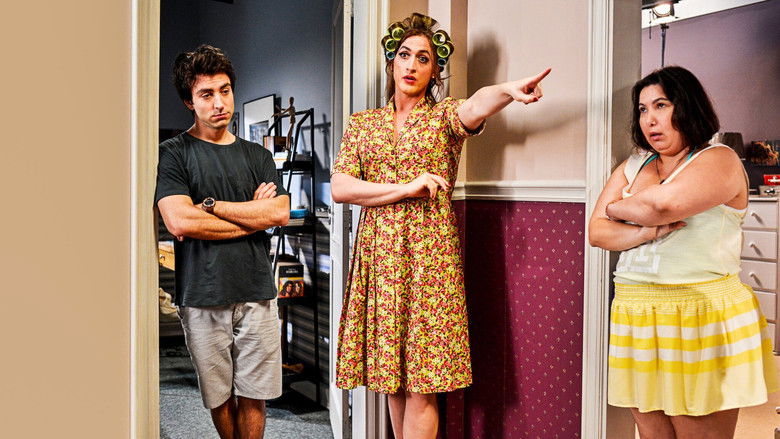

My Mom Is a Character
Minha Mãe é uma Peça: O Filme
"And you still thought that mothers were all the same."
Overview
Minha Mãe é uma Peça (My Mom Is a Character) follows the story of Dona Hermínia, a middle-aged, divorced woman living in Niterói, Rio de Janeiro. Devoted entirely to her two grown children, Marcelina and Juliano, Hermínia is a force of nature—overprotective, loud, and constantly meddling in their lives. Her world is shaken when she overhears them criticizing her overbearing nature and calling her annoying. Hurt and feeling unappreciated, she decides to run away from home without telling anyone where she is going.
Hermínia seeks refuge at the home of her beloved Aunt Zélia, an older relative suffering from memory loss. While her children and ex-husband, Carlos Alberto, panic and search for her, Hermínia spends her time venting to her aunt and reminiscing about the past. Through a series of flashbacks and confessional-style monologues, the film explores her journey of raising her children, her divorce, and the sacrifices she made. The narrative ultimately leads to a heartwarming reconciliation, where the family learns to value her presence, and Hermínia begins to accept their independence.

Core Meaning
At its heart, the film is a tribute to the unrecognized labor of motherhood. Director André Pellenz and creator Paulo Gustavo use comedy as a vehicle to explore the empty nest syndrome and the identity crisis mothers face when their children become adults. The film argues that the annoying, repetitive, and controlling behaviors of mothers often stem from an intense, overwhelming love and a fear of being left behind. It validates the maternal experience, turning a specific Brazilian archetype into a universal symbol of devotion.
Thematic DNA
The Empty Nest Syndrome
The central conflict arises from Hermínia's inability to let go. Her identity is so tightly wound around being a mother that she perceives her children's independence as a personal rejection. The film resolves this by showing her learning to value herself outside of her maternal role.
Family Dysfunctions as Love
The film portrays a chaotic, loud, and argumentative family dynamic not as broken, but as deeply loving. The screaming matches and insults (particularly regarding weight and laziness) are shown as a twisted form of intimacy and care characteristic of Brazilian family culture.
Maternal Sacrifice
Through flashbacks, the audience sees Hermínia's past struggles, including raising children alone after her husband left her for a younger woman. This theme underscores the resilience required of single mothers and demands respect for their history.
Character Analysis
Dona Hermínia
Paulo Gustavo
Motivation
To protect her children from the world and to feel needed and validated in her role as a mother.
Character Arc
She moves from a state of suffocating control and feeling unappreciated to a moment of self-exile, and finally returns with a renewed sense of self-worth and a slightly looser grip on her children's lives.
Marcelina
Mariana Xavier
Motivation
To gain independence and eat in peace without her mother's judgment.
Character Arc
Initially presented as the lazy, gluttonous target of her mother's insults, she evolves to realize how much she relies on her mother's care when Hermínia disappears.
Juliano
Rodrigo Pandolfo
Motivation
To navigate his life without disappointing his mother, while dealing with her invasive curiosity.
Character Arc
He struggles between his love for his mother and his need to express his identity (and sexuality), eventually stepping up to defend her importance to the family.
Symbols & Motifs
The Bobbins (Hair Rollers)
They symbolize Hermínia's lack of vanity and her total immersion in domestic life. She is constantly 'in process,' preparing for a life or an event that she rarely gets to enjoy herself because she is too busy serving others.
Hermínia wears them throughout the house and even in semi-public settings, marking her as the archetype of the 'dona de casa' (housewife) who prioritizes practicality over appearance.
The Kitchen
Represents Hermínia's domain of power and control. It is where she nurtures but also where she dictates the rules. Being told to 'get out of the kitchen' or leaving it signifies her loss of purpose.
Many of the most intense arguments and monologues happen in this space, establishing it as the emotional command center of the family.
Aunt Zélia's Apartment
A sanctuary of the past. It represents a space where Hermínia can be a niece and a child again, rather than just a mother. It allows for the introspection needed for her character arc.
Hermínia escapes here to hide from her children, using the location to recount her memories and validate her own life story.
Memorable Quotes
Marcelina, você tá obesa!
— Dona Hermínia
Context:
Hermínia yells this at her daughter, typically when Marcelina is eating or wearing tight clothes, highlighting the lack of boundaries in their relationship.
Meaning:
While harsh, this quote became iconic for capturing the filter-less, blunt nature of the character. It reflects the Brazilian cultural mannerism where criticism of appearance is often conflated with maternal concern.
A gente que é mãe não tem lugar sossegado dentro de casa.
— Dona Hermínia
Context:
Spoken to the camera/audience as a 'confessional' complaint about her children constantly demanding her attention, even when she is in the bathroom or trying to sleep.
Meaning:
Encapsulates the central theme of the film: the invasion of privacy and the total loss of personal space that comes with motherhood.
Eu não te engravidei sozinha!
— Dona Hermínia
Context:
Used during an argument with her ex-husband Carlos Alberto when he criticizes how the children turned out.
Meaning:
A sharp reminder of shared responsibility, directed at her ex-husband. It asserts her worth and rejects the idea that the burden of raising 'problematic' children falls solely on the mother.
Cadê o Iesa?
— Dona Hermínia
Context:
Hermínia frequently yells this name throughout the house whenever she needs something done, often without getting a response.
Meaning:
Highlights Hermínia's dependency on her domestic worker and her tendency to shout for help for minor inconveniences. 'Iesa' became a catchphrase for the invisible labor that supports the household.
Philosophical Questions
Is maternal love inherently possessive?
The film asks whether it is possible to love deeply without controlling the object of that love. Hermínia's journey is about disentangling care from control, suggesting that true maternal love eventually requires the painful act of letting go.
How do family roles construct our identity?
Hermínia has no identity outside of 'mother' and 'ex-wife.' The film explores the existential crisis that occurs when these roles are threatened, questioning who a person is when they are no longer needed by others.
Alternative Interpretations
While widely viewed as a comedy, some critics interpret the film as a tragedy of loneliness. Hermínia's constant shouting and conflict-seeking can be read as a desperate attempt to keep her family engaged with her, fearing the silence of the empty nest. Additionally, the film can be seen as a subversive queer text: a gay man reclaiming the narrative of domestic femininity, performing the role of the mother to critique patriarchal family structures where the father (Carlos Alberto) is distant and the mother bears the emotional load.
Cultural Impact
Minha Mãe é uma Peça revolutionized Brazilian comedy by placing a drag performance at the center of a mainstream family blockbuster, not as a niche act but as a representation of the 'every-mother.' Culturally, it bridged the gap between different social classes in Brazil, as Hermínia's specific brand of neurosis and affection resonated with both the wealthy and the working class. It cemented Paulo Gustavo as a queer icon and a national treasure. The film's legacy is profound; it normalized the celebration of the 'difficult' mother figure, moving away from the saintly matriarch trope to something more flawed, human, and hilarious.
Audience Reception
The film was a phenomenal commercial success and is beloved by the Brazilian public. Audiences praised the relatability of the character—almost every viewer claimed Hermínia reminded them of their own mother. Paulo Gustavo's performance was universally acclaimed for its timing and nuance. Criticism was minor but focused on the episodic nature of the script (due to its theatrical origins) and some reliance on stereotypes about weight and appearance. However, the emotional core of the film shielded it from harsh negativity, with the general verdict being that it is a 'modern classic' of Brazilian cinema.
Interesting Facts
- The film is based on a highly successful play of the same name, which Paulo Gustavo wrote and starred in for years before the movie adaptation.
- The character Dona Hermínia was directly inspired by Paulo Gustavo's real-life mother, Déa Lúcia Vieira Amaral. Her personality and mannerisms are exaggerated versions of reality.
- Paulo Gustavo plays the lead role in drag, but the performance is widely praised for being a genuine character study rather than a caricature of a woman.
- The film was the most-watched Brazilian movie of 2013, selling over 4.6 million tickets.
- The success of the film spawned two sequels, creating one of the most profitable franchises in Brazilian cinema history.
- Ingrid Guimarães, who plays the ex-husband's new wife Soraya, is a famous Brazilian comedian in her own right, adding star power to the supporting cast.
- The 'confessional' scenes where Hermínia talks to the camera were a stylistic choice to bridge the gap between the theatrical monologue format of the play and the film medium.
Easter Eggs
Real-life Mother in Credits
In the final credits (and famously in the sequels), footage and photos of the real Déa Lúcia are shown. This reveals to the audience that the 'absurd' situations they just watched are grounded in the actor's real lived experience with his mother.
Theatre Origins
The film retains the 'breaking the fourth wall' technique from the stage play. Hermínia frequently looks at or addresses the audience directly, a nod to the source material's monologue format.
⚠️ Spoiler Analysis
Click to reveal detailed analysis with spoilers
Frequently Asked Questions
Explore More About This Movie
Dive deeper into specific aspects of the movie with our detailed analysis pages
Comments (0)
No comments yet. Be the first to share your thoughts!