Skip to content
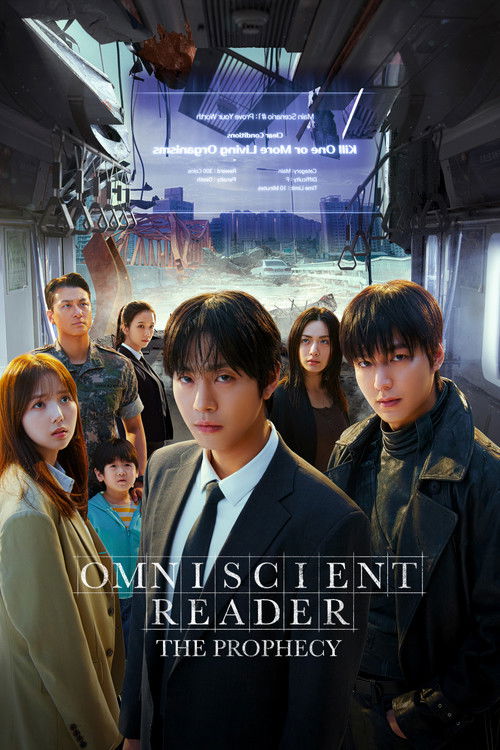
Omniscient Reader: The Prophecy
Bathed in cold apocalyptic neon and shattering glass, this dark action fantasy surges with desperate longing and visceral panic, as a lone reader's reality dissolves into a deadly narrative game where survival is written in blood.
Omniscient Reader: The Prophecy

Omniscient Reader: The Prophecy

전지적 독자 시점

"A novel known only by me has become reality."

23 July 2025 South Korea 120 min 7.1 (102)

Director: Kim Byung-woo

Cast: Ahn Hyo-seop, Lee Min-ho, Chae Soo-bin, Shin Seung-ho, Nana

Fantasy Action Adventure Fate, Free Will, and Rewriting Narrative The Relationship Between Reader, Story, and Hero Voyeurism, Media Consumption, and Gamification Isolation vs. Found Family
Box Office: $9,187,679

Overview

Omniscient Reader: The Prophecy (2025) follows Kim Dok-ja (Ahn Hyo-seop), an ordinary and socially detached contract worker at Minosoft whose sole comfort in life is reading an obscure, 3,000-chapter web novel titled Three Ways to Survive the Apocalypse (TWSA). For ten years, Dok-ja has been the single remaining reader following the story to its conclusion. Disappointed by the novel's grim ending—where the protagonist survives alone while all of humanity dies—Dok-ja emails a critical review to the mysterious author, "tls123". Immediately after sending the message on his subway ride home, the fictional nightmare manifests in real life.

A sinister, floating creature known as a Dokkaebi hijacks the train, introducing a gamified apocalyptic system governed by cosmic entities called Constellations who watch human struggles for entertainment. Forced into brutal "Scenarios" where humans must kill to survive, Dok-ja realizes that he possesses a text file containing the entire plot of TWSA. Equipped with total future knowledge, Dok-ja navigates lethal obstacles, gathers allies, and seeks out Yoo Joong-hyuk (Lee Min-ho)—the novel's overpowered, regressing protagonist—in a high-stakes bid to rewrite fate and prevent the world's destruction.
Core Meaning

Director Kim Byung-woo uses the high-concept fantasy setting to explore how stories shape human identity and resilience. The film illustrates the transition from passive observation to active agency. In modern society, individuals often feel trapped by circumstances like rigid corporate structures and social isolation. Dok-ja’s transformation from a passive reader behind a screen into an active protagonist demonstrates that fate is not an immutable script; through empathy, choices, and collective effort, individuals can write their own new outcomes even in the face of seemingly predestined ruin.

Thematic DNA

Fate, Free Will, and Rewriting Narrative 35%
The Relationship Between Reader, Story, and Hero 25%
Voyeurism, Media Consumption, and Gamification 20%
Isolation vs. Found Family 20%

Fate, Free Will, and Rewriting Narrative

Central to the film is the conflict between TWSA's predetermined, tragic narrative and Dok-ja's determination to forge a different path. While Yoo Joong-hyuk is trapped in an endless loop of death and regression, Dok-ja uses his meta-knowledge to disrupt fixed plot points and create alternative choices.

The Relationship Between Reader, Story, and Hero

The narrative examines how fiction comforts the lonely and how a reader's relationship with a story evolves. Dok-ja is not just a participant; his belief in the characters gives them purpose, blurring the lines between creator, hero, and spectator.

Voyeurism, Media Consumption, and Gamification

Represented by the Constellations who sponsor players and broadcast human trials like live-streaming content, this theme satirizes modern media culture where real human suffering is turned into gamified entertainment.

Isolation vs. Found Family

Starting as an isolated loner who prefers text on a screen to real human interaction, Dok-ja learns that survival requires genuine connection. Protecting his companions—Yoo Sang-ah, Jung Hee-won, and Lee Hyun-sung—becomes his driving force.

Character Analysis

Kim Dok-ja

Ahn Hyo-seop

Archetype: Unlikely Hero / The Omniscient Reader Key Trait: Sharp intellect, tactical meta-knowledge, and quiet resilience.

Motivation

To save his companions and rewrite the novel's tragic ending.

Character Arc

Evolves from a traumatized, detached office worker hiding behind stories into a strategic leader willing to risk everything to alter the tragic plot.

Yoo Joong-hyuk

Lee Min-ho

Archetype: Antihero / Tragic Warrior / The Regressor Key Trait: Martial power, intimidating presence, and stoic determination.

Motivation

To survive the apocalypse and reach the ultimate scenario without losing his humanity.

Character Arc

Trapped in endless cycles of death and rebirth, he starts as a cold, cynical killer, but slowly comes to view Dok-ja as an indispensable partner who offers hope of ending his curse.

All 5 characters and cast

Symbols & Motifs

The Smartphone / Web Novel File

Meaning:

Symbolizes Dok-ja’s emotional safety net, his solitary past, and his ultimate weapon—a literal text containing knowledge of the future.

Context:

Used by Dok-ja to access the full TWSA text file after the fictional apocalypse manifests in reality.

The Subway Car / Dongho Bridge

Meaning:

The subway car represents the fragile bubble of modern, mundane daily life being shattered. The ruined Dongho Bridge serves as the threshold where real life and fictional nightmare collide.

Context:

The subway car is the setting where Scenario 1 begins, while Dongho Bridge is where Dok-ja meets Yoo Joong-hyuk and is tested.

Blue Holographic System Windows

Meaning:

Symbolizes the gamification and dehumanization of the world, reducing human existence to stats, scenario rules, and viewer coins.

Context:

Appears floating in front of survivors to deliver scenario rules, stats, and Constellation notifications.

Grasshoppers / Insects

Meaning:

In Scenario 1, the insects in Lee Gilyoung's collection box symbolize lower-tier lifeforms trapped in a food chain, serving as a clever loophole Dok-ja uses to satisfy the "kill a living organism" requirement without taking human life.

Context:

Found inside Lee Gilyoung's collection box during the subway car crisis in Scenario 1.

Memorable Quotes

이 세계의 결말을 알고 있는 유일한 독자다.
— Kim Dok-ja

Context

Spoken by Dok-ja regarding his role as the sole reader who completed the web novel TWSA.

Meaning

Establishes Dok-ja's unique position and authority in the narrative; his cheat sheet knowledge is his defining edge.

살고 싶다면, 누군가를 죽여라.
— Bihyung (Dokkaebi / System Broadcast)

Context

Broadcasted to the subway passengers during the initiation of Scenario 1.

Meaning

Delivered during Scenario 1 in the subway car. It shatters societal norms, forcing humanity into a ruthless survival environment.

All 4 quotes

Philosophical Questions

Is fate fixed, or can meta-knowledge grant true free will?

Dok-ja uses his knowledge of the text to change predetermined outcomes, proving that awareness of the system allows one to rewrite destiny.

What is the ethics of viewing another person's suffering as entertainment?

The Constellations pay coins to watch humans fight for survival, posing questions about spectator ethics in modern media.

Can fiction save a person's life?

Reading TWSA provided Dok-ja with the psychological strength to endure years of isolation, demonstrating the restorative power of stories.

Alternative Interpretations

Psychological Metaphor for Escapism: Dok-ja’s entrance into the novel can be read as a literalization of psychological coping. Traumatized by real-world life, he uses the fictional narrative as a protective lens through which he processes reality.

Full ending explanation

Cultural Impact

Omniscient Reader: The Prophecy was developed during the peak of global popularity for South Korean webtoon and web novel intellectual properties. The source material, Omniscient Reader's Viewpoint by singNsong, is one of the most successful Korean web novels in history with over 300 million views. The movie reflects South Korean anxieties regarding youth unemployment, hyper-competitive social structures, and digital escapism.

Released in July 2025 as Korea's primary summer tentpole, it generated widespread global discussion. While casual cinema-goers praised its fast-paced action and visual effects, the film faced vocal debate from hardcore webtoon purists over condensed plotlines and character alterations.

Audience Reception

Praised Aspects: High-octane combat, slick visual effects for monsters, dynamic chemistry between Ahn Hyo-seop and Lee Min-ho, and an accessible entry point for general viewers unfamiliar with the novel.

Main Criticisms: Condensing 551 chapters into a 117-minute movie led to rushed character arcs, omitted world-building lore, and altered character abilities.

Controversies: Fans expressed disappointment over the removal of key Korean historical Constellations (such as Admiral Yi Sun-sin), changes to Dok-ja's psychological "Fourth Wall" mechanic, and marketing that overemphasized Jisoo’s brief role.

Overall Verdict: A fun, visual popcorn fantasy blockbuster for casual moviegoers, but a divisive adaptation among hardcore source material fans.

Interesting Facts

  • Produced by Realies Pictures (the production company behind Along with the Gods) with a reported budget of 30 billion KRW (~$21–22 million USD).
  • Director Kim Byung-woo (The Terror Live, Take Point/PMC: The Bunker) returned to feature filmmaking after seven years.
  • The project was originally optioned by Realies Pictures with the ambition of creating a 5-part cinematic franchise.
  • CG and visual effects were handled by M83 and Motorhead, creating digital environments for ruined Seoul bridges, Dokkaebi animations, and giant monsters.
  • Markedly, this was star actor Ahn Hyo-seop's feature film lead debut.
  • Director Kim Byung-woo initially worried Ahn Hyo-seop was "too tall and handsome" for an ordinary office worker, requiring styling tweaks to ground his appearance.
  • Actresses Nana, Chae Soo-bin, and Jisoo underwent rigorous physical conditioning for their specialized action sequences.
  • To streamline combat for a 117-minute runtime, certain character fighting styles were altered (e.g., Jung Hee-won was equipped with agile daggers instead of a full sword).

Easter Eggs

TWSA Chapter Count (3,000 Chapters)

A nod to massive Korean web novel culture, referencing real-world serialized web fiction that spans thousands of chapters over a decade.

Minosoft Corporation

Dok-ja’s employer serves as a satire of rigid, soul-crushing South Korean corporate work life.

Jisoo's Cameo (Lee Ji-hye)

K-pop star Jisoo makes a short appearance as sword-wielding student Lee Ji-hye, referencing her mentor relationship with Yoo Joong-hyuk.

Bihyung's Dokkaebi Visuals

The creature's design blends traditional Korean goblin myth with modern streaming mascot aesthetics.

Frequently Asked Questions

Explore More About This Movie

Dive deeper into specific aspects of the movie with our detailed analysis pages

Comments (0)

Leave a comment

No comments yet. Be the first to share your thoughts!

Similar Movies