Skip to content
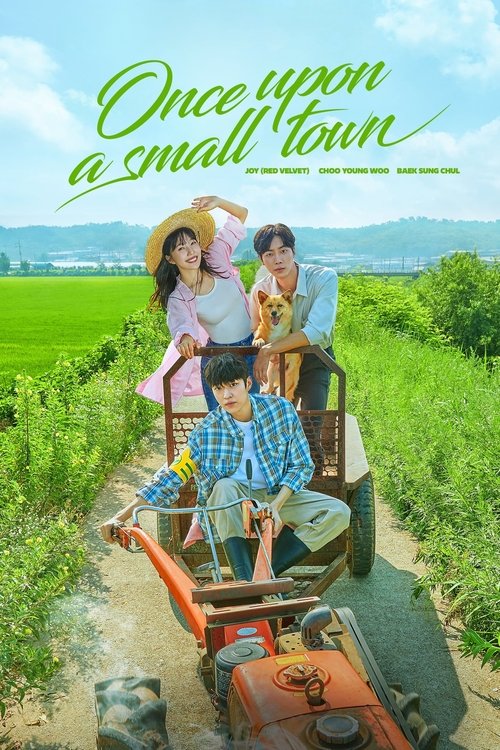
Once Upon a Small Town
A sun-drenched pastoral romantic comedy that wraps viewers in gentle solace, moving like a warm summer breeze rustling through lush peach orchards while tenderly mending unspoken childhood wounds.
Once Upon a Small Town

Once Upon a Small Town

어쩌다 전원일기

05 September 2022 — 28 September 2022 South Korea 1 season 12 episode Ended 7.5 (161)

Cast: JOY, Choo Young-woo, Baek Sung-chul, Baek Ji-won, Jeong Seok-yong

Drama Comedy Urban Isolation vs. Rural Interdependence Healing Grief and Emotional Abandonment Reconnection and Forgotten Bonds Duty to Self vs. Duty to Community

Overview

Once Upon a Small Town (어쩌다 전원일기, 2022) is a 12-episode South Korean romantic comedy web drama produced by Kakao Entertainment and streamed globally on Netflix. Directed by Kwon Seok-jang and scripted by Baek Eun-kyeong, the series is adapted from Park Ha-min’s web novel Accidental Country Diary.

The narrative follows Han Ji-yul, a cynical, boundary-conscious small-animal veterinarian working in Seoul who is tricked by his grandfather into temporarily relocating to rural Huidong Village. Expecting a quiet interim, Ji-yul instead inherits a bustling country practice catering to massive farm livestock and is plunged into an open-door community where personal privacy is practically nonexistent.

There, Ji-yul repeatedly crosses paths with Ahn Ja-young, an energetic, indispensable local police officer who serves as the village's unofficial guardian angel and problem solver. While Ji-yul initially struggles against the village's nosy camaraderie and Ja-young’s constant presence, their professional and personal interactions gradually unearth shared childhood memories, challenge their perceptions of family and belonging, and force Ji-yul to reconsider the life he truly wants to build.
Core Meaning

The core thesis of Once Upon a Small Town is that healing and genuine belonging are found not in self-protective isolation or urban status, but in intentional connection, community reciprocity, and embracing vulnerability. Through the contrast between metropolitan cynicism and countryside interdependence, the narrative demonstrates that home is defined not by geographical location or rigid independence, but by the community of people who show up for one another unconditionally.

Thematic DNA

Urban Isolation vs. Rural Interdependence 30%
Healing Grief and Emotional Abandonment 25%
Reconnection and Forgotten Bonds 25%
Duty to Self vs. Duty to Community 20%

Urban Isolation vs. Rural Interdependence

The series begins by establishing Han Ji-yul's strict boundaries and solitary existence in Seoul. As the narrative unfolds, Huidong Village systematically breaks down his emotional defenses, demonstrating that reliance on others is not a weakness but the foundation of community resilience.

Healing Grief and Emotional Abandonment

Both leads carry deep psychological wounds from losing their parents early in life. Ja-young copes by becoming indispensable to avoid abandonment, while Ji-yul relies on emotional detachment. Their relationship enables each to confront unresolved childhood grief and recognize their intrinsic worth.

Reconnection and Forgotten Bonds

Driven by the motif of childhood friendship ("secret friends"), the romantic arc shows how memory, nostalgia, and early emotional anchors resurface to clarify adult desires and realign personal priorities.

Duty to Self vs. Duty to Community

Explored through Ja-young's self-sacrificing altruism and Sang-hyeon's devotion to revitalizing local agriculture, the narrative examines the delicate balance between civic responsibility and personal happiness.

Character Analysis

Han Ji-yul

Choo Young-woo

Archetype: The Aloof Outsider / Reluctant Hero Key Trait: Professional precision concealing a tender, protective nature

Motivation

Starts with the singular goal of surviving his grandfather's clinic stint and returning to Seoul; evolves into wanting a genuine emotional home in Huidong.

Character Arc

Begins as an emotionally guarded, boundary-obsessed Seoul veterinarian resentful of country living. Gradually opens up through veterinary field emergencies and Ja-young’s presence, ultimately choosing rural life and reciprocal love over metropolitan comfort.

Ahn Ja-young

Park Soo-young (Joy)

Archetype: The Sunny Altruist / Village Guardian Key Trait: Radiant altruism paired with resilient emotional strength

Motivation

Driven by the subconscious desire to remain indispensable so she will never be discarded; evolves to pursue genuine romance and self-advocacy.

Character Arc

Outwardly vibrant, hyper-capable, and universally adored, Ja-young conceals childhood abandonment trauma by overextending herself for everyone in town. Through Ji-yul's validation, she learns to prioritize her own needs and embrace reciprocal affection.

All 4 characters and cast

Symbols & Motifs

The Bicycle / Police Scooter

Meaning:

Represents mobility, community accessibility, and Ja-young's role as the emotional and practical bridge connecting every resident in Huidong.

Context:

Used as Ahn Ja-young's primary mode of transport throughout her daily patrols and community assistance tasks across the village.

Farm Animals & Strays (Calves, Goats, Dogs)

Meaning:

Symbolize innocence, birth, shared labor, and serve as emotional mirrors reflecting Ji-yul's gradual emotional softening and empathy.

Context:

Encountered through daily veterinary emergencies, livestock births, and stray rescues in rural settings.

Peach Orchards

Meaning:

Symbolize the organic, slow-nurtured vitality of rural youth alongside the bittersweet transitions of unrequited love.

Context:

Managed by Lee Sang-hyeon, serving as the visual and working backdrop for his agricultural pursuits and personal interactions.

The "Secret Friend" Tree / Country Road

Meaning:

Symbolize preserved childhood innocence, emotional refuge, and lasting emotional foundations.

Context:

The physical rural meeting spots from their childhood that trigger buried memories for Ji-yul and Ja-young.

Memorable Quotes

희동리에선 혼자 사는 게 아니에요. 다 같이 돕고 사는 거지.
— Ahn Ja-young

Context

Spoken to an irritated Ji-yul in Episode 1 / early season as Ja-young explains the social norms of Huidong Village.

Meaning

Highlights the foundational philosophy of rural life and underscores the primary thematic conflict between urban individualism and communal solidarity.

내 비밀친구가 되어 줘서 고마웠어.
— Ahn Ja-young / Han Ji-yul

Context

Exchanged during the mid-series (Episodes 8–9) when their forgotten childhood memories are fully remembered.

Meaning

Marks the unlocking of their shared emotional history, recognizing the childhood pact that anchored both of them during their darkest orphan years.

All 3 quotes

Episode Highlights

Welcome to Huidong Village

S1E1

Ji-yul is lured to Huidong believing his grandfather had a medical emergency, only to find an animal clinic in need of care.

Significance:

Establishes the central culture clash between Ji-yul's metropolitan boundaries and Ja-young's open communal lifestyle.

A Country Vet's Hard Day

S1E3

Ji-yul deals with stubborn farm animals, including bulls and pigs, alongside Ja-young.

Significance:

The grueling physical labor initiates Ji-yul's grudging respect for Ja-young and her standing in the village community.

The Miracle of Birth

S1E5

Ji-yul and Ja-young collaborate during an intense nocturnal calf delivery on a local farm.

Significance:

The shared experience deepens their mutual trust and sparks palpable romantic tension between the two leads.

Sang-hyeon’s Confession

S1E8

Sang-hyeon openly confesses his romantic feelings to Ja-young during a walk.

Significance:

Creates romantic rivalry and forces Ja-young and Ji-yul to acknowledge and confront their true feelings.

Remembering That Summer

S1E9

Ji-yul recovers his lost childhood memories of Ja-young acting as his "secret friend" after his parents died.

Significance:

Removes the long-standing barrier of miscommunication and emotional suppression between the leads.

Confessions Under the Country Sky

S1E10

Ji-yul confronts Ja-young with honesty and affection under the rural evening sky.

Significance:

Culminates in their first reciprocal romantic confession and mutual acceptance of their relationship.

Accidental Country Diary

S1E12

Ji-yul returns to Seoul after his grandfather's return, realizes where he belongs, and chooses to move permanently to Huidong.

Significance:

Concludes the series arc by sealing Ji-yul's permanent transition into rural veterinary work and his shared future with Ja-young.

Philosophical Questions

What constitutes a meaningful home?

The narrative contrasts Seoul's material conveniences with Huidong's relational warmth, probing whether home is an isolated physical structure or an active community of mutual care.

Is self-reliance a virtue or a defense mechanism?

Through Ji-yul’s emotional detachment and Ja-young’s over-extension, the series questions whether extreme independence serves as a barrier that isolates individuals from healing.

How does childhood memory shape adult identity?

The story explores how repressed and preserved childhood experiences linger in the subconscious, subtly guiding adult emotional bonds and life-defining choices.

Alternative Interpretations

Critics and analysts have examined the series through several distinct lenses:

Full ending explanation

Cultural Impact

Once Upon a Small Town aired during a notable 2021–2023 trend in South Korean media termed the "healing/countryside romance wave" (alongside shows such as Hometown Cha-Cha-Cha, Our Blues, and Summer Strike). This phenomenon reflected growing urban burnout, soaring living costs, and post-pandemic exhaustion among young Koreans, popularizing pastoral escapism (choncance) and celebrating regional community solidarity.

Additionally, the production proved the commercial viability of high-quality, compact-format (30–40 minute) streaming dramas on KakaoTV and Netflix, offering an accessible alternative to conventional 70-minute, 16-episode broadcast formats.

Audience Reception

Audience reception for Once Upon a Small Town has been predominantly warm and positive:

  • Praised Elements: Viewers praised its high-comfort, low-stress tone as an ideal emotional "palate cleanser," alongside beautiful countryside cinematography, vibrant summer lighting, and gentle animal interactions.
  • Points of Criticism: Some viewers noted the predictable, trope-heavy narrative structure, occasional early acting stiffness, and the brief runtime that limited the development of certain supporting village residents.
  • Overall Verdict: The series was widely embraced by domestic and international audiences as a sweet, breezy, and restorative romantic comedy that succeeded in delivering comforting emotional escapism.

Interesting Facts

  • The drama is adapted from Park Ha-min’s popular 2019 romance web novel Accidental Country Diary, originally published via Ridibooks.
  • The lead roles were initially offered to Jang Keun-suk and Choi Soo-young before being recast with Joy and Choo Young-woo.
  • Veterinarians and professional animal trainers were present on set at all times, with custom silicone medical props used to avoid animal discomfort.
  • The series was filmed on location across North Gyeongsang Province, including Yeongju-si, Yecheon-gun, and Uiseong-gun.
  • Joy attended stunt school to execute police takedowns, bicycle chases, and physical restraint scenes required for her role.
  • Principal photography took place during extreme summer heatwaves in unshaded countryside fields.
  • Choo Young-woo won the Excellence Award (Actor in a Web Series) at the 9th APAN Star Awards in 2023 for his performance as Han Ji-yul.

Easter Eggs

Homage to Classic Korean Rural Dramas

The title and warm village structure are a deliberate modern nod to Korea's legendary long-running pastoral series Country Diaries (전원일기, 1980–2002), reframing traditional rural television for streaming audiences.

Joy’s Stage Name vs. Character Persona

Park Soo-young (Joy) portrays a character whose bright, sunshine external disposition mirrors her real-world K-pop persona while exploring deeper underlying layers of orphanhood and vulnerability.

Soundtrack Direction by Moon Seong-nam

The music score was overseen by Every Single Day frontman Moon Seong-nam (music director of Pasta and Pinocchio), infusing the rural setting with signature nostalgic acoustic and indie-folk textures.

Frequently Asked Questions

Explore More About This Movie

Dive deeper into specific aspects of the movie with our detailed analysis pages

Comments (0)

Leave a comment

No comments yet. Be the first to share your thoughts!

Similar Movies