Skip to content
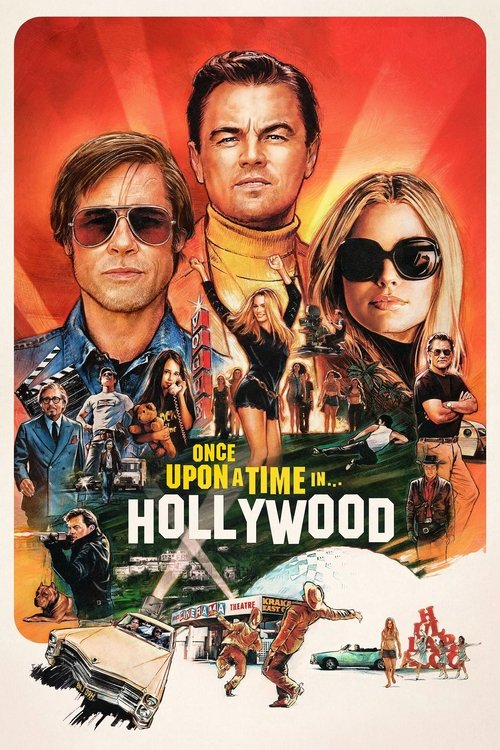
Once Upon a Time... in Hollywood
A sun-drenched elegy to a vanishing Hollywood, where friendship idles in a convertible along Sunset Boulevard and the last golden hour of an era glows just before the dark closes in.
Once Upon a Time... in Hollywood

Once Upon a Time... in Hollywood

"In this town, it can all change… Like that."

24 July 2019 China 162 min 7.4 (15,221)

Director: Quentin Tarantino

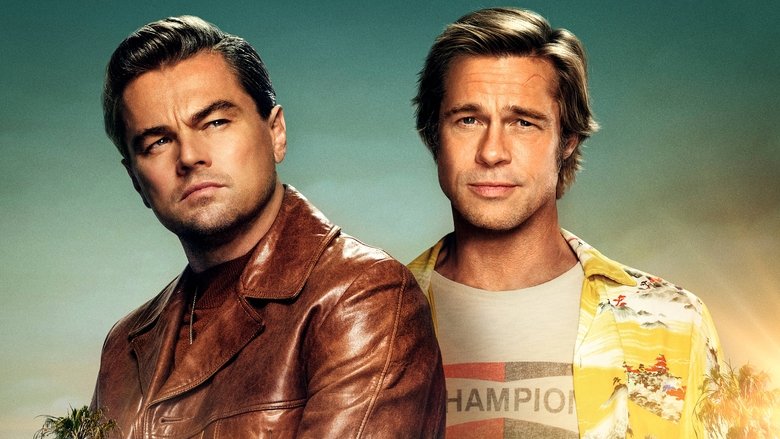
Cast: Leonardo DiCaprio, Brad Pitt, Margot Robbie, Emile Hirsch, Margaret Qualley

Drama Thriller Comedy Obsolescence and the fear of being replaced Nostalgia for a lost Hollywood Cinema's power to rewrite reality Male friendship and loyalty Innocence under the shadow of violence
Budget: $95,000,000
Box Office: $393,869,691

Overview

Los Angeles, 1969. Rick Dalton, once the star of a hit Western television series, is watching his career slide into the humiliating twilight of guest-villain roles, while his longtime stunt double and best friend Cliff Booth drives him around town, fixes his antenna, and absorbs his panic attacks with the calm of a man who has stopped needing anything from the industry. Together they drift through a town that has quietly decided it no longer has room for them.

Next door on Cielo Drive, a different Hollywood is rising: Rick's new neighbors are director Roman Polanski and the luminous young actress Sharon Tate, who embodies everything fresh, hopeful and ascendant about the new decade. The film braids these lives loosely together across a handful of days, following Rick to a soundstage, Cliff on a chance encounter with a barefoot hitchhiker, and Sharon on a drive through the city and into a movie theater where she watches strangers watch her.

Tarantino's ninth feature is less a thriller than a hangout picture with an undertow — three hours of billboards, car radios, cigarette commercials and period detail, shadowed by the audience's knowledge of what the summer of 1969 came to mean. Nostalgic, funny and unhurried, it lets dread accumulate in the margins while its characters chase one more shot at relevance.
Core Meaning

At heart this is Tarantino's most personal film — described by critics as a love letter to Hollywood, a love letter to Los Angeles, and above all a corrective for Sharon Tate, restoring her as a living, working, joyful presence rather than a crime-scene footnote. Its subject is obsolescence: the terror of becoming, in Rick Dalton's words, useless to the only art form you have ever loved.

But its thesis is about cinema itself as an instrument of moral repair. If movies are a machine for manufacturing reality, Tarantino argues, then a director can reach into history and snip out the frame he cannot bear — an act of deliberate wish fulfillment that grants the victims of the Manson Family a measure of justice the real world never gave them. The film's title is a promise of a fairy tale, and its ending insists that the fable is not escapism but a form of love: the one thing movie people can actually do for the dead is refuse to let the story end the way it did.

Thematic DNA

Obsolescence and the fear of being replaced 28%
Nostalgia for a lost Hollywood 22%
Cinema's power to rewrite reality 20%
Male friendship and loyalty 18%
Innocence under the shadow of violence 12%

Obsolescence and the fear of being replaced

Rick Dalton is an aging cowboy swimming against the unstoppable tides of time, reduced to playing heavies who lose to the next generation's rising star, weeping in his trailer at the thought of becoming useless. Cliff's obsolescence is quieter — a stuntman nobody will hire, living behind a drive-in with a dog and a TV dinner. The 1960s New Hollywood arriving next door is, for them, an eviction notice.

Nostalgia for a lost Hollywood

The film is saturated in a longing that critics called nostalgic in an out-of-reach way — neon marquees, AM radio, jingles, premieres — with something undeniably sad about a perfect version of Hollywood that still has no time for imperfect people. Tarantino reconstructs the town so lovingly that the reconstruction itself becomes the argument: this world is worth preserving on film precisely because it cannot be preserved in life.

Cinema's power to rewrite reality

Movies within movies proliferate — TV pilots, spaghetti Westerns, a picture Sharon watches with a paying audience — until the boundary between screen and world thins. The finale makes the theme literal, underscoring the power of cinema to alter reality and putting history, as Tarantino sees it, to rights.

Male friendship and loyalty

The professional relationship between a fading star and his stunt double is the film's true love story: employer and employee, protector and protected, two men whose bond outlasts both their careers. Cliff absorbs Rick's tantrums and does his dangerous work; Rick, for all his self-pity, keeps the only friend who has ever really seen him.

Innocence under the shadow of violence

Sharon Tate — whom Tarantino called the heartbeat of the story and Margot Robbie played as a ray of light — moves through the film in an aura of untouched delight, while the Spahn Ranch and its drifting young followers press in from the edges of the frame. The tension between radiance and impending horror is the engine of the entire third act.

Character Analysis

Rick Dalton

Leonardo DiCaprio

Archetype: Fading hero / insecure everyman star Key Trait: Raw, self-pitying vulnerability masked by cowboy bravado

Motivation

To stay somebody — to be seen as an actor rather than a has-been, and to keep the life and house that fame bought him.

Character Arc

Begins as a TV Western lead in freefall, sliding into guest-villain work and drink; humiliated and terrified of irrelevance, he weeps at the thought of becoming useless to the only art form he has ever loved, then finds unexpected grace in doing the work well — and, by the end, a wholly unearned second chance.

Cliff Booth

Brad Pitt

Archetype: Antihero sidekick / laconic gunslinger Key Trait: Unshakable, faintly menacing cool

Motivation

Loyalty to Rick, and a stoic's indifference to everything else; he wants nothing the industry can give or withhold.

Character Arc

Rick's longtime stunt double and driver, unemployable and unbothered, he drifts through the film as an observer — sparring with Bruce Lee, picking up a hitchhiker, wandering into Spahn Ranch — until circumstance finally hands him the one task he was always built for. Brad Pitt won the first acting Oscar of his career for the role, Best Supporting Actor at the 92nd Academy Awards.

All 3 characters and cast

Symbols & Motifs

The title card "Once Upon a Time..."

Meaning:

An explicit declaration that what follows is a fairy tale rather than history — permission, granted in advance, for the film to end the way fables do rather than the way 1969 did.

Context:

Announced in the title itself and echoed in the film's final movement, which critics have discussed precisely as Tarantino's fairy-tale finale.

The stunt double

Meaning:

A body that takes the fall so the star can survive — the perfect emblem of a film in which fiction absorbs a blow that reality dealt to real people.

Context:

Cliff Booth exists to be hurt in Rick's place, and the logic of substitution governs the whole story's relationship to actual events.

The Cielo Drive driveway and gate

Meaning:

A threshold between two Hollywoods and two fates — proximity as destiny, where an address is the difference between being forgotten and being famous forever for the worst reason.

Context:

Rick's house sits next door to Sharon Tate and Roman Polanski's; the film repeatedly stages the drive up the hill, filmed on the real Cielo Drive locations.

The movie theater marquee

Meaning:

The screen as a place where a person becomes beloved — stardom experienced not as an abstraction but as the sound of strangers laughing in the dark.

Context:

Sharon buys a ticket to a film she is in and watches the audience watch her; Tarantino incorporated footage of the real Sharon Tate rather than recreating it.

Television versus film

Meaning:

A hierarchy of worth that measures a man's soul — TV as the graveyard of a career, features as salvation, with the industry's snobbery internalized as personal shame.

Context:

Rick's terror is being a TV heavy forever; his Italian detour and his talk with an agent turn a format question into an existential one.

Spahn Ranch

Meaning:

The corpse of the Western — the sets where American myths were manufactured, now squatted in by the people who will end the decade's innocence.

Context:

Cliff returns to a ranch he once worked on and finds it occupied by Manson's followers, the old dream literally decaying beneath the new nightmare.

Philosophical Questions

Does an artist have the right to rewrite a real tragedy?

The film stakes everything on answering yes, framing its revision as a corrective for Sharon Tate and a gift to the dead rather than an appropriation of them. But it leaves the discomfort intact: the same gesture that restores her erases the actual victims' actual fate, and the most divisive scenes of 2019 exist precisely because viewers disagreed about whether the trade was worth it.

What is a person worth once they are no longer useful?

Rick's breakdown over becoming useless to the only art form he loves, and Cliff's unemployable calm, present two answers to the same condition — despair and detachment. The film refuses to resolve which is wisdom, letting an industry's measure of value collide with a human one.

Can nostalgia be honest, or is it always a lie?

Tarantino reconstructs 1969 with documentary obsession — real locations, period film stocks, archival footage — while admitting the whole thing is a fable. The result tests whether meticulous accuracy in service of a wish is a form of truth-telling or the most seductive kind of falsification.

Is violence in cinema catharsis or complicity?

The film withholds its brutality for nearly three hours and then delivers it at a pitch that critics said threatened to pull the movie apart. Audiences cheering that release are put in an uneasy position: the same appetite that makes the ending satisfying is the appetite the era's real horrors fed on.

Who gets to be remembered, and for what?

Sharon Tate is restored as a working artist watching her own film with a laughing audience, while the killers are denied the infamy history handed them. The film treats remembrance as an editorial act — a matter of whose frames we choose to keep.

Alternative Interpretations

As pure wish fulfillment. The dominant reading: the altered ending lets Tarantino rewrite history and offer a more optimistic vision, a deliberate act of wish fulfillment granting the Manson victims some measure of justice — a director snipping an unbearable frame out of the 35mm print of the past.

Full ending explanation

Cultural Impact

Arriving fifty years after the summer it depicts, the film landed as both a period reconstruction and a commercial event: it delivered Tarantino's biggest opening weekend, an estimated $40.4 million domestically, narrowly beating Inglourious Basterds, and went on to major awards recognition, with Brad Pitt taking the Golden Globe and then the first acting Oscar of his career for Best Supporting Actor at the 92nd Academy Awards.

Critically it was received as a return to form — bold, beautiful and brutal, with several reviewers calling it Tarantino's best work since Kill Bill or even Pulp Fiction, and it holds an approval rating around 87% on Rotten Tomatoes. Tarantino's screenplay and direction drew acclaim, as did DiCaprio's and Pitt's performances.

Its cultural afterlife runs along two tracks. One is aesthetic: a wave of renewed fascination with 1969 Los Angeles, with 35mm and Ektachrome textures, with the physical craft of stunt work, and with the era's radio-and-billboard ephemera. The other is ethical. By fictionalizing the Manson Family murders the film reopened debates about what artists owe real victims, and it sits alongside Inglourious Basterds and Django Unchained as the completion of Tarantino's counter-historical trilogy, in which cinema takes revenge on the twentieth century. Commentators also pressed on its blind spots — the thinness of its women's dialogue and its nostalgia for a industry hierarchy that excluded many — with some readings going as far as calling it a reactionary fable about restoring an older order.

Audience Reception

Praised. Audiences and critics converged on the performances — DiCaprio's raw, funny portrait of a disintegrating star and Pitt's effortless cool, which carried him to a Golden Globe and his first acting Oscar. The period craft drew near-universal admiration: the Kodak 35mm photography, the soundtrack of AM radio and commercials, and the reconstruction of 1969 Los Angeles. Many reviewers called it Tarantino's strongest film since Kill Bill, or even Pulp Fiction, and the picture sits around 87% on Rotten Tomatoes while posting the biggest opening weekend of his career.

Criticized. The most common complaint concerns pace and shape — nearly three hours of hangout with a plot that only arrives at the end. Detractors found it self-indulgent, and opinion writers flagged the film as a reminder of Tarantino's blind spots, particularly how little its female characters are given to say.

Controversial. The final scenes were among the most divisive of the year: the intensity of the violence struck some viewers as gleeful excess that threatened to pull the film apart, while others read it as an intentional demolition of the Tinseltown dream. The Bruce Lee sequence provoked its own backlash, and the ethics of fictionalizing the Manson murders remained a live argument.

Verdict. A polarizing but widely embraced late-career high point — Tarantino's most personal and most melancholy film, loved for its texture and its two leads, argued over for its ending, and impossible to be neutral about.

Interesting Facts

  • Cinematographer Robert Richardson shot the film on Kodak 35mm, his sixth collaboration with Quentin Tarantino.
  • Richardson aimed for high color saturation with hints of blue and deeper skin tones, and pushed the grain to keep a crisp period look.
  • Two sequences set at Sharon Tate and Roman Polanski's home were shot on Kodak Ektachrome — one in 16mm and the other in Super 8mm — to evoke home-movie textures.
  • For research, Richardson screened period films including Roman Polanski's The Fearless Vampire Killers (1967) and Rosemary's Baby (1968), plus One-Eyed Jacks, The Great Escape, Bonnie and Clyde, The Graduate, The Dirty Dozen, Valley of the Dolls, The Trip, The Thomas Crown Affair, Bullitt and Where Eagles Dare.
  • Production ran about 90 days around Los Angeles, shooting at real locations including Cielo Drive, Sunset Boulevard, Hollywood Boulevard and Burbank.
  • Tarantino told Margot Robbie early in production that Sharon Tate was 'the heartbeat of the story'; Robbie said she saw the character as 'a ray of light.'
  • In early development the project was configured very differently: there were negotiations for Samuel L. Jackson in a major role, a version in which Brad Pitt would have played a detective investigating the Tate murders, and Tom Cruise was considered for the role of Cliff Booth.
  • Bruce Lee appears in the film played by actor Mike Moh, in a scene that became one of the movie's most talked-about sequences.
  • The film gave Tarantino the biggest opening weekend of his career, taking an estimated $40.4 million in the United States and Canada and narrowly edging out Inglourious Basterds.
  • Brad Pitt won the Golden Globe and then his first career acting Academy Award, Best Supporting Actor, for playing Cliff Booth.

Easter Eggs

Real archival footage of the actual Sharon Tate

Rather than recreating her screen work entirely with Margot Robbie, Tarantino incorporated footage of the real Sharon Tate, so that when the character watches herself in a cinema the audience is watching the genuine performer. It turns a scene into an act of remembrance and is central to the film functioning as a corrective for Tate.

The Ektachrome 16mm and Super 8mm passages at the Polanski house

Shooting two sequences on reversal stock in small-gauge formats mimics late-1960s home movies, smuggling a documentary texture into a fiction film and making the Cielo Drive scenes feel like recovered private footage of people who really lived.

Bruce Lee as a character, played by Mike Moh

Dropping a real martial-arts icon into a comic set-piece with a fictional stuntman is pure Tarantino myth-collision — and it became the film's most contested moment, generating public objections from people close to Lee's legacy.

The archive of period films Richardson studied

The look quotes an entire canon — Polanski's own Rosemary's Baby and The Fearless Vampire Killers, plus Bullitt, Bonnie and Clyde, The Graduate and Valley of the Dolls — so the cinematography is itself a set of hidden citations to 1967–68 Hollywood.

The Sergio Leone echo in the title

The Once Upon a Time... construction places the film in the lineage of Leone's operatic American myths, flagging from the first frame that this is a Western fable about Hollywood rather than a historical account — which is exactly how critics read the fairy-tale finale.

Frequently Asked Questions

Explore More About This Movie

Dive deeper into specific aspects of the movie with our detailed analysis pages

Comments (0)

Leave a comment

No comments yet. Be the first to share your thoughts!

Similar Movies