
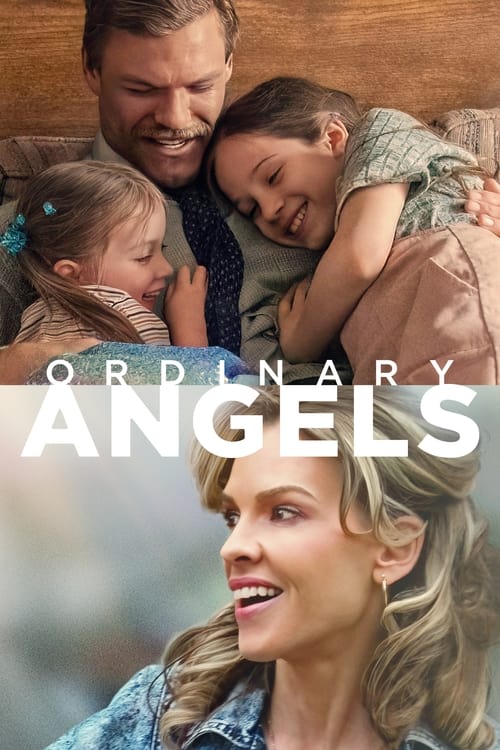
Ordinary Angels
A heartwarming biographical drama radiating with desperate hope and quiet miracles. Amidst the freezing burial of a historic snowstorm, a fractured community becomes a beacon of light, proving that flawed hands can still forge a path to salvation.
Ordinary Angels

Ordinary Angels

"Find your purpose. Make a difference."

22 February 2024 United States of America 118 min ⭐ 7.7 (353)
Director: Jon Gunn
Cast: Hilary Swank, Alan Ritchson, Emily Mitchell, Skywalker Hughes, Nancy Travis
Drama
Faith in Action vs. Passive Belief The Wounded Healer and Redemption The Burden of Stoic Masculinity The Power of Community Over Isolation
Budget: $13,000,000
Box Office: $20,571,534

Overview

Set in 1994 Louisville, Kentucky, Ordinary Angels follows the emotionally charged, true story of Ed Schmitt, a stoic and financially destitute roofer reeling from the recent death of his wife. As he struggles to care for his two young daughters, his youngest, Michelle, is diagnosed with a life-threatening liver condition that requires an immediate transplant. Drowning in grief, medical debt, and a crisis of faith, Ed's world is bleak until an unlikely force of nature enters his life.

That force is Sharon Stevens, a fiercely determined, fast-talking local hairdresser who is quietly battling her own severe alcoholism and the painful estrangement from her adult son. Desperate to find a purpose "bigger than herself," Sharon aggressively inserts herself into the Schmitt family's life. She organizes fundraisers, negotiates away crushing hospital bills, and refuses to take "no" for an answer, pushing the resistant and prideful Ed to accept the help he desperately needs.

The narrative steadily builds toward a race against time when a liver finally becomes available, coinciding with one of the most devastating blizzards in Kentucky's history. The film shifts from an intimate character study into a gripping tale of communal triumph, showcasing how an entire town must rally together against impossible odds to save a single child's life.


Core Meaning

The central message of Ordinary Angels is an exploration of "faith in action" and the concept of the wounded healer. The director, Jon Gunn, asserts that one does not need to be a saint, a wealthy benefactor, or a perfect person to enact monumental change; rather, broken people are often the most capable of recognizing and mending the brokenness in others. The film reframes the idea of divine intervention, suggesting that miracles are rarely supernatural occurrences, but rather the cumulative, gritty efforts of ordinary people choosing to act selflessly. It posits that finding a purpose greater than one's own suffering is the truest path to personal redemption and communal healing.

Thematic DNA

Faith in Action vs. Passive Belief 30%
The Wounded Healer and Redemption 30%
The Burden of Stoic Masculinity 20%
The Power of Community Over Isolation 20%

Faith in Action vs. Passive Belief

The film sharply contrasts passive, institutional faith with active, hands-on charity. Ed's passive faith is shattered by his wife's death, leading to a deep resentment toward God. In contrast, Sharon embodies faith as a verb—taking physical, relentless action to change a family's circumstances. The film suggests that true religion is found in being a "good Samaritan" to one's neighbors.

The Wounded Healer and Redemption

Sharon's altruism is inextricably linked to her own trauma and battle with alcoholism. She is not a flawless savior; she acts out of a desperate need to find meaning and quiet the inner voice telling her she is worthless. Her journey illustrates that helping others is a powerful catalyst for personal salvation and confronting one's own demons.

The Burden of Stoic Masculinity

Ed represents the traditional, working-class archetype of a man who believes he must bear all burdens silently. His pride and sense of masculine duty make him fiercely resistant to Sharon's help, feeling emasculated by a woman who easily fixes his unfixable financial and logistical problems. His arc requires him to embrace vulnerability and accept that needing help is not a weakness.

The Power of Community Over Isolation

While the film begins with isolated individuals suffering alone—Ed in his grief, Sharon in her addiction—it climaxes in a massive display of collective unity. The historic 1994 snowstorm physically isolates the town, yet it spiritually unites them as hundreds of strangers arrive with shovels to clear a helicopter landing pad, proving that communal solidarity can overcome insurmountable natural obstacles.

Character Analysis

Sharon Stevens

Hilary Swank

Archetype: The Wounded Healer / Unorthodox Mentor
Key Trait: Relentless persistence

Motivation

To find a purpose outside of herself to silence her feelings of worthlessness, and to atone for her past failures as a mother.

Character Arc

Sharon transforms from an aimless, self-destructive alcoholic into a focused, relentless force for good. Initially, her charity is almost a selfish coping mechanism, but it evolves into a genuine connection that ultimately gives her the strength to face her estranged son and embrace sobriety.

Ed Schmitt

Alan Ritchson

Archetype: The Stoic Griever
Key Trait: Guarded independence

Motivation

To protect and provide for his two young daughters at all costs, despite feeling completely inadequate and abandoned by the universe.

Character Arc

Ed begins the film paralyzed by grief, drowning in debt, and angry at God. He is fiercely independent to a fault. Through Sharon's intervention and the community's eventual support, he learns to let go of his pride, embrace vulnerability, and rediscover his faith in humanity.

Michelle Schmitt

Emily Mitchell

Archetype: The Innocent
Key Trait: Sweet optimism

Motivation

To survive, be loved, and keep the memory of her mother alive.

Character Arc

While physically deteriorating from biliary atresia, Michelle remains the emotional anchor of the film. Her unwavering innocence and simple faith inspire both her father and a complete stranger to perform the impossible.

Barbara Schmitt

Nancy Travis

Archetype: The Wise Elder / Nurturer
Key Trait: Grounded resilience

Motivation

To save her granddaughter and restore her son's shattered faith and spirit.

Character Arc

Barbara acts as the steadfast maternal presence trying to hold her son Ed together. She gently nudges him toward accepting Sharon's unorthodox help and serves as the voice of spiritual endurance, bridging the gap between Ed's anger and God's unseen plan.

Symbols & Motifs

The 1994 Kentucky Blizzard

Meaning:

The snowstorm acts as a physical manifestation of the insurmountable odds and the overwhelming nature of grief and suffering. It represents the ultimate test of human will and community spirit.

Context:

In the film's climax, the blizzard threatens to completely derail Michelle's chance at a life-saving transplant. It forces the isolated characters to finally rely on the collective strength of their neighbors to dig out a path to salvation.

Theresa's Untouched Wardrobe

Meaning:

The closed closet containing Ed's late wife's clothing symbolizes his unprocessed grief, his inability to move forward, and the emotional walls he has built around his family.

Context:

Ed avoids the closet for much of the film, holding onto the physical remnants of his past. When he finally forces himself to enter it and breaks down crying, it marks a poignant turning point in his emotional acceptance and healing.

Alcohol and the Salon

Meaning:

Sharon's drinking and the chaotic, neon-lit environment of her salon symbolize her internal escapism. They are the tools she uses to numb the pain of her past failures and her estranged relationship with her son.

Context:

Sharon is frequently seen retreating to the bottle when the pressure of her own life becomes too much. Her journey to sobriety parallels her shifting focus from self-destruction to the constructive saving of the Schmitt family.

Memorable Quotes

Find a reason to be here that's bigger than you are.

— Gabe (AA Member)

Context:

Spoken to Sharon during an Alcoholics Anonymous meeting. She takes this advice to heart, which directly leads her to attend the Schmitt family's funeral and intervene in their lives.

Meaning:

This quote serves as the thematic catalyst for the entire film. It highlights the philosophical idea that true healing from trauma or addiction comes from altruism and serving the greater good.

You're going to have to get comfortable being uncomfortable. Because this ain't about you, it's about your little girl.

— Sharon Stevens

Context:

Sharon says this to Ed when he tries to reject her help and the money she raised, stating that he prefers to do things himself.

Meaning:

This line cuts through Ed's masculine pride and ego, reminding him that a parent's ultimate duty is to their child, even if it means accepting charity and feeling emasculated.

My name is Sharon. And I'm not an alcoholic. I'm just a pissed-off hairdresser with a splitting headache and a super annoying friend.

— Sharon Stevens

Context:

Spoken during her reluctant attendance at her first AA meeting, dragged there by her friend and business partner, Rose.

Meaning:

This quote establishes Sharon's deep denial about her addiction and her use of humor and deflection as a defense mechanism.

You're not just worthy, Sharon. You're a miracle.

— Ed Schmitt

Context:

Spoken by Ed near the end of the film, finally expressing his profound gratitude and recognizing the divine timing of Sharon's relentless intervention.

Meaning:

This statement represents the ultimate validation for Sharon. It silences the internal voice that has told her all her life she is broken and worthless.

Are you mad at God, Dad? Is that why we don't pray anymore? ... It's okay. Everybody gets mad sometimes. You should still talk to Him though.

— Ashley Schmitt

Context:

Ashley says this to Ed at the gravesite, observing how her father's faith has been shattered by the loss of her mother.

Meaning:

This highlights the pure, uncomplicated faith of a child acting as a profound theological truth for a struggling adult, acknowledging the validity of anger in grief.

Philosophical Questions

The Problem of Suffering (Theodicy)

The film wrestles with the classic philosophical question: "Why does an all-powerful, loving God allow terrible things to happen to good people?" Ed is a hardworking, faithful man who loses his wife and faces the death of his child. The film does not attempt to answer "why" this evil exists, but rather explores "how" humanity must respond to it—suggesting that the remedy for inexplicable pain is found in the connective tissue of human empathy rather than divine justification.

The Nature of Altruism

Can an act be truly selfless if it is driven by a psychological need to heal oneself? Sharon helps the Schmitt family, but she does so explicitly to find a "purpose" to keep herself sober and quiet her own inner demons. The film explores the symbiotic relationship between the savior and the saved, suggesting that human charity is inherently, and perhaps necessarily, mutually beneficial.

Alternative Interpretations

While the film is overtly presented as an inspiring tale of selfless charity, critics and audiences have explored alternative psychological interpretations of Sharon's character. Some read the film as a dark commentary on the nature of altruism, suggesting that Sharon's intense, almost aggressive intervention is fundamentally a selfish act. In this reading, Sharon is not a "white savior" but rather a deeply traumatized addict using the Schmitt family as a substitute addiction to avoid facing her own failures as a mother. Her inability to take "no" for an answer borders on boundary-breaking obsession, making her a much more morally ambiguous antihero than a traditional saint.

Another interpretation focuses on Ed's journey as a deconstruction of toxic stoicism. From a gender-studies perspective, the film can be viewed as a critique of traditional patriarchal expectations. Ed feels emasculated by his inability to financially save his family and deeply threatened by a loud, brash woman who steps into the "provider" role. The film can thus be read as a narrative about the necessity of dismantling male pride and accepting matriarchal or communal support in working-class America.

Cultural Impact

Ordinary Angels arrived during a noticeable resurgence in high-quality, faith-adjacent cinema spearheaded by Kingdom Story Company (creators of Jesus Revolution). Historically, the "Christian film" genre has been heavily criticized by secular audiences and critics for featuring saccharine storylines, wooden acting, and heavy-handed sermonizing. Ordinary Angels made a significant cultural impact by subverting these expectations; it secured an impressive 80% critical approval and 99% audience score on Rotten Tomatoes, successfully uniting both secular critics and faith-based moviegoers.

By casting A-list talent like two-time Academy Award winner Hilary Swank and rising action star Alan Ritchson, the film bridged the gap between mainstream Hollywood prestige and heartland sensibilities. Culturally, the film resonated deeply in a post-pandemic society marred by political division and cynicism. It functioned as a cinematic antidote, reminding audiences of the tangible power of community and mutual aid. Philosophically, it contributed to the modern discourse on the "problem of evil" by refusing to offer cheap apologetic answers for a mother's death, instead positing that the answer to human suffering is human compassion—acting as "ordinary angels" in the absence of divine understanding.

Audience Reception

Audience reception for Ordinary Angels was overwhelmingly positive, earning a rare 99% audience score on review aggregators. Viewers heavily praised the film for being an unabashed "feel-good" movie that successfully avoided the overly preachy, saccharine pitfalls common in faith-based cinema. Hilary Swank's gritty, tornado-like performance as the flawed Sharon Stevens received widespread acclaim, as did Alan Ritchson's surprising emotional depth and vulnerability, a stark contrast to his typical tough-guy roles in shows like Reacher.

Audiences were particularly moved by the film's climax during the snowstorm, citing it as a powerful, tear-jerking reminder of community goodness in an increasingly cynical world. However, some minor criticisms arose regarding the film's pacing—with a runtime near two hours, a few viewers felt the midsection dragged. Additionally, a segment of secular audiences felt some of the emotional manipulation and convenient plot resolutions bordered on a "Lifetime movie" aesthetic, while a small fraction of deeply conservative viewers found the depiction of Sharon's alcoholism and bar-dancing slightly edgy for a Kingdom Story production. Nevertheless, the overall verdict was that it is a highly effective, grounded, and emotionally resonant crowd-pleaser.

Interesting Facts

  • The film is based on the true events of the 1994 North American cold wave, specifically the heroic actions of the Louisville, Kentucky community to clear a landing space during a record-setting blizzard.
  • Musician Dave Matthews (of the Dave Matthews Band) originally found the true story years ago, held onto it, and successfully pitched it to producer Jon Berg, who brought it to Lionsgate.
  • The movie was filmed in Winnipeg, Canada, where the production team had to contend with actual massive snowstorms, at one point dealing with half a mile of shut-down highway and two feet of real snow.
  • Hilary Swank had never met Alan Ritchson before arriving on set. She only vaguely knew he starred in the action show 'Reacher' and was pleasantly surprised by how effectively they played such polar opposite characters.
  • In real life, the real Michelle Schmitt survived the surgery, grew up, graduated from college, and got married.
  • The film's theatrical release was originally slated for October 2023 but was delayed to February 2024 to avoid competing at the box office with 'Taylor Swift: The Eras Tour'.
  • The script was co-written by Meg Tilly, the Oscar-nominated 1980s actress (Agnes of God, The Big Chill), and Kelly Fremon Craig, the acclaimed writer-director behind 'The Edge of Seventeen' and 'Are You There God? It's Me, Margaret'.

Easter Eggs

Dave Matthews credited as a Producer

Musician Dave Matthews is surprisingly credited as a producer on the film. This is a real-world Easter egg for fans of the Dave Matthews Band, referencing the fact that Matthews himself discovered the true story in the 1990s and spent years championing it to be made into a feature film.

The involvement of Southeast Christian Church

The film highlights the involvement of Pastor Dave Stone and his congregation. This is a direct nod to the real-life Southeast Christian Church in Louisville, which actually mobilized its members to shovel the massive parking lot for the helicopter in the 1994 blizzard.

⚠️ Spoiler Analysis

Click to reveal detailed analysis with spoilers

Frequently Asked Questions

Explore More About This Movie

Dive deeper into specific aspects of the movie with our detailed analysis pages

Comments (0)

Leave a comment

No comments yet. Be the first to share your thoughts!