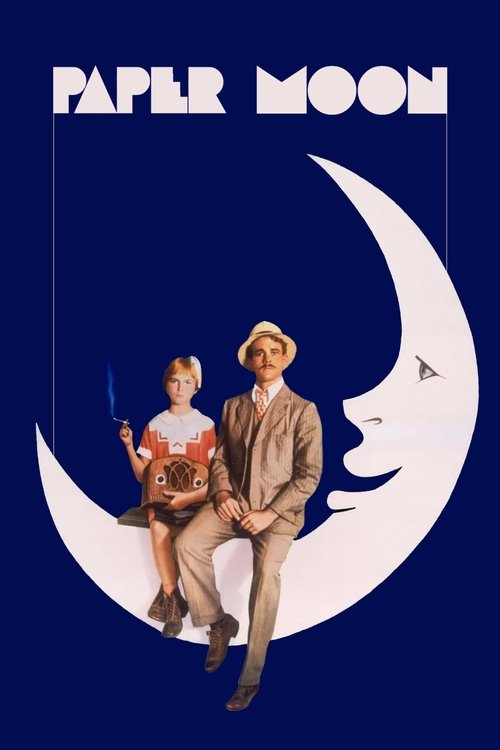
Paper Moon
A Depression-era road comedy suffused with melancholic charm, painting a stark, black-and-white portrait of unlikely companionship and the bittersweet art of the con.
Paper Moon

Paper Moon

"As P.T. Barnum put it, "There's a sucker born every minute.""

09 May 1973 United States of America 102 min ⭐ 7.9 (774)
Director: Peter Bogdanovich
Cast: Tatum O'Neal, Ryan O'Neal, Madeline Kahn, John Hillerman, Jessie Lee Fulton
Drama Crime Comedy
The Nature of Family Deception and Authenticity Survival in the Great Depression Innocence and Corruption
Budget: $2,500,000
Box Office: $30,900,000

Overview

Set in the desolate landscapes of Kansas and Missouri during the Great Depression, "Paper Moon" follows Moses Pray, a small-time con man who sells Bibles to grieving widows. At the funeral of a former flame, he is reluctantly tasked with delivering her nine-year-old, cigarette-smoking daughter, Addie Loggins, to an aunt in St. Joseph. Moses cons $200 from the brother of the man who accidentally killed Addie's mother, money that Addie quickly claims as her own after overhearing the deal.

What begins as a begrudging arrangement blossoms into an unexpectedly formidable partnership. Addie, wise beyond her years, proves to be a natural at the grift, often outsmarting her supposed guardian. Their journey is a series of schemes and misadventures as they swindle their way across the Dust Bowl, forming a complex and deeply touching bond that hovers ambiguously between a partnership in crime and a genuine father-daughter relationship.
Core Meaning

At its heart, "Paper Moon" is an exploration of the idea that family and love are not necessarily defined by blood, but by shared experience and mutual belief. The film's title, taken from the song "It's Only a Paper Moon," encapsulates this central theme: the world can be a phony, make-believe place, but it becomes real if someone believes in you. This sentiment is mirrored in the relationship between Moses and Addie. Their bond, forged through deception and hardship, becomes the most authentic element in their otherwise illusory lives. Director Peter Bogdanovich uses the backdrop of the Great Depression not just for period authenticity, but to highlight how, in times of desperation, human connection becomes the most valuable currency.

Thematic DNA

The Nature of Family 35%
Deception and Authenticity 30%
Survival in the Great Depression 25%
Innocence and Corruption 10%

The Nature of Family

"Paper Moon" challenges traditional notions of family. The central question of whether Moses is Addie's biological father is deliberately left unanswered. Instead, the film suggests that their shared experiences—their cons, their arguments, and their mutual dependency—create a bond stronger than any biological tie. Addie's line, when asked if Moses is her father, "I'm with him, ain't I?" perfectly summarizes this theme. Their relationship evolves from one of convenience and mutual exploitation into a genuine, albeit unconventional, family unit.

Deception and Authenticity

The film constantly plays with the line between what is real and what is an illusion. Moses and Addie's livelihood is built on lies, yet their growing affection for each other is profoundly real. The black-and-white cinematography itself contributes to this theme, creating a world that feels both like a documented reality of the Depression and a pastiche of 1930s Hollywood films. The very title suggests that reality is subjective and can be shaped by belief, a concept central to the life of a con artist.

Survival in the Great Depression

The film is set against the stark backdrop of the Great Depression, a time of widespread poverty and desperation. Moses and Addie's cons are presented not as acts of pure villainy, but as a means of survival in a harsh world. The film captures the desolation of the era without becoming overly bleak, blending the harsh realities with comedy and sentiment. Addie's toughness and precociousness are shown to be products of her environment, a necessary armor for a child forced to grow up too soon.

Innocence and Corruption

Addie Loggins is a fascinating paradox: a nine-year-old child who is also a cynical, chain-smoking con artist. Her character subverts the typical portrayal of childhood innocence. While she is adept at deception, she also possesses a stronger moral compass than Moses, at one point insisting they give a Bible away for free to a truly destitute family. The film explores how the harshness of the world can corrupt, but also how a child's innate sense of fairness and longing for connection can endure.

Character Analysis

Moses 'Moze' Pray

Ryan O'Neal

Archetype: Antihero / Reluctant Guardian
Key Trait: Cynical but soft-hearted

Motivation

Initially, Moses is motivated purely by money and self-preservation. He agrees to transport Addie only after extorting $200 for his troubles. As the film progresses, his motivation becomes more complex. While he continues to con for a living, his actions are increasingly driven by a desire to provide for Addie and, ultimately, by a powerful, unspoken love for her. His final act of returning for her, or at least allowing her to rejoin him, shows that his motivation has shifted from pure self-interest to a need for their connection.

Character Arc

Moses begins as a selfish, small-time grifter, seemingly unburdened by scruples. His primary motivation is his own survival and comfort. Initially viewing Addie as a nuisance and then as a tool for his cons, he slowly and reluctantly develops a deep-seated affection and sense of responsibility for her. He is repeatedly outmaneuvered and morally challenged by the nine-year-old in his charge. By the end, despite his attempts to do the 'right thing' by leaving her with her aunt, he has been fundamentally changed by their journey, choosing their unconventional family over a life of solitude.

Addie Loggins

Tatum O'Neal

Archetype: The Prodigy / The Wise Child
Key Trait: Precocious

Motivation

Addie's primary motivation is to find a place of belonging and to secure the $200 she believes is rightfully hers. She clings to the possibility that Moses is her father, as it provides an anchor in her uprooted life. She is driven by a fierce need for stability and connection, which she finds in her partnership with Moses. Her cleverness and participation in the cons are not just for monetary gain, but are also her way of proving her worth to Moses and solidifying their bond.

Character Arc

Addie starts as a stoic, recently orphaned nine-year-old, but quickly reveals herself to be exceptionally intelligent, observant, and resilient. She is not a passive ward but an active participant who quickly masters the art of the con, often proving more adept than Moses. While tough and cynical on the surface, her vulnerability and longing for a father figure are evident. Her arc is one of finding a sense of belonging and family in the most unlikely of circumstances. She ultimately chooses the uncertain but emotionally fulfilling life on the road with Moses over the stability offered by her aunt.

Trixie Delight

Madeline Kahn

Archetype: The Temptress / The Tragic Figure
Key Trait: Flamboyant

Motivation

Trixie is motivated by a desire for comfort and security. She attaches herself to Moses because he has a car and a little money, offering a temporary reprieve from her hard life. As her maid Imogene reveals, she has to 'put out' to get by, suggesting her actions are driven by desperation rather than malicious intent. She seeks a protector and a provider, but her methods and her personality clash with the established dynamic between Moses and Addie.

Character Arc

Trixie is a traveling carnival dancer who briefly becomes Moses's romantic interest, much to Addie's dismay. She represents a threat to the world Moses and Addie have built. While initially portrayed as a ditzy, promiscuous woman, her character has moments of pathos and vulnerability. She is a product of the same desperate times, using her sexuality to survive. Her arc is short and tragic; she is ultimately outsmarted by Addie and abandoned by Moses, left to her own devices in a harsh world.

Imogene

P.J. Johnson

Archetype: The Ally / The Oppressed
Key Trait: Pragmatic

Motivation

Imogene is motivated by survival and a desire for a better situation. She endures Trixie's demanding and often demeaning behavior because she has few other options. Her willingness to help Addie stems from both her friendship with the girl and a clear-eyed understanding of Trixie's character. She is pragmatic and sees an opportunity to improve her own situation while helping her new friend.

Character Arc

Imogene is Trixie's young, long-suffering African-American maid. She forms a quick and genuine friendship with Addie, bonding over their shared maturity and subordinate roles. Imogene provides Addie with crucial information about Trixie's true nature and becomes her co-conspirator in the plan to get rid of her. Her arc is one of quiet resilience. After Trixie is abandoned, Addie leaves Imogene enough money to get home, a small act of solidarity and kindness. She represents the layered social and racial hardships of the era.

Symbols & Motifs

The Paper Moon

Meaning:

The titular "Paper Moon" symbolizes the film's core theme of illusion versus reality. Carnival photo backdrops featuring a paper moon were popular, offering a whimsical, manufactured reality. The song "It's Only a Paper Moon" reinforces this, suggesting that a make-believe world can become real through love and belief. It represents the fragile, constructed nature of Moses and Addie's life, which nonetheless becomes their authentic reality because they believe in each other.

Context:

The symbol is most explicitly referenced in the carnival scene where Addie wants her picture taken sitting on a paper moon backdrop. Moses is initially too distracted by Trixie Delight to join her, and Addie has her picture taken alone. This moment underscores her loneliness and her longing for a genuine connection with him. The title itself was chosen by director Peter Bogdanovich after hearing the song, and he added the carnival scene specifically to justify its use.

The Ford Model A/V8

Meaning:

The cars in the film represent both freedom and the precariousness of Moses and Addie's lifestyle. The open road is their home, offering escape and the promise of the next con. The constant breakdowns of Moses' old Model A reflect their hand-to-mouth existence. When Moses impulsively buys a new Ford V8 convertible to impress Trixie, it symbolizes a betrayal of his and Addie's partnership and a squandering of their hard-earned money on a fleeting, superficial desire.

Context:

The cars are a constant presence in the film, carrying the pair from town to town. The argument over the Bibles, a pivotal scene in their relationship, takes place in the car. The purchase of the new car is a major point of conflict, leading Addie to conspire with Imogene to get rid of Trixie. Their escape from the sheriff and final reunion also revolve around their vehicle.

Bibles

Meaning:

The Bibles are the primary tool of Moses's trade and a symbol of exploited faith and morality. He uses a sacred object, a symbol of truth and comfort, as a prop in his deceptive schemes, preying on the vulnerability of grieving widows. This highlights the moral ambiguity of their survival tactics. For Addie, however, the Bibles also become a tool to enact her own moral code, as seen when she insists on giving one to a poor family, suggesting a conflict between the cynical use of the object and an underlying sense of justice.

Context:

The Bible scam is introduced early and is a recurring element of their journey. Moses presents himself as a representative of the "Kansas Bible Company." We see them successfully pull off the con multiple times, with Addie becoming an integral part of the act. The scene where Addie forces Moses to give a Bible to the impoverished mother and her children is a key moment in her character development.

Memorable Quotes

I want my two hundred dollars.

— Addie Loggins

Context:

Addie says this in a diner after Moses has used some of the $200 he scammed for her to fix his car and buy her a train ticket. Realizing he plans to pocket the rest, she loudly and repeatedly demands her money, forcing him to take her with him until he can pay her back.

Meaning:

This line establishes Addie's character as determined, intelligent, and not easily fooled. It's the catalyst for their entire journey together, shifting the dynamic from Moses being in control to them being reluctant partners. It's her constant refrain, reminding him of his obligation and cementing their connection.

I got scruples too, you know. You know what that is... Scruples? Addie: No, I don't know what it is, but if you got 'em, it's a sure bet they belong to somebody else.

— Moses Pray and Addie Loggins

Context:

This conversation happens when Moses is trying to justify his actions or inaction to Addie. It's a recurring theme in their banter, where Addie consistently holds up a mirror to Moses's questionable ethics.

Meaning:

This exchange perfectly encapsulates their relationship and their differing worldviews. Moses makes a weak claim to a moral compass, while Addie's witty and cynical retort shows she sees right through him. It's a humorous and sharp piece of dialogue that highlights Addie's precocious intelligence and the film's playful take on morality.

Daddy, I need to go to the shithouse.

— Addie Loggins

Context:

Addie delivers this line matter-of-factly to Moses shortly after they have begun their journey together, much to his exasperation. It highlights the stark contrast between her and the idealized image of a child.

Meaning:

This blunt and unsentimental line, one of Addie's first in the film, immediately shatters any expectation of her being a sweet, innocent orphan. It establishes her character as direct, unpretentious, and a product of a rough upbringing, setting the comedic and earthy tone of the film.

Philosophical Questions

What constitutes a family?

The film consistently challenges the viewer's preconceived notions of family. By leaving the paternity of Addie ambiguous, "Paper Moon" forces the audience to consider whether a biological link is a necessary component of a parent-child relationship. It presents a powerful argument for the concept of 'chosen family,' suggesting that the bonds forged through shared experience, loyalty, and love can be more significant than those of blood. The film explores whether the functions of a family—providing support, protection, and affection—can be fulfilled even in the most unconventional of structures.

Is morality situational?

Set during the Great Depression, the film places its characters in a context of extreme economic hardship, which serves as a crucible for their moral choices. Moses and Addie's cons, while illegal and deceptive, are framed as acts of survival. The film asks whether actions that are typically considered immoral can be justified when one's livelihood is at stake. Addie's own moral code—she is willing to con the well-off but shows compassion for the poor—suggests a nuanced, situational approach to ethics, where the morality of an act is judged by its consequences and the circumstances of those involved rather than by a rigid set of rules.

Where is the line between illusion and reality?

The film's very title alludes to the fluid boundary between what is real and what is make-believe. The characters live by creating illusions for others, yet through this shared life of deception, they find the most authentic relationship either has ever known. "Paper Moon" explores the philosophical idea that reality can be subjective, shaped by belief and perception. The love between Moses and Addie makes their precarious, 'phony' world real and meaningful for them, questioning whether an emotionally resonant 'lie' can be more valuable than a desolate 'truth'.

Alternative Interpretations

The central ambiguity of "Paper Moon" revolves around the question of Moses and Addie's biological relationship. The film deliberately leaves this open to interpretation, and different readings of their bond change the emotional resonance of the story.

One interpretation is that Moses is, in fact, Addie's father. His staunch denial is a defense mechanism, a way to avoid responsibility. In this reading, the entire film is about him slowly and subconsciously coming to accept his paternal role, with the final scene representing his full, albeit unspoken, embrace of fatherhood. The physical resemblance noted by the neighbors at the beginning of the film supports this view.

Another perspective is that they are not related by blood. In this interpretation, the film becomes a more profound statement on the nature of chosen family. Their bond is not one of biological obligation but one forged through shared struggle, mutual respect, and genuine affection. It suggests that the roles of 'father' and 'daughter' are not defined by genetics but by actions and emotional connection. The ending, in this light, is a conscious choice by both individuals to be a family, which is perhaps even more powerful than if they were related by blood.

The ending itself is also open to interpretation. Is their reunion a happy one, promising more charming adventures? Or is it a tragic choice, with Addie forsaking a chance at a normal life for a precarious existence of crime and instability with a fundamentally unreliable guardian? Some viewers see the ending as uplifting and inevitable, the only right conclusion for their story. Others view it with a sense of melancholy, understanding that while they have each other, their future is uncertain and potentially dangerous.

Cultural Impact

"Paper Moon" was a critical and commercial success upon its release, standing out in the New Hollywood era for its nostalgic yet unsentimental look at the past. While many of its contemporaries were exploring gritty, contemporary themes, Peter Bogdanovich created a film that was both a loving homage to the road movies and screwball comedies of the 1930s and a work that felt fresh and modern in its character dynamics. The film's black-and-white cinematography, a bold choice for 1973, was widely praised for its atmospheric quality and for perfectly capturing the stark beauty of the Dust Bowl-era Midwest.

The movie's most significant cultural legacy is arguably the star-making, Oscar-winning performance of Tatum O'Neal. Her portrayal of Addie Loggins remains one of the most acclaimed child performances in cinema history and set a new standard for naturalism in young actors. The film also solidified Madeline Kahn's reputation as a brilliant comedic actress, earning her an Oscar nomination as well.

"Paper Moon" has influenced subsequent films, particularly those featuring unconventional parent-child relationships and road-trip narratives. Its blend of comedy, drama, and period detail can be seen as a precursor to films like the Coen Brothers' "O Brother, Where Art Thou?". The dynamic between Moses and Addie has also been cited as an influence on the relationship between Obi-Wan Kenobi and Leia Organa in the "Obi-Wan Kenobi" television series. A short-lived TV series based on the film, starring Jodie Foster as Addie, aired in 1974.

Audience Reception

Audiences at the time of its release and in the decades since have generally responded very positively to "Paper Moon." It is widely regarded as a charming, witty, and moving film. The central performances by the real-life father-daughter duo, Ryan and Tatum O'Neal, are almost universally praised. Viewers frequently highlight the incredible, Oscar-winning performance of Tatum O'Neal as the film's standout element, admiring her ability to portray a character who is simultaneously tough and vulnerable. The chemistry between the two leads is often cited as the heart of the film.

Points of praise often include the sharp, humorous dialogue, the beautiful black-and-white cinematography that perfectly evokes the era, and the film's successful balancing of comedic and dramatic tones. Many viewers appreciate that the film avoids becoming overly sentimental, maintaining a certain grit and realism despite its nostalgic feel.

Criticism of the film is less common, but some viewers have found the pacing to be meandering, characteristic of a road movie. A few have also commented on the moral ambiguity of the characters' actions, though most accept it as part of the film's Depression-era context. The ending is a frequent point of discussion, with most audiences finding it to be the perfect, heartwarming conclusion, while a minority question the morality of Addie returning to a life of crime.

Interesting Facts

  • Tatum O'Neal became the youngest person in history to win a competitive Academy Award, winning for Best Supporting Actress at the age of 10.
  • The film was shot in black and white at the suggestion of director Peter Bogdanovich's friend and mentor, Orson Welles, who told him, "Every performance is better in black and white."
  • The film's title was changed from the novel's title, "Addie Pray." Bogdanovich heard the song "It's Only a Paper Moon" and, after Orson Welles praised the title, added the carnival scene with the paper moon photo booth to justify its use.
  • Paul Newman and his daughter, Nell Potts, were originally considered for the lead roles when John Huston was attached to direct.
  • Due to Tatum O'Neal's young age and lack of acting experience, director Peter Bogdanovich sometimes had to film up to 50 takes of a single scene to achieve the naturalistic performance he wanted.
  • The cigarettes Addie smokes throughout the film were not real tobacco; they were made from lettuce leaves.
  • The iconic 1930s Ford Model A used in the film was prone to breaking down, which, while causing production delays, inadvertently added to the authenticity of their Depression-era struggle.
  • A young Jodie Foster auditioned for the role of Addie.
  • The long, continuous take during the argument in the car over the Bibles was notoriously difficult to film, requiring 36 takes over two days.

⚠️ Spoiler Analysis

Click to reveal detailed analysis with spoilers

Frequently Asked Questions

Explore More About This Movie

Dive deeper into specific aspects of the movie with our detailed analysis pages

Comments (0)

Leave a comment

No comments yet. Be the first to share your thoughts!