Skip to content
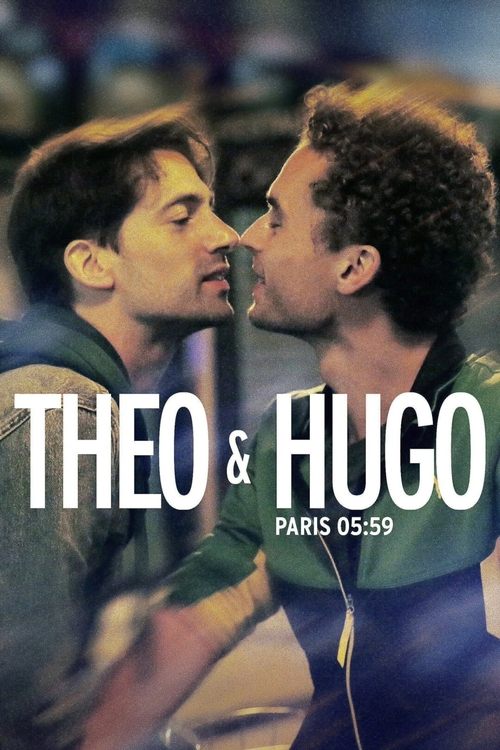
Paris 05:59 / Théo & Hugo
A single Paris night distilled: bodies meeting in red darkness, then two strangers pedalling through empty streets as an unwanted truth turns desire into tenderness before sunrise.
Paris 05:59 / Théo & Hugo

Paris 05:59 / Théo & Hugo

Théo et Hugo dans le même bateau

27 April 2016 France 97 min 6.7 (129)

Director: Olivier Ducastel, Jacques Martineau

Cast: Geoffrey Couët, François Nambot, Georges Daaboul, Elodie Adler, Claire Deschamps

Drama Romance Desire without shame Risk, HIV and responsibility Intimacy compressed into real time The nocturnal city and its strangers Choosing to stay

Overview

Paris, some time after four in the morning. In the strobing red half-light of a sex club, Théo and Hugo see each other across a room of anonymous bodies and, out of all that anonymity, choose each other. What begins as pure carnal attraction takes on a weight neither expected, and when they step out into the cold air of the street they are no longer two strangers who had sex but two people who cannot quite bring themselves to say goodnight.

The film then follows them in real time — the action begins at 4:27 a.m. and ends at 5:59 a.m. — through a Paris emptied of everyone but night workers, insomniacs and the odd passer-by. They cycle, they walk, they eat, they talk; they exchange the biographies that lovers usually trade over weeks, compressed into ninety minutes because something has happened that forces honesty on them immediately.

Directed and written by Olivier Ducastel and Jacques Martineau, it is at once an explicit erotic film, an unsentimental portrait of contemporary gay life and its medical realities, and an old-fashioned romance about the hours in which two people decide whether they are willing to be frightened together. The title's French original — Théo et Hugo dans le même bateau, "Théo and Hugo in the same boat" — states the film's proposition plainly.
Core Meaning

Ducastel and Martineau set out to show that desire and responsibility are not opposites. The film's structure is an argument: it begins with an extended, unsimulated sequence of anonymous sex and then refuses to punish it, instead letting that encounter grow — through a single continuous night — into intimacy, care and something that looks very much like love.

The central move is the reframing of an HIV-related crisis. Rather than treating serodiscordance as tragedy or moral verdict, the film treats it as information — something to be handled with medicine, a hospital visit, honest conversation and an unglamorous 4 a.m. bureaucracy. What the directors want to say is that in the era of post-exposure prophylaxis and effective treatment, the real test is not the virus but whether two people can stay in the same boat once fear enters it.

Underneath sits a quieter claim about time: given ninety uninterrupted minutes and nowhere else to be, strangers can become essential to one another. The real-time form insists that intimacy is not built over months but in the decision, taken again and again through a night, not to walk away.

Thematic DNA

Desire without shame 25%
Risk, HIV and responsibility 25%
Intimacy compressed into real time 20%
The nocturnal city and its strangers 15%
Choosing to stay 15%

Desire without shame

The film opens in a sex club and stays there, wordlessly, for roughly twenty minutes — bodies, looks, the slow narrowing of a crowd to two people. The directors shoot cruising not as sordid prelude but as a legitimate way of meeting, and everything romantic that follows is presented as having grown out of that encounter rather than in spite of it.

Théo and Hugo never apologise for wanting each other, and the film never asks them to.

Risk, HIV and responsibility

The night turns when it becomes clear that they had unprotected sex and that Hugo is HIV-positive. The film follows the consequences with almost documentary literalism: the emergency room, the questions, the antiretroviral treatment Théo must begin immediately as post-exposure prophylaxis.

Crucially, blame is dispersed rather than assigned. Hugo carries guilt he does not entirely owe; Théo carries a fear he has to learn to name. The theme is not contagion but what people owe each other after a moment of forgetting.

Intimacy compressed into real time

From 4:27 to 5:59 a.m., there are no ellipses. Conversations run their awkward length; silences are not cut around. The two men interrogate each other about family, work, past lovers, the future — the whole apparatus of getting to know someone, forced into a single unbroken stretch because the crisis has removed the option of small talk.

The nocturnal city and its strangers

Paris between four and six in the morning belongs to a different population: hospital staff on night shift, kebab-shop workers, cleaners, insomniacs on the métro. Théo and Hugo pass through this parallel city, and each encounter briefly widens the film beyond the couple, situating their private emergency inside a working, multi-ethnic, sleepless metropolis.

Choosing to stay

Every twenty minutes the film offers both men an exit — the club door, the bike ride home, the hospital corridor, the dawn. The drama is entirely in their refusal to take it. Romance here is defined not as falling but as remaining, deliberately, once the romantic haze has been replaced by paperwork and fear.

Character Analysis

Théo

Geoffrey Couët

Archetype: The impulsive romantic / hero of the night Key Trait: Impulsive tenderness

Motivation

To hold on to the extraordinary thing that happened in the club rather than let it dissolve into another anonymous night; and, once frightened, to not be alone with the fear.

Character Arc

He enters as pure appetite — the one who initiates, who wants, who does not calculate. The discovery that he has been exposed to HIV strips that lightness away and forces him through fear, anger and the unlovely mechanics of emergency treatment. By dawn he has moved from wanting Hugo to choosing him, with full knowledge of the cost.

Hugo

François Nambot

Archetype: The wounded guide / mentor in survival Key Trait: Guilty lucidity

Motivation

To do right by someone he has just met, and to test whether his status makes him unlovable — a question the night finally answers.

Character Arc

Living with HIV and long practised at managing it, Hugo begins as the more composed of the two and becomes the more exposed. He must confess, absorb blame that is only partly his, and steer Théo through a medical system he knows too well — all while risking that honesty will end the encounter. His arc runs from guilt toward the fragile permission to be loved.

Symbols & Motifs

The red light of the club

Meaning:

Pure appetite: a space outside language, identity and consequence, where faces matter less than bodies. Its saturated red is both womb-like and infernal — desire before it has to explain itself.

Context:

The film's long opening sequence is bathed in it; every subsequent scene is lit by streetlamps, neon, fluorescent hospital tubes or the first grey of dawn. The palette shift is the narrative.

The bicycles

Meaning:

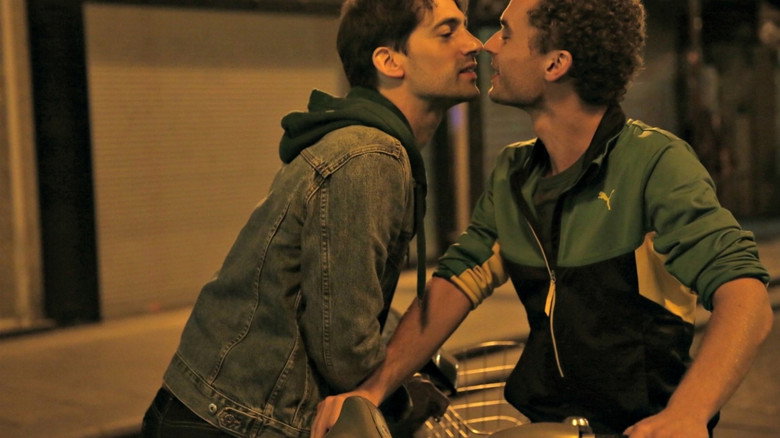
Motion, exposure and equality. Two people side by side, moving under their own effort through a city that belongs to nobody at that hour — the opposite of the static, enclosed club.

Context:

They ride together through empty streets after leaving the club, in the film's first sustained image of the pair as a couple rather than as lovers.

The hospital

Meaning:

The intrusion of the real. Institutional light, forms, questions and pills stand for everything the erotic encounter had suspended, and the film's insistence that care is unromantic and therefore trustworthy.

Context:

The emergency-room sequence, where Théo begins post-exposure prophylaxis, occupies the film's centre and functions as its true love scene: the moment they are seen as a pair by the outside world.

The clock — 04:27 to 05:59

Meaning:

Finitude. The film is a countdown to dawn, and the title fixes its last minute in advance, making every scene an expenditure of a fixed, shrinking resource.

Context:

Times are foregrounded by the international title Paris 05:59 and by the strict real-time construction; the story simply stops when the clock reaches the title.

The boat of the French title

Meaning:

Shared fate. Être dans le même bateau — to be in the same boat — turns a medical asymmetry between two men into a common situation they either navigate together or not at all.

Context:

Present only in the original French title, Théo et Hugo dans le même bateau, which reframes the whole plot as a question of solidarity rather than of infection.

Dawn

Meaning:

Ambiguous renewal: the end of the night's suspended state and the beginning of ordinary life, where whatever they have decided must survive daylight.

Context:

The light rises steadily across the film's second half, until the final minutes are played in the pale, exposed clarity of early morning.

Philosophical Questions

Can anonymous desire be a legitimate origin for love?

The film stakes everything on this. It refuses the conventional hierarchy in which "real" relationships begin with conversation and cruising is a lesser mode. By showing the club encounter in full and then letting it flower into care, it argues that intimacy has no privileged starting point — only a subsequent willingness to continue.

What do we owe a stranger after a moment of shared recklessness?

Neither man has any prior claim on the other. The night tests whether obligation can be generated in an instant: Hugo's duty to disclose, Théo's decision not to flee, the hospital's impersonal duty of care. The film suggests ethics begins not in relationship but in exposure, in both senses.

Does a medical fact define who a person is?

Hugo's serostatus threatens to become his whole identity in the moment he names it. The remaining hours of the film work to dissolve that reduction — through biography, humour, appetite and argument — until the diagnosis is one fact among many rather than the thing he is.

Is love a feeling or a decision made repeatedly under pressure?

Structurally the film is a chain of exits not taken. Because it unfolds without ellipsis, we watch each choice to stay in real time, and the accumulation of those choices — not any declaration — constitutes whatever exists between them by 5:59.

What does the finitude of a night teach about the finitude of a life?

Borrowing Varda's clock, the film makes time visible and scarce. Knowing in advance when it will end, the viewer measures every digression against the shrinking remainder — a small rehearsal of mortality that gives ordinary conversation an unexpected charge.

Alternative Interpretations

As an optimistic manifesto. The most common reading takes the film at its word: a serodiscordant couple is possible, medicine works, and love survives disclosure. On this view the dawn ending is straightforwardly hopeful and the film is a corrective to decades of queer cinema in which HIV meant death.

Full ending explanation

Cultural Impact

The film arrived at a moment when European queer cinema was renegotiating how to depict gay sexuality after the arrival of PrEP and post-exposure prophylaxis. By opening with an extended, explicit and unsimulated club sequence and then pivoting into a talky, tender, medically literal drama, it made a case that hardcore imagery and moral seriousness are compatible — a position that became a reference point in debates about explicitness in art cinema.

Its Berlinale reception sealed that status: a Panorama Audience Award and the Teddy audience prize marked it as a crowd film as much as a critics' film, and it went on to a substantial international festival run and favourable notices. Within the wider conversation, it belongs beside other mid-2010s works that put HIV and gay community history back on screen for a generation that had not lived the worst of the epidemic.

Culturally, its most durable contribution may be the emergency-room sequence, one of the few mainstream depictions of what actually happens when someone seeks PEP: the questions, the waiting, the immediate start of treatment. For many viewers the film functioned as practical information as much as drama — an unusual role for a romance.

Audience Reception

Reception was broadly favourable, and unusually warm among festival audiences: the film took both the Panorama Audience Award for Best Narrative Feature and the Teddy audience prize at the 2016 Berlinale, prizes voted by viewers rather than juries. Critics repeatedly praised its emotional rawness and immediacy, the naturalism of the two leads, and its willingness to be frank and graceful at once about gay desire.

The most discussed element is the opening: an explicit, unsimulated, near-wordless twenty-minute sex sequence that some viewers found among the boldest and most beautiful shot in recent gay cinema, and others found a barrier to entry — a stretch of hardcore imagery that shapes who will ever see the rest of the film. The abrupt tonal shift from that sequence into dialogue-driven drama also divided opinion, read by admirers as the film's whole point and by detractors as two films stitched together.

Secondary criticisms cluster around the talkiness of the second half, the occasional sense that the characters articulate themselves more fluently than exhausted strangers would at 5 a.m., and the schematic neatness of the setup. Against that, viewers living with HIV or working in sexual health frequently singled out the emergency-room scenes for their accuracy and for treating post-exposure prophylaxis as ordinary medicine rather than melodrama.

Overall verdict: a small, formally disciplined film that earns its explicitness, valued less as a provocation than as one of the more humane contemporary portraits of desire and serodiscordance.

Interesting Facts

  • The film unfolds in real time: the action begins at 4:27 a.m. and concludes at 5:59 a.m., the time given in the international title Paris 05:59.
  • The real-time conceit and the time-stamped title are an explicit nod to Agnès Varda's French New Wave classic 'Cléo de 5 à 7'.
  • The original screenplay was very different: it did not open with a twenty-minute sex scene, and the story was spread across 28 days rather than a single night.
  • Olivier Ducastel and Jacques Martineau, who have co-written and co-directed together for years, deliberately stepped outside the traditional French financing system after struggling to fund their previous films, setting out to make a film that could be shot with almost no money.
  • The production was mounted with limited means and a very small technical crew, which is part of why the film is confined to a handful of night locations.
  • Lead actors Geoffrey Couët and François Nambot agreed to perform non-simulated sex scenes in the opening sequence.
  • The film premiered in the Panorama section of the 2016 Berlin International Film Festival, where it won the Panorama Audience Award for Best Narrative Feature.
  • It also took the Teddy Award audience prize at the 2016 Berlinale, the festival's long-running honour for queer cinema.
  • The film was released internationally under the title 'Paris 05:59: Théo & Hugo', with distributors foregrounding the clock rather than the French idiom 'dans le même bateau' ('in the same boat').

Easter Eggs

The time-bracketed structure and title echo Agnès Varda's 'Cléo de 5 à 7' (1962).

The directors have acknowledged the reference explicitly. Varda's film follows a woman in near-real time as she waits for medical test results that may reveal she has cancer; Ducastel and Martineau transpose that structure onto a gay Paris night and an HIV exposure, placing their film inside a French New Wave lineage of clock-driven, city-walking cinema while updating its anxiety for a new era.

Frequently Asked Questions

Explore More About This Movie

Dive deeper into specific aspects of the movie with our detailed analysis pages

Comments (0)

Leave a comment

No comments yet. Be the first to share your thoughts!

Similar Movies