Skip to content
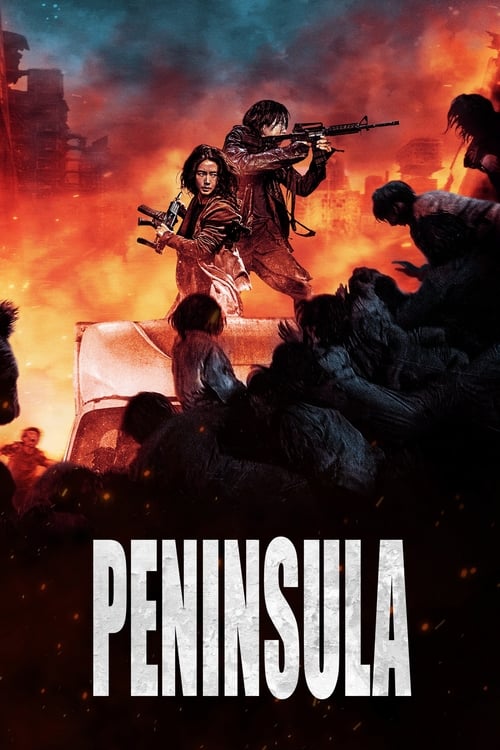
Peninsula
A neon-drenched post-apocalyptic action thriller dripping with claustrophobic dread and relentless velocity, where a shattered soul navigates a dead city's purgatory to trade haunting guilt for spiritual redemption.
Peninsula

Peninsula

반도

"Escape the apocalypse."

15 July 2020 South Korea 116 min 6.7 (2,618)

Director: Yeon Sang-ho

Cast: Gang Dong-won, Lee Jung-hyun, Lee Re, Kwon Hae-hyo, Kim Min-jae

Action Thriller Adventure Horror Guilt, Trauma, and Spiritual Redemption Dehumanization vs. Preserving Humanity Refugee Stigma, Isolation, and Social Alienation The Illusion of Wealth and Capitalist Nihilism Resilience of Youth and Found Family
Budget: $17,000,000
Box Office: $42,698,327

Overview

Four years after the catastrophic zombie outbreak that crippled South Korea in Train to Busan, the entire Korean Peninsula has been completely quarantined and abandoned by the international community. Former Marine Captain Jung-seok, having escaped to Hong Kong, lives as an impoverished refugee consumed by guilt after failing to save his sister and young nephew during the initial evacuation. Desperate to escape their grim, marginalized existence abroad, Jung-seok and his surviving brother-in-law Chul-min accept a high-risk covert job from Hong Kong triad gangsters. The mission requires them to infiltrate the ruined, zombie-infested wasteland of Incheon, locate an abandoned food truck containing $20 million in U.S. cash, and drive it back to the docks within three hours.

Upon returning to the pitch-black, decaying cityscape, the retrieval team quickly discovers that the undead—who become blind in darkness but remain hypersensitive to light and sound—are not the only threat lurking in the shadows. The team is ambushed by Unit 631, a rogue military militia turned feral, who patrol the ruins and treat surviving civilians as playthings in brutal arena games. Rescued from the brink of death by two resourceful young sisters, Jung-seok aligns with their fierce mother, Min-jung, initiating a high-octane battle against both human warlords and swarming zombie hordes to secure the cash truck and reach an extraction point.

Core Meaning

Director Yeon Sang-ho utilizes Peninsula to explore how human morality, empathy, and social structures endure—or collapse—when societal systems disappear. While Train to Busan critiqued corporate selfishness during the onset of a crisis, Peninsula examines the psychological aftermath of long-term trauma, isolation, and abandonment.

The film contrasts the moral decay of Unit 631 (who succumb to nihilism and savagery when left without hope) against the fierce humanity maintained by Min-jung’s family. Yeon Sang-ho demonstrates that true "home" or salvation is not defined by geographical safety or physical wealth, but by human connection, selflessness, and the willingness to sacrifice for others. Furthermore, through the depiction of Korean refugees facing xenophobia and prejudice in Hong Kong, the film offers a poignant commentary on global apathy toward displaced victims of catastrophe.

Thematic DNA

Guilt, Trauma, and Spiritual Redemption 30%
Dehumanization vs. Preserving Humanity 25%
Refugee Stigma, Isolation, and Social Alienation 20%
The Illusion of Wealth and Capitalist Nihilism 15%
Resilience of Youth and Found Family 10%

Guilt, Trauma, and Spiritual Redemption

Central to Jung-seok's narrative arc. His lingering trauma over refusing to help a stranded mother (Min-jung) and failing to save his own family four years earlier drives his stoic apathy. His redemption comes through risking his life to ensure Min-jung and her daughters escape.

Dehumanization vs. Preserving Humanity

Represented by the stark contrast between Unit 631 and Min-jung's family. Unit 631 surrenders to savagery, holding gladitorial human-versus-zombie matches, whereas Min-jung raises her children with compassion, playfulness, and moral dignity despite living in hell.

Refugee Stigma, Isolation, and Social Alienation

The opening and ending sequences highlight how South Korean survivors are treated as second-class citizens and bio-threats in foreign countries. The entire Korean Peninsula functions as a geopolitical prison forgotten by the outside world.

The Illusion of Wealth and Capitalist Nihilism

The catalyst for the plot—$20 million in paper cash—is ultimately worthless in a post-apocalyptic wasteland. Characters driven purely by greed (the triad bosses, Sergeant Hwang, Captain Seo) meet gruesome deaths, proving that material wealth cannot buy genuine salvation.

Resilience of Youth and Found Family

Min-jung’s daughters, Jooni and Yu-jin, adapt to the wasteland not as broken victims, but as capable, spirited survivors who rebuild hope and trust among adults.

Character Analysis

Jung-seok

Gang Dong-won

Archetype: Traumatized Antihero undergoing redemption Key Trait: Tactical military precision combined with a deeply buried conscience.

Motivation

Escaping poverty, alleviating survivor's guilt, and protecting Min-jung’s family.

Character Arc

Begins as an emotionally numb, guilty ex-soldier living in apathy. Through rescuing Min-jung and her daughters, he regains his moral conviction and willingness to sacrifice himself for others.

Min-jung

Lee Jung-hyun

Archetype: Protective Mother / Fierce Survivor Key Trait: Unshakeable maternal resolve and tactical adaptability.

Motivation

Ensuring the survival and eventual escape of her two young daughters.

Character Arc

Having survived four years stranded in Incheon, she has transformed into an expert survivalist. She teaches Jung-seok that living with hope and humanity is worth fighting for.

All 5 characters and cast

Symbols & Motifs

Remote-Controlled (RC) Light-Up Cars

Meaning:

Symbolize childhood innocence adapted into tactical survival tools.

Context:

Yu-jin uses bright, noisy toy cars to trick and divert sound/light-obsessed zombie hordes, turning a symbol of play into a life-saving mechanism.

The $20 Million Cash Truck

Meaning:

Symbolizes the false promise of salvation and the corrupting nature of greed.

Context:

It serves as a literal Trojan horse that brings destruction to whoever seeks to claim it.

Unit 631’s Gladiatorial Arena ("The Cage")

Meaning:

Symbolizes the complete collapse of human ethics into Roman-style barbarism.

Context:

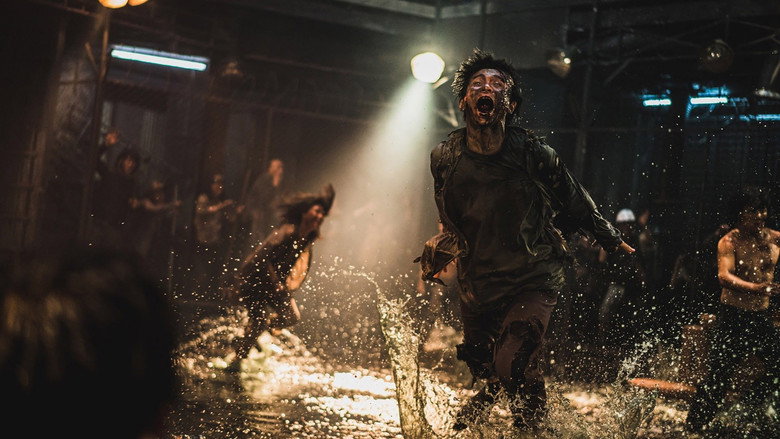
Unarmed captives marked with numbers on their chests are forced to run from zombies for sixty seconds while soldiers gamble and cheer.

Headlights, Flares, and Darkness (Light/Sound Motif)

Meaning:

A dual motif representing both lethal hazard and tactical advantage.

Context:

Because zombies are dormant and blind in total darkness, artificial light and sudden sound act as beacons of death or tools for distraction.

The Satellite Phone

Meaning:

Symbolizes the fragile link to global civilization.

Context:

It becomes the primary catalyst for betrayal within Unit 631, driving Captain Seo to murder his own allies to secure single ownership.

Memorable Quotes

너 시도는 해봤냐? 정석아 너도 괴롭잖아. 그냥 포기해버렸으니까.
— Chul-min (Kim Do-yoon)

Context

Spoken in Hong Kong when discussing the heist proposal.

Meaning

It confronts Jung-seok’s emotional apathy and establishes the film's core exploration of guilt versus effort.

살고 싶으면 타요!
— Jooni (Lee Re)

Context

Spoken when Jooni rescues Jung-seok from a zombie horde in her armored SUV.

Meaning

It subverts traditional action tropes by having a young teenage girl rescue a veteran soldier.

All 4 quotes

Philosophical Questions

Is human ethics an inherent trait or merely a luxury of structured society?

Explored through Unit 631's rapid descent into barbarism when abandoned without social institutions.

What defines true home and salvation?

Explored through Jooni and Elder Kim, who demonstrate that happiness is defined by human love rather than physical locations.

Can severe survivor's guilt be redeemed through sacrifice?

Explored through Jung-seok’s choice to risk his life for strangers to break his cycle of regret.

Alternative Interpretations

The Geopolitical Reading: The isolated, abandoned Peninsula serves as a metaphor for Korea's history of foreign occupation, national division, and geopolitical abandonment by major global powers.

Full ending explanation

Cultural Impact

Released in 2020 amid real-world pandemic shutdowns, Peninsula took on an unintended prescience. Its depiction of quarantined populations, closed borders, and social stigma against refugees resonated strongly with global audiences navigating isolation.

In South Korean cinema, the film marked an ambitious push into visual CGI-heavy blockbusters, blending Hollywood post-apocalyptic tropes with Korean emotional melodrama (sinpa). While it received mixed reviews compared to the critical acclaim of Train to Busan, it was praised for its technical ambition, set design, and vehicular action.

Audience Reception

Praised Aspects: Spectacular, fast-paced vehicular car chases; Lee Re’s standout performance as Jooni; impressive atmospheric production design; dynamic performances by Koo Kyo-hwan and Gang Dong-won.

Main Points of Criticism: Over-reliance on visual CGI car effects compared to practical stunts; loss of the tight, claustrophobic survival horror tension present in Train to Busan; melodramatic pacing during the climactic scene.

Overall Verdict: Regarded as an entertaining, action-packed standalone sequel that succeeds as a blockbuster action flick, though it trades its predecessor's intimacy for scale.

Interesting Facts

  • Peninsula was selected for the official line-up of the 2020 Cannes Film Festival, continuing the legacy of Train to Busan.
  • Production designer Lee Mok-won constructed a massive 250-meter-long post-apocalyptic outdoor set representing destroyed Incheon highways, filled with weathered vehicles, dirt, and overgrown vegetation.
  • Drawing from his roots as an animation director (The King of Pigs, Seoul Station), Yeon Sang-ho designed complex car chases using extensive Previs (pre-visualization) animation to plan camera angles before shooting.
  • Released in July 2020 during the COVID-19 pandemic, Peninsula was one of the first major global theatrical releases, grossing over $42 million worldwide and reigniting Asian box offices.
  • Yeon Sang-ho intentionally chose not to make a direct continuation with original characters, expanding the "Busan-verse" into a distinct heist/action-thriller genre shift.

Easter Eggs

Unit 631 Historical Reference

The unit's designation "631" is a sinister reference to Japan's WWII biological warfare test group Unit 731, symbolizing institutionalized cruelty and human experimentation.

Mad Max Homage

The vehicular chase sequences, crash-zoom camera framing, modified armored cars, and feral militia culture heavily reference George Miller’s Mad Max 2: The Road Warrior and Mad Max: Fury Road.

Terminator Reference

Jooni’s rescue line "If you want to live, get in!" is a direct homage to the classic line from James Cameron's The Terminator franchise.

George A. Romero’s Land of the Dead

Unit 631’s subterranean zombie fight arena pays direct homage to the gladiatorial zombie pits in Romero’s Land of the Dead (2005).

Manga/Anime Influences

Yeon Sang-ho cited Katsuhiro Otomo's post-apocalyptic manga Akira and Minetaro Mochizuki's Dragon Head as visual blueprints for a ruined city overrun by rogue survivor factions.

Frequently Asked Questions

Explore More About This Movie

Dive deeper into specific aspects of the movie with our detailed analysis pages

Comments (0)

Leave a comment

No comments yet. Be the first to share your thoughts!

Similar Movies