Skip to content
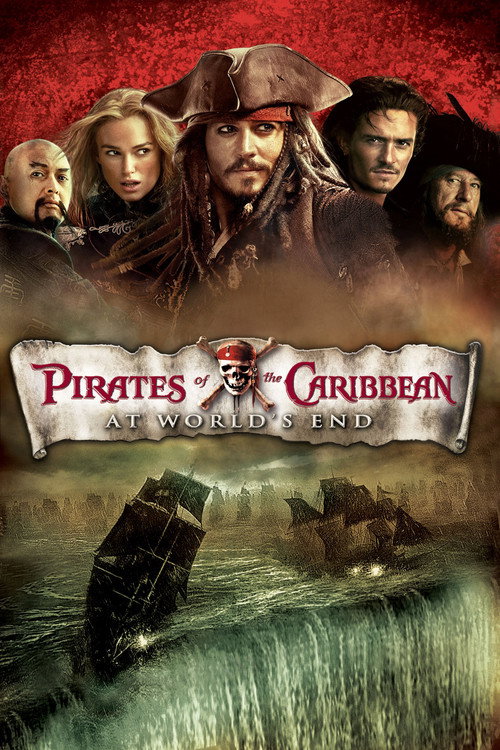
Pirates of the Caribbean: At World's End
A storm-lashed swashbuckling epic of rebellion and farewell, where lantern-lit pirates sail off the edge of the map and a whirlpool becomes the final stage for love, betrayal and a dying age.
Pirates of the Caribbean: At World's End

Pirates of the Caribbean: At World's End

"At the end of the world, the adventure begins."

19 May 2007 United States of America 169 min 7.3 (15,955)

Director: Gore Verbinski

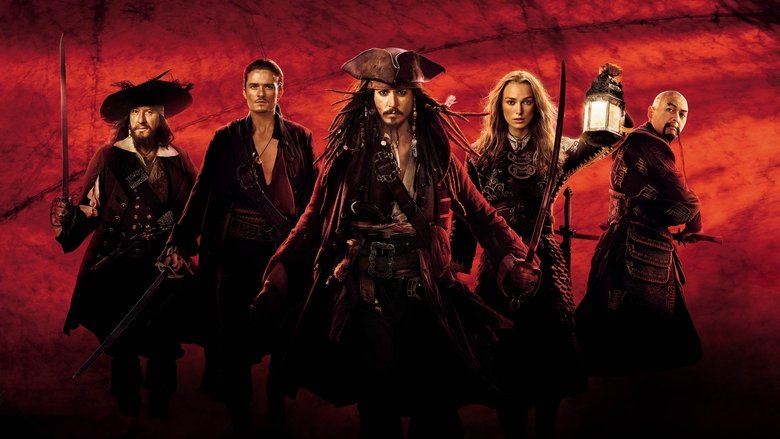
Cast: Johnny Depp, Geoffrey Rush, Orlando Bloom, Keira Knightley, Jack Davenport

Fantasy Action Adventure Freedom versus order Betrayal and shifting loyalties Love and sacrifice Death, return and the end of an age Madness and self-interest
Budget: $300,000,000
Box Office: $961,691,209

Overview

The third Pirates of the Caribbean film, directed by Gore Verbinski, opens with the pirate world under siege. Lord Cutler Beckett and the East India Trading Company are hunting pirates to extinction. Jack Sparrow is stuck in Davy Jones' Locker, and a strange alliance forms to bring him back.

The rescue party includes Barbossa, Will Turner, Elizabeth Swann, Tia Dalma and the surviving crew of the Black Pearl. Their search takes them to Singapore, where Pirate Lord Sao Feng holds the charts to the Locker. The East India Company attacks there, and the trip becomes a larger fight over who will control the seas.

The film moves through shifting allegiances, the Brethren Court of nine Pirate Lords, and a larger war between free piracy and corporate empire. It has comic and spooky set pieces, and a long finale at sea. It was the longest of the series and was originally meant to be its last chapter.
Core Meaning

The film is an elegy for freedom in a world that is being mapped, taxed and regulated. Beckett's Company stands for order, commerce and law, and the pirates stand for chaos and individual liberty. Barbossa's line that the world used to be a bigger place states the central feeling. The frontier is closing, and the free life survives only through alliance, sacrifice and myth.

The film also argues that freedom has a price. Characters who put self-interest first must choose to commit to something larger, and love and loyalty cost them real separation. Betrayal is everywhere, but the story still rewards those who honour a bond.

Thematic DNA

Freedom versus order 30%
Betrayal and shifting loyalties 25%
Love and sacrifice 20%
Death, return and the end of an age 15%
Madness and self-interest 10%

Freedom versus order

The East India Trading Company wants to hang or control every pirate and turn the sea into a trade lane. The pirates, however chaotic, defend an open world.

Betrayal and shifting loyalties

Sao Feng, Beckett, Barbossa and Jack all double-cross allies for advantage. Every alliance is provisional, and the film asks what makes one binding.

Love and sacrifice

Will and Elizabeth marry in the middle of battle, and the price is a separation of ten years. Davy Jones' bitter, broken love for Calypso mirrors them.

Death, return and the end of an age

Jack and Barbossa have returned from the dead. The Locker and the Dutchman's duty of ferrying souls make death a place to be navigated rather than a final end.

Madness and self-interest

Jack's selfish, unstable cunning is treated as a survival skill, and the film asks whether it can serve a cause.

Character Analysis

Captain Jack Sparrow

Johnny Depp

Archetype: Trickster antihero Key Trait: Chaotic cunning

Motivation

Freedom, the Black Pearl and survival.

Character Arc

Jack is rescued from the Locker, haunted by the visions it left him with, and torn between running and helping. He ends up on his own again, pursuing a new adventure.

Captain Hector Barbossa

Geoffrey Rush

Archetype: Scheming rival turned reluctant leader Key Trait: Pragmatic opportunism

Motivation

Saving piracy while securing the Pearl and his own position.

Character Arc

Barbossa pushes for the Brethren Court, schemes against Jack, and ends up leading the pirate fleet in a war he can't dodge.

All 5 characters and cast

Symbols & Motifs

The edge of the world and the Locker

Meaning:

The limit of the known map and the border between life and death.

Context:

The crew must be 'lost' to find the Locker. The ship sails over a waterfall at the edge of the world, and the Locker is shown as a surreal white desert.

The maelstrom

Meaning:

Rage, chaos and the pirates' last stand, with the sea itself as a force of nature.

Context:

Calypso's fury creates the whirlpool where the Black Pearl and the Flying Dutchman duel in the climax.

Davy Jones' heart and the chest

Meaning:

Emotion locked away and set aside out of pain. The film also treats duty and love as heavy.

Context:

Jones cut out his heart after Calypso's betrayal and hid it in a chest. Control of the heart means control of the Dutchman.

The Pirate Code and the Brethren Court

Meaning:

Pirate democracy, a fragile law among outlaws.

Context:

The Pirate Lords meet at Shipwreck Cove, argue the rules, and vote on whether to fight.

Jack's compass

Meaning:

Desire and the idea that what a person wants most may not be where he thinks.

Context:

The compass points to what its holder wants most, and Jack tells Beckett it points to Jack dead.

The Black Pearl

Meaning:

Freedom itself, and the thing every character wants to command.

Context:

Many characters, including Jack, Barbossa and Will, treat getting the Pearl as the goal.

Memorable Quotes

For certain, you have to be lost to find a place that can't be found, elseways everyone would know where it was.
— Captain Barbossa

Context

Said as the crew navigates toward the Locker.

Meaning

A paradoxical bit of pirate wisdom: to reach the unreachable you have to abandon what you know.

The world used to be a bigger place.
— Captain Barbossa

Context

Barbossa and Jack discuss summoning the Brethren Court.

Meaning

The film's elegiac statement. Jack replies that the world is the same and there is just less in it.

All 6 quotes

Philosophical Questions

Is freedom worth the price of chaos?

The pirates are selfish and treacherous but defend a world without the Company's control. The film leaves open whether freedom can be defended without order.

Can duty and love coexist?

Davy Jones abandoned his duty for love and was betrayed, and Will accepts duty at the cost of Elizabeth's company.

What does death mean when it can be reversed?

Jack and Barbossa return, and the Dutchman's crew exist between life and death, so the film treats mortality as a negotiation.

How It Ends

Alternative Interpretations

Some read the film as a political allegory of corporate power versus individual freedom, with Beckett's imperial bureaucracy as an analogue to modern authority. Others see it mainly as a farewell to the romantic age of adventure, in line with Barbossa's elegy. Some critics treat the tangle of betrayals as intentionally absurd, a war of all against all, while others see it as simply overstuffed. The ending can be read as tragic, because Will and Elizabeth are separated, or hopeful, because of the post-credits reunion.

Full ending explanation

Cultural Impact

The film arrived in 2007 as a huge summer blockbuster based on a Disneyland ride. It grossed about $963.4 million worldwide. Critics were mixed: it holds a 44% Rotten Tomatoes rating and 50 at Metacritic, and the most common complaint was a convoluted plot. Its imagery, including the maelstrom battle, Davy Jones' design and the Hoist the Colours scene, remains widely recognized, and it helped sustain the franchise through further sequels despite having been intended as the finale.

Audience Reception

Reviews were mixed. Audiences praised the scale, the spectacle, the maelstrom battle, Depp's performance, Davy Jones and the score. The most common criticism was that the plot is too convoluted to follow, with uneven pacing and a very long running time. Some found the film dark and overstuffed, and one reviewer called the war of all against all absurd. Others thought the central marriage mid-battle was rushed. Overall verdict: spectacular and ambitious but bloated.

Interesting Facts

  • The film was produced under the working title Pirates of the Caribbean III, with production beginning on February 28, 2005.
  • At 168-169 minutes depending on the source, it is the longest film in the series.
  • Producer Jerry Bruckheimer maintained that the long running time was needed to make the final battle work in terms of build-up.
  • The film was originally intended to be the final installment of the series.
  • Parts of the film were shot during the long location shoot for Dead Man's Chest, which finished on March 1, 2006.
  • The Singapore set was built on Stage 12 of the Universal backlot and had 40 structures in a tank 42 inches deep.
  • Filming finished on December 12, 2006 in Molokai; the first assembly cut was three hours, and twenty minutes were removed.
  • The special effects were finished in just five months.
  • Hans Zimmer composed eight new motifs for the score, including a new love theme.
  • The film cost an estimated $300 million and earned about $963.4 million at the box office.

Easter Eggs

Keith Richards plays Captain Teague, Jack's father, keeper of the Pirate Code.

Richards was a famous inspiration for Jack's mannerisms. The skull ring he wears in the scene is not a prop; he has worn it since a 1978 birthday gift.

The post-credits scene shows Elizabeth and her son watching the Flying Dutchman return after ten years.

It resolves the separation promised by Will's new duty as ferryman, with a hint of hope.

Frequently Asked Questions

Explore More About This Movie

Dive deeper into specific aspects of the movie with our detailed analysis pages

Comments (0)

Leave a comment

No comments yet. Be the first to share your thoughts!

Similar Movies