Skip to content
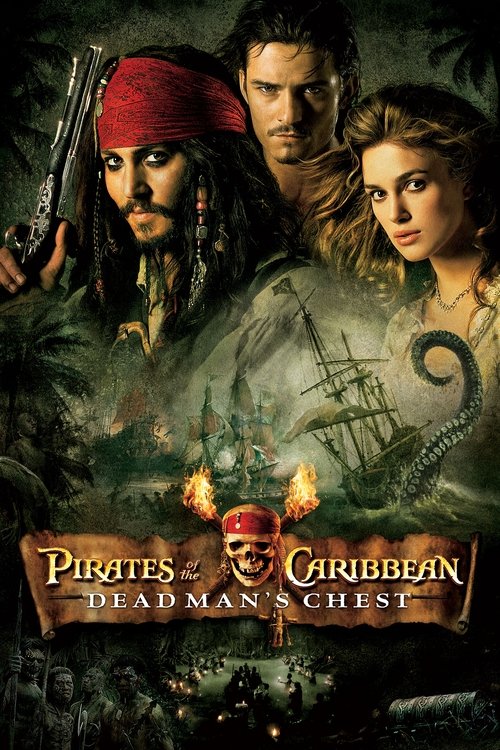
Pirates of the Caribbean: Dead Man's Chest
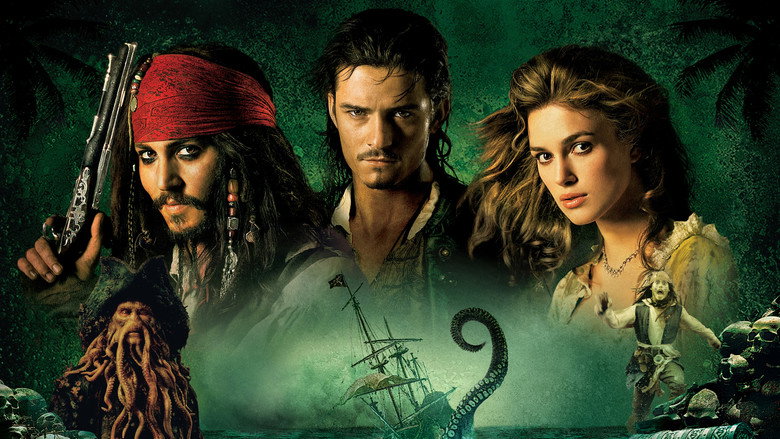
A sun-bleached, barnacled adventure where every debt comes due: dread and delight braided together like a tentacled beard, as a compass that points at desire drags three souls toward a chest that holds a beating heart.
Pirates of the Caribbean: Dead Man's Chest

Pirates of the Caribbean: Dead Man's Chest

"Captain Jack is back!"

06 July 2006 United States of America 151 min 7.4 (17,543)

Director: Gore Verbinski

Cast: Johnny Depp, Orlando Bloom, Keira Knightley, Jack Davenport, Bill Nighy

Fantasy Action Adventure Debt, bargains and the impossibility of escaping them Fate versus free will Love, loyalty and betrayal Moral ambiguity and the death of the clean hero The fear of death and the refusal to feel
Budget: $200,000,000
Box Office: $1,066,179,747

Overview

Set shortly after the events of The Curse of the Black Pearl, the film opens on a wedding that never happens. Lord Cutler Beckett of the East India Trading Company arrives in Port Royal with warrants for Will Turner and Elizabeth Swann, and offers Will a bargain: hunt down Captain Jack Sparrow and return with his peculiar compass, and the charges disappear. What looks like a simple errand is really the first link in a chain of bargains that will bind every character in the story.

Jack, meanwhile, is running. Thirteen years earlier he struck a deal with Davy Jones, captain of the Flying Dutchman, and the bill has come due — a debt collected in souls and enforced by a leviathan. Jack's only hope is a legend: a chest, buried on a forgotten island, containing something Davy Jones once cut out of himself. Whoever holds it holds the seas.

From a cannibal island to a Caribbean swamp where the mystic Tia Dalma reads futures in crab claws, Gore Verbinski's sequel widens the first film's world into a supernatural mythology of oaths, monsters and merciless commerce. Old enemies resurface with new agendas, loyalties bend under pressure, and by the final act nobody's motives are quite what they appeared to be — least of all Elizabeth's.
Core Meaning

At its heart, Dead Man's Chest is a film about debt — the moral kind. Its world runs on bargains: Beckett's contracts, Jones's hundred years before the mast, Jack's borrowed thirteen years, Will's promise to his father, Elizabeth's promise to Will. The film argues that freedom, the great pirate ideal of the first movie, is an illusion purchased on credit, and that every character is eventually presented with the invoice.

Verbinski also darkens the trilogy's moral palette deliberately. Where the first film had a clean line between heroes and cursed villains, here the villain is a ledger-keeping company man in a powdered wig, the monster is a heartbroken lover, and the "good" characters lie, manipulate and kill to survive. The message is that the heart is the price of power: Jones literally cut his out to stop feeling, Beckett wants it in a box so the sea can be run like a business, and Elizabeth discovers that saving everyone requires her to do something she can never take back.

Thematic DNA

Debt, bargains and the impossibility of escaping them 25%
Fate versus free will 25%
Love, loyalty and betrayal 20%
Moral ambiguity and the death of the clean hero 18%
The fear of death and the refusal to feel 12%

Debt, bargains and the impossibility of escaping them

Almost every scene is a negotiation. Beckett trades Will's freedom for Jack's compass; Jones claims Jack's thirteen years as captain of the Black Pearl and demands one hundred souls in three days; Jack tries to pay his debt with Will's life. Jones's own retort — "One soul is not equal to another" — is the film's economic thesis: souls are currency, but the exchange rate is rigged. Even the Kraken is essentially a collection agent.

Fate versus free will

Jack's compass doesn't point north; it points to what its holder wants most, which makes it useless to anyone who doesn't know their own heart — the film's cleverest device for turning desire into destiny. The theme is stated outright when Will insists "I choose my own fate" and Jones answers "Then it wouldn't be fate, would it?" Tia Dalma's prophecies, the Turner bloodline curse, and the recurring image of a compass needle spinning all ask whether the characters are steering or drifting.

Love, loyalty and betrayal

The love triangle between Jack, Will and Elizabeth is not romantic decoration — it is the mechanism of the plot. Will's devotion to Elizabeth is exploited by Beckett; Bootstrap Bill's love for his son condemns them both; Davy Jones's ruined love for Calypso is the origin of every monster in the film. The climax turns on a kiss that is simultaneously sincere and a weapon, making betrayal the ultimate expression of love's cost.

Moral ambiguity and the death of the clean hero

The sequel systematically compromises everyone. Jack condemns an innocent man to servitude and shrugs it off; Elizabeth commits murder-by-manipulation; Will lies to both of them; Norrington, once the incorruptible naval officer, is introduced as a filthy drunk in a Tortuga gutter. Only Beckett is consistent — because he has principles instead of a conscience.

The fear of death and the refusal to feel

Jones's taunt — "Do you fear death? Do you fear that dark abyss?" — is aimed at Jack but interrogates the audience. The Flying Dutchman's crew are men who chose eternal service over dying, and are slowly absorbed into the ship's coral and barnacles as punishment. Jones himself cut out his heart to stop grief; the film's monsters are all people who tried to opt out of mortality or emotion, and were deformed by the attempt.

Character Analysis

Captain Jack Sparrow

Johnny Depp

Archetype: Trickster / antihero Key Trait: Improvisational cowardice with an inconvenient conscience

Motivation

Self-preservation, and beneath it an almost metaphysical terror of death and the loss of his ship — the two things he cannot talk his way out of.

Character Arc

Begins as a fugitive improvising his way out of a debt he has spent thirteen years ignoring, and spends the film selling out everyone around him — including telling Jones he is "good with" condemning Will to eternal servitude. His arc is a slow, grudging turn toward conscience: he sails away from the doomed Pearl, then turns back. That flicker of decency is exactly what makes him vulnerable to Elizabeth in the final act.

Will Turner

Orlando Bloom

Archetype: Hero on a divided quest Key Trait: Stubborn integrity curdling into desperation

Motivation

To marry Elizabeth and to save his father — two promises the film makes mutually exclusive.

Character Arc

Coerced into hunting Jack to save Elizabeth, Will instead finds his father Bootstrap Bill fused to the Flying Dutchman and acquires a second, competing vow: to free him. Torn between fiancée and father, he hardens from earnest blacksmith into someone willing to scheme, steal and lie — and his defiant "I choose my own fate" is answered by the plot with steady irony.

All 5 characters and cast

Symbols & Motifs

The chest and the beating heart

Meaning:

Literalised emotion. The heart is vulnerability made portable — Davy Jones removed it so he would never again feel the grief and guilt of his betrayed love for the sea goddess Calypso. That it still beats inside a locked box says everything: you can bury feeling, but you cannot kill it.

Context:

Buried on Isla Cruces and pursued by Jack, Jones, Norrington and ultimately Beckett. The film's final shot of the object in the wrong hands transforms it from a personal wound into an instrument of empire.

Jack's broken compass

Meaning:

Desire as navigation. It points to what the holder wants most, so it fails precisely when a person is divided against themselves — a lie detector for the soul.

Context:

It spins uselessly for Jack when he can't admit what he wants, and works perfectly for Elizabeth once she stops pretending. Beckett wants it not for treasure but because a device that maps human wanting is the ultimate tool of control.

The Kraken

Meaning:

Inescapable consequence. Unlike a duel or a storm, it cannot be outwitted, only paid off or endured — the physical form of a debt collector.

Context:

It is preceded by the black spot on Jack's palm and the slow, dreadful tick of Jones's music box logic. Its attacks punctuate the film like deadlines.

The East India Trading Company's seal and letters of marque

Meaning:

Bureaucratic evil. Where the first film's villains were cursed skeletons, here the true threat is paperwork — commerce annexing the last free space on earth.

Context:

Beckett brands pirates with a hot iron and speaks of the sea in the language of assets and leverage; his warrants open the film and his possession of the heart closes it.

Barnacles, coral and the tentacled beard

Meaning:

Moral decay made flesh. The longer a man serves the Dutchman, the less human he is — the sea slowly digests those who sold themselves to it.

Context:

Bootstrap Bill's face is already half-claimed by the ship, showing Will exactly what awaits him; Jones is furthest gone of all, his organ-playing hands and cephalopod face signalling a man almost entirely converted into ocean.

The wedding dress and the interrupted wedding

Meaning:

Civilisation's promises broken. The dress recurs as an image of a future that keeps being deferred by the sea.

Context:

Elizabeth is arrested in the rain in her wedding gown in the opening; later a similar dress appears as an apparition to the superstitious crew, a ghost of the life she is steadily abandoning for piracy.

Memorable Quotes

Do you fear death? Do you fear that dark abyss? All your deeds laid bare, all your sins punished?
— Davy Jones

Context

Delivered to Jack aboard the Flying Dutchman as Jones presses him on his overdue debt, framing the film's central bargain.

Meaning

The trilogy's thesis statement about mortality. Jones offers immortality as a service contract, and the film's whole supernatural economy runs on the fact that men will trade anything — their bodies, their humanity — to avoid the abyss.

Life is cruel. Why should the afterlife be any different?
— Davy Jones

Context

Jones's dismissal of any appeal to mercy while dealing with a soul in his power.

Meaning

A one-line theology of the film's world: there is no redemptive justice at sea, only terms and enforcement. It also quietly explains Jones himself — a man who concluded that feeling anything was a design flaw.

All 6 quotes

Philosophical Questions

Can you escape suffering by removing your capacity to feel?

Davy Jones is the experiment: he cut out his heart to be rid of grief and guilt after his betrayal of the woman he loved. The film's answer is a resounding no — his rage, sadism and organ-playing melancholy are all the same wound in different clothes, and his scream over the empty chest proves that what he removed never actually left him. He didn't stop feeling; he only stopped being able to be healed.

Is a promise binding if it was made under duress or in ignorance?

Jack raised the Black Pearl not knowing the true price; Will signs on to the Dutchman to save his father; Elizabeth's engagement is pledged in one world and tested in another. The film refuses the comfortable exit: Jones's insistence that thirteen years is thirteen years regardless of mutiny suggests that in this universe consequences do not care about your intentions when you signed.

How many lives is one life worth?

The question is posed literally — Jones must collect one hundred souls, and rejects Will as a substitute for Jack with "One soul is not equal to another" — and then dramatised at the climax when Elizabeth trades one man for a boat full of people. The film stages the trolley problem on a sinking ship and declines to say whether she was right.

Does knowing what you truly want set you free or trap you?

The compass only works for those honest about their desire, which makes self-knowledge a navigational instrument. But every character who achieves that clarity — Norrington wanting his old life, Beckett wanting the sea, Elizabeth wanting survival — uses it to do something morally worse than what they were doing while confused.

Can freedom survive institutions?

Beckett doesn't hunt pirates with a fleet so much as with warrants, letters of marque and leverage. The film sets the ungovernable, mythic sea against a company that wants it inventoried, and quietly suggests that the pirates' greatest enemy is not the supernatural but the paperwork — that once the heart is in the ledger, freedom is a line item.

Alternative Interpretations

Was Elizabeth's kiss betrayal or heroism? The most argued-over moment in the trilogy. One reading holds that Elizabeth murders Jack in cold blood, exploiting his one moment of genuine courage — the fact that he came back — to save herself and the crew. Another holds it is the film's only truly heroic act: someone finally makes the hard sum that Jack has been dodging all film, and pays for it with guilt she carries into the sequel. A third reading, common among viewers who dislike it, sees the kiss as narratively convenient character assassination.

Full ending explanation

Cultural Impact

Commercially, it was a landmark. Released in July 2006, Dead Man's Chest shattered opening-weekend records with a US debut of roughly $135 million, finished with $423.3 million domestically and $1.066 billion worldwide, and became only the third film in history — after Titanic and The Lord of the Rings: The Return of the King — to join the billion-dollar club, reaching that mark faster than any film before it. It was the highest-grossing release of 2006 and confirmed that a theme-park ride could sustain a blockbuster franchise, accelerating Hollywood's shift toward IP-driven, back-to-back-shot sequel trilogies.

Technologically, its influence is still visible. ILM's work on Davy Jones won the 2006 Academy Award for Best Visual Effects and introduced iMocap, a portable on-set motion-capture system that let actors perform in costume on location instead of on a stage. That approach — a full digital character built on a photographed human performance shot alongside the rest of the cast — became a standard route to the modern performance-capture creature, and Davy Jones was quickly canonised, appearing on Entertainment Weekly's 2007 list of favourite CG characters.

Critically, it was the moment the franchise's reputation split from its receipts. Reviews were decidedly mixed — the film sits in the mid-50s on the Tomatometer — with praise for Depp's performance, Nighy's Jones and the set pieces, and complaints that the picture was overstuffed and overlong, lacking the easygoing, organic charm of the original. Culturally, it nonetheless cemented Jack Sparrow as one of the defining screen characters of the 2000s and made the tentacle-faced Jones an instantly recognisable Halloween and merchandising icon.

Audience Reception

The split verdict. Audiences turned out in unprecedented numbers — the record-breaking opening and $1.066 billion worldwide gross made it the biggest film of 2006 — while critics were far cooler, leaving the film in the mid-50s on the Tomatometer. The critical consensus was that for all its inventive effects and exciting set pieces there is simply too much in this chest, and that it lacks the loose, organic charm of The Curse of the Black Pearl.

Most praised: Bill Nighy's Davy Jones, almost universally singled out as a great screen villain whose humanity survives a full digital face; the Oscar-winning visual effects and the design of the Flying Dutchman's crew; the three-way sword duel on the runaway water wheel; Hans Zimmer's score; Depp's still-fresh comic timing; and Stellan Skarsgård's quietly heartbreaking Bootstrap Bill.

Most criticised: the near two-and-a-half-hour running time and cluttered plotting; the cannibal-island sequence, faulted both for padding and for its caricatured natives; Orlando Bloom's comparatively bland Will; and the decision to end on an unresolved cliffhanger, which many viewers experienced as half a film sold at full price.

Most divisive: Elizabeth's kiss and the chaining of Jack to the mast. It remains the franchise's most debated scene — celebrated by some as the moment she became genuinely interesting and condemned by others as an unearned betrayal of both characters. The resurrection of Barbossa in the final shot, by contrast, is one of the trilogy's best-loved crowd-pleasing moments.

Interesting Facts

  • Industrial Light & Magic won the 2006 Academy Award for Best Visual Effects for the film, largely on the strength of the fully digital Davy Jones.
  • To create Davy Jones, ILM invented a new motion-capture system called iMocap — a lightweight, robust rig that could be used on location — making this the first time actors had been motion-captured so freely on set during principal photography rather than in a dedicated volume.
  • Bill Nighy performed the role on set in a grey motion-capture suit covered in tracking dots, with markers on his face, so that his body movements and facial mannerisms could be transferred to the CG character in post-production.
  • Nighy dryly described the job as playing a man with an octopus growing out of his chin, which he noted had been outside his previous experience.
  • Davy Jones's tentacle beard was a major animation challenge: creature-development artists had to build custom controls so animators could drive each fleshy appendage as a living creature rather than as simple hair or cloth.
  • Stellan Skarsgård's Bootstrap Bill was the only member of the Flying Dutchman's crew realised with practical prosthetic makeup; the rest of the crew were computer-generated.
  • Director Gore Verbinski's brief for the crew was that they should look like humans partially eaten away and absorbed by sea creatures — hence the coral, barnacles and shells growing through them.
  • Davy Jones was named one of Entertainment Weekly's '10 Favorite CG Characters' in 2007.
  • The film opened to a then-record American debut of roughly $135 million and went on to earn $423.3 million domestically and $1.066 billion worldwide — at the time the fastest film ever to pass $1 billion, and only the third to reach that milestone after Titanic and The Lord of the Rings: The Return of the King.
  • It was the highest-grossing film of 2006 and is regularly listed among the most expensive movies ever made.

Easter Eggs

Johnny Depp's Keith Richards influence

Depp famously modelled Jack Sparrow's swaying gait and slurred grandeur partly on Rolling Stones guitarist Keith Richards. The joke was made canon after this film: Richards was cast as Jack's father, Captain Teague, in the third instalment — so Dead Man's Chest sits exactly on the fault line where an actor's private reference became franchise mythology.

The title's literary lineage

"Dead man's chest" comes from the pirate refrain popularised by Robert Louis Stevenson's Treasure Island"Fifteen men on a dead man's chest / Yo ho ho and a bottle of rum". The film turns a nonsense sea-shanty phrase into a literal MacGuffin: an actual chest, containing an actual heart.

The Flying Dutchman legend

Davy Jones and his ghost ship are drawn from centuries of real maritime folklore: "Davy Jones's Locker" as sailors' slang for the bottom of the sea, and the Flying Dutchman as the cursed vessel doomed never to make port. The film's innovation is fusing the two legends into a single character and giving him a broken love story as the cause.

Norrington's fall happens off-screen

His ruin is delivered entirely in a Tortuga tavern monologue about pursuing the Black Pearl into a hurricane — a whole tragic subplot compressed into dialogue, rewarding viewers who remember exactly how upright he was in the first film.

Frequently Asked Questions

Explore More About This Movie

Dive deeper into specific aspects of the movie with our detailed analysis pages

Comments (0)

Leave a comment

No comments yet. Be the first to share your thoughts!

Similar Movies