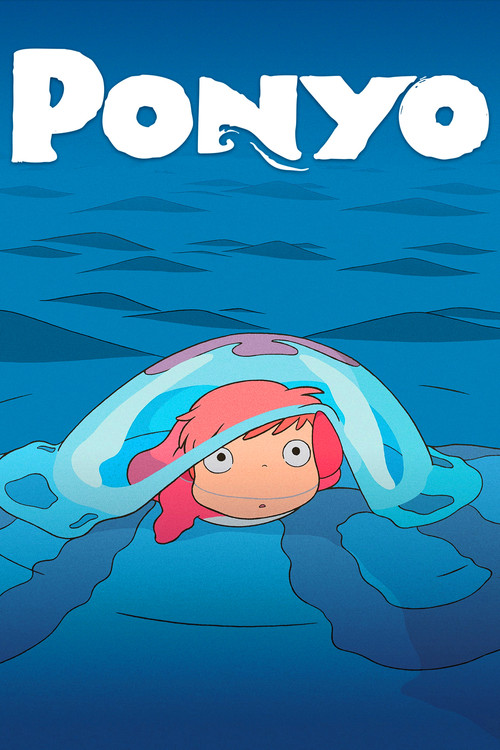
Ponyo
崖の上のポニョ
"Welcome to a world where anything is possible."
Overview
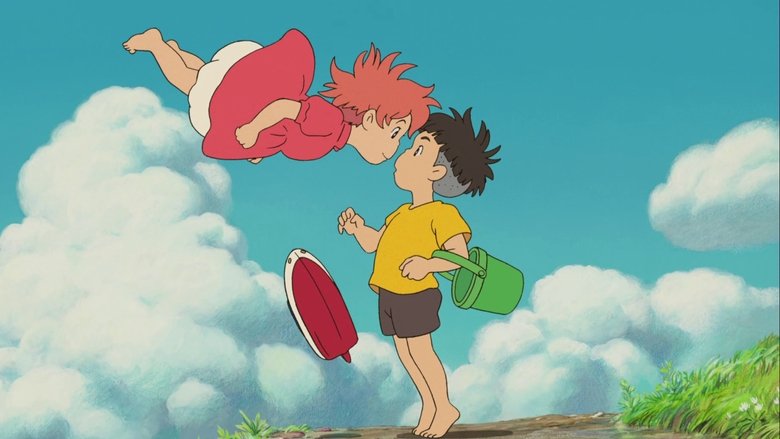
Ponyo tells the enchanting story of a goldfish princess named Brunhilde who, during a forbidden excursion to the surface world, meets a five-year-old human boy named Sosuke. After he rescues her from a glass jar and names her Ponyo, she develops a profound desire to become human to stay with him. This wish, fueled by her powerful magic, upsets the delicate balance of nature, triggering a massive storm and tsunami that floods Sosuke's seaside town.
As the ocean rises and ancient sea life returns, Ponyo transforms into a little girl and reunites with Sosuke. Together, they embark on a journey across the flooded landscape to find Sosuke's mother, Lisa. The film culminates in a test of Sosuke's love, overseen by Ponyo's sorcerer father Fujimoto and her sea-goddess mother Gran Mamare, to determine if Ponyo can remain human without throwing the world into chaos.
Core Meaning
At its heart, Ponyo is a celebration of the unconditional acceptance found in childhood love and the vital balance between humanity and nature. Miyazaki illustrates that love requires responsibility and that humans must learn to coexist with the natural world rather than dominate it. The film suggests that the purity of a child's promise has the power to bridge worlds and restore harmony.
Thematic DNA
Humanity vs. Nature
The film constantly juxtaposes the human world (represented by the cliffside town and trash in the ocean) with the magical underwater realm. The conflict is resolved not through battle, but through balance and integration, symbolized by the flood that brings ancient sea life to the surface.
Childhood Innocence and Promise
The plot hinges entirely on Sosuke's innocent promise to protect Ponyo. The film validates the seriousness of children's emotions, showing that a five-year-old's commitment can be as powerful and binding as any adult contract.
Metamorphosis and Evolution
Ponyo's physical transformation from fish to "chicken-legged" creature to human mirrors the evolutionary history of life emerging from the sea (the Devonian period). It celebrates the fluidity of life and the constant state of change.
Love as a Force of Nature
Ponyo's love for Sosuke is literalized as a destructive yet beautiful storm. The film depicts love not just as a gentle emotion, but as a powerful, sometimes chaotic force that can reshape the world.
Character Analysis
Sosuke
Hiroki Doi (Japanese) / Frankie Jonas (English)
Motivation
To protect Ponyo and find his mother, Lisa.
Character Arc
Sosuke starts as a responsible young boy and proves his maturity by keeping his promise to Ponyo. His journey is one of unwavering loyalty, passing the test that adults (like his father) might fail.
Ponyo (Brunhilde)
Yuria Nara (Japanese) / Noah Cyrus (English)
Motivation
To become human and be with Sosuke.
Character Arc
Ponyo moves from a curious fish to a determined human girl. She learns that becoming human requires giving up magic and accepting the natural order.
Lisa
Tomoko Yamaguchi (Japanese) / Tina Fey (English)
Motivation
To care for her son and the elderly people she works with.
Character Arc
Lisa represents a grounded, sometimes reckless, but deeply loving modern parent. She accepts the magical situation with remarkable adaptability, treating Ponyo like her own child.
Fujimoto
George Tokoro (Japanese) / Liam Neeson (English)
Motivation
To restore the balance of the ocean and protect his daughters.
Character Arc
He begins as a controller trying to keep Ponyo isolated, fearing humans will destroy the planet. He eventually learns to trust the next generation and let his daughter go.
Gran Mamare
Yuki Amami (Japanese) / Cate Blanchett (English)
Motivation
To ensure the cycle of life continues and her daughter finds happiness.
Character Arc
She serves as the calm, cosmic counterpoint to Fujimoto's anxiety. She facilitates the resolution by proposing the test for Sosuke.
Symbols & Motifs
The Ocean
The ocean represents both the source of life (the subconscious, the mother) and a destructive force. It is a living character that can be nurturing or overwhelming.
The water is animated to look like waving hands or giant fish, emphasizing its sentient nature throughout the film.
The Tunnel
A classic liminal space representing rebirth or a passage to the afterlife. It signifies a transition where the characters must face fear to reach the other side.
Sosuke and Ponyo must pass through a dark, scary tunnel during their boat journey. Ponyo reverts to fish form here, signaling a loss of power/identity before her final test.
Bubbles
Symbolize magic, protection, and fragility. They represent the barrier between the underwater world and the surface.
Fujimoto travels in a bubble; Ponyo is encased in one when she sleeps; and the final test involves a kiss inside a bubble to seal her humanity.
Toy Boat
Represents human ingenuity and navigation through life's changes. It is Sosuke's vessel for maturity.
Ponyo uses magic to enlarge Sosuke's pop-pop boat, turning a child's toy into a life-saving vehicle for their journey.
Memorable Quotes
Ponyo loves Sosuke! I will be a human, too!
— Ponyo
Context:
Ponyo shouts this after transforming into a human girl and running to Sosuke's house in the rain.
Meaning:
The central declaration of the film. It expresses the simple, powerful logic of childhood love that drives the entire plot.
I love Ponyo whether she's a fish, a human, or something in between.
— Sosuke
Context:
Sosuke answers Gran Mamare's question at the film's climax, sealing Ponyo's fate as a human.
Meaning:
This is the answer to the "test" of true love. It signifies total unconditional acceptance of the other person's nature.
Life is mysterious and amazing, but we have work to do now, and I need you both to stay calm.
— Lisa
Context:
Lisa says this to the children while preparing food during the storm/flood.
Meaning:
Captures Lisa's pragmatic worldview. She accepts the magic happening around them but prioritizes survival and duty.
I'd let a fish lick me if it'd get me out of this wheelchair.
— Yoshie
Context:
Said by one of the elderly women at the senior center when Sosuke visits with Ponyo.
Meaning:
A humorous foreshadowing of the healing power of the ocean/magic, which later allows the elderly residents to run freely.
Humans are disgusting! They take the life out of the sea!
— Fujimoto
Context:
Fujimoto grumbling while making his magical elixirs underwater.
Meaning:
Establish's Fujimoto's motivation and the environmental theme. He sees humanity as a plague on the ocean.
Philosophical Questions
Can humanity and nature truly coexist without one destroying the other?
The film presents a conflict where human pollution harms the sea (Fujimoto's view), but the solution isn't the removal of humans. Instead, it proposes a symbiosis where the magic of the sea (Ponyo) integrates into the human world, suggesting that balance requires a fundamental change in how we relate to nature—treating it as family rather than a resource.
What is the nature of true love?
Through the 'test' of Sosuke, the film posits that love is acceptance of change. Sosuke must love Ponyo regardless of her form. This challenges the conditional nature of many adult relationships and elevates the purity of a child's bond as the ideal form of love.
Alternative Interpretations
The Afterlife Theory: A widely discussed interpretation suggests that everyone in the town died in the tsunami. Proponents point to the fact that the town is underwater yet the water is crystal clear and breathable for the elderly residents, who can suddenly walk again (shedding their mortal ailments). The tunnel Sosuke and Ponyo travel through is seen as the passage to the afterlife (the Sanzu River). The final scene is thus a reunion of souls in a heaven-like realm. Miyazaki has not confirmed this, but the dreamlike, painless nature of the flood supports this reading.
The Environmental Warning: While cute, the film can be read as a apocalyptic warning. Ponyo's magic disrupts the moon's gravity, causing satellites to fall and tides to rise. It suggests that nature's power is indifferent to humanity and that we exist at its mercy, surviving only through adaptation and respect.
Cultural Impact
Ponyo was a massive commercial success, becoming the 4th highest-grossing film in Japan's history upon release. Culturally, it marked a return to pure hand-drawn animation for Studio Ghibli after they experimented with CGI in previous films. It resonated globally for its accessible, child-friendly narrative that still carried weighty environmental themes.
Critics praised its visual splendor, particularly the 'liquid' animation style of the waves, which has become iconic in animation history. The film helped cement Miyazaki's reputation in the West not just as a creator of complex epics (like Spirited Away) but also as a master of capturing the essence of childhood. It also sparked discussions about the representation of modern families, with Lisa being praised as a realistic, flawed, and strong single-mother figure.
Audience Reception
Ponyo is overwhelmingly loved for its visuals and charm, holding a 91% on Rotten Tomatoes. Praised aspects include the breathtaking animation of the water, the adorability of Ponyo, and the heartwarming relationship between the children. Criticism often focuses on the plot being 'too simple' or 'nonsense' compared to the complexity of Spirited Away or Princess Mononoke. Some western viewers initially found the dub voice of Ponyo (Noah Cyrus) slightly annoying, though it is generally accepted now. The verdict is that it is a masterpiece of visual art and a perfect entry point for younger children into Ghibli's world.
Interesting Facts
- The film features over 170,000 hand-drawn frames, a record for a Miyazaki film at the time, as he wanted to capture the ocean's fluidity without CGI.
- The character of Ponyo is loosely based on Hans Christian Andersen's 'The Little Mermaid', but with a happy ending and no soul-searching.
- Ponyo's real name, 'Brunhilde', is a reference to the Valkyrie from Richard Wagner's opera 'Die Walküre'.
- The name 'Ponyo' is an onomatopoeia Miyazaki created to describe the feeling of touching something soft and squishy.
- Sosuke is based on Miyazaki's own son, Goro Miyazaki, when he was five years old.
- The seaside town is inspired by Tomonoura, a real town in Setonaikai National Park in Japan, where Miyazaki stayed in 2005.
- The 'pop-pop boat' Sosuke uses is a real type of toy powered by a candle and a simple steam engine/diaphragm.
Easter Eggs
Happy As Can Be / Sanpo Song
When Lisa is cheering up Sosuke, she sings 'Happy as can be'. This is the melody and lyrics of the opening song 'Hey Let's Go' (Sanpo) from My Neighbor Totoro.
Koganei Maru Ship
The name of the ship Sosuke's father captains is the Koganei Maru. 'Koganei' is the city in Tokyo where Studio Ghibli's headquarters are located.
Totoro on the Fridge
There is a magnet on Lisa's refrigerator that clearly depicts a small Totoro sprite.
⚠️ Spoiler Analysis
Click to reveal detailed analysis with spoilers
Frequently Asked Questions
Explore More About This Movie
Dive deeper into specific aspects of the movie with our detailed analysis pages
Comments (0)
No comments yet. Be the first to share your thoughts!