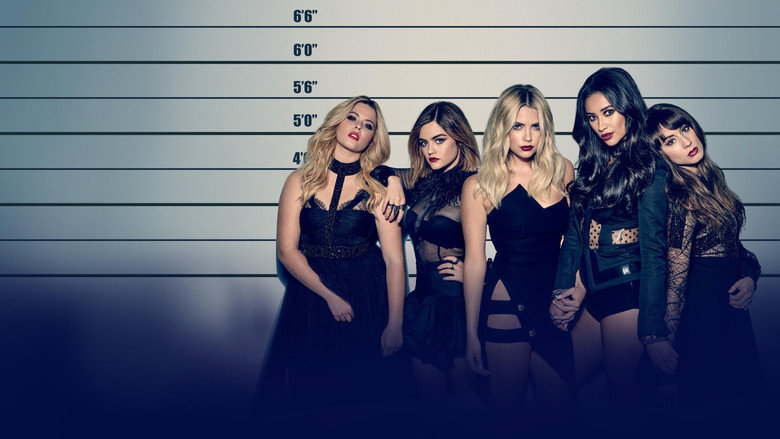

Season 1 — the premise. Alison DiLaurentis vanishes on a summer night; a year later her body is found and her four estranged friends begin receiving texts from \"A\", someone who knows secrets only Alison knew. The season establishes each Liar's vulnerability — Aria's relationship with her teacher Ezra Fitz, Hanna's shoplifting and eating disorder, Emily's closeted sexuality, Spencer's family fractures — and reveals that the girls, under Alison's direction, blinded Jenna Marshall in a prank, the original sin the whole series builds on.
Season 2 — the first unmasking. The masquerade-set finale UnmAsked reveals that \"A\" is Mona Vanderwaal, Hanna's best friend, a girl the clique bullied and dismissed. Her motive is revenge for exclusion, and the reveal recasts the entire first two seasons as the consequence of Alison's cruelty rather than her disappearance. Mona's confinement at Radley Sanitarium introduces the institution that will underwrite the rest of the mythology.
Season 3 — the second game. The hoodie passes to an organized \"A-Team\", and Mona becomes a partial ally. The season's engine is the discovery that Alison is alive — the body in her grave belongs to someone else.
Season 4 — Alison's version. In A is for Answers Alison finally recounts the night she disappeared: she was struck and buried by someone she trusted and rescued, then spent years in hiding while an unknown protector kept her alive. The rooftop confrontation that ends the season leaves Ezra shot, closing the era in which Alison was only an absence.
Season 5 — the Dollhouse. Alison returns, is framed and imprisoned, and the Liars are abducted into an underground replica of their bedrooms where they are made to perform a fabricated prom for their captor. Mona, believed murdered, is found alive there. The season makes the show's surveillance metaphor literal and turns the series fully toward horror.
Season 6 — Charlotte. Game Over, Charles reveals that the figure behind the \"Charles DiLaurentis\" mystery is CeCe Drake, who is Charlotte — born Charles, a member of the DiLaurentis family institutionalized at Radley, whose long confession reframes the family history and the origins of the game. The season then jumps five years forward, dispersing the Liars into adult lives before Charlotte's release and murder drags them home.
Season 7 and the finale. Mary Drake, Charlotte's birth mother and Jessica DiLaurentis's twin, emerges as a central figure, and a new tormentor, A.D., hunts whoever killed Charlotte. The two-hour finale Til Death Do Us Part, aired June 27, 2017, reveals A.D. as Alex Drake — Spencer's identical twin, the daughter of Mary Drake and Peter Hastings, raised in England and unknown to Spencer her entire life. Driven by jealousy of the life Spencer was given and by grief for Charlotte, Alex has been impersonating Spencer and running the endgame from inside the group. Also revealed: Spencer was born of Mary Drake, not the mother who raised her; Mona ultimately captures Alex and Mary and keeps them imprisoned in a doll-house of her own, the series' final and most literal image of the watcher becoming the watched.
Hidden meanings visible only in retrospect. The show's real structure is a chain of doubles: Jessica and Mary, Charles and Charlotte, Spencer and Alex, Alison and her impersonators, each pair asking which twin got the love. Every \"A\" is a girl who was excluded or erased and who then rebuilt herself as a watcher, which retroactively makes the series less a whodunit than a study of what Rosewood does to the daughters it discards. The endings. Aria and Ezra marry and plan to adopt after learning she cannot conceive, Alison and Emily raise their children together, Hanna discovers she is pregnant, Spencer reunites with Toby — and a closing scene of a new group of girls implies the game simply begins again.