Skip to content
Pretty Little Liars
A small town where every porch light hides a watcher: four girls bound by one missing friend, stalked by an anonymous text that turns adolescence itself into a crime scene.
Pretty Little Liars

Pretty Little Liars

"Time to bring your A game."

08 June 2010 — 27 June 2017 United States of America 7 season 161 episode Ended 8.0 (2,829)

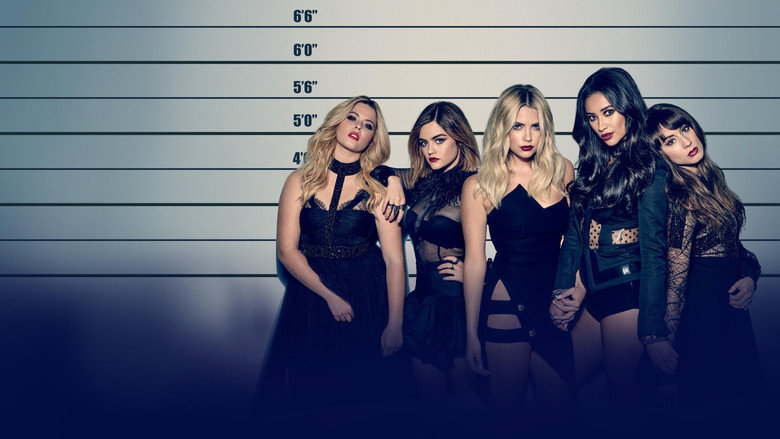
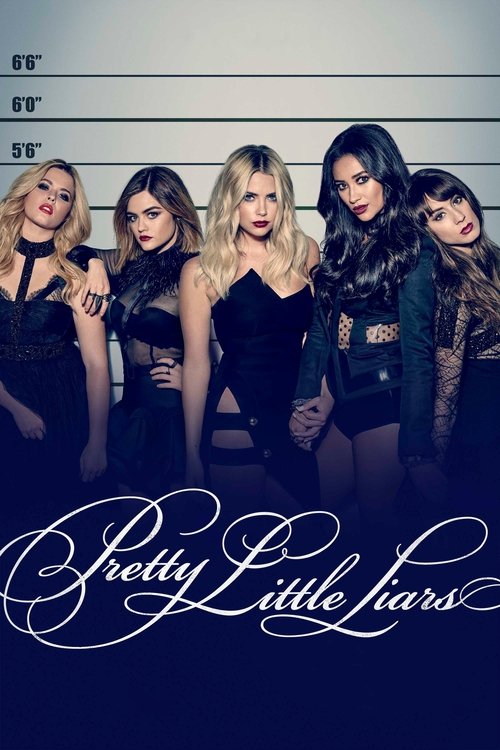
Cast: Lucy Hale, Troian Bellisario, Ashley Benson, Shay Mitchell, Sasha Pieterse

Drama Mystery Surveillance, paranoia and the female gaze turned inward Secrets, lies and the currency of shame Female friendship as survival Identity, doubles and the unstable self Trauma, mental illness and who gets believed

Overview

Pretty Little Liars, developed by I. Marlene King from Sara Shepard's novels, premiered on ABC Family (later Freeform) on June 8, 2010 and ran seven seasons before ending on June 27, 2017. It opens on the fracture of a friendship: Aria Montgomery, Hanna Marin, Emily Fields and Spencer Hastings drift apart after the disappearance of their magnetic, cruel ringleader, Alison DiLaurentis. A year later they are pulled back together by anonymous messages from someone signing off as "A" — a stalker who knows the secrets only Alison knew.

Across its run the series braids two engines together: a serialized whodunit about what really happened to Alison, and a soapy small-town drama about growing up in Rosewood, Pennsylvania, a place of manicured lawns, wealthy families and permanently drawn curtains. Each season escalates the surveillance — texts become cameras, cameras become abductions, and the girls' parents, teachers, boyfriends and police all become suspects. The "A" mantle passes between hands over the years, so that solving the mystery never ends it; every answer reopens the question.

What holds the show together across seven seasons is the friendship itself. The Liars lie to their families, to the law and to each other, but the alliance survives because they are the only people who believe one another. As the series moves from high school hallways into adulthood, its concerns shift from popularity and first love to trauma, complicity and whether people who were watched their whole adolescence can ever learn to stop looking over their shoulders.

Core Meaning

At its heart, Pretty Little Liars is about what secrecy does to young women. The show literalizes a feeling rather than a plot: the sense that a girl's every choice is observed, catalogued and ready to be used against her. "A" is less a person than a mechanism — the collective gaze of a town, a school, a family, and eventually the internet — and the series spends seven years asking what it costs to live inside it.

Its second argument is that shame is only powerful while it stays private. Every escalation of the mystery follows the same logic: the Liars are punished not for crimes but for things they were afraid to say out loud — a sexuality, a relationship, an addiction, a cruelty they committed at fifteen. The show's answer is not innocence but solidarity. The girls survive because they hand their secrets to each other, converting the weapon into a bond.

Finally, the series is a study in how victims and villains are made from the same material. Nearly every antagonist turns out to be someone who was excluded, institutionalized, disbelieved or erased — a mirror image of the heroines who happened to have friends. The message that emerges across all seven seasons is that the difference between the girl who is stalked and the girl who stalks is often just whether anyone was willing to listen to her.

Thematic DNA

Surveillance, paranoia and the female gaze turned inward 25%
Secrets, lies and the currency of shame 22%
Female friendship as survival 20%
Identity, doubles and the unstable self 18%
Trauma, mental illness and who gets believed 15%

Surveillance, paranoia and the female gaze turned inward

The series' defining sensation is being watched. Early seasons deliver it through phones buzzing in class and photographs left where only an intruder could leave them; by the middle seasons it becomes literal — hidden cameras, monitors, a subterranean bunker built to observe the girls like specimens. Critics have described how these devices create a distinct sense of paranoia, where women feel that their behaviour is being continually observed and subsequently judged.

The theme evolves rather than repeats: what begins as an external threat is gradually internalized, until the Liars police themselves, curate their own alibis and can no longer tell the difference between privacy and hiding. In the later seasons, adulthood does not free them from the gaze; it only changes who is holding the camera.

Secrets, lies and the currency of shame

The title is a thesis. Each Liar carries a secret she believes would destroy her, and the show's engine is the constant threat of exposure. Secrets function doubly: they bind the four together and simultaneously arm anyone who learns them, which is why the group's greatest danger is always a friend who knows too much.

Over seven seasons the show tracks a slow reversal. Season by season the girls confess more — to parents, to partners, to police — and each confession costs less than the last. By the final stretch, secrecy has migrated from the teenagers to the adults, revealing that Rosewood's parents built the whole machine of silence their daughters inherited.

Female friendship as survival

Aria, Hanna, Emily and Spencer are not simply friends; they are one another's alibi, therapy and evidence. The pilot's premise is a broken clique, and the series' true arc is its repair — through betrayals, breakups, jail, disappearances and a jump forward in time that scatters them across the country before pulling them home.

The show insists on the unglamorous version of loyalty: the girls lie to each other, suspect each other and forgive each other anyway. Where most teen dramas treat romance as the destination, here the romances rotate while the friendship is the constant — the one relationship the series never seriously threatens to end.

Identity, doubles and the unstable self

Masks, wigs, twins, aliases and impersonation run through every season. Characters are mistaken for each other, buried under other people's names, or discovered to have been living a second life; the villain is always someone wearing another identity. The recurring image of a body double or a stolen face makes literal the adolescent fear of not knowing who you are behind the performance.

As the series matures, the motif turns inward: characters ask whether they are the person Rosewood decided they were at sixteen. The final seasons push this to its extreme conclusion, making the question of who is really who the last mystery the show has left.

Trauma, mental illness and who gets believed

Institutionalization, medication, addiction and post-traumatic collapse recur constantly: Radley Sanitarium looms over the town's history the way Alison's disappearance looms over the girls'. The show repeatedly stages a scene in which a young woman tells the truth and an authority figure decides she is unstable.

Its treatment is uneven and has been criticized for equating mental illness with villainy, yet the cumulative effect across seven seasons is a sustained argument that Rosewood manufactures its own monsters by locking away inconvenient girls. Nearly every antagonist's origin story is one of being disbelieved.

Character Analysis

Spencer Hastings

Troian Bellisario

Archetype: The driven detective-heroine (intellectual hero) Key Trait: Relentless, analytical intelligence that shades into obsession

Motivation

Initially the need to solve — for Spencer, information is control and control is safety. That motive gradually broadens into protection of the other three, and finally into the search for a self that is not defined by her family name or by being the smartest person in the room.

Character Arc

Spencer begins as the group's engine: the overachieving Hastings daughter who treats the mystery like an assignment she can out-research. Across the seasons her competence becomes her wound — she is the one who most needs to know, and knowing repeatedly costs her: her family's respectability collapses, her sense of her own sanity is attacked, and she is pushed into addiction and institutional care.

By the later seasons she has traded certainty for endurance, learning that some questions have no clean answers. Her arc culminates in the series' final revelation about her own identity, which forces the show's most rational character to confront the one thing she could not have deduced.

Aria Montgomery

Lucy Hale

Archetype: The romantic outsider / artist Key Trait: Romantic conviction paired with a stubborn moral flexibility

Motivation

To be seen as an adult and to hold onto love in a town that punishes it. Over time the motivation shifts from keeping her relationship secret to being able to live honestly — and to forgiving herself for what she hid.

Character Arc

Returning from a year in Iceland, Aria positions herself as the group's outsider-aesthete and immediately entangles herself in the show's most controversial relationship, with a man who turns out to be her English teacher, Ezra Fitz. Her early seasons are about carrying a secret that is entirely her own choice, in contrast to the secrets forced on her friends.

Later seasons dismantle that romance and rebuild her: she discovers how deeply she has been used and observed, becomes complicit in the group's darker decisions, and moves from a girl defined by whom she loves to a woman confronting her own capacity for deception. The finale gives her the domestic resolution she chased all series, with marriage and plans to adopt.

All 5 characters and cast

Symbols & Motifs

The anonymous text signed "—A"

Meaning:

The single letter stands for the interchangeable, immortal nature of the threat: not a villain but a role that anyone can put on. Signing with a letter rather than a name makes the antagonist a system rather than a person — gossip, surveillance and shame given a signature.

Context:

Established in the pilot's final beat and repeated in nearly every episode across all seven seasons, the buzzing phone becomes the show's punctuation mark. The mantle passes between multiple people over the years, so the sign-off outlives each individual who uses it.

The black hoodie

Meaning:

Facelessness itself. The hood erases gender, age and identity, allowing the audience to project any suspect onto the figure and reinforcing the idea that the watcher could be anyone in Rosewood — including someone the girls love.

Context:

Glimpsed at the edge of frames from season one onward, usually in reflections, doorways and long lenses, the hooded silhouette became the series' most reproduced image and its shorthand in promotional material.

Dolls, dollhouses and mannequins

Meaning:

Control and objectification. To be a doll is to be posed, dressed and stored by someone else — precisely what "A" does to four girls, and what Rosewood's expectations of pretty, well-behaved daughters do more quietly.

Context:

Recurring as gifts, warnings and finally as an entire architecture in the fifth season, when the Liars are held in a replica of their own bedrooms and forced to perform their lives for an unseen audience.

Rosewood itself

Meaning:

The Gothic house enlarged into a town: beautiful, historic, wealthy and rotten underneath. Its picture-book surface is the lie, and every basement, sanitarium and locked room is the truth the surface exists to conceal.

Context:

Scholars have read the series through Gothic conventions, and the town functions accordingly throughout all seven seasons — the girls repeatedly try to leave and are always pulled back, as though the place itself refuses to release them.

Alison's yellow top

Meaning:

The relic of the missing girl. A single garment carries the whole mystery: worn, buried, found on another body, it stands for how a girl can be reduced to an object of evidence after she vanishes.

Context:

Introduced in the first season's investigation into Alison's disappearance and returned to repeatedly in flashbacks, it is the show's clearest example of clothing used as narrative rather than decoration.

Masks and Halloween

Meaning:

The permission to become someone else. In a town where everyone is already performing, a literal mask is almost redundant — which is why the show's most dangerous revelations arrive at costume parties.

Context:

The series made an annual ritual of Halloween specials and masquerade episodes, staging pursuit sequences among crowds of identically masked bodies where the villain is hidden in plain sight.

Memorable Quotes

I'm still here, bitches. And I know everything. —A
— "A" (anonymous text message)

Context

The final beat of the pilot, delivered as a simultaneous text to all four Liars at Alison's memorial — the moment the show pivots from grief drama to thriller and defines the format of its next seven years.

Meaning

The series' mission statement in nine words. It establishes the antagonist as a voice rather than a body, converts grief into threat, and promises the audience that the missing girl's knowledge has outlived her.

Buckle up, bitches. Nothing is as it seems.
— Mona Vanderwaal

Context

Spoken by Mona after her exposure and confinement, in the third-season premiere, as the mystery restarts with a new player behind the hoodie.

Meaning

A direct address to the audience as much as to the characters — a warning that the show operates on permanent instability, where every answer is provisional and every ally is a potential suspect. It has since been quoted in academic writing on the series' Gothic construction.

All 4 quotes

Episode Highlights

Pilot

S1E1

Introduces Rosewood, the fractured clique and the disappearance of Alison DiLaurentis one year earlier, then reunites the four girls at her memorial. It also plants the series' most controversial thread by revealing that Aria's new romance is with her English teacher.

Significance:

Its closing text message from "A" establishes the format that would sustain 160 episodes: the mystery is not what happened to Alison but who is still watching. It set the template for a decade of serialized teen thrillers.

UnmAsked

S2E25

The masquerade-set second-season finale unmasks Mona Vanderwaal as the original "A", delivering the show's first true answer and reframing every earlier episode as the revenge of a girl the clique bullied and ignored.

Significance:

Widely regarded as one of the series' best hours; critics praised the satisfying reveal, Mona's motivations and the performances, particularly Janel Parrish and Shay Mitchell, and fans still frequently rank the second season as the show's strongest.

A is for Answers

S4E24

Alison finally tells the Liars her own version of the night she vanished, filling in years of gaps in a single extended confession, before the episode explodes into violence on a rooftop.

Significance:

It converts the show's central absence into a living character and closes the era in which Alison was only a memory. Voters consistently rank it among the very best episodes of the series.

Welcome to the Dollhouse

S5E24

The Liars are imprisoned in an underground replica of their own bedrooms, forced to attend a fabricated prom and live as their captor's playthings under constant observation.

Significance:

The series' surveillance metaphor made fully literal, and its darkest sustained sequence. Regularly ranked the single best episode of the show, it marks the point where the teen soap fully embraces horror.

Game Over, Charles

S6E10

The long-running "Charles DiLaurentis" mystery resolves as CeCe Drake is revealed to be the person behind the hoodie, and a feature-length confession reframes the DiLaurentis family history, Radley Sanitarium and the origins of the entire game.

Significance:

Closes the show's second and most elaborate "A" cycle and hands the mantle onward. It is also the series' most debated reveal, praised by some for its emotional ambition and criticized by others for its handling of identity and mental illness.

Til Death Do Us Part

S7E20

The two-hour series finale, aired June 27, 2017, unmasks A.D. as Alex Drake — Spencer's previously unknown British twin, daughter of Mary Drake and Peter Hastings — who has been impersonating Spencer while avenging Charlotte.

Significance:

It resolves seven years of mystery with the show's ultimate doubling motif and then grants each Liar a future: Aria and Ezra married and planning to adopt, Alison and Emily raising a family, Hanna pregnant, and Spencer reunited with Toby — while a final scene suggests Rosewood's games never truly end.

Philosophical Questions

Can a person be free if she knows she is always being watched?

The series answers largely in the negative. Under permanent observation the Liars stop distinguishing between what they want and what is safe; they curate themselves preemptively. Even after each "A" is exposed, the reflex remains — the girls keep checking windows and phones, suggesting that surveillance produces a permanent change in the self rather than a temporary condition.

Is a secret a bond or a weapon?

The show refuses to choose. Alison's rule that friends share secrets is both the source of the clique's intimacy and the mechanism of its destruction. Across seven seasons the Liars discover the variable is consent: a secret given freely binds people together, while a secret taken becomes leverage. The same information saves them or ruins them depending on who is holding it.

What separates a victim from a villain?

Almost nothing, the series concludes. Each antagonist is revealed as someone who was excluded, institutionalized or erased, and each Liar has done something cruel enough to have created an antagonist of her own. The show's most unsettling implication is that the difference is circumstantial — the girls who had three friends who believed them became heroines; the girl who had none became "A".

Can you outgrow the person your hometown decided you were?

The time jump into adulthood tests this directly: the Liars build careers and lives elsewhere and are still pulled back, still legible to Rosewood as the girls they were at sixteen. The finale grants them futures, but only after they return and face the town, implying that escape requires confrontation rather than distance.

Does knowing the truth actually set anyone free?

Spencer's arc is the sustained test case. She pursues the truth more relentlessly than anyone, and each answer costs her more than the ignorance did — her family, her health, eventually her certainty about herself. The series suggests that truth is necessary but not redemptive: it ends the mystery without healing the damage the mystery caused.

Alternative Interpretations

The mystery as metaphor rather than plot. One widely shared reading holds that \"A\" was never meant to withstand logical scrutiny. Under this view the endless reveals are a deliberate feature: \"A\" is patriarchy, or gossip, or the internet, or simply the condition of being a teenage girl under observation — a role that can be filled by anyone because the watching never stops. This reading is strengthened by the fact that unmasking one \"A\" only produces another.

Full ending explanation

Cultural Impact

Historical context. Arriving in 2010, Pretty Little Liars was the first major teen drama built natively for the smartphone era. Its antagonist attacked by text message at exactly the moment its audience lived by text message, and its plot mechanics — leaked photos, anonymous accounts, screenshots as evidence — turned adolescent digital anxiety into genre. It was, in effect, a show about being surveilled, released to a generation that was just learning it always would be.

Influence on television. Commentators credit the series with informing a decade of teen TV: the glossy, moody, mystery-driven format it perfected can be traced through Riverdale, You and a long line of successors, and its investigative fandom culture passed directly into theirs. It also pioneered social television as a business model — live-tweeting, cast interaction, hashtag campaigns and record-setting premiere engagement, including the most-tweeted season premiere in history at the time.

Representation. Emily Fields' coming-out story is among the show's most durable legacies, praised as realistic and empowering for young LGBTQ+ viewers who saw themselves reflected in a mainstream network teen drama. It was not without criticism — the novels' Emily questions her sexuality across a bisexual spectrum, while the series' producers committed to a lesbian identity and said they had no plans to explore bisexuality — but the character's visibility, and the fact that she survives and builds a family, mattered enormously to a generation of viewers.

Aesthetic and commercial legacy. The show's costuming became a case study in wardrobe as characterization, spawning collaborations and collections, and its cinematography supplied a template countless teen dramas would copy. Legacy. Fifteen years on, writers describe it as a cultural reset that colonised a generation's teenage years, an addictive, sometimes incoherent, undeniably influential artifact that spawned an entire franchise, including the spin-offs Ravenswood, The Perfectionists and Pretty Little Liars: Original Sin (2022–2024), the last of which was received as one of the strongest small-screen slashers of its era.

Audience Reception

Early seasons. The show built its audience fast on the strength of its hook and its atmosphere. The second season drew particular critical praise for its complex storylines, thrilling mood and characters, and it has been widely hailed by fans in the years since as the best season of the series — with the finale, UnmAsked, receiving widespread acclaim for a genuinely satisfying reveal, for the coherence of Mona's motivations and for its performances, particularly Janel Parrish and Shay Mitchell.

Middle seasons. This is where opinion divides most sharply. Seasons four and five delivered the show's most-loved individual hours — A is for Answers and Welcome to the Dollhouse both sit at the top of fan rankings — but also the mounting complaint that the mystery had begun eating itself. Viewers loved the escalation into outright horror while increasingly noticing that clues were being retconned and that answers arrived only to be dissolved.

Later seasons and the finale. The sixth-season \"Charles\" resolution and the time jump into adulthood split the fandom, and the seventh-season finale's evil-twin reveal became the show's most argued-over moment: some found it a fitting culmination of the series' obsession with doubles, many found it an implausible last-minute swerve. The paired happy endings were broadly welcomed as emotionally generous even by viewers unhappy with the mechanics of the mystery.

Points of criticism. Retrospective reviews consistently name three: a central mystery that didn't always make sense, romances that were inherently problematic — above all the teacher-student relationship at the show's heart — and a treatment of mental illness and identity that has aged poorly. Overall verdict. Even its harshest critics concede its almost unparalleled staying power in pop-culture terms; fifteen years after the premiere, writers still describe it as a hell of a ride and a defining shared experience for the generation that grew up with it.

Interesting Facts

  • The series was developed by I. Marlene King from Sara Shepard's novel series, premiered on ABC Family on June 8, 2010, and ended after seven seasons on Freeform on June 27, 2017.
  • Rosewood was built on the Warner Bros. backlot in Southern California, with interiors shot on Stages 6, 7 and 8 — the same lot that housed productions including Friends, ER, Gilmore Girls and The Big Bang Theory.
  • The theme song, "Secret" by The Pierces, was Ashley Benson's discovery: she found the track while filming the pilot and pushed to show it to I. Marlene King, believing it could be the series' theme.
  • Troian Bellisario was 25 years old when she played 16-year-old Spencer Hastings in the first season — and she is roughly eleven months older than Ian Harding, who played high-school teacher Ezra Fitz.
  • Sasha Pieterse was only 12 years old when she was cast as Alison DiLaurentis, the character the other Liars looked up to as their queen bee.
  • Lucy Hale's famous "shush" pose from the earliest promotional campaign was improvised on the spot during the shoot and ended up defining the show's entire visual branding.
  • Tammin Sursok was pregnant while filming the fourth season; the production went to considerable lengths with staging and wardrobe to keep it invisible on screen.
  • The show was a landmark for social television: its January 2014 winter premiere became the most-tweeted season premiere in history at the time, with the fandom live-solving the mystery in real time.
  • Creator I. Marlene King appears on screen in the series herself, credited in an on-camera role as a photographer.

Easter Eggs

I. Marlene King's on-screen cameo as a photographer

The show's developer and principal creative voice literally steps into the frame holding a camera — a fitting joke for a series in which being photographed is the central threat, and in which an unseen observer directs everyone's lives.

The theme song was cast by an actor, not a music supervisor

"Secret" by The Pierces became the show's sonic signature because Ashley Benson heard it during the pilot shoot and lobbied for it. The lyric "two can keep a secret if one of them is dead" was so on-theme that it functions as an epigraph for all seven seasons.

The "shush" pose

Improvised by Lucy Hale during a promo shoot, the finger-to-lips gesture became the series' universal icon, reproduced across posters, merchandise and countless imitators. An accident of a photo session ended up encoding the show's entire premise: silence as both bond and threat.

Halloween and masquerade specials as an annual ritual

The show turned costume episodes into a recurring event, borrowing openly from Gothic and slasher traditions. Scholars have analysed the series precisely through these Gothic conventions, noting how masks, doubles and haunted houses let a teen soap operate as horror.

Frequently Asked Questions

Explore More About This Movie

Dive deeper into specific aspects of the movie with our detailed analysis pages

Comments (0)

Leave a comment

No comments yet. Be the first to share your thoughts!

Similar Movies