Skip to content
Psycho-Pass
A cold, neon-lit cyberpunk crime drama where conscience is measured by number and dread hums beneath orderly streets. Justice feels like a gun that decides for you, glowing in a hand that still trembles.
Psycho-Pass

Psycho-Pass

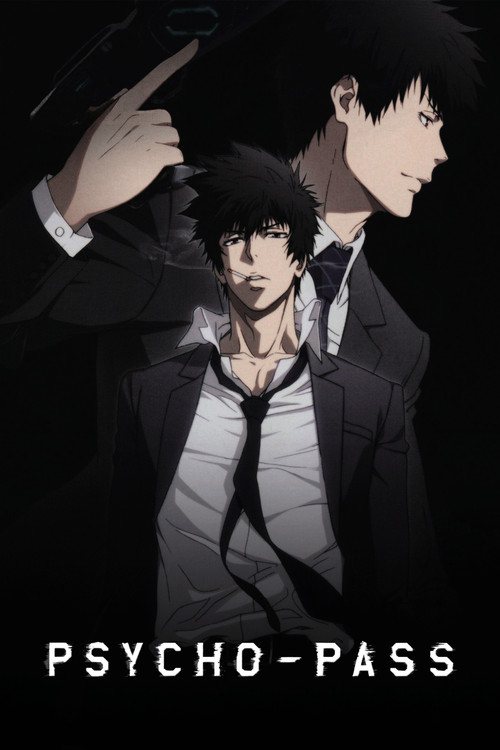
PSYCHO-PASS サイコパス

12 October 2012 — 13 December 2019 Japan 3 season 41 episode Ended 7.7 (498)

Cast: Kana Hanazawa, Tomokazu Seki, Takahiro Sakurai, Ayane Sakura, Miyuki Sawashiro

Crime Animation Sci-Fi & Fantasy Action & Adventure Free will versus the algorithmic society Justice, law and morality Identity, mental health and stigma Individual versus collective Revenge, obsession and the cost of pursuit

Overview

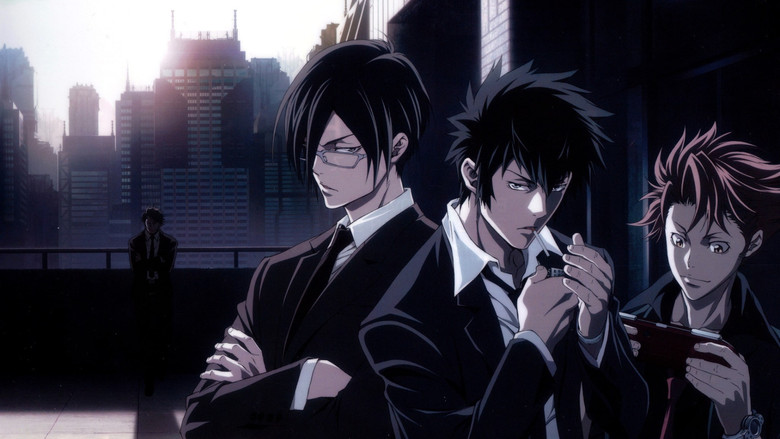
Psycho-Pass is a Japanese cyberpunk anime produced by Production I.G and aired on Fuji TV's Noitamina block. It is set in a future Japan where the Sibyl System measures every citizen's mental state and "Crime Coefficient" in real time. People whose readings climb too high are treated as latent criminals before they commit any crime. The Public Safety Bureau's Inspectors carry Dominator guns that read those numbers. They lead Enforcers, detectives who are themselves classed as latent criminals.

The story follows rookie Inspector Akane Tsunemori as she joins Unit One and works beside the hardened Enforcer Shinya Kogami. Their cases lead them to a criminal whose mind the system cannot read, and to questions about what the system actually is. Later seasons widen the world: a new ideologue challenges the system from inside the Bureau, and then Japan's technology spreads abroad into an international order.

Across the three seasons (41 episodes in total) the series moves between procedural cases and philosophical confrontation. It asks whether safety bought with obedience is worth having.


Core Meaning

The series argues that a society which hands moral judgment to an impersonal system gets comfort, not justice. Sibyl gives security and takes away individual responsibility, choice and the capacity to bear guilt. The creators do not make destroying the system the answer. Akane's path suggests that a flawed institution has to be kept and reformed by people who can feel the weight of judgment, and that human beings are not interchangeable data points.

The series also treats the opposite pole, anarchic freedom as personified by its villains, as seductive and just as dangerous. Its message is to keep thinking and choosing, and to refuse both blind trust in the system and nihilistic rebellion against it.

Thematic DNA

Free will versus the algorithmic society 30%
Justice, law and morality 25%
Identity, mental health and stigma 20%
Individual versus collective 15%
Revenge, obsession and the cost of pursuit 10%

Free will versus the algorithmic society

Sibyl decides careers, social standing and who counts as a criminal. Season 1 shows the human cost of this. Season 2 pushes it further with a villain who tests whether the system can judge itself. Season 3 carries the question into a world of AI prediction and gambling on outcomes.

Justice, law and morality

The gap between what the law permits and what is right drives each season. Akane keeps asking whether the law is worth following when it fails the people it protects. Her answer changes from naive faith to a conscious choice to uphold it.

Identity, mental health and stigma

The Crime Coefficient and the Hue turn the mind into a public score. Enforcers are shunned for their numbers, and ordinary people suppress themselves to stay clear. The series shows how measuring the psyche shapes behavior and fears.

Individual versus collective

A system built from many minds judges individuals, while antagonists and the Bureau's own people struggle with being seen as a statistic. Season 2's collective-mind villain makes the question literal.

Revenge, obsession and the cost of pursuit

Kogami's hunt for Makishima consumes him and costs him his place in society. His arc shows how pursuing justice outside the law can turn into personal vendetta.

Character Analysis

Akane Tsunemori

Kana Hanazawa

Archetype: Idealistic hero Key Trait: Unshakably empathetic, with a steel will that keeps her Psycho-Pass clear

Motivation

She wants to protect people and make the law actually serve them. Over time her motivation turns from trusting the rules to choosing them knowingly.

Character Arc

Akane begins as an innocent rookie. The staff said her growth from an innocent rookie to a mature and haunted person was one of their main objectives. She is forced to confront the system's flaws, and she grows into a hardened and morally independent leader who keeps the system standing while trying to improve it. In later seasons she is the steady center of a changed Bureau.

Shinya Kogami

Tomokazu Seki

Archetype: Brooding antihero and mentor Key Trait: Relentless, instinctive hunter

Motivation

He wants to see Makishima stopped, and to be a detective rather than a killer. This slides toward a personal vendetta.

Character Arc

A former Inspector turned Enforcer, Kogami starts out as Akane's guide. His obsession with Makishima pulls him outside the system. He is absent from season 2 and returns later with further depth, and his path ends away from the society he once served.

All 4 characters and cast

Symbols & Motifs

The Dominator

Meaning: Judgment delegated to a machine, and the moral weight of lethal force.
Context: The gun reads a Crime Coefficient and then paralyzes or kills depending on the number. Moments where it will not fire, or where Akane uses it against its logic, mark turning points about the system's reliability.

The Psycho-Pass hue and cloudiness

Meaning: The reduction of a soul to a visible color, and the pressure to appear clean.
Context: Characters constantly monitor how cloudy their hue is. Characters who hide or manipulate their readings, and those whose hue stays clear while their acts are monstrous, expose the gap between measurement and morality.

Books and literature

Meaning: Human thought and culture that the system can no longer produce or protect.
Context: Makishima collects and quotes from physical books, and the antagonists' reading offers an older, unmonitored form of moral reasoning set against Sibyl's data.

Sibyl's hidden face

Meaning: The Greek-prophetess name stands for a collective authority that claims to foresee, and it hides the human minds behind it.
Context: The system is named after the Sibyl and reveals its true nature late in season 1. Season 2 returns to the question of whether it can accept or judge a mind outside itself.

Holograms and surface decoration

Meaning: A comfortable public image laid over hidden decay.
Context: Public spaces are covered with hologram skins that change appearance. The world is visually pleasing while the people inside it are being managed.

Memorable Quotes

I wonder what sort of criteria you use to divide people into good and evil.
— Shogo Makishima

Context

Listed among Makishima's best-known lines in Psycho-Pass quote compilations; his confrontations in season 1.

Meaning

Condenses the series' central challenge to any system that sorts people by number.

Beautiful flowers, too, eventually wither and fall. That's the fate of all living beings.
— Shogo Makishima

Context

Quoted in quote compilations as a Makishima line from season 1.

Meaning

Shows his fatalistic view of life and decay.

All 4 quotes

Episode Highlights

Crime Coefficient

S1E1

On her first day Akane joins Unit One, and Enforcer Kagari finds Nobuo Okura. Shinya Kogami tries to kill a victim whose Crime Coefficient rises, and Akane stops him with her Dominator.

Significance:

Establishes the system's cold logic and Akane's refusal to accept it blindly.

Those Capable

S1E2

Akane is depressed after paralyzing Shinya. Ginoza reprimands her and they argue.

Significance:

Sets up the core tension between the Inspector and the Enforcers.

Methuselah's Game

S1E10

Makishima and Senguji use Akane's friend Yuki as bait to lure Shinya into an abandoned subway station, where Shinya must evade a cyborg and his drone dogs.

Significance:

A tense set-piece that deepens the Kogami-Makishima rivalry.

Season 1, episode 20

S1E20

Sibyl makes Akane an offer, exploiting her wish to protect society while dealing justice. She does not refuse.

Significance:

Defines Akane's choice to remain inside the system.

Season 2 finale

S2E11

Akane leads Kirito Kamui to the core of Sibyl. Sibyl decides to recognize him as a collective mind of seven people.

Significance:

Shows the system changing by accepting what it once could not judge.

Philosophical Questions

Can a person be justly judged for crimes they have not committed?

Crime Coefficients punish potential, and the series shows both lives saved and lives destroyed by that logic.

Is a safe society worth the loss of free will?

Citizens enjoy peace but have careers and futures assigned. Antagonists in each season test what happens when that structure is shaken.

Can a system judge itself?

Season 2 stages this literally when Sibyl must decide whether to accept a mind it cannot categorize.

How It Ends

Alternative Interpretations

Akane's final choice to stay inside Sibyl can be read as pragmatic hope that institutions can be reformed from within, or as tragic compromise that legitimizes a system she knows is corrupt. Makishima can be read as a true liberator or as a nihilist using philosophy to excuse murder. Season 2's ending is read both as the system evolving and as it absorbing and neutralizing dissent.

Full ending explanation

Cultural Impact

Psycho-Pass belongs to the post-cyberpunk tradition, using surveillance and predictive policing to ask contemporary questions about technology and social control. Its first season won critical acclaim in Japan and the west, with critics praising the characters and the dystopian setting. Gen Urobuchi, known for Puella Magi Madoka Magica and Fate/Zero, wrote it. It spawned a second season, a 2015 film, a third season and manga adaptations. Kogami won the 'Mister Noitamina' award and placed in Newtype popularity polls. Season 2 received a mixed response over its heavy gore and its villain, and many critics hold the first season to be the best.

Audience Reception

Season 1 was widely praised for its characters, the Kogami-Makishima conflict and its dystopian setting; its animation was praised too, although issues in later episodes had to be fixed for the DVD releases. Season 2 received a mixed response, criticized for its heavy gore and the characterization of its villain. Kogami's return in the film and season 3 was welcomed. A CBR comparison concluded the first season is superior to the sequels in originality, while acknowledging that the later seasons added world-building. Overall the verdict is that season 1 is a modern classic and later seasons are uneven but worthwhile expansions.

Interesting Facts

  • The first season was first announced in late March 2012 by Fuji TV at its Noitamina press conference.
  • The first season aired from October 12, 2012, to March 22, 2013, and was directed by Naoyoshi Shiotani and written by Gen Urobuchi.
  • Season 2 was produced by Tatsunoko Production rather than Production I.G, and Tow Ubukata replaced Urobuchi as main writer, with Urobuchi supervising.
  • Season 2 aired October 10 to December 19, 2014 for 11 episodes; season 3 aired October 24 to December 12, 2019 for 8 episodes.
  • The staff called the series 'anti-moe' and decided to have Kogami rather than Akane remove clothing in a scene, and to focus on friendships rather than romance.
  • At early screenings of the finale, over 1,000 people queued although the venue held only seventy, according to producer Akitoshi Mori.
  • Anime News Network listed the first season as the fifth most accessible anime for newcomers.

Easter Eggs

Pascal's line on justice and might is quoted in the dialogue between Makishima and Kogami.

A direct reference to the philosopher Blaise Pascal, framing the series' debate on power and justice.

The second season's opening becomes more static and glitchy with each episode, and season 1's ending credits update details by episode.

Subtle visual storytelling in the title sequences.

Frequently Asked Questions

Explore More About This Movie

Dive deeper into specific aspects of the movie with our detailed analysis pages

Comments (0)

Leave a comment

No comments yet. Be the first to share your thoughts!

Similar Movies